
Multi-Agent Systems for Enterprise Automation: Architecture and Use Cases
Most multi-agent systems enterprise pilots stall in the same place: the gaps between the agents. The models reason well enough and the demo convinces the steering committee, but production traffic then exposes missing state management, fuzzy permissions, and handoffs nobody can reconstruct after the fact. If you own the architecture or the automation roadmap, those in-between parts are your problem, not the model vendor's.
The stakes are rising on both sides. Gartner listed multiagent systems among its top strategic technology trends for 2026, yet in June 2025 the same firm predicted that more than 40% of agentic AI projects will be canceled by the end of 2027 because costs climb, the business value stays fuzzy, or risk controls fall short. Both forecasts can hold at once, and the distance between them is mostly a design and governance problem rather than a model problem.
A multi-agent design is not automatically better than one well-built agent. It earns its place when a workflow contains distinct sub-tasks that need different tools, permissions, or reasoning styles, and when the coordination overhead costs less than the gain. Everything below is about judging that trade-off honestly and then engineering for it.
What Is a Multi-Agent System in Enterprise Automation?
A multi-agent system is a software architecture in which several AI agents, each with a narrow role, its own instructions, and its own tool permissions, coordinate through an orchestration layer to complete a business process that no single agent owns end to end. In enterprise work, an agent is usually a large language model running in a loop. It reads its context, picks a next step, calls a tool such as an ERP endpoint or a document parser, checks the result, and repeats until it reaches a stopping condition.
The "multi" part means you split that loop across specialists. Instead of one prompt that extracts invoice fields, checks payment terms, and emails the supplier, you get an intake agent, a policy agent, and a correspondence agent, each testable on its own. A supervisor agent (sometimes called the orchestrator) decides who works next and keeps the case moving.
One Agent With Ten Tools Is Still One Agent
A single agent that calls many tools remains a single agent, because one reasoning loop holds all the context and makes every decision. The line is crossed only when separate agents own separate decisions and hand work to each other. That boundary matters for governance, since each agent becomes a unit you can permission, evaluate, version, and replace without touching the others.
Where RPA and Embedded Application AI Fit
Approach
RPA bots
Strong at
Fast, repeatable clicks and data entry on stable screens
Weak at
Unstructured input, exceptions, judgment calls
Typical role in a multi-agent design
An execution tool that agents call
Approach
AI embedded in one application (for example, a CRM assistant)
Strong at
Context-rich help inside that one app
Weak at
Work that crosses system boundaries
Typical role in a multi-agent design
A data source or a peer agent
Approach
Single LLM agent
Strong at
Contained, well-defined tasks
Weak at
Long workflows, mixed permissions, many domains
Typical role in a multi-agent design
A building block
Approach
Multi-agent system
Strong at
Cross-system processes with distinct sub-tasks
Weak at
Coordination overhead, cost, traceability
Typical role in a multi-agent design
The coordinating architecture
The four approaches usually coexist rather than compete. Most production designs keep RPA bots and API integrations as the hands, while agents decide which hands to use and when. Tearing out automation that already works, just to make room for agents, is rarely worth the migration risk.
Why Are Enterprises Moving From One Agent to Many?
Enterprises are moving to multiple agents because a single agent runs into practical ceilings on context size, permission scope, and testability once a workflow crosses several systems and decision types. Analyst data shows how quickly interest has grown. Gartner reported a 1,445% jump in client inquiries about multiagent systems between the first quarter of 2024 and the second quarter of 2025.
Adoption forecasts point the same way. In an August 2025 forecast, Gartner projected that 40% of enterprise applications will integrate task-specific AI agents by the end of 2026, compared with under 5% in 2025, and that by 2027 a third of agentic AI deployments will pair agents that have different skill sets. That second figure deserves the most attention from architects, because pairing skills is exactly where coordination design starts to decide outcomes.
Engineering evidence is more nuanced than the analyst numbers. Anthropic reported that its research feature, with Claude Opus 4 as a lead agent directing Claude Sonnet 4 subagents, beat a single Claude Opus 4 agent by 90.2% on an internal research evaluation. The same engineering write-up is candid that the win depended on spending far more tokens and on tasks that split cleanly into independent threads.
Four Pressures That Push Teams Toward Specialization
Context limits. A single agent juggling procurement policy, contract terms, and supplier history fills its context window with material that is irrelevant to most of its decisions, and output quality tends to slip as a result.
Permission boundaries. The agent that reads HR records should not also be able to issue refunds. Splitting roles lets you apply least-privilege access per agent instead of granting one agent the sum of every permission.
Testability. A narrow agent with a defined input and output can be regression-tested like any other component. A generalist prompt that does everything is far harder to evaluate after each change.
Parallel work. Independent checks, such as sanctions screening and a credit review, can run at the same time instead of queuing behind each other.
How a Multi-Agent Workflow Runs From Trigger to Audit Log
A multi-agent workflow runs as a repeating cycle of decomposing the job, delegating pieces, executing them with tools, verifying results, and committing changes, with every step written to shared state so the next agent and the auditor can both see what happened. A concrete case makes the sequence easier to follow. Picture a supplier invoice at a mid-sized manufacturer that comes in 6% above its purchase order.
Trigger. The invoice lands in the accounts payable inbox, and an event on the message bus opens a new case with a unique ID.
Intake. An extraction agent reads the PDF, pulls header and line-item fields, and writes them to the case record with confidence scores.
Planning. The supervisor agent compares the invoice with the purchase order and goods receipt, spots the price variance, and breaks the work into three sub-tasks.
Parallel specialist work. A contract agent checks whether a price escalation clause applies, a history agent looks for earlier disputes with this supplier, and a tolerance agent checks the variance against the company's approval policy.
Shared state update. Each specialist posts findings to the case record (often called a blackboard) rather than messaging the others directly, so nothing depends on one agent remembering what another said.
Verification. A reviewer agent checks the combined findings for contradictions, such as a clause the contract agent cited that does not appear in the actual contract text.
Policy gate. Because the variance exceeds the auto-approval limit, the case pauses for a human-in-the-loop decision, and the AP specialist sees a one-screen summary with links to the evidence.
Commit. After approval, an execution agent posts the adjusted invoice to the ERP with an idempotency key, so a retry cannot post it twice.
Trace and learn. Every prompt, tool call, and decision is logged against the case ID, and the reviewer's catch becomes a new test case for the contract agent.
Only step 8 changes a system of record, and it happens after verification and the policy gate. That ordering is the single most useful habit in this kind of design. Agents can be wrong in drafts all day, but they should almost never be wrong in commits.
The Seven Layers of a Production Reference Architecture
A production multi-agent system needs seven layers: the agents themselves, orchestration, shared state and memory, tool integration, inter-agent messaging, identity and policy, and observability. A sound agentic architecture keeps these layers loosely coupled, so you can swap a model, a framework, or a protocol without rewriting everything around it. Most enterprises already own pieces of several layers, which shortens the build considerably.
Layer
Agents
What it does
Role-specific prompts, models, and tool scopes
What you may already own
Contracts with one or more LLM providers
Layer
Orchestration
What it does
Routes work, sequences agents, enforces stop conditions
What you may already own
Workflow engines, BPM suites, durable job runners
Layer
Shared state and memory
What it does
Holds case records, intermediate results, and long-term knowledge
What you may already own
Operational databases, vector stores, document stores
Layer
Tool integration
What it does
Connects agents to ERP, CRM, ticketing, and data platforms
What you may already own
API gateways, iPaaS connectors, RPA bots
Layer
Inter-agent messaging
What it does
Moves tasks and results between agents and services
What you may already own
Kafka, RabbitMQ, or a cloud event bus
Layer
Identity and policy
What it does
Gives each agent an identity, permissions, and guardrails
What you may already own
IAM, secrets vaults, policy engines
Layer
Observability and evaluation
What it does
Traces runs, scores quality, tracks spend
What you may already own
OpenTelemetry pipelines, APM tools, a SIEM
Orchestration and Shared State
The orchestrator is the control plane, and it should be deterministic wherever it can be. Let a model decide what a sub-task needs, but let ordinary code decide retries, timeouts, maximum loop counts, and which states a case is allowed to move between. Durable state that survives a process restart is non-negotiable for any workflow that can pause for human approval over hours or days.
Tools, Protocols, and Messaging
Agents reach enterprise systems through tools, and the Model Context Protocol (MCP) has become a common way to expose those tools in a standard format. For traffic between agents, especially across frameworks or vendors, the Agent2Agent (A2A) protocol defines how agents advertise their capabilities and hand tasks to one another. Underneath both, event-driven messaging keeps long-running work asynchronous, so a slow credit bureau call does not freeze the rest of the case.
Identity, Guardrails, and Observability
Treat every agent as a non-human identity with its own credentials, scoped permissions, and audit trail, the same way you would treat a service account. Guardrails belong outside the prompt as well: input filters, output validators, allow-lists of permitted actions, and spending caps enforced by the platform rather than by the model's good behavior. Observability ties it together with one trace per case showing every model call, tool call, token count, and decision, which is the first thing both your auditors and your on-call engineers will ask to see.
Choosing a Multi Agent Orchestration Pattern
The right orchestration pattern is the simplest one that mirrors how the business process already flows, which for most regulated enterprise work means a fixed pipeline or a supervisor model rather than open-ended negotiation between agents. Each pattern trades flexibility against control. The table compares the five you will run into most often.
Pattern
Sequential pipeline
How it works
Agents run in a fixed order, each consuming the previous output
Best fit
Stable, linear processes such as document intake
Governance difficulty
Low
Pattern
Supervisor (orchestrator-worker)
How it works
One lead agent plans, delegates to specialists, and merges their results
Best fit
Most cross-system business processes
Governance difficulty
Low to moderate
Pattern
Hierarchical teams
How it works
Supervisors manage sub-supervisors, each running its own group of specialists
Best fit
Large processes that span departments
Governance difficulty
Moderate
Pattern
Group chat or peer collaboration
How it works
Agents converse in a shared thread and settle on next steps together
Best fit
Research, brainstorming, code review
Governance difficulty
High
Pattern
Market or bidding
How it works
Agents bid for tasks based on capability and current load
Best fit
Resource allocation and scheduling
Governance difficulty
High
Start with a pipeline or a supervisor and move up only when a real requirement forces it. Peer patterns look impressive in demos because they resemble teamwork, but their behavior is harder to predict and much harder to explain to an auditor. Many teams settle on a hybrid, where a supervisor runs the main flow and calls a small peer group for one open-ended step such as drafting options.
How Many Agents Should You Start With?
Count the distinct decisions in the process, not the steps. Ten steps that apply the same judgment belong in one agent, while two steps that need different data, permissions, or expertise usually justify two. If you cannot write a one-sentence job description for an agent that differs clearly from its neighbors, merge them.
Frameworks and Protocols to Evaluate
Protocol choice matters more than framework choice, because frameworks turn over every year or two while the interfaces your agents use to reach tools and each other tend to outlast several framework migrations. Both major protocols now sit under neutral governance. Anthropic donated MCP in December 2025 to the Agentic AI Foundation, an initiative the Linux Foundation runs as a directed fund with Anthropic, Block, and OpenAI as co-founders, and InfoQ's coverage notes that Google had already moved A2A to the Linux Foundation earlier that year.
Framework
Microsoft Agent Framework
Orchestration style
Agents plus graph-based workflows in .NET and Python
Worth a look if
You run on Azure or .NET, or you have Semantic Kernel or AutoGen code to migrate
Framework
LangGraph
Orchestration style
Stateful graphs with checkpoints and human interrupts
Worth a look if
You want explicit control over every state transition
Framework
CrewAI
Orchestration style
Role-based crews that pass tasks along defined responsibilities
Worth a look if
You want fast prototypes of role-driven workflows
Framework
Managed cloud agent platforms
Orchestration style
Hosted runtimes with built-in identity and monitoring
Worth a look if
You would rather buy the control plane than build it
Teams already standardized on one cloud usually get the most from that provider's framework, since identity, hosting, and monitoring come pre-wired. Microsoft's developer blog describes its Agent Framework as the successor to both Semantic Kernel and AutoGen, with MCP, A2A, and AG-UI support included, and the SDK reached version 1.0 in April 2026. Wondering how its orchestration model holds up against real enterprise requirements? Our Microsoft Agent Framework deep dive works through it in detail.
Enterprise Use Cases Where Multiple Agents Earn Their Cost
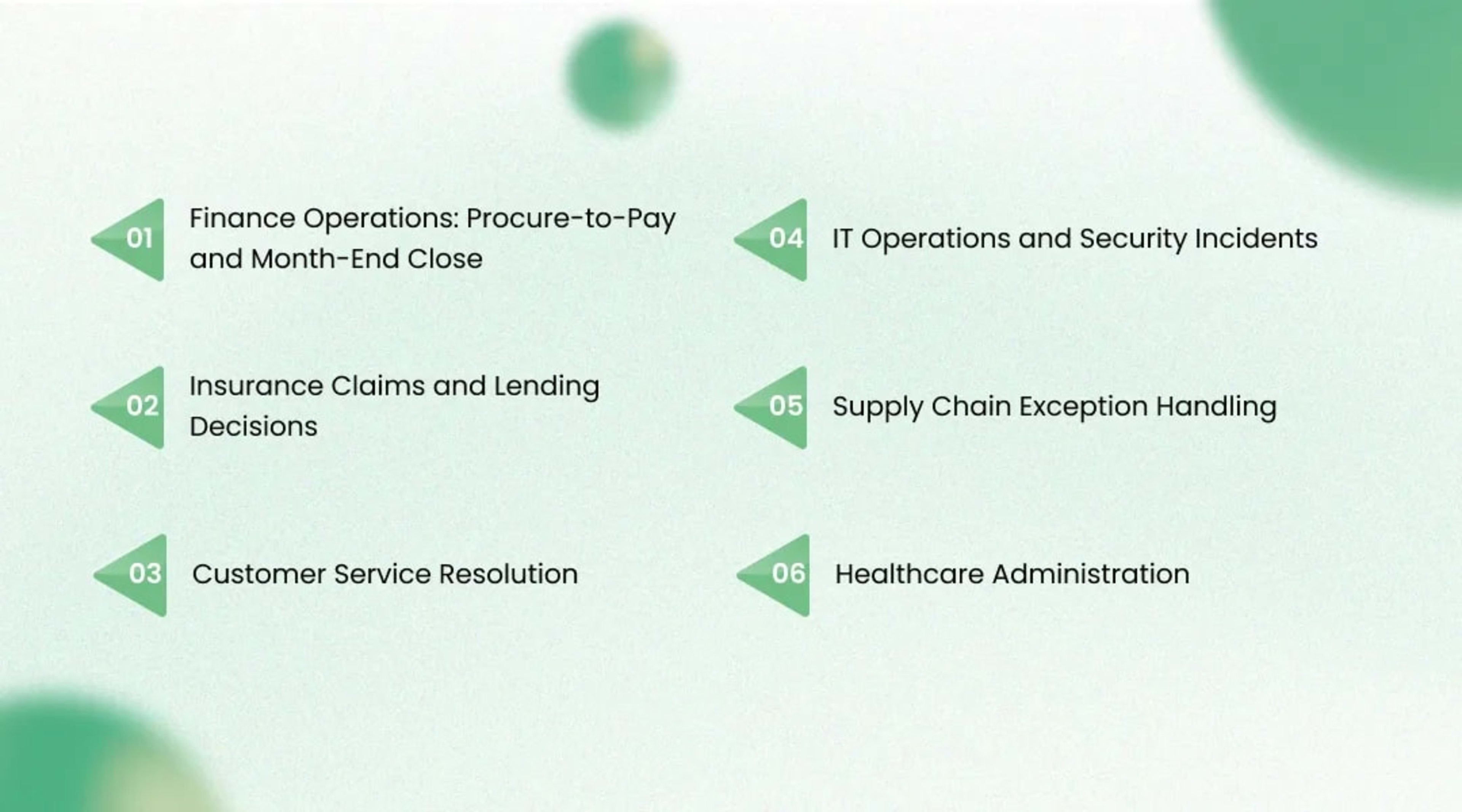
Multiple agents earn their cost in processes that are high volume, heavy on exceptions, and spread across several systems, such as finance operations, insurance claims, service resolution, IT incidents, supply chain disruptions, and healthcare administration. The common thread is that a person currently stitches together information from three or more screens before making a call. That stitching is what enterprise AI agents do well, while the final call often stays with a human.
Finance Operations: Procure-to-Pay and Month-End Close
In accounts payable, an intake agent captures invoices, a matching agent runs the three-way match, a contract agent interprets pricing clauses, and a scheduling agent times payments against cash targets. Approval authority above a set threshold stays with finance staff. During close, reconciliation agents can work through account pairs in parallel and pass only the genuine breaks to accountants, which is where the hours usually come back.
Insurance Claims and Lending Decisions
A claims design typically pairs a first-notice agent that classifies the loss, a coverage agent that reads the policy wording, and a fraud-signal agent that flags inconsistencies, with a routing step that sends complex or high-value claims to an adjuster. Lending follows a similar shape, with document, KYC and AML screening, and underwriting-summary agents feeding a human decision. In both cases the agents assemble the file, and a licensed professional signs it.
Customer Service Resolution
A triage agent reads the request and sentiment, an account agent pulls order and billing history, a policy agent checks what the company allows, and an action agent processes the refund or change. The customer sees one coherent reply, not a relay race. When confidence drops or a request falls outside policy, the case moves to a human with the full context already attached.
IT Operations and Security Incidents
Monitoring alerts feed a correlation agent that groups related signals, a diagnosis agent that proposes likely causes, and a remediation agent that suggests a runbook step. Any change to production waits for an engineer's approval, at least until the team has months of evidence that a given action is safe to automate. A final agent drafts the incident timeline, which saves the least popular hour of every postmortem.
Supply Chain Exception Handling
When a shipment slips, a detection agent spots the delay, a sourcing agent checks alternative suppliers and stock in other warehouses, an impact agent identifies which customer orders are at risk, and a procurement agent drafts the purchase order for a planner to approve. This is agent workflow automation at its most practical. The agents do not run the supply chain; they shrink the time between a disruption and a decision.
Healthcare Administration
Provider credentialing, prior authorization preparation, and referral scheduling all involve collecting documents from several systems and checking them against rules. Separate agents for document collection, license verification, and payer-rule checks keep protected health information scoped to the agents that truly need it. Clinical judgment stays entirely with clinicians, and the agents handle the paperwork around it.
What Do Multiple Agents Really Cost?
A multi-agent workflow usually costs several times more per task than a single agent, so it pays off only when the accuracy, speed, or straight-through processing it adds is worth more than the extra compute and engineering. Anthropic's published numbers give a useful sense of scale. In its data, single agents used about four times the tokens of a normal chat interaction, and its multi-agent research system used about fifteen times as many.
Run the math before you commit. Suppose, purely as an illustration, that a single-agent pass on an invoice exception costs 5 cents in model fees and a multi-agent pass costs 25 cents. If the multi-agent version clears an extra thousand exceptions a month without a person touching them, and each manual touch costs your shared services team a few dollars, the additional 20 cents per case is trivial. If it only nudges accuracy upward on cases a person reviews anyway, it is waste.
Model fees are also not the whole bill. Trace storage, evaluation suites, prompt and model version management, and retries all add up, and token prices change whenever a provider updates its lineup. A realistic multi-agent systems enterprise budget includes these line items and a hard spending cap per case from day one, not after the first cloud invoice surprises finance.
Limitations: What Multi-Agent Systems Cannot Do Well
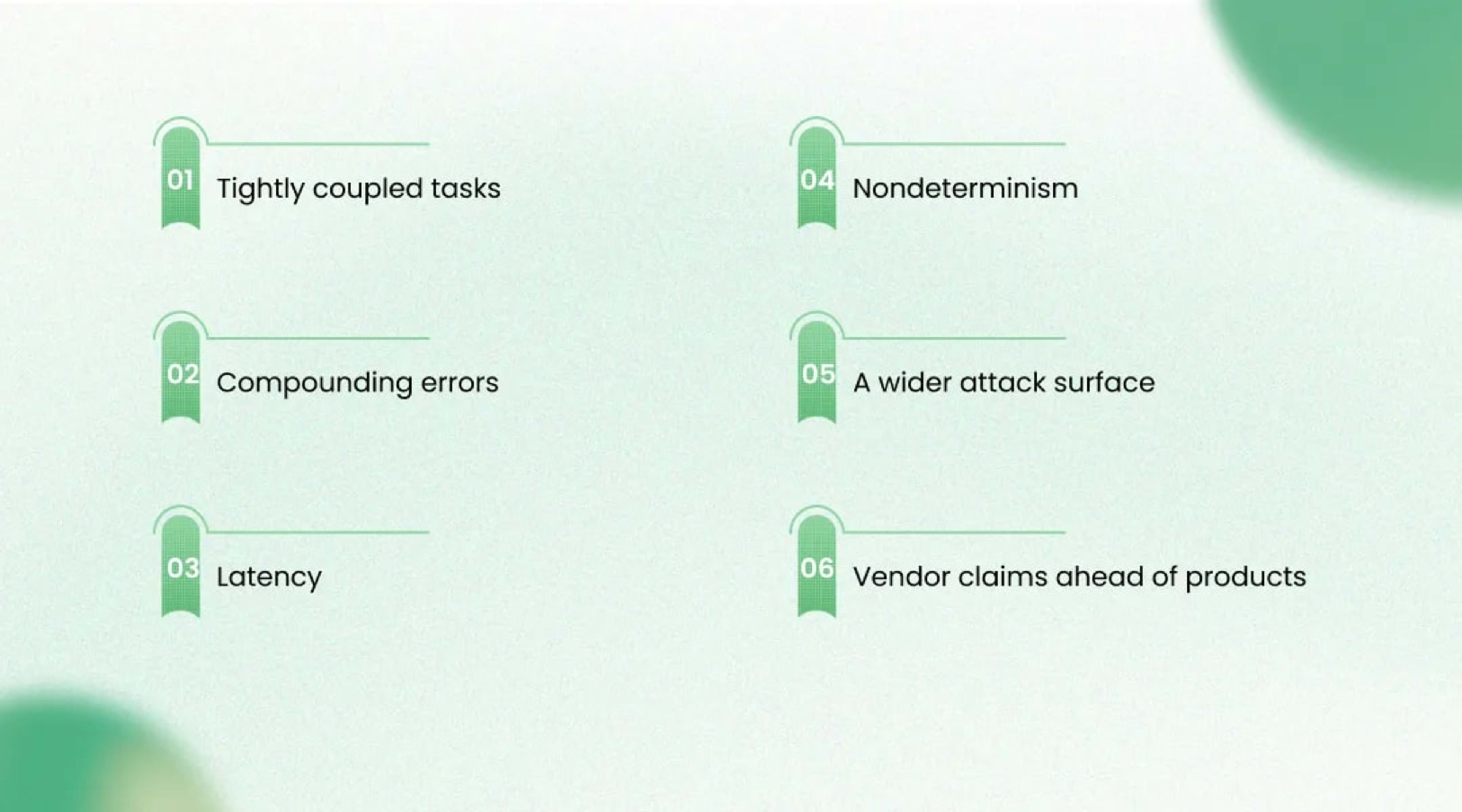
Multi-agent systems handle tightly coupled work poorly, especially work where every agent needs the same complete context, and they add failure modes around error propagation, latency, cost predictability, security, and auditability that a single agent or a fixed workflow does not have. These limits are structural, not bugs a framework update will remove. Knowing them up front keeps the pattern out of places it does not belong.
Tightly coupled tasks. Anthropic's own engineering write-up says domains where agents must share the same context, or where agents depend heavily on each other, are not a good fit today. Many software development tasks fall into this category.
Compounding errors. A field misread by the intake agent becomes the premise for every downstream decision, and the final output can look confident while resting on a mistake made four steps earlier.
Latency. Each handoff adds at least one model round trip. A back-office batch job barely notices, but a customer waiting on a live call feels every second.
Nondeterminism. The same input can take a slightly different path on two runs, which complicates audits and root-cause analysis in regulated settings.
A wider attack surface. A prompt injection hidden in a document read by a low-privilege agent can travel toward an agent with write access unless outputs are validated between hops.
Vendor claims ahead of products. Gartner estimated that only about 130 of the thousands of vendors marketing agentic AI offer genuine agentic capabilities, and it labels the rest "agent washing."
None of this argues against the pattern. It means a multi-agent design should answer a specific problem you can name, rather than serving as the default for every automation request. If a deterministic workflow with one AI step solves the problem, that simpler build is usually the better engineering decision.
Designing for Failure When an Agent Breaks Mid-Workflow
When an agent fails partway through a workflow, a well-designed system resumes from its last checkpoint, retries only steps that are safe to repeat, reverses partial changes with compensating actions, and hands the case to a person instead of guessing. Few vendor pages discuss this, yet it decides whether your system survives its first bad week in production. Six controls cover most of the risk.
Checkpoint after every agent. Persist the case state when each agent finishes, so a crash costs you one step instead of the whole run.
Make every write idempotent. Attach a unique key to each ERP posting, email, or ticket update, so a retry produces the same result rather than a duplicate.
Plan compensating actions. For multi-system changes, define the undo for each step in advance (void the payment, reopen the ticket), following the saga pattern familiar from distributed systems.
Cap time, loops, and spend. Set a timeout per agent, a maximum number of planning iterations, and a token budget per case, and stop the run when any limit trips.
Route failures to a human queue. Cases that exhaust retries go to a dead-letter queue with the full trace attached, so a person can finish the job without starting over.
Keep a fallback path. If a model provider has an outage, the orchestrator should fail over to a second model or pause cleanly, not leave half-finished cases scattered across systems.
These controls are standard distributed-systems engineering applied to a new kind of component. The teams that struggle are usually the ones that treated agents as clever scripts instead of as unreliable network services. Design for the agent being wrong, slow, or unavailable, and the good days take care of themselves.
How Should You Measure a Multi-Agent Deployment?
Measure a multi-agent deployment at two levels: each agent against its own narrow job, and the whole workflow against the business outcome it was built to improve. An agent can pass every unit test while the end-to-end flow still fails because of poor handoffs. Tracking both levels is the only way to find where a problem actually lives.
Metric
Straight-through processing rate
What it tells you
Share of cases completed with no human touch
Level
Workflow
Metric
Human override rate
What it tells you
How often reviewers reverse an agent recommendation
Level
Workflow
Metric
Escaped error rate
What it tells you
Mistakes discovered after a case was closed
Level
Workflow
Metric
Cost per completed case
What it tells you
Model fees plus infrastructure, divided by finished cases
Level
Workflow
Metric
Cycle time
What it tells you
Elapsed time from trigger to commit
Level
Workflow
Metric
Task accuracy
What it tells you
Correct outputs on a labeled test set for one agent's job
Level
Agent
Metric
Handoff completeness
What it tells you
Whether each agent passes every field the next one needs
Level
Agent
Metric
Guardrail blocks
What it tells you
Actions stopped by policy, a sign of drift or attack
Level
Agent
Capture a baseline for the manual process before launch, or you will have no honest way to show improvement. Re-run the agent-level test sets every time you change a prompt, a model, or a tool schema. A small regression in one specialist can quietly lower the straight-through rate for the entire workflow.
Multi-Agent Systems Enterprise Readiness Checklist
You are ready to build when you can name a process owner, document the decisions in the workflow, reach the relevant systems through APIs, define who approves what, and measure today's baseline. Missing two or more of these usually means the first project should be groundwork rather than agents. Use the list below as a quick self-assessment.
A single accountable owner for the target process, with authority to change it
Written business rules and approval thresholds, not tribal knowledge
API or connector access to every system the agents must read or write
A non-human identity model, so each agent can get its own scoped credentials
A defined human-in-the-loop point for every decision with financial, legal, or safety impact
Baseline metrics for volume, cycle time, error rate, and cost per case
An observability stack that can store full traces for audit periods
An executive sponsor who accepts that the first version will be narrow
This approach is not for everyone. If your target process changes every month, lives mostly in people's heads, or runs at a few dozen cases a week, a single agent or plain workflow automation will return more value for less effort. Plenty of successful multi-agent systems enterprise programs begin with unglamorous groundwork, such as cleaning up data access and writing the process down, and only then add agents.
A 90-Day Pilot Plan
Weeks 1 to 3: Scope and baseline. Pick one process, map its decisions, set target metrics, and capture current performance.
Weeks 4 to 6: Build the spine. Stand up orchestration, shared state, identity, and tracing before writing a single specialist prompt.
Weeks 7 to 9: Add agents one at a time. Introduce each specialist behind a feature flag and test it against labeled cases before the next one joins.
Weeks 10 to 12: Shadow, then limited live. Run in shadow mode next to the human team, compare outputs, and then release a capped share of real cases with full review.
A pilot that ends with clear metrics and a documented failure log is a success, even if the answer is "not yet." Treat the decision to scale as a separate gate with its own business case. The spine you built in weeks four to six carries straight into the next workflow either way.
Build In-House, Buy a Platform, or Bring In a Partner?
Build in-house when agent orchestration is central to how you compete and you have platform engineers to own it, buy a platform when your processes closely match its templates, and bring in a partner when you need production experience faster than you can hire it. Most large organizations end up mixing the three. A common split is a bought control plane, in-house ownership of business rules and evaluation, and outside help for the first two or three builds.
Buying looks cheapest at first, but check how a platform handles open protocols, data residency, and export of your prompts, traces, and test sets. Building gives you full control, and it also gives you full responsibility for upgrades every time a model or framework changes. Partnering works best when the contract requires knowledge transfer, so your team can run the system after the engagement ends.
Not every team needs to begin with a multi-agent design. A single, well-scoped agent that handles one decision reliably is often the fastest way to prove value and lay the integration groundwork a later multi-agent system will reuse. If that is where you are, specialist AI Agent Development support can help you ship that first agent with production controls in place.
Taking Your First Multi-Agent Workflow to Production
Getting a multi-agent workflow into production comes down to choosing one process that justifies several agents, building the orchestration, state, identity, and tracing spine first, and proving value against a measured baseline before you scale. The technology is ready for that path, provided the engineering around it is treated as seriously as the models. Skipping the spine is how promising pilots join the canceled-projects statistic.
A multi-agent systems enterprise rollout also goes faster with people who have already shipped one, especially for the architecture decisions that are expensive to reverse later. If you want a team to design the reference architecture, orchestration pattern, guardrails, and pilot plan with you, explore our Multi-agent systems development services and book a scoping conversation. You will leave that first session with a clear view of whether your target process is ready for multiple agents, or whether a simpler build will get you there sooner.
FAQs
A multi-agent system is a group of AI agents, each assigned one specific job, that coordinate through an orchestration layer to finish a larger business process. Think of it as a small team of specialists with a supervisor, rather than one generalist doing every task. In enterprise automation, the agents usually read from and write to systems such as ERP, CRM, and ticketing platforms.
Agentic AI is the broad category of AI that plans and takes multi-step actions toward a goal with some autonomy. A multi-agent system is one way to build agentic AI, in which the work is divided among several coordinating agents instead of handled by one. Every multi-agent system is agentic, but plenty of agentic systems use only a single agent.
Agents resemble microservices in that each has a narrow scope and a defined interface, but they differ because an agent decides which actions to take instead of executing fixed logic. That decision-making is what makes agents flexible and also what makes them less predictable. Many architectures use microservices as the tools that agents call.
Anthropic reported that its multi-agent research system used about fifteen times the tokens of a standard chat interaction, compared with about four times for a single agent. Actual costs depend on the models, the number of agents, and how often agents retry or loop. The extra spend is justified only when it removes enough manual work or errors to outweigh it.
Yes, a multi-agent system can work with legacy platforms as long as each one is reachable through an API, a connector, a database interface, or an RPA bot. Agents treat these integrations as tools with defined inputs and outputs. The quality of those integrations usually limits results more than the agents themselves do.
Yes, existing RPA bots can serve as execution tools that agents trigger when a screen-based step is needed. This lets you keep automation that already works while adding judgment and exception handling around it. Many enterprises adopt agents this way instead of replacing their RPA estate.
In a well-designed system, a failed agent is retried from its last checkpoint, and a wrong answer is caught by a verification step or a policy gate before anything is written to a system of record. Cases that cannot be resolved automatically go to a human queue with the full trace attached. Without these controls, one agent's error can spread through every step that follows it.
Regulated organizations can deploy multi-agent systems when each agent has least-privilege access, every action is logged, and humans approve decisions with financial, legal, or clinical impact. The orchestration layer must produce audit trails that show which agent did what and why. Supervisor and pipeline patterns are generally easier to certify than open peer-to-peer designs.
A first deployment needs one agent per genuinely distinct decision in the process, plus a supervisor or pipeline to coordinate them. For a well-scoped workflow, that often means a handful of specialists rather than dozens. Adding agents beyond the number of real decisions increases cost and coordination overhead without improving results.
A multi-agent system mainly removes the repetitive gathering, checking, and drafting work that sits between decisions, while people keep approval authority and handle exceptions. Roles tend to shift toward review, policy design, and handling the cases agents cannot resolve. Current agents still make mistakes that need human judgment to catch, which is why fully unattended operation remains rare for consequential work.
Krushang Mandani is the CTO at KriraAI, driving innovation in AI-powered voice and automation solutions. He shares practical insights on conversational AI, business automation, and scalable tech strategies.