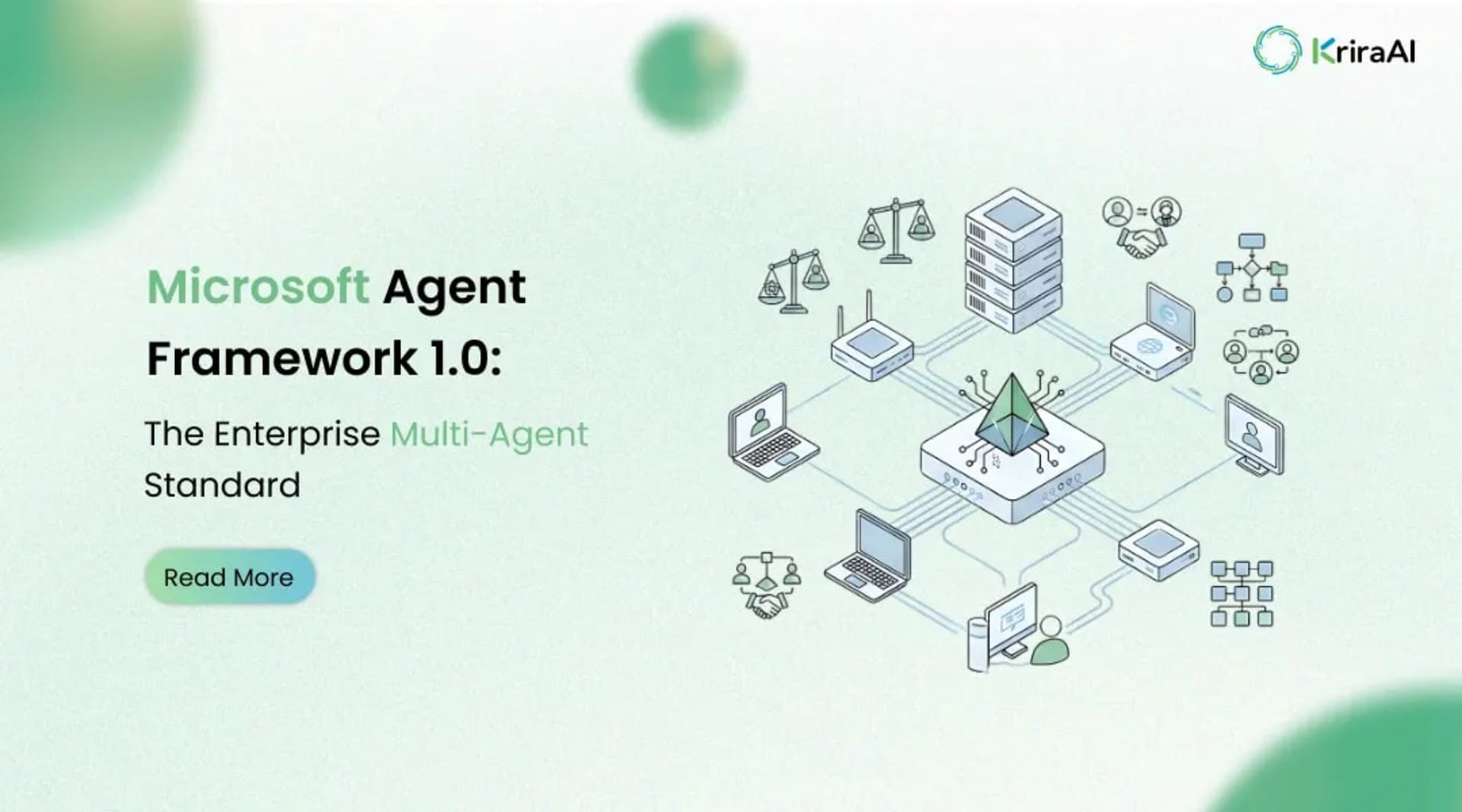
Microsoft shipped Agent Framework 1.0 GA on April 3, 2026, marking the production-ready convergence of two projects, Semantic Kernel and AutoGen, into a single unified SDK. That date matters more than it first appears. For the preceding two years, enterprise teams building agentic AI systems on Microsoft infrastructure faced a structurally awkward decision: use Semantic Kernel for enterprise integration quality at the cost of limited multi-agent orchestration, or use AutoGen for sophisticated multi-agent patterns at the cost of a rougher production story. The 1.0 release ends that tradeoff with a commitment that practitioners and architects needed before betting production workloads on the platform.
The significance here is not that Microsoft shipped a new AI SDK. The AI tooling space is saturated with frameworks that appear and disappear on quarterly cycles. The significance is that Microsoft Agent Framework 1.0 is the first enterprise agent SDK to ship a genuine 1.0, with long-term support guarantees, dual-runtime parity across .NET and Python, and native implementations of both the Model Context Protocol for tool integration and the Agent-to-Agent protocol for cross-framework agent collaboration. Gartner reported a 1,445% surge in multi-agent system inquiries from Q1 2024 to Q2 2025, yet 40% of multi-agent pilots fail within six months.The failure pattern is not usually a model quality problem. It is a framework stability and architecture problem: teams pick the wrong orchestration pattern, build on unstable APIs that break between preview releases, or over-engineer systems that accumulate custom glue code to bridge tools, memory backends, and inter-agent communication.
Microsoft Agent Framework 1.0 addresses all three of those failure modes simultaneously. This blog covers the architectural foundation of the framework, the five stabilized orchestration patterns and when to use each, the MCP and A2A interoperability story, the memory and middleware architecture that makes enterprise compliance tractable, the honest limitations teams need to understand before committing, and what the right adoption strategy looks like for organisations at different stages of their agentic AI journey. Teams at KriraAI, which builds and delivers production AI systems for enterprises, have been tracking this framework closely precisely because the LTS commitment and open standards alignment represent the kind of stability signal that separates frameworks worth building on from those that remain perpetual experiments.
Understanding why Microsoft Agent Framework 1.0 matters requires understanding the architecture gap it closes. Before Agent Framework, Microsoft's two main open-source building blocks in this area were Semantic Kernel and AutoGen. Semantic Kernel was the company's model-agnostic SDK for integrating AI capabilities into applications and for building and orchestrating agents and multi-agent systems, while AutoGen was focused on creating multi-agent AI applications in which agents could act autonomously or collaborate with humans.
These were not redundant projects. They solved genuinely different layers of the same problem. Semantic Kernel gave teams a production-grade plugin model, Entra ID authentication, Azure service connectors, session-based state management, and type safety. AutoGen gave teams GroupChat, hierarchical agent coordination, event-driven orchestration, and the research-validated patterns that emerged from Microsoft Research's work on autonomous agent systems. The problem was that building a real enterprise agentic application required both layers, and the two frameworks did not compose naturally. Teams building on Semantic Kernel struggled to implement AutoGen-style multi-agent coordination without significant custom scaffolding. Teams starting from AutoGen's orchestration model found the .NET story rough and the enterprise integration features absent.
The result was exactly what you would expect: fragmented codebases where production teams had stitched together their own bridges between the two frameworks, often reinventing the same patterns in slightly different ways. Between them the two predecessor projects accumulated more than 75,000 GitHub stars and three years of enterprise field experience. That institutional knowledge is now unified in a single codebase under a single API surface.
The conceptual shift between AutoGen's model and what Agent Framework provides is worth naming precisely. AutoGen used a conversation model for multi-agent coordination: you placed agents in a GroupChat, gave them roles and personas, and the system used LLM reasoning to manage turn-taking and task allocation. This felt intuitive in demos but introduced a specific class of production failure. When agent coordination logic itself runs through an LLM, the coordination becomes non-deterministic. A 4-agent GroupChat with 5 rounds requires a minimum of 20 LLM calls, and the path through those calls is model-dependent rather than deterministically controlled. At high volumes, the cost and latency implications are severe. More critically, in regulated enterprise environments, coordination behaviour that cannot be predicted and audited before deployment is not deployable.
Agent Framework combines AutoGen's simple agent abstractions with Semantic Kernel's enterprise features, including session-based state management, type safety, middleware, and telemetry, and adds graph-based workflows for explicit multi-agent orchestration. The graph-based workflow engine is the architectural replacement for GroupChat's LLM-driven coordination. Developers define agent collaboration topology as typed graphs, with explicit edge semantics that control which agent activates under which conditions. The result is orchestration behaviour that is deterministic, checkpointable, and auditable without adding the unpredictability of a coordinating LLM to the control plane.
Semantic Kernel does not disappear in this unification. Semantic Kernel is the foundation layer and AutoGen-style orchestration is a graph workflow on top.The kernel provides the dependency injection container, the plugin model, the provider connector abstractions, and the service integration infrastructure. Everything that Semantic Kernel teams built around AI function registration, memory plugins, and Azure service integration continues to work. The migration path is not a rewrite. It is an incremental adoption of the graph-based workflow engine on top of an existing Semantic Kernel foundation, using the migration assistant that ships with the 1.0 release to identify which patterns need updating.
Microsoft Agent Framework 1.0 is best understood as five cooperating layers rather than a monolithic SDK. Each layer has a distinct engineering concern and can be adopted or extended independently.
The Connector Layer handles model and service provider integration. Agent Framework ships with first-party service connectors for Microsoft Foundry, Azure OpenAI, OpenAI, Anthropic Claude, Amazon Bedrock, Google Gemini, and Ollama.Every connector implements the IChatClient abstraction from Microsoft.Extensions.AI, which means swapping providers requires a single registration change without touching business logic. This multi-provider first-party support is operationally important: teams that want to run cost optimisation experiments by routing different workloads to different models, or that need vendor redundancy for reliability, can do so without building and maintaining custom provider adapters.
The Middleware Layer is where compliance, observability, and content safety live. The middleware pipeline lets you intercept, transform, and extend agent behavior at every stage of execution: content safety filters, logging, compliance policies, custom logic, all without modifying agent prompts.This three-tier interception model is architecturally significant for regulated industries. Financial services and healthcare teams need to enforce content policies, log every agent decision for audit, and apply PII detection without coupling those concerns to the agent's reasoning logic. The middleware pipeline provides this separation cleanly.
The Memory and Context Layer provides pluggable storage for the three types of state that production agents need.
Conversational history manages short-term in-session context across multi-turn interactions.
Persistent key-value state stores agent-specific state that survives session boundaries, enabling long-running workflows that pause, resume, and recover from failures.
Vector-based retrieval provides semantic memory access for RAG patterns where agent reasoning needs to query a knowledge base rather than rely on in-context information.
Supported backends include Memory in Foundry Agent Service, Mem0, Redis, Neo4j, or a custom store. The backend is swappable without changing agent code, which matters for teams that start with in-memory state during development and graduate to Redis or Cosmos DB in production.
The Workflow and Orchestration Layer is the graph-based engine that replaces AutoGen's conversation-model coordination. Workflows are directed graphs where nodes are agents or functions and edges encode execution logic. The engine supports checkpointing at every node transition, pause and resume for long-running processes, and human-in-the-loop approval gates that halt a workflow pending external input. YAML-based declarative agent definitions allow agent configuration to live in version control and be reviewed through standard code review processes, an operational maturity upgrade that is easy to undervalue until a production incident requires reconstructing why an agent was configured the way it was.
The Protocol and Interoperability Layer includes MCP and A2A support, which will be addressed in detail in the next section.
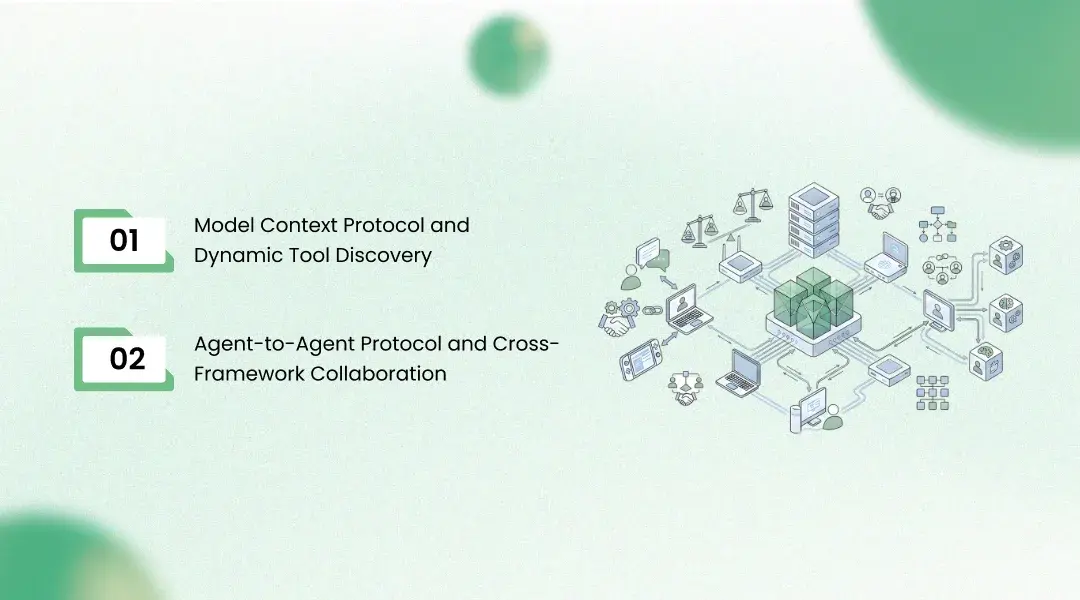
The most strategically important aspect of Microsoft Agent Framework 1.0 for enterprise architects is not any individual feature. It is the native implementation of two complementary interoperability protocols that are converging as the default standards for production agentic systems.
Full Model Context Protocol support lets agents dynamically discover and invoke tools exposed by any MCP-compliant server, at runtime, without code changes. In practice, this means your agents can connect to any of the thousands of MCP servers that have emerged in the ecosystem.The architectural significance of MCP in Agent Framework is how tool resolution works at runtime. An agent does not need a statically compiled list of callable tools. It connects to an MCP server endpoint and receives a live catalog of available tools with their schemas. As the tool catalog on the server evolves, the agent discovers the changes without redeployment. Forrester predicts that 30% of enterprise application vendors will launch MCP servers this year.For teams building agents that need to integrate with enterprise software ecosystems, MCP removes the tool integration overhead that previously required custom adapter code per service.
A2A serves a different purpose from MCP. Where MCP connects an agent to tools, A2A connects agents to other agents across runtime and framework boundaries. An Agent Framework agent can receive tasks from, and dispatch tasks to, agents running in LangGraph, CrewAI, or a custom implementation, provided all parties implement A2A's structured messaging interface. On April 9, 2026, Google's Agent-to-Agent Protocol reached its one-year anniversary with impressive adoption: 150 or more organisations, 22,000 or more GitHub stars, and production deployments in Azure AI Foundry, Amazon Bedrock AgentCore, Copilot Studio, Salesforce, SAP, and ServiceNow.
The enterprise implication is significant. Most large organisations are not going to run all of their agentic workloads on a single framework. Different teams will adopt different tools based on different requirements. Without an interoperability protocol, the result is agent silos that cannot collaborate. A2A provides the wire format that allows a supply chain optimisation agent built on LangGraph to hand off to a compliance check agent built on Agent Framework without custom integration code between them. The architecture is important here: A2A and MCP serve different purposes. MCP connects agents to tools. A2A connects agents to other agents. Together, they give you a complete interoperability story for complex multi-agent systems.
Microsoft Agent Framework 1.0 ships five stabilised orchestration patterns drawn from AutoGen's research and validated in enterprise customer deployments before the 1.0 release. Selecting the wrong pattern is the most common cause of multi-agent pilots failing to reach production. Each pattern has a distinct cost and latency profile, failure mode, and appropriate use case.
Sequential executes agents one after another in a defined order, passing the output of each agent as input to the next. This is the cheapest pattern per run but serialises every step. It is appropriate when tasks have strict data dependencies and low tolerance for partial execution, such as document processing pipelines where extraction must complete before classification can begin.
Concurrent executes multiple agents in parallel against the same input or independent subtasks, then collects results. It reduces wall-clock time at the cost of parallel token expenditure. It is appropriate when subtasks are genuinely independent, such as running parallel research agents against different data sources before a synthesis step.
Handoff transfers full control of a conversation from one agent to the next. Unlike sequential, there is no aggregation step: the receiving agent takes ownership and the transferring agent exits. This pattern suits domain specialisation scenarios where a routing agent identifies intent and passes the user interaction to a domain expert, such as the interview coach example Microsoft documented with five specialised agents each handling a distinct phase.
Group Chat places multiple agents in a shared conversation context where they can observe each other's outputs and contribute based on their specialisations. This is the AutoGen GroupChat pattern re-implemented on the typed graph engine, making its behaviour more predictable than the original but still more expensive than structured handoff patterns for the same workload.
Magentic-One is the most sophisticated pattern, involving an orchestrator agent that reasons about task progress and dynamically assigns subtasks to specialist agents. It is powerful for open-ended tasks that cannot be decomposed into a fixed workflow in advance, but the orchestrator's reasoning adds latency and token cost at every step. It is appropriate for research or analysis tasks where the path through the task is determined by what is discovered along the way, not for high-volume, latency-sensitive workflows.
Production agents fail in ways that do not appear in demos. The most common failure is state loss: a long-running workflow crashes partway through, loses its position, and either restarts from the beginning at significant cost or fails entirely. The second most common failure is context degradation: an agent operating across many turns accumulates a context window that exceeds the model's effective reasoning range, causing quality degradation that is difficult to attribute without proper observability.
Agent Framework 1.0 addresses both failure modes with an explicit state management architecture. The checkpoint system persists workflow state at every node transition in the orchestration graph. If an agent process is interrupted, the workflow resumes from the last successful checkpoint rather than restarting. For human-in-the-loop workflows where a step requires approval before continuing, checkpointing enables the workflow to pause, serialise its full state, and resume when the approval arrives, potentially hours or days later. This is not theoretical: BMW is using Agent Framework multi-agent systems to analyse terabytes of vehicle telemetry in near real time with durability requirements that make checkpointing a production necessity, not an optional feature.
The memory context providers address the context degradation problem through a three-tier memory abstraction. In-session conversational history maintains the immediate turn-by-turn context. Persistent key-value state stores agent-specific variables across sessions. Vector-based retrieval through backends like Redis or Neo4j allows agents to query semantic memory at reasoning time rather than stuffing entire knowledge bases into the context window. For teams building agents that need to maintain context across days or weeks of interaction, this separation prevents the context explosion that degrades quality in simpler implementations.
Commerzbank is piloting Microsoft Agent Framework to power avatar-driven customer support, enabling more natural, accessible, and compliant customer interactions.The Commerzbank deployment illustrates a pattern that KriraAI, which applies emerging AI techniques to real enterprise problems, frequently encounters when working with regulated financial institutions: the compliance and observability requirements are as demanding as the functional requirements. The middleware pipeline that intercepts and logs every agent action is not a nice-to-have in these environments. It is the feature that makes deployment possible at all.
BMW is using Microsoft Agent Framework and Foundry Agent Service to orchestrate multi-agent systems that analyse terabytes of vehicle telemetry in near real time, enabling engineers to accelerate design cycles and spot issues earlier in testing.The BMW deployment reveals a different requirement: the ability to handle high-throughput, durable workloads where individual agent failures cannot cascade into total workflow failures. Checkpointing, parallel concurrent execution patterns, and OpenTelemetry-native observability are the features that make this class of deployment tractable.
Both deployments share a common characteristic that is worth emphasising. Neither is a chatbot with tool calling bolted on. Both are multi-agent systems where specialised agents with distinct responsibilities collaborate through structured orchestration to produce outputs that no single agent could produce reliably alone. That architectural pattern, what is increasingly called the microservices moment for AI, is where Agent Framework's graph-based workflow engine provides its clearest differentiation from simpler frameworks.
No production technology evaluation is complete without an honest assessment of current limitations. Microsoft Agent Framework 1.0 has several that matter for specific adoption scenarios.
The first is Azure gravity. Azure lock-in is real and intentional. The key design decisions favour Azure services, but running this framework outside Azure requires fighting the abstractions. Teams running on AWS or GCP as their primary cloud will find that the framework's richest features, Foundry integration, Cosmos DB memory, Entra ID authentication, Azure App Service deployment, are all Azure-native. The core SDK is cloud-agnostic and the six provider connectors work outside Azure, but the operational experience is materially better inside Azure infrastructure.
The second is complexity overhead for simple use cases. The complexity overhead is enormous for simple use cases. What LangGraph does in 50 lines often takes significantly more scaffolding when Azure services are involved. Teams evaluating Agent Framework for simple single-agent applications with basic tool calling should consider whether the enterprise scaffolding adds value for their specific complexity level. The framework's strengths are most visible in multi-agent, long-running, compliance-sensitive workflows. For a team building a single-agent customer support assistant, CrewAI or the OpenAI Agents SDK may reach production faster.
The third is A2A maturity. Full A2A 1.0 support was listed as arriving imminently at the 1.0 release date rather than shipping as a stable feature at launch. Teams whose architecture depends on cross-framework agent collaboration should treat A2A as nearly but not fully production-ready and track the repository for the stable release.
The fourth is the Java and TypeScript gap. The 1.0 release provides first-class support for .NET and Python. Teams with JavaScript-heavy or Java-heavy infrastructure will need to wait for parity, use the Python SDK as a bridge, or accept that they are building against preview-quality support.
A pragmatic adoption sequence for enterprise teams evaluating Microsoft Agent Framework 1.0 follows a three-phase approach based on reducing risk while accelerating learning.
Phase 1: Inventory and Classify Current Agent Workloads. Before writing any new code, assess which existing agent or automation workloads are currently in production or near-production. Classify each against the five orchestration patterns to identify whether the current implementation pattern matches the right pattern for the workload. Many organisations discover they are using LLM-driven coordination for workflows that would be safer and cheaper as deterministic graph-based sequential or handoff patterns.
Phase 2: Run a Focused Pilot on a New Workload. The most effective first Agent Framework deployment is a net-new workflow, not a migration. Choose a workflow that has clear domain specialisation requirements, two or more distinct agent roles, and human-in-the-loop approval steps. These characteristics make the framework's graph-based workflow engine, middleware pipeline, and checkpointing most visible. Build the pilot with DevUI enabled so the team develops familiarity with the execution trace visualization from day one.
Phase 3: Plan Migrations Incrementally. AutoGen is now in maintenance mode. It will continue receiving security patches, but new features and orchestration patterns will only land in Agent Framework. Teams running AutoGen in production should plan their migration during 2026 while AutoGen remains supported. The migration assistant that ships with Agent Framework analyses existing code and generates migration plans. Semantic Kernel migrations can proceed lazily, migrating components as new feature requirements justify the work.
For teams in the .NET ecosystem specifically, Agent Framework 1.0 represents the most compelling reason to move agentic workloads off custom scaffolding that has been maintaining its own bridges between Semantic Kernel and AutoGen.
Three things are most important to carry forward from everything covered here. First, the architectural merger at the core of Agent Framework 1.0 is not a rebrand. It is a genuine unification of two complementary engineering philosophies into a single coherent abstraction where the graph-based workflow engine provides the deterministic, auditable orchestration control that AutoGen's conversation model could not guarantee, and Semantic Kernel's enterprise middleware and connector infrastructure provides the compliance and observability capabilities that AutoGen lacked. Teams that understand this architecture will make better decisions about which orchestration patterns to use and why.
Second, the convergence of MCP and A2A as the production standard for agent interoperability is the most strategically important development in the agentic AI space in 2026. The frameworks and models that organisations choose matter less than whether those choices are built on open standards that allow agent collaboration across runtime and vendor boundaries. Agent Framework 1.0 ships native implementations of both protocols, which is the feature most likely to determine whether an organisation's agent investments in 2026 compose well with the infrastructure they will build in 2027.
Third, organisations that are currently running AutoGen in production need an explicit migration plan. AutoGen is in maintenance mode as of this release. New orchestration patterns and enterprise features will not appear in AutoGen going forward. The migration assistant that ships with Agent Framework reduces the technical barrier, but the migration requires deliberate scheduling before maintenance-mode signals escalate into security or compatibility concerns.
At KriraAI, which builds and delivers production AI systems for enterprises across regulated and complex industries, the approach to every new framework is the same: assess whether it is genuinely ready for the workloads where it claims to add value, not whether the announcement narrative is compelling. Microsoft Agent Framework 1.0 passes that test for enterprise teams on Azure with multi-agent, compliance-sensitive, or long-running workflow requirements. KriraAI stays at the frontier of AI infrastructure precisely to make these assessments concrete and actionable rather than theoretical. If your organisation is evaluating where to build its agentic AI foundation for the next two to three years, we would welcome the conversation about what Microsoft Agent Framework 1.0 could mean for your specific infrastructure and requirements.
Microsoft Agent Framework 1.0, released on April 3 2026, is a production-ready open-source SDK and runtime for building, orchestrating, and deploying AI agents and multi-agent workflows in .NET and Python. It is the direct successor to two previously separate Microsoft AI frameworks: Semantic Kernel, which provided enterprise-grade plugin models, Azure service integration, and provider-agnostic LLM connectivity; and AutoGen, which provided multi-agent orchestration patterns validated through Microsoft Research. Version 1.0 unifies both projects into a single codebase where Semantic Kernel becomes the foundation layer for connectors, middleware, and state management, and AutoGen's orchestration concepts are re-implemented as a graph-based workflow engine on top. Both Semantic Kernel and AutoGen remain in maintenance with security patches, but all new orchestration development now happens in Agent Framework. The combined GitHub presence of the two predecessor projects exceeded 75,000 stars, and that community investment is now directed at the unified framework under a long-term support commitment.
Microsoft Agent Framework 1.0 ships five stabilised multi-agent orchestration patterns: sequential, concurrent, handoff, group chat, and Magentic-One. Sequential executes agents in a fixed order and is appropriate when tasks have strict data dependencies and consistent workload volume. Concurrent runs agents in parallel for independent subtasks and reduces wall-clock time at the cost of parallel token expenditure. Handoff transfers full conversational control from one agent to the next without aggregation, making it suitable for domain specialisation workflows with a routing agent. Group Chat places multiple agents in a shared context suitable for collaborative analysis tasks. Magentic-One uses an orchestrator agent to dynamically assign subtasks based on reasoning about task progress, appropriate for open-ended research workflows where the decomposition cannot be determined in advance. Pattern selection has direct cost and latency implications: a Magentic-One workflow for a task that could use sequential pattern wastes significant token budget on orchestrator reasoning that adds no value.
Model Context Protocol support in Microsoft Agent Framework 1.0 allows agents to connect to any MCP-compliant server and dynamically discover the tool catalog that server exposes at runtime. When an agent is configured with an MCP server endpoint, the framework handles tool schema resolution, calling convention translation, and response parsing automatically. The agent does not need a statically compiled list of available tools: as the server's tool catalog evolves, agents discover changes without code changes or redeployment. This is particularly valuable in enterprise environments where tool ecosystems are large, heterogeneous, and changing. A compliance audit agent, for example, can connect to an MCP server that exposes current regulatory policy checks and automatically picks up new policy tools as they are added to the server, without the development team needing to update agent code for each policy addition. Forrester has predicted that 30% of enterprise software vendors will ship MCP servers in 2026, which means the available tool ecosystem accessible through this pattern will grow substantially during the year.
The 1.0 designation reflects a specific and verifiable set of production-readiness commitments rather than a marketing milestone. Microsoft has committed to long-term support with stable API contracts and a documented upgrade path, which is a meaningful differentiator from the majority of AI frameworks that ship breaking changes in minor versions. The Release Candidate phase that preceded 1.0 explicitly locked the feature surface in February 2026 and ran a community validation period before the general availability announcement. The 1.0 core covers single-agent abstractions, all six provider connectors, the middleware pipeline, the memory and context provider system, the graph-based workflow engine, all five orchestration patterns, MCP support, and YAML declarative agents. Several adjacent capabilities including DevUI, Foundry hosted agent integration, and A2A shipped as preview features at 1.0, with a clear signal that they will graduate to stable status as they complete their validation cycle. Enterprise customers including Commerzbank and BMW were running pre-release versions in pilot production environments before the 1.0 announcement, which provides a meaningful signal that the framework has been tested against real enterprise load and compliance requirements.
Microsoft Agent Framework 1.0, LangGraph, and CrewAI represent three different architectural philosophies with distinct enterprise fit profiles. LangGraph, with more than 97,000 GitHub stars, is the most flexible option for teams that need fine-grained control over conditional execution graphs, durable execution patterns, and LangSmith-based observability. It does not carry an LTS commitment and has no .NET support. CrewAI, with approximately 45,900 GitHub stars and more than 12 million daily agent executions reported in production, optimises for developer speed: its role-based team metaphor produces working multi-agent pipelines quickly but reaches architectural limits when workflow complexity grows. Microsoft Agent Framework wins on enterprise stability criteria specifically: it is the only framework with an LTS commitment, the only one with first-class .NET parity, and the only one with deep Azure service integration that does not require custom adapter code. For teams running multi-year enterprise programs in regulated industries on Azure infrastructure, Agent Framework provides the clearest commitment to long-term API stability. For teams on other clouds or prioritising maximum flexibility in graph topology, LangGraph remains a strong alternative. For teams prioritising initial development velocity on simpler workflows, CrewAI remains faster to prototype.
Founder & CEO
Divyang Mandani is the CEO of KriraAI, driving innovative AI and IT solutions with a focus on transformative technology, ethical AI, and impactful digital strategies for businesses worldwide.