Finance
Agents review KYC documents, investigate transactions, and draft credit memos, with a validation agent checking each output. Analysts focus on exceptions instead of routine cases.
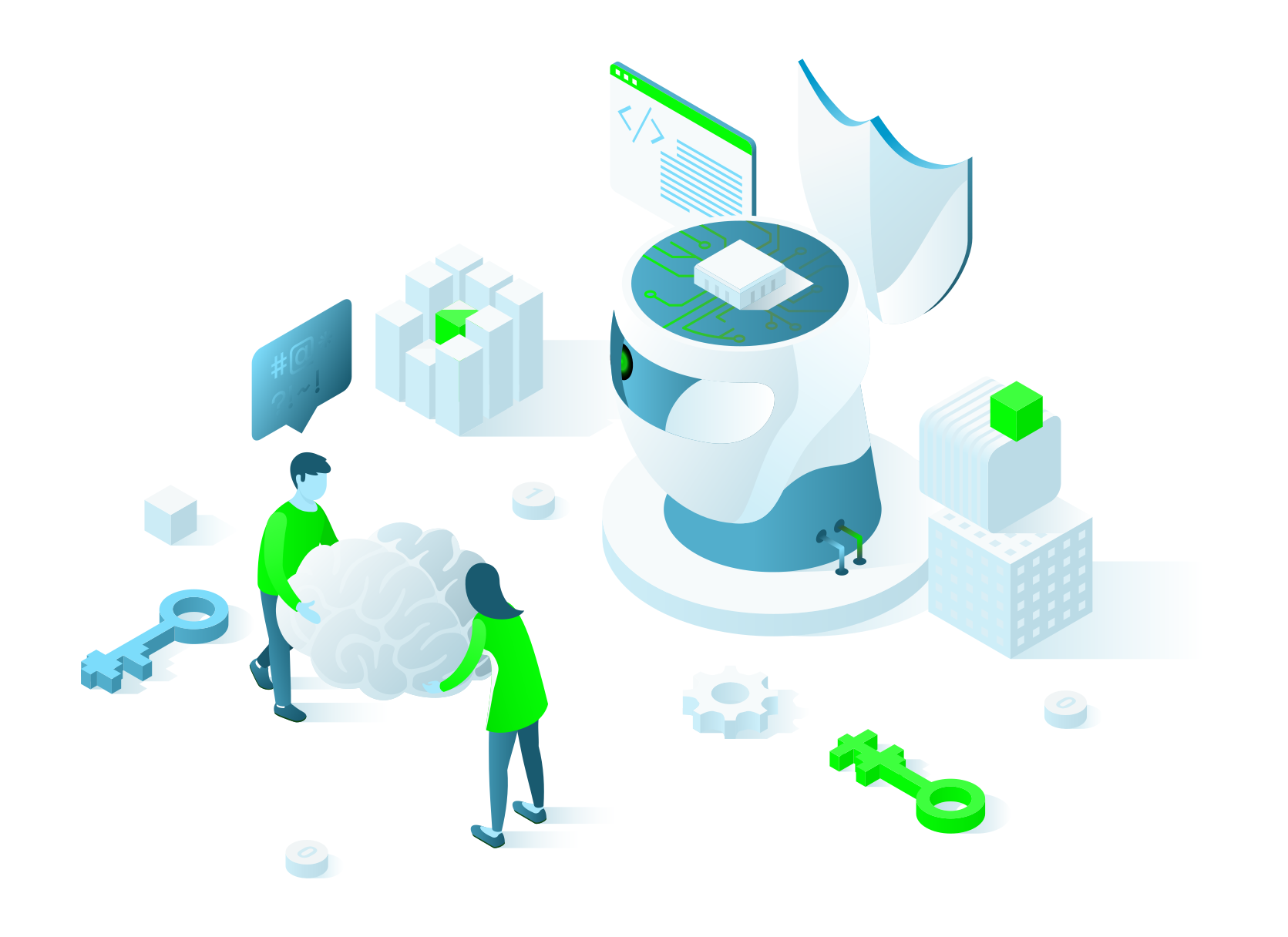
A multi-agent system is an AI architecture in which several specialised agents, each with its own tools, work together toward a shared goal. An orchestration layer routes tasks between them, so one agent can research, another can validate, and a third can act in your business systems. Multi agent AI turns a large problem into focused roles that are easier to test, govern, and improve.
Factor
Single AI Agent
Multi-Agent System
Best for
Narrow, defined tasks
Complex workflows across systems
Reliability on long tasks
Drops as steps grow
Higher, with smaller scope per agent
Governance
One permission set
Role-based permissions per agent
Scaling
Expand one agent
Add specialist agents
AI agent orchestration in our systems covers task routing, shared memory, communication, and recovery. Agents exchange context through open standards such as the Model Context Protocol (MCP) and Agent2Agent (A2A). When an agent fails or returns low-confidence output, the orchestrator retries, reroutes, or escalates to a person.
We select the multi agent framework that fits your control, scale, and infrastructure needs. Our team builds with LangGraph, CrewAI, AutoGen, the OpenAI Agents SDK, and Semantic Kernel, using models from OpenAI, Anthropic, Google, and open-source families. Deployment runs in the cloud or on-premise to meet your security and data residency requirements.
Agents review KYC documents, investigate transactions, and draft credit memos, with a validation agent checking each output. Analysts focus on exceptions instead of routine cases.
Agents summarise records, prepare prior authorisations, and route referrals while clinicians approve every decision. Data access follows HIPAA and equivalent regional rules.
Quality and maintenance agents use sensor and ERP data to flag defects and schedule repairs. Supervisors approve plan changes from a single dashboard.
Agents track shipments, predict delays, rebook carriers, and notify customers of exceptions. Dispatchers step in only for high-value or unusual cases.
Catalogue, pricing, and service agents keep product data accurate and resolve order issues across channels. Merchandisers set the rules each agent follows.
KriraAI has delivered production AI systems for enterprise clients across 22+ industries. We build autonomous AI agents with governance, evaluation, and integration as core engineering work. Our model-agnostic approach means your system is never locked to one vendor.
A Proof of Concept validates one high-value workflow in a short, fixed-scope engagement. A Dedicated Agent Team places KriraAI engineers inside your roadmap for continuous delivery. An End-to-End Build covers architecture, development, integration, and long-term support under one contract.



A multi-agent system is an AI setup where several specialised agents each handle part of a larger task. An orchestration layer coordinates their actions and shares results. This makes complex workflows more reliable than a single agent.
AI agents use tools to complete tasks, often guided step by step by a user. Autonomous agents create their own plan, execute multiple steps, and check their results with little human input. In enterprises, that autonomy runs within defined permissions.
Use a multi-agent system when a workflow needs several skills, touches multiple systems, or requires independent verification. Single agents suit narrow tasks but lose reliability as steps increase. A short discovery assessment shows which approach fits.
AI agent orchestration is the control layer that assigns tasks, manages order, shares context, and handles failures between agents. It decides when to retry, reroute, or escalate to a person. Strong orchestration makes multi-agent systems dependable in production.
No single framework fits every case. LangGraph suits precise state control, CrewAI suits role-based teams, and AutoGen suits conversational, research-heavy setups. The right choice depends on your control needs and existing stack.
We use role-based permissions, output validation, action limits, and human approval for high-impact decisions. Every action is logged for audit. Monitoring can pause agents automatically if behaviour looks unusual.
Yes, agents connect to ERP, CRM, ticketing tools, databases, and internal APIs through secure connectors. Standards such as MCP keep tool access consistent across agents. All integrations follow your authentication and data policies.
A proof of concept usually takes a few weeks, and a production system typically takes a few months. Timelines depend on agents, integrations, and compliance needs. We confirm a fixed timeline after discovery.
Cost depends on the number of agents, integrations, model usage, and governance needs. A proof of concept needs a smaller fixed investment than a full production build. We share a detailed estimate after a short discovery session.
No, they handle repetitive, multi-step work so people can focus on judgement and exceptions. Most deployments keep humans in the loop for approvals. The usual result is more capacity for existing teams.