If your team is still copying data between spreadsheets in 2026, you don’t have a workload problem.
You have a system problem.
I’ve spent the last decade leading AI automation projects at KriraAI. I’ve seen exhausted founders. Burned-out operations managers. Finance teams buried in invoices. Smart people doing work that software should have handled years ago.
Let me ask you something uncomfortable.
How many hours did your team waste last week on repetitive tasks?
Exactly.
AI automation is the use of artificial intelligence to perform tasks that normally require human decision-making.
Not just clicking buttons.
Thinking.
Traditional workflow automation software follows fixed rules. If X happens, do Y. That’s robotic process automation (RPA).
But AI process automation? That’s different.
It learns patterns. It reads emails. It classifies invoices. It predicts demand. It improves over time.
That’s intelligent automation.
Traditional automation = rules-based. AI automation for business = decision-based.
Robotic process automation (RPA) works well for structured tasks. But once data becomes messy (and trust me, real-world data is always messy), you need AI workflow automation.
Here’s the simplified version I give non-technical founders:
Collect business data
Train AI models on patterns
Integrate into existing systems
Monitor and improve
That’s business process automation using AI in action.
I’ve audited dozens of companies across India.
The pattern is always the same.
Manual approvals. Data entry. Report generation.
You don’t notice the hours bleeding out.
But they are.
Invoices miscalculated. Customer data duplicated. Orders misplaced.
One small mistake. One unhappy client.
You hire more people to manage inefficiency instead of fixing the root problem.
That’s not growth. That’s leakage.
Smart employees doing copy-paste work lose motivation.
And then they leave.
Here’s the brutal truth.
Manual systems collapse under growth.
You can’t scale chaos.
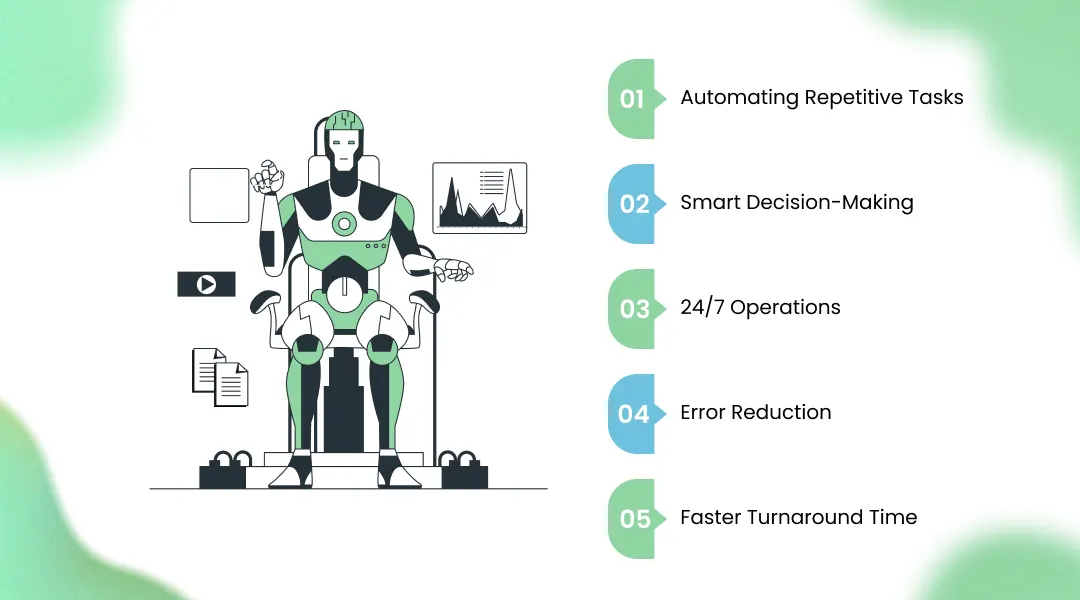
This is where AI automation solutions change the equation.
You can automate repetitive tasks like:
Invoice processing
Lead sorting
Data extraction
Report generation
You save time using AI. Instantly.
AI in operations management can predict inventory demand. Flag risky transactions. Prioritize leads.
Not random decisions. Data-driven ones.
AI doesn’t sleep.
Customer queries at midnight? Handled.
AI models don’t get tired. They don’t mistype numbers.
Accuracy improves.
One logistics client reduced dispatch processing time by 42% after implementing AI workflow automation. (Yes, we measured it. I don’t believe in vanity metrics.)
Let’s make this practical.
AI automation examples include intelligent chatbots that answer FAQs, track orders, and escalate complex issues.
AI tools for business automation extract invoice data automatically and update accounting systems.
AI automation for business can score leads based on behavior patterns.
Your sales team talks only to serious prospects.
AI productivity tools filter CVs based on skill relevance.
Recruiters focus on interviews, not scanning PDFs.
Predictive AI reduces stockouts and overstock.
AI identifies intent and routes emails automatically.
Digital transformation using AI isn’t abstract. It’s operational.
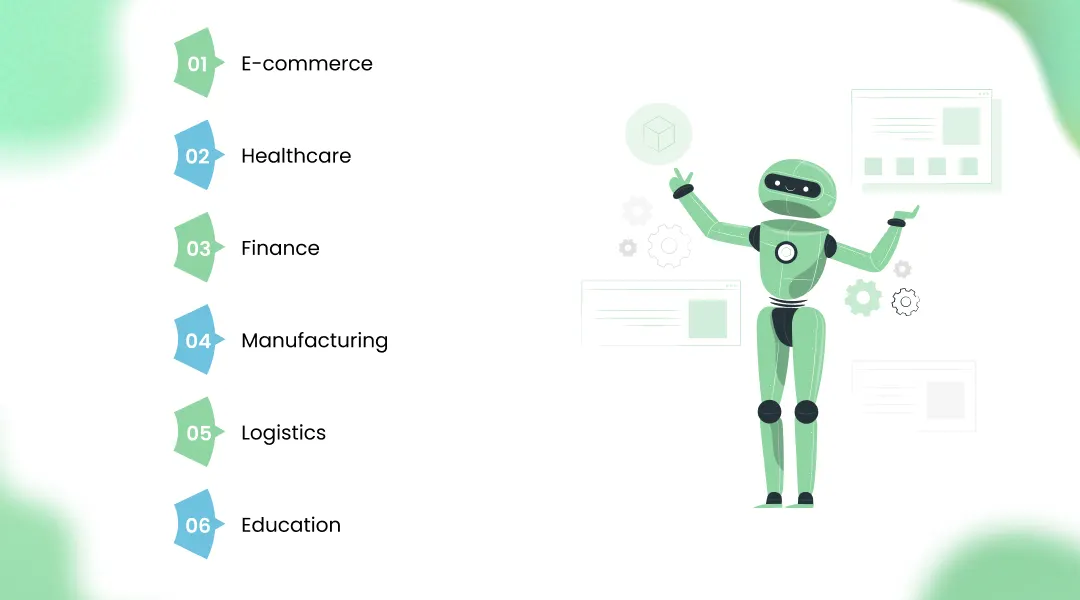
I’ve implemented AI automation services across multiple sectors.
Order management, returns processing, and demand forecasting are exactly where e-commerce AI solutions can save time and reduce errors.
AI for small business works beautifully here.
Appointment scheduling. Patient data entry. Billing automation.
Fraud detection. Reconciliation. Compliance monitoring.
Production planning. Quality checks.
Route optimization. Dispatch coordination.
Student onboarding. Query handling.
If your industry handles data, it can benefit.
How to Start AI Automation in Your Business
Here’s the framework I use with clients, and this Step-by-Step Guide to Implementing AI Automation in Your Workflow adds a practical rollout sequence.
Start small. Don’t automate everything at once.
Ask: What process consumes the most time?
Not every AI automation company understands business realities.
You need partners who build practical AI automation solutions, not flashy demos.
At KriraAI, we integrate AI development services with real operational workflows. That’s why many clients consider us the Best AI development Company for mid-sized businesses.
(And yes, results matter more than marketing.)
Pilot. Measure ROI. Expand.
That’s how intelligent automation succeeds.
Traditional automation = rule-based. AI automation = learning-based.
Robotic process automation handles structured data. AI handles complexity.
If tasks are repetitive and predictable → RPA works. If tasks involve judgment and variation → AI automation.
Sometimes, you combine both, especially when tasks need autonomy and decision-making,g as explained in AI Agents Explained: Types, Uses & How to Build One.
No.
AI removes repetitive work. Humans handle strategy and creativity.
Is AI automation affordable for small businesses?
When you calculate cost savings from reduced errors and labor hours, ROI often appears within months.
Wrong.
AI for small business adoption is rising because cloud-based workflow automation software makes it accessible.
Let’s talk numbers.
Teams report 30–50% reduction in manual processing time.
Lower staffing costs. Fewer errors.
How can AI automation reduce operational costs? By eliminating redundant human effort and minimizing mistakes.
Employees shift from clerical tasks to strategic roles.
Faster responses. Accurate processing.
Happy customers.
Manual work isn’t a badge of honor.
It’s friction.
AI automation isn’t about replacing humans. It’s about redesigning work.
If your business feels busy but not efficient, you’re not alone.
But you don’t have to stay stuck.
Start small. Measure impact. Scale responsibly.
That’s how real AI automation works.
And if you’re serious about business process automation using AI, talk to a team that understands both technology and operations at KriraAI.
Because technology alone doesn’t fix chaos.
Systems do.
AI automation uses artificial intelligence to perform tasks that normally require human thinking, such as data analysis and decision-making.
Robotic process automation follows fixed rules. AI automation learns from data and adapts to changing patterns.
Yes. Cloud-based AI tools and phased implementation make it accessible and cost-effective for small businesses.
Start with repetitive, time-consuming tasks like invoice processing, data entry, or customer query handling.
Basic AI workflow automation projects can be deployed within weeks, depending on complexity and integration needs.
Founder & CEO
Divyang Mandani is the CEO of KriraAI, driving innovative AI and IT solutions with a focus on transformative technology, ethical AI, and impactful digital strategies for businesses worldwide.