Let me guess.
You’ve seen the term AI agents everywhere lately. LinkedIn. Twitter. Product launches. Every second, a startup suddenly claims they have one.
And you’re thinking… “Is this just another buzzword?”
Fair question.
I’ve been building AI systems for years at KriraAI, and I’ll be blunt: 90% of what you’re reading online is noise. The remaining 10%? That’s where the real opportunity sits.
Why are AI Agents trending in 2026? Because businesses are done with passive tools. They want systems that act, not just respond.
Quick definition: An AI agent is a system that can perceive, decide, and act independently to achieve a goal.
Not just an answer. Not just suggest. Act.
Let’s strip this down.
If a chatbot is like a receptionist answering questions, an AI agent is like an employee who actually gets work done.
Still unclear? Here’s a better analogy. Think of a food delivery app: a chatbot tells you menu options, while an AI agent places the order, tracks it, updates you, and resolves issues — the same shift we help retailers make with our ecommerce AI solutions.
See the difference?
That’s the real AI agent: systems that don’t wait for instructions every step of the way.
At their core, most AI agents, as explained, follow a simple loop:
Input → Processing → Decision → Action
Input: Data from users, systems, or the environment
Processing: AI models (ML, NLP, rules) interpret it
Decision: The system chooses what to do
Action: Executes the task
Sounds simple. It’s not.
Because the magic lies in how well the system handles uncertainty.
(And trust me, real-world data is messy. Always.)
This is where:
Machine Learning helps with predictions
NLP helps with language understanding
Automation connects actions to real systems
That’s the backbone of modern AI agent architecture.
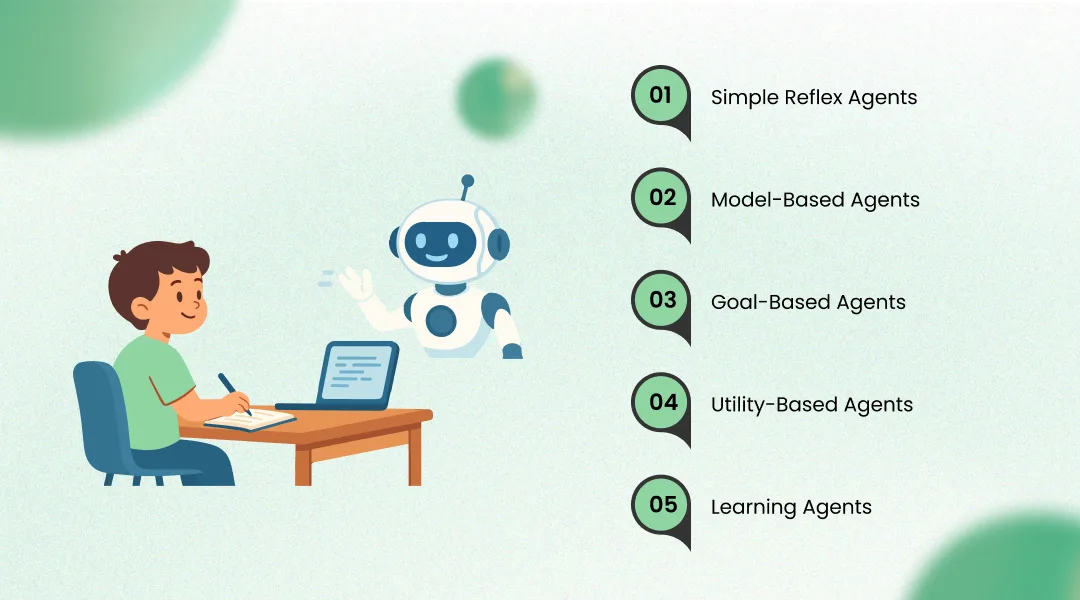
Not all agents are created equal. And this is where most people get it wrong.
React instantly based on rules. No memory. Example: Basic automation scripts.
Maintain an internal state. They “remember” context.
Make decisions based on goals, not just conditions.
Choose the best possible outcome among the options.
They improve over time. This is where things get interesting.
These categories fall under broader intelligent agents in AI, and in 2026, most real systems will be hybrids.
Let’s move from theory to reality.
Because this is where businesses start paying attention.
AI agents handle queries, escalate issues, and resolve tickets.
not just talking, but booking appointments, making calls, and closing loops. We build AI voice agent solutions at KriraAI, and the difference in response time is dramatic.
Netflix-style personalization—but now more proactive.
From logistics routing to fraud detection.
These are real AI agent use cases, not experiments.
This confusion needs to die.
Seriously.
Feature | Chatbots | AI Agents |
Interaction | Reactive | Proactive |
Capability | Answer questions | Perform tasks |
Memory | Limited | Context-aware |
Autonomy | Low | High |
Here’s the blunt truth:
If your “AI” only replies… It’s not an agent.
This is why businesses are shifting toward AI agents for customer support instead of traditional bots.
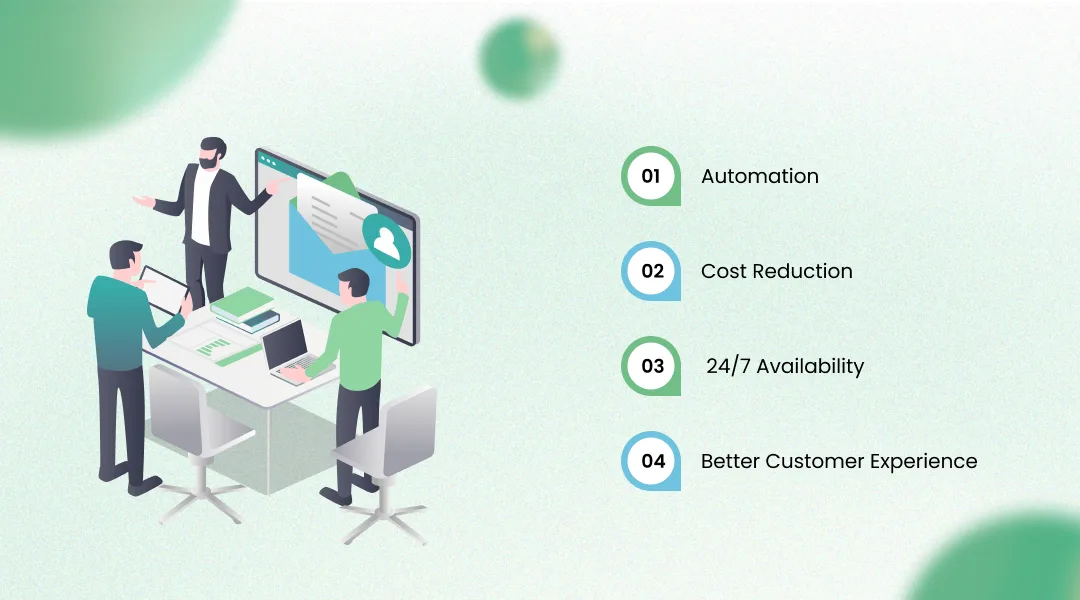
Benefits of AI Agents for Businesses. Let's talk outcomes, not theory — we've broken down the real benefits AI agents bring to businesses in more depth elsewhere.
Tasks that used to take hours? Done in minutes.
Fewer repetitive roles. More strategic focus.
No burnout. No downtime.
Faster responses. Smarter interactions.
But here’s the catch.
If implemented poorly, AI agents can create chaos faster than humans ever could.
(I’ve seen it happen. It’s not pretty.)
This is where things get… interesting.
Multiple agents collaborating. Think digital teams.
Instant decision-making with live data.
Voice is becoming the primary interface.
We’re already seeing growth in AI Voice Agents in Retail and AI Voice Agents in Travel—where speed and personalization matter most.
Autonomous Workflows: entire business processes running with minimal human input. This is part of a larger shift toward AI agents replacing traditional process automation that we cover in detail.
Now the practical question.
“Can I build one?”
Yes. But it depends on your goals.
Good for quick prototypes. Limited flexibility.
More control. Requires technical expertise.
Best for scaling real business solutions.
(This is where most serious companies end up, by the way.)
At KriraAI, we’ve found that businesses trying to shortcut this phase often pay more later fixing broken systems.
Some popular options include:
OpenAI-based systems
LangChain frameworks
AutoGPT-style agents
Enterprise AI platforms
But here’s the truth no one tells you:
The tool matters less than the design.
Bad architecture = bad outcomes. No matter how good the platform is.
Let’s not pretend this is perfect.
AI can make wrong decisions.
Sensitive data needs protection.
No data = no intelligence.
And here’s a tough question:
Are you ready to trust a system that learns on its own?
Because that’s the real decision.
AI agents aren’t hype.
But they’re also not magic.
They’re tools. Powerful ones. If designed correctly.
If not? They become expensive experiments.
I've worked with companies that transformed operations using AI agents for business automation — that's the work we do every day at KriraAI. And others burned budgets chasing trends instead.
The difference?
Clarity. Strategy. Execution.
That’s it.
An AI agent is a system that can make decisions and take actions independently to achieve a goal.
Chatbots respond to queries, while AI agents perform tasks and act autonomously.
They replace repetitive tasks, not human judgment or creativity.
It depends. Simple agents are affordable; complex systems require investment.
Yes, using no-code tools—but scalability may be limited.
Founder & CEO
Divyang Mandani is the CEO of KriraAI, driving innovative AI and IT solutions with a focus on transformative technology, ethical AI, and impactful digital strategies for businesses worldwide.