In today’s hyper-connected digital economy, Machine Learning has become the backbone of intelligent enterprises. Organizations across industries are rapidly adopting machine learning for real-time business automation to process data instantly, optimize workflows, and make faster decisions. Businesses leveraging advanced Machine Learning Services and AI Agents in Machine Learning are no longer dependent on manual processes or delayed insights. Instead, they operate with speed, precision, and adaptability, key factors for sustainable growth in a competitive market.
From automating operational tasks to powering intelligent decision engines, machine learning is redefining how modern businesses function in real time.
Real-time business automation refers to systems that analyze data and trigger actions instantly without human intervention. Unlike traditional automation, which follows static rules, machine learning-driven automation continuously learns from data patterns and improves outcomes over time.
By implementing machine learning-powered business automation solutions, companies can automatically respond to market changes, customer behavior, and operational challenges as they happen. This capability is essential in sectors such as finance, eCommerce, healthcare, logistics, and SaaS, where delays can result in lost revenue or poor user experiences.
Machine learning models enable systems to:
Process streaming data in real time
Identify patterns and anomalies instantly
Trigger automated decisions and actions
Continuously optimize business processes
One of the most powerful applications of machine learning is in real-time machine learning decision-making systems. These systems ingest large volumes of live data, transactions, user interactions, sensor data, or operational metrics, and convert them into actionable insights within milliseconds.
For example:
An eCommerce platform can adjust pricing dynamically based on demand.
A financial institution can detect fraudulent transactions instantly.
A supply chain system can reroute shipments in real time due to disruptions.
Machine learning models are trained on historical and live data, allowing businesses to make smarter, data-driven decisions without waiting for manual analysis.
Intelligent automation using machine learning algorithms goes beyond simple task automation. It combines machine learning, data analytics, and AI to create systems that think, learn, and adapt.
Key capabilities include:
Automated decision workflows
Context-aware process execution
Continuous performance optimization
Self-learning operational systems
Unlike rule-based automation, machine learning algorithms can handle unstructured data such as text, voice, images, and logs. This makes them ideal for automating complex business processes like customer support, quality control, document processing, and compliance monitoring.
Modern enterprises generate massive amounts of data every second. Turning this data into value requires machine learning for smart enterprise decision-making. Machine learning models analyze structured and unstructured data to uncover insights that humans might miss.
These insights help enterprises:
Forecast trends and demand
Optimize resource allocation
Improve customer engagement
Reduce operational risks
By embedding machine learning into enterprise systems such as ERP, CRM, and BI platforms, organizations enable decision-makers to act faster and more accurately.
Predictive analytics has evolved significantly with the introduction of real-time capabilities. Real-time predictive analytics with machine learning allows businesses to anticipate outcomes as events unfold, rather than relying on retrospective reports.
Use cases include:
Predicting customer churn during live interactions
Forecasting equipment failure using IoT data
Identifying sales opportunities in real time
Anticipating supply chain disruptions
Machine learning models continuously update predictions as new data arrives, ensuring decisions are based on the most current information available.
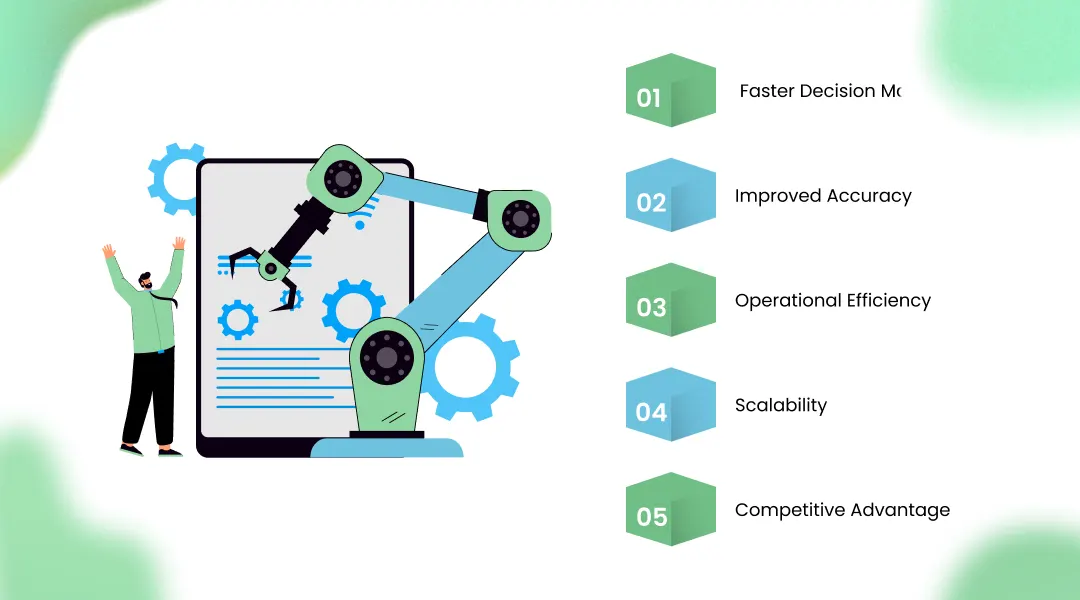
Adopting machine learning-powered business automation solutions delivers measurable benefits across the organization:
Real-time analytics and automated responses eliminate delays, allowing businesses to act instantly.
Machine learning models reduce human errors and improve prediction accuracy over time.
Automation minimizes manual effort, reduces costs, and improves productivity.
Machine learning systems scale easily to handle growing data volumes and business complexity.
Organizations using intelligent automation outperform competitors relying on traditional methods.
AI Agents in Machine Learning play a crucial role in executing real-time decisions. These agents act autonomously within defined environments, continuously observing data, learning from outcomes, and taking actions to achieve specific business goals.
Examples of AI agents include:
Virtual assistants handling customer queries
Fraud detection agents monitoring transactions
Recommendation agents personalizing user experiences
Operational agents optimizing workflows
When integrated with real-time data pipelines, AI agents enable fully autonomous, self-optimizing business systems.
Machine learning models detect fraud, assess credit risk, and automate compliance in real time.
Dynamic pricing, personalized recommendations, and inventory optimization rely on machine learning for real-time business automation.
Real-time patient monitoring, diagnostic support, and operational automation improve outcomes and efficiency.
Predictive maintenance and quality control systems use machine learning algorithms to reduce downtime.
User behavior analysis, churn prediction, and feature optimization are powered by real-time machine learning systems.
To successfully deploy real-time machine learning automation, organizations need robust Machine Learning Services that cover the entire lifecycle, from data preparation to model deployment and monitoring.
Key implementation steps include:
Identifying high-impact automation use cases
Building scalable data pipelines
Selecting appropriate machine learning algorithms
Deploying models for real-time inference
Continuously monitoring and optimizing performance
Partnering with an experienced machine learning development team ensures faster deployment, better accuracy, and long-term scalability.
While machine learning automation offers immense value, businesses must address challenges such as:
Data quality and availability
Model bias and explainability
Integration with legacy systems
Security and compliance
Best practices include:
Using high-quality, diverse datasets
Monitoring models continuously
Ensuring transparency in decision logic
Aligning automation goals with business objectives
As data volumes and computing power continue to grow, machine learning will become even more central to real-time automation. Advances in edge computing, generative AI, and autonomous AI agents will further accelerate intelligent decision-making.
Businesses that invest early in machine learning for smart enterprise decision-making will be better positioned to adapt, innovate, and lead in the digital economy.
Machine learning is no longer a futuristic concept; it is a core driver of real-time business automation and intelligent decision-making today. From real-time machine learning decision-making systems to intelligent automation using machine learning algorithms, organizations are transforming how they operate, compete, and grow.
By leveraging real-time predictive analytics with machine learning and deploying scalable automation solutions, businesses can unlock efficiency, agility, and sustained competitive advantage. The future belongs to enterprises that embrace machine learning as a strategic foundation for real-time, data-driven innovation.
Founder & CEO
Divyang Mandani is the CEO of KriraAI, driving innovative AI and IT solutions with a focus on transformative technology, ethical AI, and impactful digital strategies for businesses worldwide.