User-Centered Thinking
We design around real user tasks rather than adding visual elements without a clear purpose.
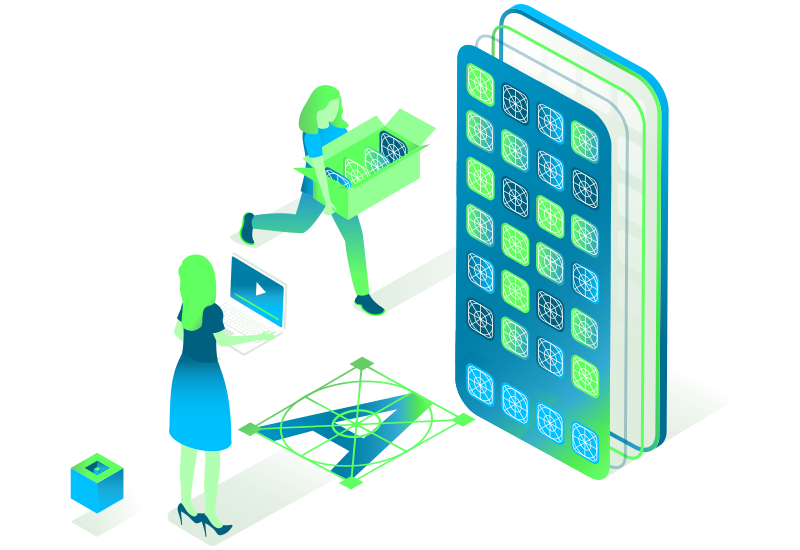
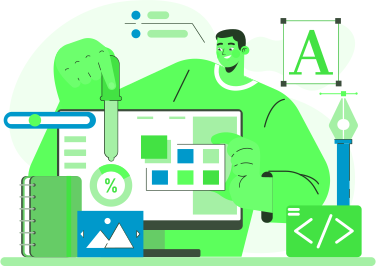
Great digital products are not defined only by how they look. They need clear navigation, intuitive interactions, fast task completion, and a consistent experience across devices. KriraAI provides UI/UX design services for web, mobile, SaaS, and business applications, helping teams turn complex product requirements into simple, usable digital experiences. From early discovery and user flows to wireframes, high-fidelity interfaces, interactive prototypes, usability testing, and developer handoff, our design process connects user needs with business goals.
We design around real user tasks rather than adding visual elements without a clear purpose.
A good user experience should also support measurable business objectives such as adoption, engagement, retention, or conversion.
Because UI/UX connects directly with development, understanding technical constraints helps us create designs that are practical to implement.
We build reusable UI patterns that can evolve as your product adds screens, features, users, and workflows.
Our design approach can support web products, mobile applications, SaaS platforms, dashboards, and other digital interfaces.
Regular feedback cycles help align product owners, designers, developers, and stakeholders throughout the project.
We design around real user tasks rather than adding visual elements without a clear purpose.


We were mainly concerned about AI accuracy for our use case. After testing, the solution achieved around 98% accuracy on our evaluated workflow. KriraAI also worked closely with us during testing and fine-tuning, which made a big difference.
Prashant Gupta
Working with KriraAI from another country was surprisingly smooth. The team communicated clearly, understood our requirements without too much back and forth, and was comfortable working across time zones. The quality of the AI development was exactly what we were looking for.
Alexander Weber
The technical knowledge of the KriraAI team was probably the best part of the project. We could discuss AI models, APIs, data, architecture, integrations, and deployment with the same team. They were able to explain technical decisions clearly without making things unnecessarily complicated.
Rohan Shah
KriraAI delivered a custom AI solution that matched our business requirements well. From AI architecture and development to integration and deployment, the team handled the project professionally. We particularly appreciated their focus on reliability, scalability, and making the technology useful for our actual business.
William Harris
I'll be honest, I wasn't sure any team could really handle the technical complexity of our customer support workflow. KriraAI proved me wrong. They took the time to understand our process, built a solution that fit our actual needs, and tested it thoroughly before going live. The result was about a 30% improvement in processing time, but what impressed me more was how accurate and reliable it was from day one. My concerns about technical skill turned out to be completely unfounded.
Roshan Patel
A UI/UX design company researches user needs, plans product structure and user flows, designs interfaces, creates prototypes, validates usability, and prepares designs for development.
UX focuses on how a product works and how users complete tasks. UI focuses on the visual interface, including layouts, typography, components, colors, and interaction states.
Yes. A redesign can start with an assessment of the existing interface, user journeys, navigation, usability issues, and business requirements before creating an improved experience.
Yes. UI/UX design can cover responsive websites, web applications, SaaS products, dashboards, and mobile applications.
Depending on the project, the handoff can include organized design files, components, responsive states, assets, design specifications, interaction guidance, and supporting documentation.
UI/UX work should begin before development so user flows, information architecture, and important interactions can be validated before engineering effort is committed.
Yes. The design workflow can include collaboration with your developers, product managers, and internal stakeholders to make sure the final designs are practical to implement.