I'm going to tell you something that might annoy you: most articles about machine learning in business are written by people who've never actually implemented it.
I have. Fifteen times, to be exact. And I've learned more from the three projects that spectacularly failed than from the twelve that succeeded.
My name is Hit, and I'm a Senior Machine Learning Strategist at KriraAI. I've spent the last eight years in the trenches, building predictive models for a Mumbai retailer that cut their overstock by 34%, designing a churn prevention system that saved a SaaS company $2.1M annually, and (less glamorously) watching a $400K ML project collapse because nobody bothered to check if the training data was any good.
So when I talk about the future of machine learning in business applications, I'm not speculating. I'm reporting from the front lines.
Let me strip away the mystique.
Machine learning is pattern recognition on steroids. That's it. You feed a system historical data, it identifies patterns humans can't see (or would take years to find), and then it makes predictions or decisions based on those patterns.
When someone says "we're using ML for customer segmentation," they mean: We're letting the computer find the hidden patterns in our customer data that reveal who's likely to buy, churn, or upgrade.
It's not magic. It's math. Very, very fast math.
Here's where machine learning for business growth is already happening - right now, in companies you've heard of and dozens you haven't.
Netflix doesn't guess what you want to watch. It knows. That recommendation engine processes 3 billion data points daily to predict your next binge with eerie accuracy.
But you don't need Netflix's budget. I helped a mid-sized e-commerce client implement a basic product recommendation system for $18K. It increased their average order value by 23% in four months.
One of my manufacturing clients used to order raw materials based on "gut feel plus last year's numbers." Their warehouse was either overflowing or empty.
We built a demand forecasting model using three years of sales data, seasonal trends, and external factors like local events and weather. First-quarter forecast accuracy jumped from 64% to 91%. Their CFO cried.
This is how machine learning is used in business: taking decisions you currently make with intuition and giving them a data backbone.
Banks and fintech companies have been early adopters here, because fraud costs them billions. ML models can analyze thousands of transaction variables in milliseconds and flag anomalies that human analysts would miss.
But here's the part nobody tells you: these systems also generate false positives. I've seen fraud detection models so aggressive they blocked 15% of legitimate transactions. The algorithm was "accurate," but the business outcome was a disaster.
Marketing teams are drowning in data and starving for insights. ML can segment audiences, predict campaign performance, optimize ad spend, and personalize email content at scale.
I watched a B2B company use predictive lead scoring to prioritize their sales pipeline. Their close rate increased 41% because reps stopped wasting time on leads that were never going to convert.
This is where machine learning use cases in business get unglamorous but incredibly valuable. Route optimization. Predictive maintenance. Inventory management. Energy consumption forecasting.
A logistics client saved $340K annually by using ML to optimize delivery routes. Not sexy. Very profitable.
Now let's talk about where this is all headed. Because the future isn't distant, it's already arriving in boardrooms across India and beyond.
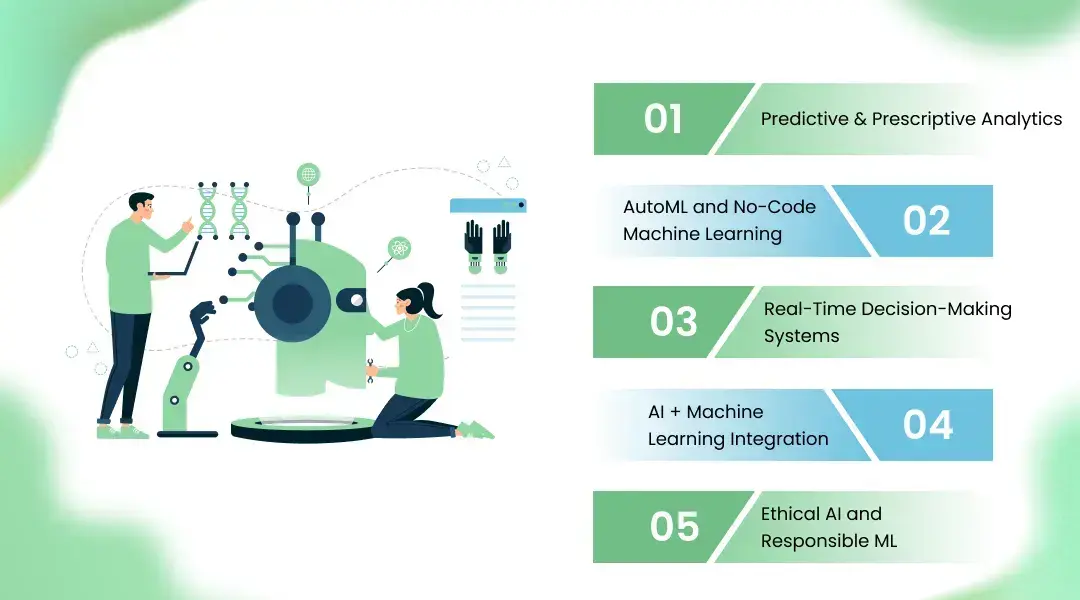
Predictive analytics tells you what will happen. Prescriptive analytics tells you what to do about it.
The next wave of machine learning solutions for enterprises won't just forecast that customer churn will spike next quarter, they'll automatically recommend the three retention strategies most likely to work, ranked by ROI.
Here's a controversial opinion: most businesses don't need a PhD data scientist.
AutoML platforms are democratizing ML by automating model selection, feature engineering, and hyperparameter tuning. Google's AutoML, H2O.ai, DataRobot, these tools let business analysts build functional models without writing code.
Does this mean data scientists are obsolete? No. But it does mean the barrier to entry is collapsing.
Batch processing is dying. Real-time is everything.
Modern ML systems can ingest data, update models, and make decisions in milliseconds. Dynamic pricing for e-commerce. Real-time credit approvals. Instant fraud detection.
I recently worked on a real-time recommendation engine for a media company. The old batch system updated recommendations once daily. The new system? Every 30 seconds. Engagement increased 28%.
Machine learning for decision making is increasingly being paired with generative AI for content, reasoning, and interaction.
Think: an ML model predicts which customers are at risk of churning, and a generative AI system automatically drafts personalized retention emails based on each customer's history and preferences.
We're moving from "smart systems" to "systems that can explain their own smartness."
This isn't just a buzzword. It's a legal and reputational necessity.
Businesses are waking up to algorithmic bias, explainability requirements, and data privacy regulations. The EU's AI Act is coming. India's Digital Personal Data Protection Act is here.
If your ML system can't explain why it made a decision, you're building a liability, not an asset.
Let me put on my futurist hat, but I promise to keep it grounded.
We're moving toward self-optimizing systems. Imagine: your supply chain automatically adjusts procurement based on predicted demand, your pricing engine continuously tests and optimizes without human intervention, your customer service system resolves 80% of issues before a human ever sees them.
Not science fiction. Early versions exist today.
Every customer will experience your business differently, because ML will tailor every touchpoint to their behavior, preferences, and context.
Website content that changes based on who's viewing it. Product catalogs that rearrange themselves. Chatbots that remember your last five interactions and adjust their tone accordingly.
This is where AI Agents in Machine Learning get fascinating.
We're not talking about dumb chatbots that follow decision trees. We're talking about autonomous agents that can book meetings, negotiate with vendors, troubleshoot technical issues, and learn from every interaction.
A Machine Learning Services Company like KriraAI is already building these for clients, virtual assistants that don't just respond, but anticipate.
Airlines have been doing dynamic pricing for decades. Now every business can.
ML models that analyze competitor pricing, demand elasticity, inventory levels, customer segments, and market conditions, then adjust prices in real-time to maximize revenue.
I've seen hotels, e-commerce platforms, and SaaS companies increase revenue 15-30% with intelligent pricing alone.
The ultimate goal: systems that improve themselves without human intervention.
Marketing campaigns that automatically A/B test and optimize. Supply chains that learn from disruptions. Customer service workflows that continuously refine themselves based on resolution rates.
We're not there yet. But we're closer than you think.
Let me be blunt about the benefits of machine learning for businesses—because the generic lists you've read elsewhere are useless.
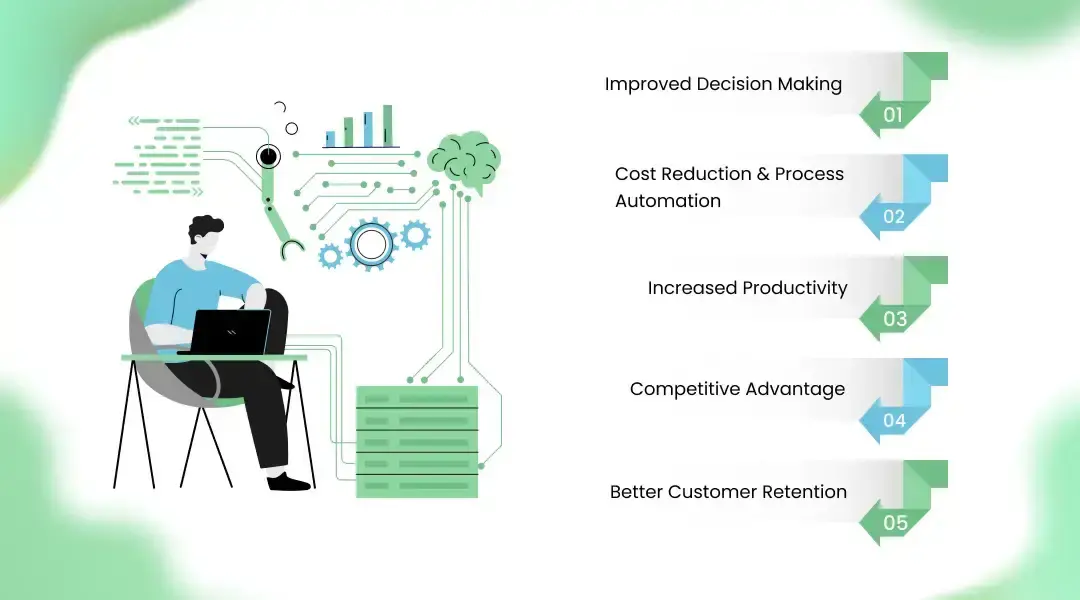
ML doesn't replace human judgment. It augments it. You still make the final call—but now you're making it with 10x more information and 100x less bias.
Every hour your team spends on manual data entry, reporting, or repetitive analysis is an hour they're not spending on strategy.
One client automated their invoice processing with ML. What used to take their AP team 40 hours weekly now takes 4 hours. That's not just cost savings, it's talent redeployment.
ML handles the grunt work. Your people handle creative problem-solving.
Here's the uncomfortable truth: your competitors are already exploring this. The question isn't if you'll adopt ML. It's when and whether you'll be a leader or a laggard.
Acquiring a new customer costs 5-7x more than retaining an existing one. ML-powered retention strategies (churn prediction, personalized engagement, proactive support) directly impact your bottom line.
Now for the part most consultants skip: where this goes wrong.
Garbage in, garbage out. This is the #1 killer of ML projects.
I've seen companies with terabytes of data and none of it usable. Inconsistent formats, missing values, duplicates, errors. Your ML model is only as good as your data hygiene.
Finding ML talent is expensive and competitive. The average ML engineer in India commands ₹15-30 lakhs annually. Senior practitioners? Double that.
Most mid-sized businesses can't afford in-house teams. (This is where partnering with a Machine Learning Services Company becomes strategic.)
Your shiny new ML model is useless if it can't talk to your CRM, ERP, or analytics stack.
Integration is where timelines explode and budgets balloon. Plan for this upfront.
ML projects can range from ₹5 lakhs for a simple pilot to ₹50+ lakhs for enterprise-grade systems.
Here's my advice: start small, prove ROI, then scale. Don't bet the farm on your first ML initiative.
Enough theory. Here's your action plan.
Technology is the easy part. Culture is the hard part.
If your leadership team doesn't trust data-driven decisions, if your employees resist change, if your organization rewards gut feel over evidence, no ML system will save you.
Start small: implement dashboards, track KPIs, make decisions transparently.
Not every problem needs ML. Some problems need better processes, not better algorithms.
Ask yourself: Is this a pattern recognition problem? Do I have historical data? Will the prediction create business value?
If the answer to all three isn't "yes," ML probably isn't the answer.
Unless you're Google or Amazon, you probably shouldn't build ML expertise from scratch.
Partner with specialists who've done this before. Look for companies (like KriraAI) that focus on Machine learning Services with proven case studies, transparent pricing, and a track record of projects that actually shipped.
Red flags: anyone promising "AI transformation" without asking detailed questions about your data, processes, and goals.
Pilot projects. MVPs. Proof of concepts.
I've seen too many businesses commit to 18-month ML roadmaps before validating a single hypothesis.
Instead: pick one high-impact use case, build an MVP in 8-12 weeks, measure results, then decide whether to scale, pivot, or kill it.
Fail fast. Learn faster.
The future of machine learning in business applications isn't about sentient robots or digital overlords. It's about businesses making smarter decisions, faster and at scale.
It's about a retailer predicting demand so accurately they never run out of bestsellers or get stuck with dead inventory. It's about a service company identifying at-risk customers before they churn. It's about a manufacturer scheduling maintenance before equipment fails, not after.
But here's what I need you to understand: ML is a tool, not a religion. It won't solve bad strategy, broken processes, or poor leadership. It will, however, amplify whatever you're already doing, good or bad.
So before you chase the next shiny algorithm, ask yourself: Do I have the data, the culture, and the patience to do this right?
If the answer is yes, the opportunity is massive. If you're ready to explore how Machine learning Services can transform your specific business challenges into competitive advantages, we should talk.
Because the future isn't about who has the best technology. It's about who deploys it most effectively.
Machine learning in business applications refers to using algorithms that learn from data to automate decisions, predict outcomes, and optimize processes - like forecasting sales, personalizing customer experiences, or detecting fraud.
Costs vary widely based on complexity. A simple pilot project might cost ₹5-10 lakhs, while enterprise-grade solutions can range from ₹20-50+ lakhs. Starting with a focused MVP is the smartest financial approach.
The top use cases include customer segmentation and personalization, sales forecasting, fraud detection, predictive maintenance, churn prediction, dynamic pricing, and marketing automation.
Not necessarily. Many businesses partner with specialized ML service providers or use AutoML platforms that require less technical expertise. The key is having clean data and clear business objectives.
With a well-scoped pilot project, you can see measurable results in 3-6 months. However, building mature ML capabilities is a multi-year journey. Start with quick wins, then build from there.
Founder & CEO
Divyang Mandani is the CEO of KriraAI, driving innovative AI and IT solutions with a focus on transformative technology, ethical AI, and impactful digital strategies for businesses worldwide.