Three months into a project, a founder once told me:
"We automated everything… but nothing really changed."
That sentence stuck with me.
Because it reveals a hard truth, most businesses don’t fail at AI because of technology. They fail because they don’t understand how to implement it properly.
If you're weighing this decision, working with AI consultancy services early can save you from the exact mistake that opens this article: automating without a real problem to solve. Wondering if this is worth your time or just another expensive experiment.
Good. That’s the right mindset.
Let me walk you through what actually works.
Let’s keep this simple.
AI solutions for business are systems that help your company make decisions, automate tasks, or improve outcomes using data.
Not magic. Not robots taking over your office.
Just smarter systems doing specific jobs better.
Machine Learning Systems that learn from data. Example: predicting which customers might leave.
Natural Language Processing (NLP) is the understanding of human language. Think chatbots or email automation.
Computer Vision: Understanding images and videos. Used in quality checks, security, and healthcare.
AI automation replaces repetitive manual work. Invoices, support tickets, internal workflows.
Let me be blunt.
AI is no longer optional.
Not because it’s trendy, but because your competitors are quietly using it already.
Market pressure: Faster companies are winning.
Customer expectations: This is especially visible with retail businesses adopting AI, where instant responses and personalization now shape whether a customer buys or bounces.
Operational inefficiencies: Manual work is too slow. Too expensive.
Cost reduction
Faster decision-making
Better customer experience
But here’s the catch…
AI doesn’t fix broken processes. It amplifies them.
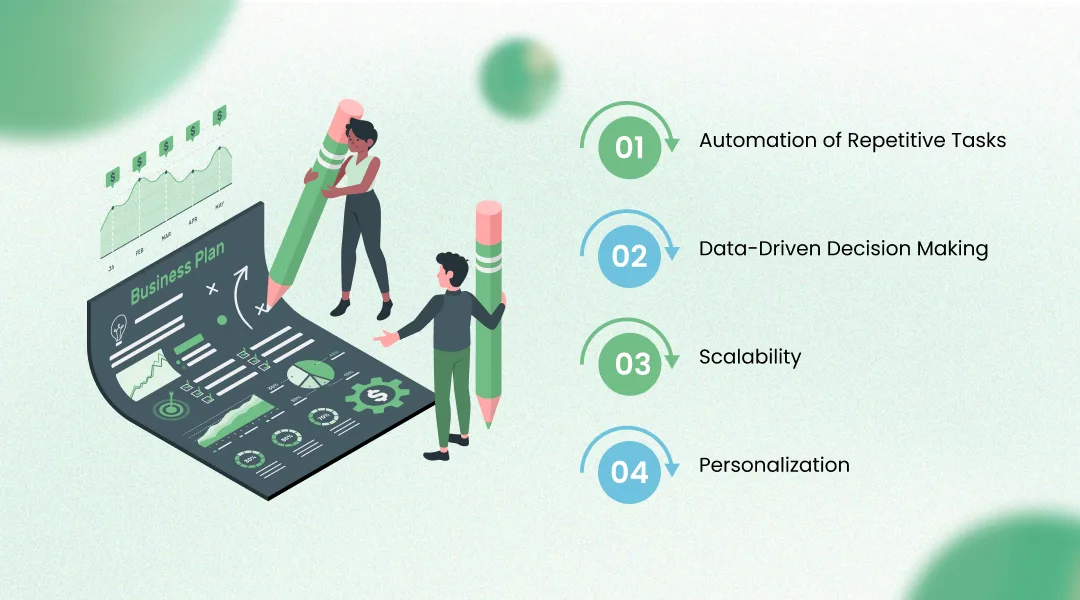
Let’s cut through the noise and talk about actual outcomes.
You don’t need humans copying data between spreadsheets anymore.
No more guessing. You start seeing patterns.
Your operations grow without hiring at the same pace.
Customers don’t feel like “users.” They feel understood.
Now, quick question:
Are you trying to grow your business… or just manage chaos more efficiently?
Because AI helps with both, but the approach is very different.
This is where most articles get vague.
I won’t.
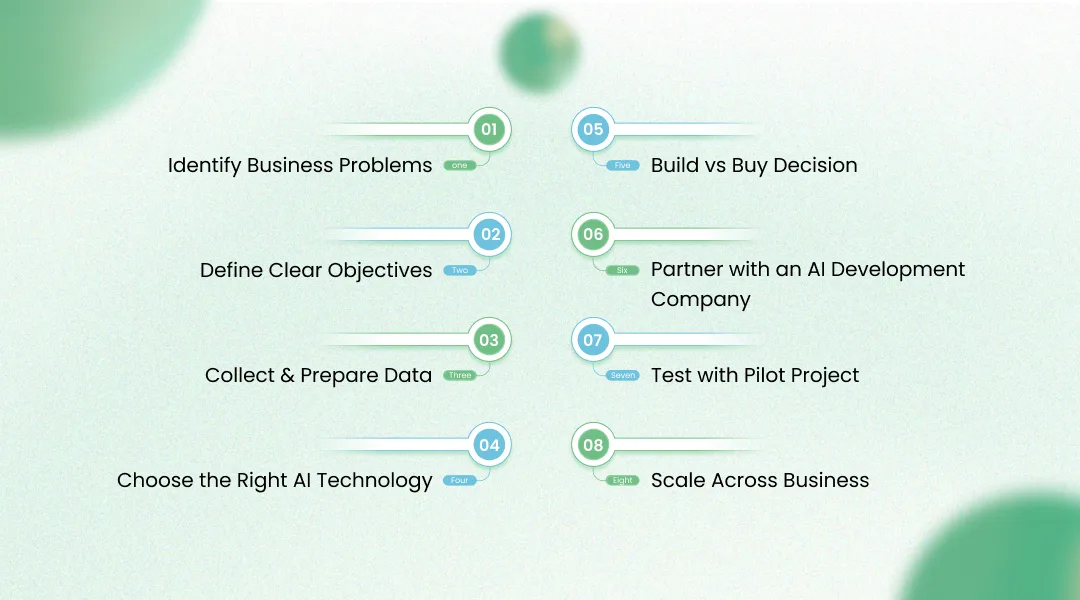
This is the exact framework I’ve used across projects.
Start here. Always.
That question matters even more if you're trying to implement AI without a large tech team, since the smallest, cheapest fix is usually the right starting point, not the most ambitious one.
Customer response delays?
High operational costs?
Poor forecasting?
AI is the solution, not the starting point.
What does success look like?
Reduce support costs by 30%
Increase lead conversion by 20%
If you can’t measure it, you can’t improve it.
No data = no AI.
And bad data?
Even worse.
You need:
Clean
Relevant
Structured data
(Yes, this is the boring part. It’s also the most important.)
Don’t overcomplicate.
Need predictions? → Machine Learning
Need conversations? → NLP
Need automation? → AI workflows
Simple mapping. Big difference.
This is where budgets get wasted.
Buy if your problem is common (chatbots, CRM automation)
Build if your problem is unique
Custom AI solutions give control but require expertise.
This step can make or break everything.
A good partner won’t sell you AI.
They’ll challenge your assumptions first.
(At KriraAI, we’ve turned down projects because the problem wasn’t clear. That’s not arrogance; it’s responsibility.)
If you're searching for the Best AI development Company, don’t look for promises. Look for clarity.
Never go all-in immediately.
Start small:
One department
One use case
Validate results.
Once it works?
Expand.
But carefully.
AI implementation is not a one-time task. It’s an evolving system.
For a deeper look at the uncomfortable part, our breakdown of common AI development challenges covers the data, monitoring, and team-structure issues that quietly derail most projects.
Garbage in. Garbage out.
Jumping into AI without a plan.
People assume it’s either cheap or insanely expensive.
It’s neither. It depends.
Teams don’t trust new systems.
And honestly?
That’s fair.
Because bad implementations break trust fast.
This is the question everyone asks.
“How much will it cost?”
Here’s the honest answer:
It depends on three things:
Complexity of the problem
Data availability
Customization level
Small solutions: ₹2L – ₹10L
Mid-scale systems: ₹10L – ₹50L
Enterprise-grade: ₹50L+
But cost alone is the wrong question.
Ask this instead:
“What will it save or generate over time?”
Because good AI pays for itself.
I’ve seen companies burn money here.
Don’t.
Experience: Real projects. Not just demos.
Industry understanding: Your business is not generic.
Custom approach: Avoid one-size-fits-all solutions.
Post-deployment support: AI needs maintenance and improvement.
If a company jumps straight to pricing…
Walk away.
AI isn’t complicated.
But implementing it correctly? That’s where things get real.
You don’t need to understand algorithms.
At KriraAI, that's the conversation we start every project with:h understanding the business problem before touching a single model.
Everything else follows.
And if you take one thing from this article, let it be this:
Start small. Stay clear. Think long-term.
That’s how AI actually works in the real world.
Start by identifying business problems, define goals, prepare data, choose the right technology, test with a pilot, and scale gradually.
Yes, especially for automation and cost reduction. Even small implementations can deliver strong ROI when focused on specific problems.
Costs vary from ₹2L to ₹50L+ depending on complexity, data, and customization needs.
Buy for common needs. Build custom AI solutions for unique business challenges.
Look for experience, industry knowledge, custom solutions, and long-term support, not just pricing.
Founder & CEO
Divyang Mandani is the CEO of KriraAI, driving innovative AI and IT solutions with a focus on transformative technology, ethical AI, and impactful digital strategies for businesses worldwide.