I’ve spent nine years inside the messy, fascinating world of AI development for business. And here’s something I’ll admit upfront: AI isn’t difficult because of algorithms. It’s difficult because of expectations. Most founders walk in imagining a magic button. Most CTOs walk in imagining instant transformation. And most teams walk in thinking AI will fix broken processes without fixing the processes first.
If you’re feeling a bit lost about where to start or worse, afraid of choosing the wrong direction - you’re not alone. I’ve watched companies burn money on models that never made it past the demo stage. I’ve helped others correct the damage from overconfident vendors. And yes, I’ve rescued more AI projects than I’ve built from scratch.
So let’s talk honestly about the real challenges in AI development for business and the best practices that keep projects alive.
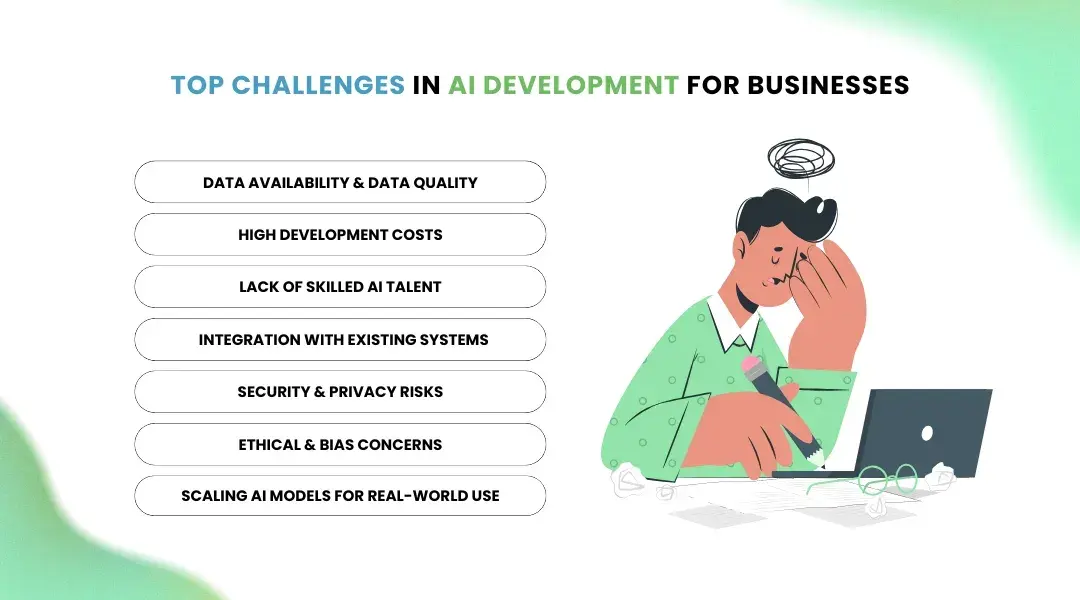
Ask me the number one reason AI development for business fails? Data chaos. Not bad models. Bad data. Missing fields. Contradictory records. Outdated logs. I’ve seen companies with strong AI strategy on paper collapse under weak data foundations.
This is where data challenges in AI show up aggressively. Without reliable data, even the smartest system will behave like a confused intern.
People often ask, “How much does a custom AI model cost?” My honest answer: It depends on the ambition. AI development for business takes skilled engineers, cloud resources, experimentation cycles, and continuous tuning. This is exactly why cost challenges in AI projects become one of the biggest barriers for founders.
You can’t build Intelligent automation with a generic dev team. You need ML engineers, data scientists, MLOps specialists, domain experts, and product thinkers. Finding these people? A challenge in itself. That’s why companies often decide to Hire AI Developer externally rather than build an internal unit from scratch.
Here’s a truth no one likes to say out loud: AI isn’t the hard part. Integration is.
ERP systems from 2013. CRMs no one updated. Custom-built software with zero documentation.
The moment you try connecting AI to these ecosystems, AI integration challenges emerge like cracks in a wall.
Any AI development process that deals with customer data invites risk. Data leaks. Unauthorized access. Compliance pressure. I spend a considerable amount of time designing systems that respect privacy instead of abusing convenience.
This is one area companies underestimate until something embarrassing happens. If your training data is biased, your model will be biased. And once that reaches users? You’re in damage-control mode. These ethical challenges in AI aren’t academic—they’re reputational.
A model working on a laptop is cute. A model working across thousands of users? That’s engineering. This is where scalable AI systems separate serious companies from hobby projects.
Let me be blunt. These are the usual killers:
Overconfidence in early prototypes
Zero clarity on business goals
Assuming AI can “figure it out”
Ignoring the AI development lifecycle
No monitoring or post-deployment ownership
Building everything at once instead of iterating
Outsourcing without internal alignment
Ever seen a model that technically works but delivers zero value? That happens when AI development for business becomes an academic exercise instead of a commercial one.
Don’t start with “We need AI.” Start with “We need to reduce support time by 40%,” or “We need to predict demand more accurately.” AI development best practices begin with boring clarity.
This includes collection, preprocessing, quality checks, and governance. If the data is shaky, everything else is shaky.
Your goal is not to chase trends. Your goal is to choose tools that support your AI project management efficiently.
Small experiments reduce risk and cost. Every iteration reveals hidden AI implementation challenges.
Machines don’t understand context. People do. This is how you avoid embarrassing bias issues.
Think of AI as a living system. You don’t build it once. You maintain it. Monitoring is what keeps AI development solutions relevant in real environments.
The moment a model succeeds, everyone wants it everywhere. Design for that day.
Define the gap. The opportunity. The measurable outcome.
Where is your data? Who owns it? What shape is it in?
Experimentation. Model selection. Feature engineering. This is where your team earns its salary.
Transitioning from notebooks to production-grade systems. This is where AI integration challenges scream the loudest.
No monitoring? No value. Simple.
AI development for business isn’t a mystery. It’s a craft. A craft built on discipline, clarity, and continuous refinement.
If you understand the challenges in AI development, follow the best practices for AI projects, and approach everything iteratively, your chances of success multiply.
AI isn’t here to replace your team, it’s here to strengthen them. And done right, it becomes a long-term competitive advantage instead of a short-term experiment.
Poor data quality, high costs, integration issues, and unclear goals are the most common barriers.
Costs vary based on complexity, data volume, and automation needs, typically ranging from moderate to high investment.
Most failures come from unclear expectations, weak data strategy, and skipping steps in the AI development lifecycle.
Start with a clear problem statement and build a strong data foundation before developing the model.
If you have repetitive tasks, large data volumes, or slow decision processes, AI can create measurable improvement.
Founder & CEO
Divyang Mandani is the CEO of KriraAI, driving innovative AI and IT solutions with a focus on transformative technology, ethical AI, and impactful digital strategies for businesses worldwide.