I’ve walked into too many boardrooms where someone says, “We want AI.”
And when I ask, “What kind?”
Silence.
Then comes the real question hiding underneath:
Fair question.
As a Senior AI Solutions Architect at KriraAI, I’ve led over 25 deep learning implementations. Some succeeded brilliantly. A few failed hard (we learned fast). What I’ve seen repeatedly is this:
Deep learning isn’t hype. It’s a capability shift.
Let me show you why.
So, what is deep learning in AI?
At its core, deep learning is a subset of machine learning that uses multi-layered neural networks in artificial intelligence to learn patterns from massive amounts of data. Instead of being programmed with rules, the system learns representations automatically.
Not manually. Automatically.
The importance of deep learning in AI lies in this ability to extract complex patterns without human feature engineering. That’s what changed everything.
In traditional ML, engineers define features. “Look for this pattern.” “Measure that signal.” It’s structured. Controlled.
Deep learning vs machine learning becomes clear when data grows messy. Images. Voice. Natural language. Behavioral data.
Traditional ML struggles.
Deep learning algorithms adapt. They learn hierarchies of patterns.
And yes, it demands more data. More compute. More patience.
But when it works? The accuracy jump is real.
Neural networks in artificial intelligence mimic, loosely, the layered structure of the human brain.
Input layer. Hidden layers. Output layer.
Each layer refines the signal. Each pass adjusts weights. Tiny corrections. Millions of them.
And suddenly the model can recognize tumors. Detect fraud. Predict churn.
That’s not magic. It’s math. And data. Lots of data.
Early AI was rule-based. If X, then Y. Hard-coded logic.
It was brittle.
The role of deep learning in AI changed the trajectory. Instead of programming rules, we let systems learn patterns directly from data.
I remember deploying a fraud detection system for a fintech client. Their old rule-based system caught 62% of fraudulent cases. After implementing a deep learning model development service, detection jumped to 89%.
Same business. Same customers. Better intelligence.
That’s evolution.
Face recognition. Speech-to-text. Language translation. Autonomous navigation.
These deep learning applications in AI weren’t feasible at scale with older approaches.
Because deep learning and artificial intelligence together enable perception — not just calculation.
And perception is what makes AI feel “smart.”
Let’s address the real question:
How does deep learning improve AI model accuracy in real business environments?
How deep learning improves AI accuracy comes down to layered feature learning.
Instead of relying on predefined signals, the model discovers subtle relationships.
In an e-commerce recommendation engine we built, switching to deep learning improved conversion lift by 14%. Why? It detected nonlinear behavior patterns traditional models ignored.
Small edge. Big revenue.
Deep learning solutions for business shine when data explodes.
Clickstreams. Images. IoT sensors.
Humans can’t engineer that complexity manually. Deep learning algorithms can process millions of variables simultaneously.
Pattern recognition at scale. That’s the difference.
Big data isn’t useful if your models can’t absorb it.
Deep learning thrives on volume. The more relevant data, the better the representations.
But here’s the uncomfortable truth: garbage in, garbage out.
We’ve rejected projects where clients wanted AI model performance improvement without fixing data pipelines first. Data quality in AI matters more than the model architecture.
Always.
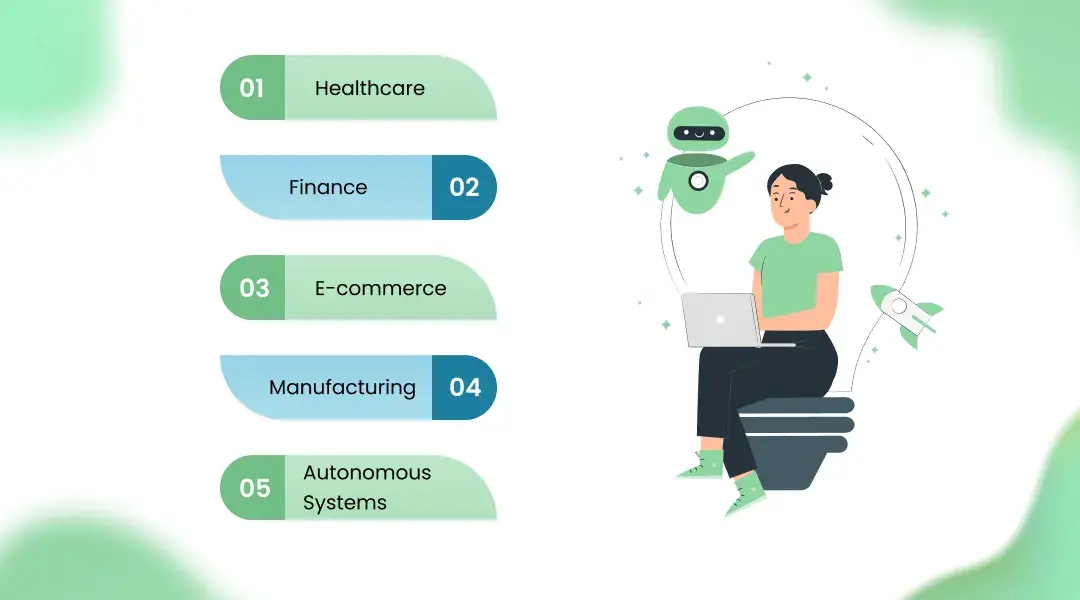
Let’s ground this.
Medical imaging diagnostics. Disease prediction. Treatment personalization.
We implemented deep learning examples in business within a diagnostic imaging startup, reducing manual review time by 37%.
Fraud detection. Credit scoring. Algorithmic trading.
Deep learning applications in AI here focus on anomaly detection and risk modeling.
Recommendation systems. Visual search. Demand forecasting.
Personalization becomes granular. Behavior-driven. Dynamic.
Predictive maintenance. Quality inspection via computer vision.
Downtime drops. Margins improve.
Self-driving vehicles. Smart drones. Robotics.
Without deep learning in artificial intelligence, autonomy at scale simply doesn’t happen.
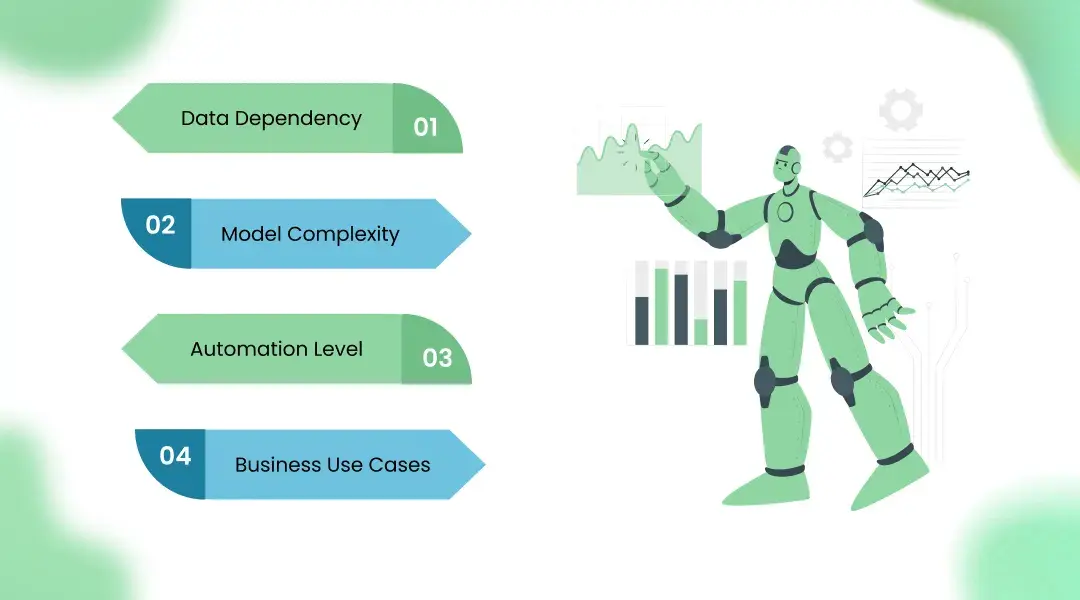
Deep learning vs machine learning boils down to one thing: data appetite.
Deep learning requires large datasets. Machine learning can function with less.
Deep models are computationally intensive. Multiple layers. Millions of parameters.
ML models are simpler. Faster to train.
Deep learning automates feature extraction.
Machine learning often depends on human-crafted features.
For structured data and smaller problems? Traditional ML is fine.
For perception tasks, large-scale prediction, or AI-driven products? Deep learning wins.
Is deep learning better than machine learning for startups?
Not always. It depends on data maturity and business goals. I’ve advised startups to begin with simpler models before scaling.
Strategy over ego.
The benefits of deep learning in AI include predictive accuracy that directly informs strategy.
Forecasting. Risk modeling. Customer insights.
Automation improves operational efficiency.
We deployed a deep learning service in a logistics firm that reduced manual routing errors by 22%.
Less human correction. Lower cost.
Behavioral modeling enables tailored experiences for millions simultaneously.
The future of deep learning in AI belongs to companies that integrate it into products, not just dashboards.
Products that learn. Adapt. Improve.
Let’s not pretend it’s easy.
Poor labeling. Biased samples. Missing values.
Deep learning magnifies data flaws.
GPUs. Cloud costs. Infrastructure planning.
You need budget alignment.
Deep networks can be black boxes.
Executives ask: “Why did the model decide this?”
Fair question. Explainability tools are improving, but transparency remains a challenge.
If you're searching for an AI development company, here’s what I tell every founder:
Look for proven deep learning model development services across industries.
Not just prototypes. Production deployments.
Do they audit your data first? Or jump to modeling?
If they skip data strategy, walk away.
Deep learning examples in business should match your domain.
Healthcare isn’t fintech. Context matters.
Ask about maintenance. Monitoring. Retraining pipelines.
At KriraAI, we position ourselves not just as an AI development services provider, but as a long-term partner. Many clients consider us their Best AI development Company because we focus on practical deployment, not flashy demos.
And yes, our Deep Learning Service is built around measurable business KPIs.
That’s the difference.
Deep learning and artificial intelligence together represent a structural shift in how machines learn.
The importance of deep learning in AI is not theoretical. It’s measurable - in accuracy, automation, and product intelligence.
But it’s not for everyone. It requires data maturity. Strategic clarity. The right partner.
The question isn’t “Should we use deep learning?”
It’s this:
Are we ready for systems that learn faster than we can manually optimize?
If the answer is yes - do it properly.
Deep learning is a subset of AI that uses multi-layer neural networks to automatically learn patterns from large datasets without manual feature engineering.
By learning layered representations of data, deep learning captures complex patterns traditional models miss, leading to stronger predictive performance.
Healthcare, finance, e-commerce, manufacturing, and autonomous systems see significant impact due to large-scale data processing needs.
Not always. Startups with limited data may begin with simpler models before transitioning to deep learning.
Evaluate technical expertise, data strategy, industry experience, and long-term scalability planning.
Founder & CEO
Divyang Mandani is the CEO of KriraAI, driving innovative AI and IT solutions with a focus on transformative technology, ethical AI, and impactful digital strategies for businesses worldwide.
