I’ve lost count of how many meetings start the same way.
A founder leans forward and says, “We want to use deep learning.” I ask, “For what problem?” Silence. Then buzzwords.
That moment tells me everything.
Deep learning technology is everywhere in AI conversations, but rarely understood. Not really. Not at the level where it turns into business impact instead of an expensive science project.
I’ve built these systems. I’ve broken them. I’ve watched them outperform humans and I’ve watched them quietly drain budgets when used for the wrong reason.
So let’s slow down. Strip away the noise. And talk honestly about how deep learning in artificial intelligence actually works, why it matters, and when it’s worth your time.
If you’re asking what deep learning technology, here’s the clearest explanation I know.
Deep learning is a specialized subset within broader machine learning development services that teaches computers to learn patterns the way humans roughly do by stacking layers of understanding.
Not rules. Not “if-this-then-that” logic. Patterns.
At its core, deep learning technology in AI uses large neural networks to process massive amounts of data and gradually improve accuracy through exposure and feedback.
Think less “programming” and more “training.”
That difference changes everything.
A neural network is inspired by the human brain, but only loosely. No magic here.
It’s a structure of connected nodes that process inputs, apply weights, and pass signals forward. Each layer refines the signal. Each mistake adjusts the weights.
Simple idea. Brutally complex execution.
And when you stack many layers together, you get deep learning models capable of recognizing speech, understanding language, or identifying objects in images.
Here’s the part most sales decks skip.
Deep learning algorithms don’t “understand” anything. They correlate. Repeatedly. At scale.
The learning process depends on:
Data quality
Data volume
Feedback loops
Time
Miss one of those, and your model behaves confidently wrong. (Which is worse than being uncertain, by the way.)
I’ve seen models trained on biased data make decisions that looked accurate in testing and collapsed in the real world.
That’s not an edge case. That’s normal if you’re careless.
This distinction isn’t academic. It affects budgets, timelines, and risk.
Traditional machine learning:
Works well with structured data
Requires feature engineering
Trains faster
Is easier to explain
Deep learning:
Excels with unstructured data
Learns features automatically
Requires more data and compute
Trades explainability for performance
If your problem doesn’t involve images, speech, language, or complex patterns, deep learning might be overkill.
Yes. I said it.
Convolutional Neural Networks are the backbone of deep learning in computer vision.
They excel at:
Image classification
Object detection
Medical imaging analysis
I’ve used CNNs in healthcare systems where identifying a visual anomaly mattered more than speed. Accuracy wasn’t optional. Lives were involved.
Recurrent models handle sequences time, order, context.
They power:
Forecasting systems
Behavior analysis
Time-series predictions
They were once dominant. Now? Often replaced.
Transformers changed everything.
They handle context better. Scale better. Learn relationships across long sequences. They’re the foundation of modern NLP and generative systems.
If you’re exploring deep learning in natural language processing today, transformers are unavoidable.
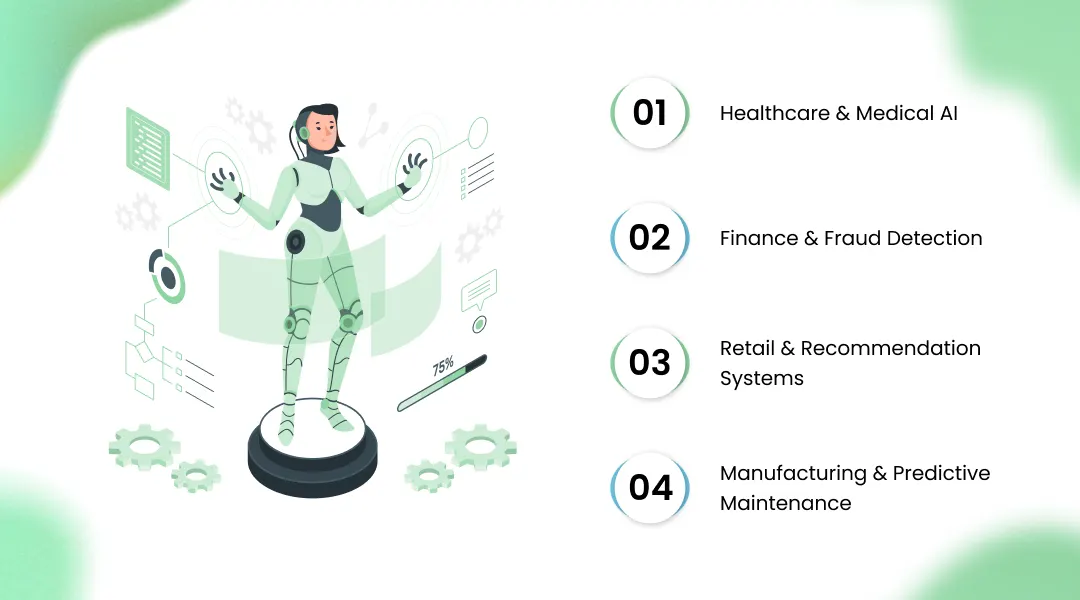
The strategic application of AI in healthcare shines when complex visual and clinical patterns are too subtle for human detection alone.
Applications include:
Medical image diagnostics
Patient risk prediction
Clinical decision support
I’ve seen models spot early indicators doctors couldn’t, because no human can process millions of cases simultaneously.
That’s where deep learning earns trust.
Deep learning in finance thrives on anomaly detection.
Transaction flows. Behavior shifts. Subtle deviations.
Deep learning use cases here focus on prevention, not reaction. When it works, fraud never happens. And nobody notices.
That’s success.
Personalization engines depend on deep learning applications in business.
Purchase history. Browsing patterns. Contextual signals.
The best systems don’t just recommend products; they predict intent.
In manufacturing, applying Machine Learning in Predictive Maintenance provides enterprise operations with critical foresight to prevent unplanned downtime.
Equipment failure rarely happens suddenly. The signals are there. Deep learning models catch them early.
Downtime avoided is profit earned.
Voice systems rely on deep learning to:
Transcribe speech
Detect intent
Adapt to accents and noise
Accuracy improves with exposure. So does cost.
That trade-off matters.
Surveillance, quality control, and autonomous systems all depend on visual understanding.
Deep learning doesn’t “see.” It statistically interprets pixels. Fast. At scale.
From sentiment analysis to document intelligence, deep learning in natural language processing has moved AI from keywords to context.
Still imperfect. Still powerful.
Both can be true.
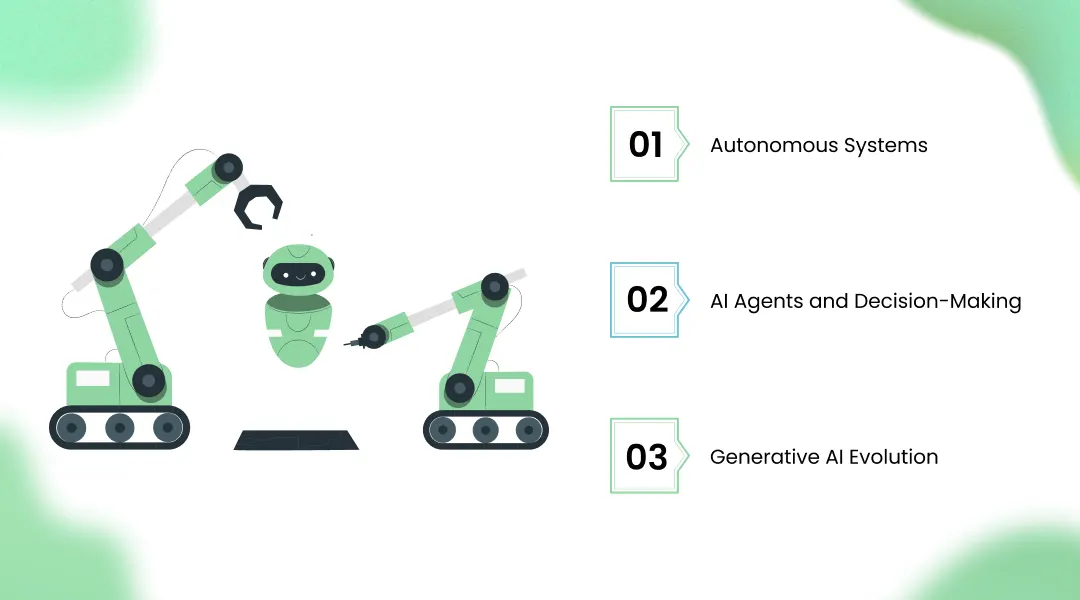
Self-driving platforms, robotics, and industrial automation rely on deep learning to perceive and decide.
Not perfectly. But increasingly reliably.
Modern AI agents combine deep learning with reasoning layers.
Perception feeds judgment. Judgment feeds action.
That stack is where enterprise AI is heading.
Generative systems didn’t appear out of nowhere. They’re built on deep learning foundations refined over years.
Text, images, code - all generated through learned probability, not creativity.
Important distinction.
Let’s be honest.
Deep learning technology is:
Expensive to train
Data-hungry
Hard to explain
Energy-intensive
And brittle when deployed carelessly.
I’ve seen companies chase deep learning because competitors mentioned it on earnings calls.
That’s how money disappears quietly.
Because when deep learning is the right tool, nothing else compares.
Businesses invest because:
Automation reduces human error
Prediction beats reaction
Scale beats intuition
But only when aligned with real problems.
This is why companies look for the best AI development Company that asks uncomfortable questions instead of selling shiny models.
Start smaller than you want.
Define the decision you want to improve
Audit your data brutally
Test with a limited model
Measure impact, not accuracy
Scale only when results justify it
If your partner skips step two, walk away.
At KriraAI, this discipline is non-negotiable. It’s how deep learning solutions for enterprises stay sustainable instead of speculative.
Deep learning technology isn’t the future because it’s fashionable.
It’s the future because it handles complexity humans can’t.
But power without judgment creates chaos.
If you remember one thing from this article, let it be this: Deep learning works best when paired with restraint, experience, and clarity.
Everything else is noise.
Deep learning technology teaches machines to recognize complex patterns by training multi-layer neural networks on large datasets.
Deep learning uses neural networks with many layers and works best with unstructured data like images, audio, and text.
Sometimes. Only when the problem involves scale, complexity, or pattern recognition beyond traditional analytics.
Usually thousands to millions of examples. Data quality matters as much as quantity.
Healthcare, finance, retail, manufacturing, and any domain dealing with complex, high-volume data.
Founder & CEO
Divyang Mandani is the CEO of KriraAI, driving innovative AI and IT solutions with a focus on transformative technology, ethical AI, and impactful digital strategies for businesses worldwide.