Something shifted in enterprise AI over the past month. A wave of June and July 2026 research papers and product launches converged on one unglamorous problem. That problem is what AI agents remember, and whether anyone can prove it. Agent memory governance is now moving from an afterthought to an architectural requirement. On July 9, 2026, AgentPrizm launched a governed memory platform built around lineage and audit receipts. AgentPrizm describes agentic memory as a persistent, governed context that an agent can recall, verify, and delete on request. Two days earlier, Oracle shipped a database-backed memory layer with finer control over storage and retrieval. In the same window, several arXiv papers formalized how memory should carry provenance and verifiable deletion.
For two years, most teams treated agent memory as a convenience. You embedded past turns into a vector store and retrieved them by similarity. That approach works in a demo. It fails the moment an agent touches regulated data or acts across many users. A vector store can tell you that a memory is similar to a query. It cannot tell you where that memory came from. It cannot tell you whether the memory is still true. It cannot tell you who is allowed to see it, or whether you may safely delete it.
This blog explains what agent memory governance is and how governed memory works under the hood. It shows how governed memory differs from the memory layers most teams ship today. It covers the mechanisms that make memory auditable, the honest trade-offs involved, and what regulators now expect. The goal is a clear and technical picture that an engineering leader can act on this quarter.
Most production agents in 2026 still use a vector database as their memory. Text gets chunked, embedded, and stored. At query time, the system retrieves the nearest neighbors and injects them into the prompt. This is fast to build and genuinely useful for recall. The problem is that similarity is the only property the system tracks. Governance needs several other properties that vectors were never designed to carry.
The memory layer answers one question: what is relevant to this query? The governance layer answers a different set of questions entirely. It asks where a stored fact originated, who owns it, and whether it is current. It asks who accessed it, and which decisions it influenced downstream. These are the same requirements any regulated data system must meet. A vector index provides none of them as native capabilities.
This distinction matters because governance is an architectural property, not a configuration flag. You cannot bolt a retention setting onto an embedding store and call it governed. The store has no concept of derivation, ownership, or supersession. It treats a hallucinated note and a verified fact identically once both are embedded. That equivalence is precisely what breaks in production.
The gap between a memory layer and a governance layer is where real incidents live. Enterprise teams tend to discover these failure modes only after deployment. Naming them makes the risk concrete rather than abstract.
Memory poisoning happens when malicious or malformed content is written to memory and later retrieved as trusted context. This is now a documented attack surface, not a theoretical concern.
Stale context happens when a superseded fact keeps getting retrieved because nothing marked it as outdated. The agent acts confidently on information that is no longer true.
Access violations happen when one user's memory surfaces in another user's session because retrieval ignored ownership. Similarity does not respect tenant boundaries.
Unprovable deletion happens when a deletion request cannot be verified or shown to be complete. The data may persist in derived summaries you never tracked.
Untraceable decisions happen when you cannot reconstruct which memories drove an action without that trace; audit and debugging both stall.
Agent memory governance is the discipline of treating what an agent stores and retrieves with the same rigor as any enterprise data system, the standard already expected of AI deployed in financial services. It means every memory object carries the metadata needed for accountability. That metadata makes the memory auditable, revocable, and traceable. Recent work is converging on a small set of first-class properties. A June 2026 arXiv design for governed shared memory captures this well.
In that design, each memory object carries a creation timestamp, optional supersession references, contradiction markers, provenance metadata, and a confidence state. Contradictory writes are resolved by temporal ordering and policy rules rather than left to coexist. Every object also stores its writer identity, source system, derivation history, and modification lineage. That combination is what enables auditability, debugging, and compliance. It is also what separates governed memory from a plain retrieval index.
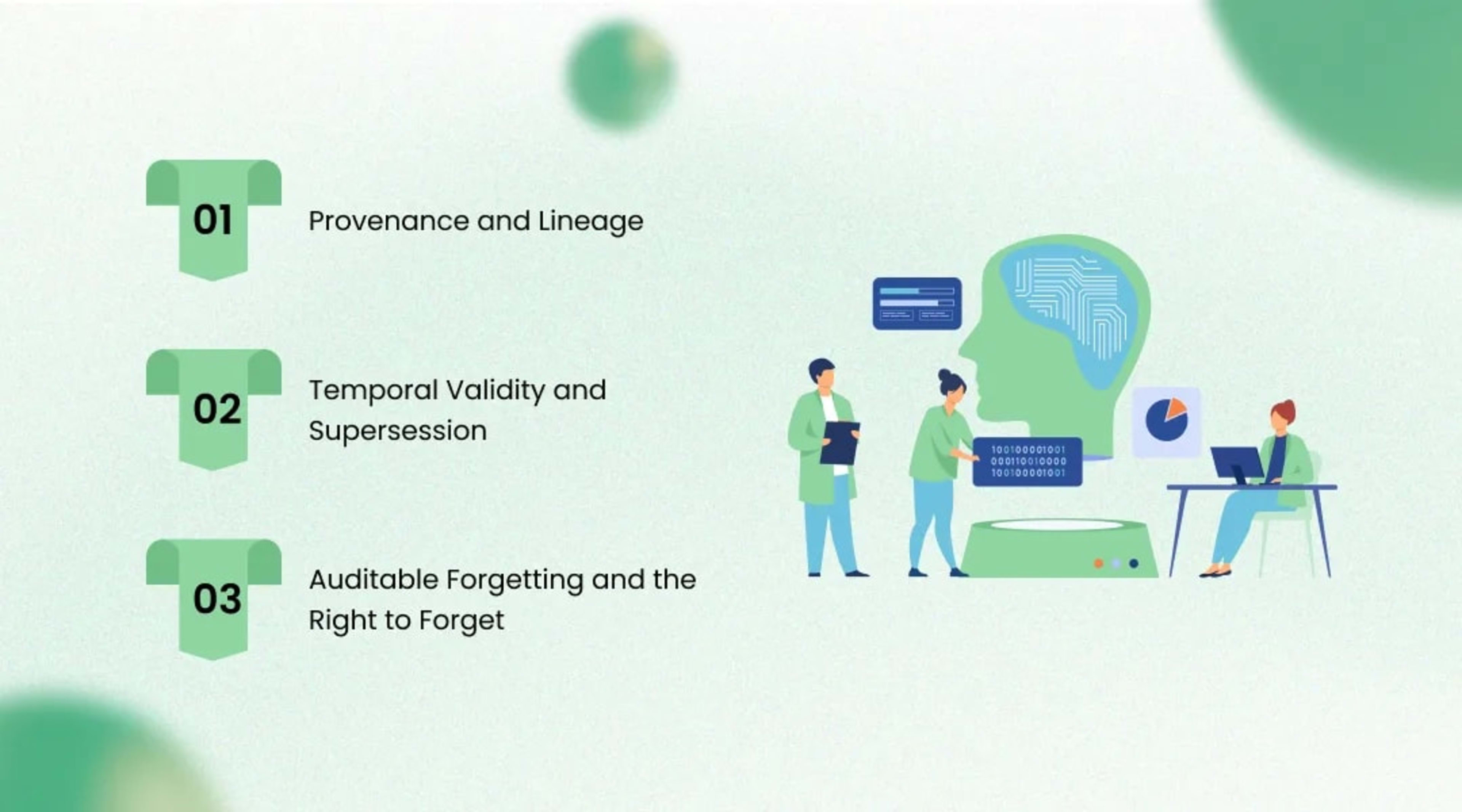
Agent memory provenance is the record of where a stored fact came from and how it was derived. Lineage extends that record across every transformation the fact undergoes. If a memory were summarized from three tool outputs, lineage links back to all three. If that summary later seeds another memory, the chain continues forward. This is the same idea data teams use for column-level lineage, applied to agent state.
Provenance is what lets an agent answer the question every auditor eventually asks. That question is simple: on what basis did you act? Without agent memory provenance, an agent can produce a confident claim with no defensible source. Researchers have named the failure that follows, where flat text memory loses attribution, and the agent invents authority. Structured provenance prevents that collapse by keeping source and derivation attached to every entry.
Temporal validity is the property that tells a system whether a memory is still true right now. Facts expire. A customer's address changes, a policy is updated, a contract is renewed. A governed memory object records when it was created and when it was superseded. Retrieval can then prefer current facts and demote or exclude stale ones.
Supersession is the mechanism that links an old fact to the newer one that replaced it. This preserves history without letting history contaminate present decisions. You keep the audit trail while acting on the current state. This is exactly where mem0 reported its largest gains in April 2026. Its 2026 algorithm improved temporal queries by 29.6 points and multi-hop reasoning by 23.1 points over the prior version.
Auditable forgetting is the ability to delete a memory and prove the deletion was complete. This is harder than it sounds because agents derive memories from other memories. Deleting a source without deleting its descendants leaves the information alive in summaries. A governed system uses lineage to cascade deletion through the derivation graph. That is what makes a right to forget request defensible rather than aspirational.
Governed agent memory borrows its core ideas from distributed systems and cryptography, not from search, the same shift we cover in our breakdown of Microsoft Agent Framework 1.0's enterprise memory architecture. Once memory is shared across agents and users, the operational concerns resemble a distributed database. You need synchronization, consistency, ordering, access control, and tamper evidence. Recent research treats agent memory governance as a systems layer, and the mechanisms reflect that. At KriraAI, where we build and deploy production AI systems for enterprise clients, this is the layer we now design before an agent ever ships.
The foundation is cryptographic integrity on every write. A June 2026 method called MemLineage builds its store as an append-structured log with a Merkle tree over the entries. Each entry is signed per principal, so the writer of every memory is provable. In a controlled harness, that design drove memory poisoning attack success rate to zero while keeping per-operation overhead below one millisecond. Tamper evidence means you can detect if any stored memory was altered after the fact. That property is the base that everything else rests on.
Signing also solves the identity question that pure vector stores ignore. When you know which agent or user wrote a memory, you can enforce policy on it. You can scope retrieval to the right owner. You can attribute a bad write to a specific source and revoke it.
The second mechanism is a derivation graph, often a weighted directed acyclic graph. Each node is a memory, and each edge records which prior memories influenced it. This graph is what makes cascade deletion and full lineage possible. It is also the basis for a powerful safety control. The system can refuse a sensitive action if its justification traces back to an untrusted source.
This is subtle and worth stating plainly. An agent may recall an externally injected note for a benign summary without harm. The same note becoming the basis for a wire transfer is a different matter. Untrusted path enforcement blocks the second case while allowing the first. It reasons over provenance, not over content alone.
The third mechanism handles the reality that memories conflict. Two tools report different values. A user corrects an earlier statement. Rather than storing both and retrieving whichever is more similar, a governed store resolves the conflict. It uses timestamps, supersession links, and policy rules to decide which fact wins. Each object also carries a confidence state that retrieval and reasoning can weigh.
The governed memory vs vector database question is not about replacing one with the other. Most production systems keep a vector store for fast semantic recall. Governance sits alongside it as a metadata and policy layer. The useful framing is to compare them on the properties that audits and regulators care about. The gap is stark once you list the criteria.
Provenance: a vector store records an embedding and its text, while governed memory records source, writer, and full derivation.
Temporal validity: a vector store has no concept of supersession, while governed memory marks facts as current or outdated.
Access enforcement: a vector store retrieves by similarity across tenants, while governed memory enforces ownership at retrieval and inference.
Verifiable deletion: a vector store deletes a row, while governed memory cascades deletion through derived entries and proves completion.
Decision traceability: a vector store cannot link a memory to an action, while governed memory records which memories influenced which decisions.
The lesson from this comparison is consistent across recent analyses. Unstructured memory is easy to populate and impossible to govern. Governed memory demands an upfront investment but produces answers you can defend. Expanding context windows does not resolve this, since they shift latency and cost but not accountability. The two axes are independent, and only governance closes the compliance gap.
Knowing how to implement agent memory governance starts with an honest inventory. Most teams already have a memory layer and no governance layer. The work is to add the governance properties without rebuilding everything at once. You can adopt these capabilities in stages, and each stage delivers value on its own. KriraAI applies this staged pattern when we take enterprise agents from pilot into regulated production.
The sequence below reflects what actually reduces risk first. It front-loads the controls that block the most damaging failures. Later stages add the properties that satisfy auditors and privacy law.
Assign an identity to every write, so each memory records the agent or user that created it. This alone ends shared credential ambiguity.
Attach provenance and source metadata to stored entries, so every fact links back to its origin. This is the base for lineage and audit.
Add temporal fields and supersession, so retrieval can prefer current facts and demote stale ones. Stale context failures drop sharply here.
Build the derivation graph so you can trace and cascade deletion across derived memories. This makes right-to-forget requests real.
Enforce policy at retrieval and at inference, so access respects ownership and sensitivity every time. Enforcement at each tool call beats a one-time grant.
Turn on audit logging for reads, writes, and deletions, so any action is reconstructable end to end. This is what a security questionnaire now demands.
A practical note keeps this grounded. You do not need cryptographic signing on day one to gain most of the benefit. Identity, provenance, and temporal validity remove the majority of production incidents. Signing and tamper-evident logs matter most for high-stakes and adversarial settings. Sequence the investment to your actual risk profile rather than chasing completeness.
Governed memory earns its cost in specific settings, and it is honest to name where it does not. The overhead is real, both in engineering time and in system complexity. Applying it everywhere would slow teams down for little gain. The right approach is to match the level of governance to the stakes of the workflow.
Governed memory matters most where agents act on regulated or cross-tenant data. Financial services, healthcare, legal, and any multi-user platform sit squarely here. It also matters where decisions must be explained after the fact. If an auditor, a regulator, or a customer can demand a rationale, you need provenance. These are the same domains where enterprises are deploying agents most cautiously today.
Governed memory matters less for single-user, low-stakes, and stateless tasks. A personal coding assistant that forgets between sessions barely needs it. A demo or an internal prototype can defer governance without harm. The genuine tension in the field is also worth stating clearly. An append-only ledger that guarantees tamper evidence conflicts with a hard delete requirement. Derivation graphs ease this by enabling cascade deletion, but the trade-off between immutability and forgetting is not fully solved. Any team adopting governed memory should treat that boundary as a live design decision.
AI agent memory compliance is no longer a future concern because concrete obligations arrive in August 2026, the same deadline we detail in our look at the Microsoft Agent Governance Toolkit for AI runtime security. A new wave of EU AI Act obligations takes effect that month, and provenance requirements extend to what AI agents remember. Building agent memory without governance, therefore, creates a compliance liability, not merely a technical debt. The direction of travel is clear across regulators. Governments now treat agent accountability as a standardized requirement rather than a best practice.
The United States moved on a parallel track earlier this year. On February 5, 2026, NIST released a concept paper on accelerating the adoption of AI agent identity and authorization, aimed at enterprise settings. Privacy law adds the sharpest edge through the right to be forgotten. GDPR requires that personal data be deleted on demand, in ways that are auditable and defensible. An agent that cannot prove complete deletion cannot satisfy that requirement. This is why auditable forgetting has moved from research curiosity to a procurement checklist.
The commercial pressure is arriving faster than many teams expect. AI agent memory compliance now shows up directly in enterprise sales cycles. Security questionnaires ask how each agent is identified, scoped, and audited. Weak agent governance blocks deals the way a missing security certification once did. For a company like KriraAI, which stays current with the AI research frontier and delivers production systems for enterprises, meeting these questions early is a competitive advantage rather than a burden.
The scale of adoption explains the urgency behind these rules. Interest in multi-agent systems is rising steeply across the market. Gartner analysis cited in industry reporting projects that 40 percent of business applications will include task-specific agents by the end of 2026, up from under 5 percent in 2025. The same report expects 71 percent of businesses to run more than one AI agent by year-end. As agents multiply, ungoverned memory multiplies the surface for incidents and audits alike.
Three takeaways should stay with any team-building agents this year. First, agent memory governance works by attaching provenance, identity, temporal validity, and lineage to every stored memory, then enforcing policy over that metadata. Second, it matters most where agents touch regulated data, act across users, or must explain their decisions, which describes most serious enterprise deployments. Third, the practical move is to adopt governance in stages, starting with identity and provenance, well before the August 2026 EU AI Act obligations land. Doing this now is a first-mover advantage, not a defensive scramble.
The deeper point is that memory has become infrastructure. What an agent remembers is now part of your compliance surface, your security surface, and your audit trail. Treating it as a cache was fine for demos and is untenable for production. The research and product wave of the past month makes that shift explicit and actionable. Teams that internalize it will ship agents that their auditors and customers can trust.
This is the frontier KriraAI works at every day. We build and deploy production-grade AI systems for enterprise clients, and we adopt emerging techniques only when they are ready to produce measurable value. Governed agent memory has crossed that line, moving from research into shippable practice. We apply it to reduce real risk, not to chase novelty. If you are evaluating what agent memory governance could mean for your organization, KriraAI can help you design and deploy it against your actual workflows and compliance requirements.
Agent memory governance is the practice of ensuring that what an AI agent stores, retrieves, and acts on meets the same compliance, access, and auditability standards as any enterprise data system. It adds first-class properties to memory, including provenance, ownership, temporal validity, access enforcement, and decision traceability. These properties let teams prove where a memory came from, whether it is still valid, who could see it, and what it influenced. Without them, a memory store is a convenient cache that no auditor can trust.
A vector database retrieves memories by semantic similarity and tracks little else about them. Governed memory adds a metadata and policy layer that records source, writer, derivation, and validity for each entry. The governed memory vs vector database distinction comes down to accountability rather than recall speed. A vector store can tell you a memory is relevant, but it cannot tell you where it came from, whether it is current, or whether deletion was complete. Most production systems keep the vector store and add governance beside it rather than replacing it.
You implement the right to forget by giving memory a derivation graph that links each stored fact to everything derived from it. When a deletion request arrives, the system cascades the deletion through that graph, removing descendants such as summaries and derived notes. Because agents build memories from other memories, deleting only the source leaves the information alive downstream. A governed store also logs the deletion so completion can be proven to a regulator or customer. This auditable and cascading deletion is what turns a legal requirement into a defensible technical control.
Memory poisoning is an attack in which malicious or malformed content is written into an agent's memory and later retrieved as if it were trusted context. Because a plain vector store treats all stored text equally, a poisoned entry can silently influence future decisions. Governed memory defends against this by signing writes, tracking provenance, and refusing sensitive actions whose justification traces to an untrusted source. In one 2026 research harness, a lineage-based defense reduced the poisoning attack success rate to zero with negligible overhead. This makes provenance enforcement a practical security control, not only a compliance feature.
Yes, the EU AI Act's provenance and data governance obligations extend to what AI agents store and reuse, and a new wave of these obligations takes effect in August 2026. This means AI agent memory compliance now requires lineage, access control, temporal validity, and auditable deletion as documented capabilities. Building an agent on ungoverned memory creates a compliance liability that surfaces during audits and enterprise procurement. Organizations that add governance early can answer security questionnaires crisply and move through regulated deals faster. Those who wait inherit credential drift, unprovable deletion, and untraceable decisions that are expensive to fix later.
Founder & CEO
Divyang Mandani is the CEO of KriraAI, driving innovative AI and IT solutions with a focus on transformative technology, ethical AI, and impactful digital strategies for businesses worldwide.