Modern AI is no longer a research experiment. It is a production-grade infrastructure discipline, and the companies winning with AI are not the ones with the most impressive models on paper. They are the ones with the most reliable, scalable, and operationally mature systems serving those models in the real world.
At the center of that operational maturity sits a category of capability that most enterprises underestimate until they feel its absence: Deep Learning Services. These are not simply tools for data scientists to train neural networks. They are the industrial-grade infrastructure, tooling, and managed capabilities that make deep learning viable, repeatable, and profitable at enterprise scale.
Consider the business reality: a global financial institution builds a fraud detection model that achieves 97% accuracy in staging. Yet in production, it degrades to 89% within 60 days due to data drift, latency mismatches, and a deployment architecture that was never designed for real-time throughput. The model failed not because of its algorithmic design, but because the surrounding services were inadequate.
This is the precise gap that enterprise-grade deep learning services are built to close. From real-time AI inference services for enterprise applications to automated feature engineering, scalable deployment, and model operationalization platforms, these services form the connective tissue between AI ambition and AI outcomes.
In this guide, we examine seven foundational reasons why deep learning services are not optional infrastructure for modern enterprises. They are the primary determinant of whether your AI investments generate returns or remain confined to demonstration environments.
Deep Learning Services refer to the managed, platform-based, or API-accessible capabilities that enable organizations to design, train, optimize, deploy, monitor, and scale neural network-based AI systems in production environments. They span the full ML lifecycle, from raw data ingestion and feature engineering through model training, inference serving, performance monitoring, and iterative retraining.
The distinction between "doing deep learning" and "delivering deep learning services" is critical. A data science team doing deep learning might successfully train a computer vision model on a GPU workstation. A deep learning services infrastructure delivers that model as a low-latency API endpoint that processes millions of images per day, degrades gracefully under load, retrains automatically when accuracy drifts, and produces audit-ready logs for compliance review.
The global AI services market reached approximately $150 billion in 2024 and is projected to exceed $420 billion by 2030, according to multiple analyst estimates. Within that figure, the infrastructure and services layer, encompassing model deployment, inference optimization, and MLOps tooling, represents the fastest-growing segment. Enterprises are discovering that model development costs, while significant, are dwarfed by the operational costs and lost value associated with inadequate serving infrastructure.
Three forces are converging to make deep learning services a board-level priority in 2025.
The Production Gap Is Widening. Industry surveys consistently show that between 60% and 85% of machine learning models developed internally never reach production. The primary barriers are not algorithmic. They are operational: inadequate serving infrastructure, insufficient monitoring, poor integration with existing systems, and the organizational complexity of managing model lifecycle at scale.
Data Volumes Are Exceeding Human Capacity. The exponential growth in structured and unstructured enterprise data, from IoT sensor streams to document repositories to customer interaction logs, has made manual analysis economically indefensible. Deep learning services allow organizations to extract value from these data assets continuously, at a cost and scale that human-in-the-loop processes cannot match.
Model Complexity Is Increasing Faster Than In-House Capability. The state-of-the-art in deep learning, including large language models, multimodal architectures, and diffusion models, requires specialized knowledge for deployment and optimization that most enterprise ML teams lack. Deep learning services abstract that complexity, allowing organizations to leverage frontier model capabilities without building world-class infrastructure engineering teams from scratch.
The term "inference" refers to the process of running a trained neural network model on new input data to generate predictions, classifications, or outputs. In isolation, inference sounds simple. In enterprise production environments, it is one of the most operationally demanding challenges in modern computing.
Real-time AI inference services for enterprise must simultaneously satisfy requirements that exist in direct tension with one another: extremely low latency (often sub-100ms for user-facing applications), massive throughput (potentially millions of requests per hour), high availability of 99.9% or better, and cost efficiency that does not erode the business case for AI.
A well-documented pattern in enterprise AI deployment goes as follows: a team builds an excellent model, deploys it on a standard web server, and discovers that it handles 10 requests per second adequately but collapses at 100. Scaling the server adds cost linearly, and the response time degrades non-linearly as load increases. What appeared to be an AI problem is actually an inference serving problem.
Purpose-built real-time AI inference services for enterprise solve this through several mechanisms that general-purpose infrastructure cannot replicate.
Dynamic Batching. Rather than processing each inference request independently, production inference servers intelligently batch concurrent requests together, dramatically increasing GPU utilization and throughput without proportional increases in latency. NVIDIA TensorRT-LLM, for instance, can increase effective throughput by 3x to 8x through optimized batching strategies alone.
Model Parallelism and Sharding. For large models that exceed the memory capacity of a single GPU, inference services implement sophisticated parallelism strategies by splitting the model across multiple GPUs or even multiple servers while maintaining coherent, low-latency responses. This is computationally non-trivial and requires deep systems expertise to implement correctly.
Adaptive Resource Allocation. Enterprise inference traffic is rarely uniform. Customer-facing AI applications experience demand spikes tied to business cycles, marketing events, and usage patterns. Production-grade Deep Learning Services implement auto-scaling policies that provision GPU capacity ahead of demand spikes and release it during quiet periods, maintaining both performance and cost efficiency.
The financial stakes of inference performance are concrete. In e-commerce, recommendation systems operating under 50ms deliver measurably higher conversion rates than those operating at 200ms. Multiple controlled experiments have documented 1% to 3% revenue differences attributable to latency alone. In financial services, fraud detection systems that cannot deliver real-time decisions are functionally unusable for card-present transactions. In healthcare diagnostics, inference latency determines whether AI assistance can fit within a clinical workflow or becomes an impediment to care delivery.
The deployment model for inference serving carries significant strategic implications. Cloud-based inference services offer elasticity and minimal upfront capital expenditure, but introduce data sovereignty considerations, variable costs that can escalate unpredictably with usage growth, and network latency for applications that require edge processing.
On-premise inference infrastructure provides deterministic performance, eliminates data egress costs and privacy concerns, and allows for hardware optimization specific to the model architecture in use. The trade-off is capital intensity and the operational complexity of managing specialized hardware.
Many enterprises adopt hybrid inference architectures. Latency-sensitive, high-volume workloads run on optimized on-premise hardware, while development, experimentation, and burst capacity leverage cloud inference services. Production-grade Deep Learning Services providers typically support both deployment models through unified control planes that abstract the underlying infrastructure differences.
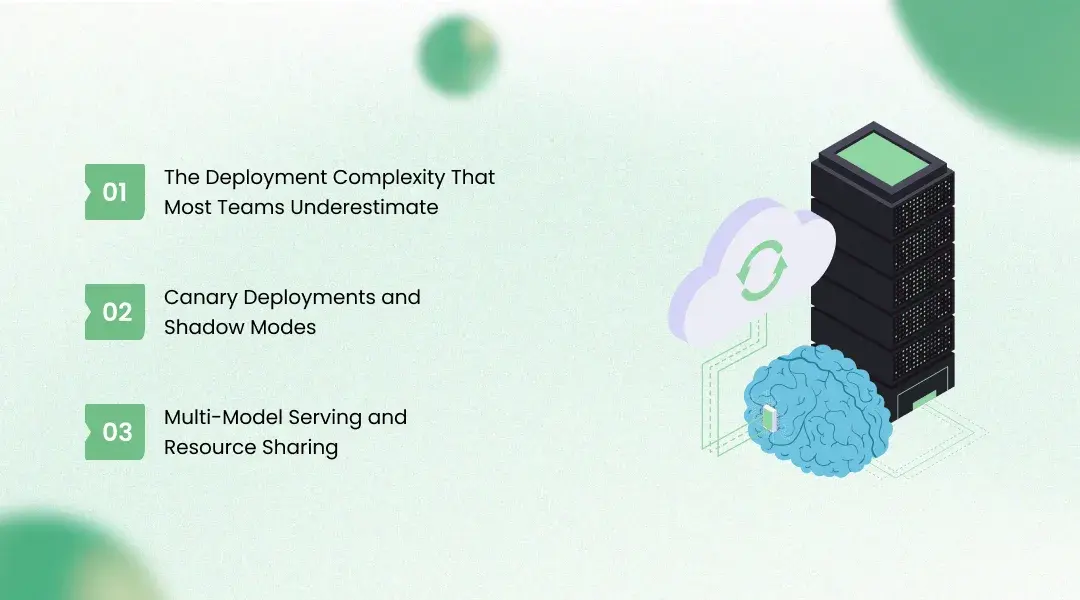
Training a neural network is a computationally intensive but fundamentally finite operation: you run training until the model converges, and the GPU cluster returns to baseline. Deployment is the opposite. It is an indefinitely ongoing operational commitment that must scale with business growth, remain available during hardware failures, and adapt to evolving model architectures without service interruption.
Scalable neural network deployment solutions address this complexity through a combination of containerization, orchestration, version management, and traffic management capabilities that transform model files into reliable, maintainable production services.
Consider what a robust neural network deployment actually requires. The model weights must be stored and versioned. The serving runtime must be configured with appropriate hardware assignments. API endpoints must be defined, secured, and rate-limited. Traffic must be routable across multiple model versions to support A/B testing and gradual rollouts. Health checks must detect and recover from inference server failures. Logging must capture inputs, outputs, and performance metrics without introducing unacceptable latency overhead. Rollback mechanisms must allow rapid recovery from problematic model updates.
Each of these requirements is independently solvable. The challenge is solving all of them simultaneously, maintaining their interactions as the system scales, and doing so for potentially dozens or hundreds of models across a large enterprise. This is precisely the operational surface that scalable neural network deployment solutions are designed to manage.
Among the most valuable capabilities in mature deployment platforms is support for controlled model updates. Canary deployment routes a small percentage of production traffic to a new model version while monitoring its performance against the incumbent, dramatically reducing the risk of model updates. If the new version underperforms on a critical metric, traffic is automatically shifted back before business impact accumulates.
Shadow mode deployment takes this further. A new model version processes production inputs in parallel with the live model, but its outputs are logged rather than served to end users. This allows comprehensive validation of model behavior on real production data before any user-facing exposure, eliminating the gap between staging validation and production reality.
Enterprise AI systems rarely involve a single model. A customer experience platform might simultaneously run models for intent classification, sentiment analysis, product recommendation, churn prediction, and content personalization. Deploying each model on dedicated infrastructure is both expensive and operationally cumbersome.
Multi-model serving, a core capability of mature Deep Learning Services platforms, allows multiple models to share GPU and CPU resources intelligently, with dynamic allocation based on real-time demand. A model experiencing a traffic spike receives additional resources automatically, while a model with light traffic releases resources to others. This resource-sharing efficiency typically reduces infrastructure costs by 40% to 60% compared to dedicated per-model deployments.
One of the most persistent and costly inefficiencies in enterprise AI programs is the gap between model development and model value delivery. Research from multiple technology analysts indicates that the median time from initial model development to production deployment exceeds six months for enterprises operating without mature pipeline infrastructure. For some organizations, the gap stretches to 18 months or longer.
Production-grade deep learning pipeline services collapse this timeline by automating the orchestration of data ingestion, preprocessing, model training, evaluation, deployment, and monitoring into repeatable, auditable workflows that function as organizational capability rather than one-off engineering efforts.
A production pipeline is not simply a sequence of scripts executed in order. It is an orchestrated system with dependency management, failure handling, resource optimization, and operational observability built into its architecture. The key stages include the following.
Data Ingestion and Validation. Raw data from source systems is ingested, validated against schema expectations, and flagged for quality issues before entering the training workflow. This stage catches data quality problems before they corrupt model training, a critical safeguard in regulated industries where data provenance must be auditable.
Feature Engineering and Transformation. Raw data is transformed into the numerical representations that neural networks consume. Production pipelines apply these transformations consistently between training and serving. This requirement sounds obvious but is violated frequently in ad hoc implementations, leading to the training-serving skew that degrades model performance in production.
Model Training and Hyperparameter Optimization. Automated training pipelines manage GPU allocation, experiment tracking, hyperparameter search, and artifact storage. Rather than relying on individual data scientists to manually track experiments, production pipelines capture every training run with its configuration, metrics, and output artifacts, enabling systematic comparison and reproducibility.
Evaluation and Quality Gates. Production pipelines enforce quality gates that prevent underperforming models from progressing to deployment. These gates compare candidate models against incumbent models on held-out evaluation datasets, checking performance, fairness, robustness, and computational efficiency against predefined thresholds.
Automated Deployment and Rollback. Models that pass quality gates are automatically packaged for deployment and promoted through staging environments to production. Rollback triggers monitor production metrics and automatically revert to previous model versions if performance degrades beyond defined thresholds.
Model performance in production is not static. As the world changes, customer behavior shifts, product catalogs evolve, and language usage patterns drift. The statistical distributions that models were trained on diverge from the distributions they encounter in production. Without systematic retraining, model accuracy degrades continuously.
Production-grade Deep Learning Services include automated monitoring for data drift and model performance degradation, with configurable triggers that initiate retraining pipelines when drift metrics exceed acceptable thresholds. This transforms model maintenance from a periodic manual exercise into a continuous automated process, sustaining model performance without proportional increases in data science team workload.
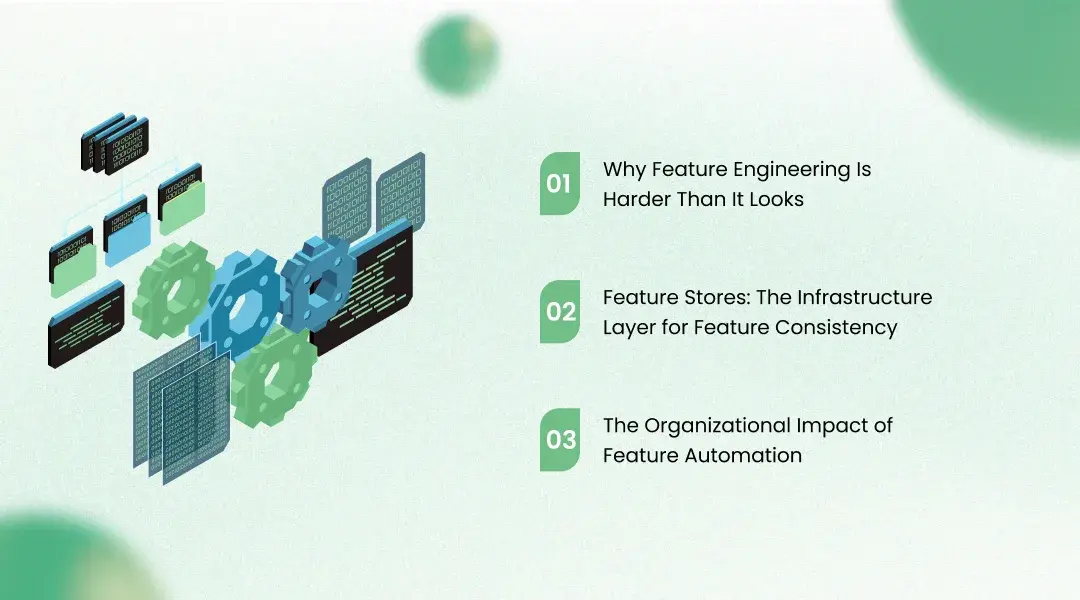
Feature engineering, the process of transforming raw data into the structured numerical representations that neural networks use for learning, has historically been the most time-consuming and expertise-dependent phase of machine learning development. Senior data scientists have estimated that feature engineering consumes between 60% and 80% of model development time in traditional workflows.
Deep learning feature engineering automation addresses this bottleneck through automated feature generation, selection, and validation capabilities that reduce manual effort while simultaneously improving feature quality and consistency.
The challenge of feature engineering in deep learning contexts is multidimensional. Neural networks theoretically learn feature representations automatically from raw data, which is one of their defining advantages over classical machine learning methods. In practice, however, the quality and structure of input features still profoundly influences training stability, convergence speed, and final model performance.
For tabular data, transformations such as normalization, categorical encoding, temporal feature extraction, and interaction term creation require domain expertise to implement correctly. For time-series data, features must be computed consistently across training and serving windows without introducing look-ahead bias that inflates validation metrics. For multimodal data combining text, images, and structured inputs, feature alignment across modalities requires careful engineering.
A feature store is the production infrastructure component that addresses one of the most pervasive failures in enterprise deep learning: inconsistency between features computed for training and features computed for serving. When this inconsistency exists, models perform differently in production than in validation, often significantly worse, because the model learned patterns in one feature space and is evaluated in another.
Feature stores serve as the authoritative, centralized repository for feature computation logic. Training pipelines read features from the same feature store as serving pipelines, guaranteeing computational consistency. Features are versioned, documented, and reusable across models, reducing redundant computation and enabling collaboration across data science teams.
Automated feature engineering capabilities within matureDeep Learning Services platforms extend this further. They analyze input data, propose candidate features based on statistical properties and domain heuristics, evaluate feature importance, and generate the transformation code that implements accepted features consistently across the pipeline.
The business case for feature engineering automation extends beyond individual productivity gains. When feature logic is centralized, versioned, and automated, the institutional knowledge that previously resided in individual data scientists becomes organizational infrastructure. Model development becomes less dependent on specific individuals, more reproducible, and more amenable to audit and compliance review.
For regulated industries including banking, insurance, healthcare, and pharmaceuticals, this auditability is not merely convenient. It is a compliance requirement. Automated feature pipelines with complete lineage tracking provide the documentation trail that regulators require to validate AI-assisted decisions.
The transition from model development to model operation represents a fundamental shift in the expertise, tooling, and organizational processes required. Data science teams excel at model development. Sustaining models in production at enterprise scale requires a different discipline, one that combines elements of software engineering, DevOps, site reliability engineering, and domain expertise.
Deep learning model operationalization platforms, the core of what the industry calls ML Ops, bridge this gap by providing the tooling, automation, and governance frameworks that allow organizations to operate AI systems with the reliability and efficiency standards of production software.
Model Registry and Governance. A centralized model registry functions as the definitive catalog of all models across an enterprise: their training configurations, evaluation metrics, approval status, deployment history, and lineage. Without this infrastructure, enterprises operating at scale inevitably develop shadow AI, which refers to models running in production that lack documentation, governance oversight, or operational support.
Experiment Tracking. Reproducibility is fundamental to responsible AI development. Experiment tracking systems capture every element of each training run, including code version, data version, hyperparameters, hardware configuration, and output metrics, enabling exact reproduction of any prior result and systematic comparison across experimental configurations.
CI/CD for Machine Learning. The practices of continuous integration and continuous delivery, proven in software engineering, apply with equal force to machine learning systems. Automated test suites validate model behavior, data pipelines, and serving infrastructure with each code or configuration change, catching regressions before they reach production.
Observability and Alerting. Production models require comprehensive monitoring: prediction distribution statistics, input feature distributions, latency percentiles, error rates, and business-level KPIs. Alerting systems notify relevant teams when metrics deviate from expected ranges, enabling proactive intervention before business impact accumulates.
A/B Testing and Experimentation Infrastructure. Sustained model improvement requires structured experimentation. Operationalization platforms provide the traffic routing, statistical analysis, and decision-making frameworks that allow data science teams to run rigorous controlled experiments with production traffic, validating that model updates deliver genuine business improvements.
The financial cost of inadequate model operationalization is often underestimated because it accumulates gradually. A model that degrades silently without monitoring does not produce a visible failure event. It produces a slow erosion of the business value it was delivering. A fraud detection model losing 2 percentage points of precision over six months generates additional fraud losses that accumulate quietly. A recommendation model losing relevance over time reduces conversion rates gradually, without an obvious causal event.
Deep Learning Services that include robust operationalization capabilities transform this invisible erosion into a monitored, managed process. The operational overhead reductions are equally concrete: automation of routine retraining, deployment, and monitoring tasks typically reduces the data science and ML engineering time required to maintain a production model by 50% to 70%, freeing team capacity for higher-value development work.
The computational cost of running deep learning models in production is, for many enterprises, the single largest line item in their AI infrastructure budget. A large language model serving millions of requests daily can consume GPU resources worth millions of dollars annually. Unoptimized inference not only increases direct infrastructure costs, it also increases latency, reduces throughput, and limits the number of concurrent users the system can serve.
Deep learning inference optimization services apply a battery of specialized techniques that reduce computational requirements, often dramatically, while preserving model performance within acceptable degradation bounds.
Quantization. Neural network weights are typically stored and computed in 32-bit floating point precision during training. Quantization reduces this to 16-bit, 8-bit, or in some cases 4-bit representations for inference. The reduction in memory footprint and computational requirements is directly proportional to the reduction in bit width. 8-bit quantization roughly halves memory requirements and increases throughput by 2x to 4x on compatible hardware. Modern quantization techniques, including post-training quantization and quantization-aware training, achieve this compression with accuracy degradation typically below 1% on most benchmarks.
Pruning. Modern neural networks are significantly over-parameterized relative to their actual representational requirements. Pruning identifies and removes weights that contribute minimally to model outputs, reducing model size and computational requirements. Structured pruning, which removes entire neurons, attention heads, or layers, delivers hardware efficiency gains that unstructured pruning cannot, since general-purpose hardware achieves speed improvements from structured sparsity rather than random sparsity.
Knowledge Distillation. A large, computationally expensive model can be used to train a smaller, faster student model that approximates the large model's behavior. This technique is particularly powerful for applications where a frontier model has established high quality but its computational requirements are incompatible with production deployment constraints. Student models can achieve 80% to 95% of teacher model performance at a fraction of the computational cost.
Hardware-Specific Compilation. General-purpose neural network implementations are not optimized for specific hardware architectures. Frameworks like TensorRT (for NVIDIA GPUs), OpenVINO (for Intel hardware), and Apple Neural Engine compilation transform models into hardware-specific representations that exploit the architectural features of target hardware, achieving throughput improvements of 2x to 10x over generic implementations.
Caching and Speculative Execution. For applications with repeated or predictable query patterns, inference caching stores and reuses outputs for identical or near-identical inputs, reducing redundant computation. Speculative execution techniques pre-compute likely next steps in autoregressive generation, reducing the sequential bottleneck that limits large language model throughput.
The return on investment from inference optimization services is calculable with reasonable precision. If a model optimized from baseline through quantization and hardware compilation achieves 3x greater throughput on existing hardware, the enterprise either serves 3x more traffic on the same infrastructure cost, or serves the same traffic on one-third the infrastructure, representing a cost reduction of up to 67%.
For an enterprise spending $2 million annually on inference GPU infrastructure, a 3x efficiency improvement translates to $1.33 million in annual savings. Against optimization service fees and engineering investment typically in the range of $200,000 to $500,000, the net ROI is substantial and realized within the first year of deployment.
Deep learning is not a stable technology. It is one of the fastest-evolving areas of computer science in history. The dominant model architectures, hardware platforms, and serving frameworks of 2022 are substantially different from those of 2025, and the trajectory suggests equivalent change over the next three years. Enterprises that build AI systems tightly coupled to specific architectures or frameworks face recurring migration costs that erode the cumulative value of their AI investments.
Deep learning services built on well-designed abstraction layers insulate enterprise AI systems from architectural disruption. Rather than coupling business applications directly to model implementations, they provide stable API contracts that can be satisfied by updated model architectures, new hardware platforms, and evolved serving frameworks without requiring application-layer changes.
Model Architecture Evolution. The transformer architecture that dominated NLP since 2017 is now being challenged by hybrid attention-convolution architectures, state-space models like Mamba, and mixture-of-experts designs that offer superior efficiency at scale. Enterprises whose inference serving infrastructure is architecture-agnostic can adopt these improvements without infrastructure overhaul.
Hardware Platform Transition. The AI accelerator market is in rapid evolution. NVIDIA's GPU dominance is being challenged by purpose-built inference chips from Google (TPUs), Amazon (Inferentia and Trainium), Intel (Gaudi), and a range of startups. Hardware-agnostic serving frameworks allow enterprises to migrate to more cost-effective or performant hardware as the market matures, without rewriting serving infrastructure.
Regulatory and Compliance Evolution. AI governance requirements are evolving rapidly across jurisdictions. The EU AI Act, US federal AI policy guidance, and sector-specific regulations in financial services and healthcare are establishing new requirements for model documentation, bias assessment, explainability, and audit trails. Deep Learning Services that include governance infrastructure position enterprises to meet evolving requirements without disruptive system rebuilds.
Foundation Model Integration. The emergence of large foundation models as AI infrastructure, accessible via API and fine-tunable for specific enterprise applications, is changing the economics of model development. Deep learning service architectures that support hybrid approaches, combining fine-tuned foundation models with custom-trained specialist models, allow enterprises to leverage both paradigms optimally.
The strategic principle underlying future-proofing through deep learning services is optionality: maintaining the technical and organizational flexibility to adopt superior solutions as they emerge without prohibitive transition costs. This optionality has measurable economic value. Enterprises locked into specific model architectures or hardware platforms pay a premium in cost, performance, and strategic agility that compounds over multi-year technology cycles.
Deep learning services that implement open standards, support multiple hardware backends, and maintain clean separation between model logic and serving infrastructure deliver this optionality as a structural property of the architecture, not as a feature requiring ongoing effort to maintain.
Selecting the right deep learning services for an enterprise context requires evaluating candidates against both current requirements and anticipated future needs. The following framework provides a structured approach to this evaluation.
Inference Performance. Benchmark candidate services against your actual model architectures and traffic patterns. Vendor-published performance numbers are generated under controlled conditions that may not reflect your use case. Test with representative production loads, including peak scenarios.
Scalability Architecture. Verify that the scaling mechanism, whether horizontal scaling, vertical scaling, or hybrid, matches your traffic pattern. Applications with predictable load benefit from different architectures than applications with bursty, unpredictable demand.
Framework and Hardware Compatibility. Confirm compatibility with the frameworks your data science teams use (PyTorch, TensorFlow, JAX) and the hardware platforms available or planned in your infrastructure.
Monitoring and Observability. Evaluate the depth and accessibility of monitoring capabilities. Inspect not just what metrics are collected, but how alerting is configured, how anomalies are surfaced, and how integration with existing observability infrastructure is supported.
Vendor Stability and Support. Deep learning services are operational dependencies of production AI systems. Evaluate vendor financial stability, support tier availability, SLA commitments, and incident response history.
Total Cost of Ownership. Look beyond per-inference pricing to include data egress costs, monitoring and logging overhead, support fees, and the internal engineering time required for integration and maintenance.
Compliance and Security. Assess data handling practices, encryption standards, access control capabilities, audit logging completeness, and alignment with relevant regulatory frameworks.
Integration Ecosystem. Evaluate how the service integrates with your existing data infrastructure, model development tooling, and application platforms. Friction in these integrations compounds into ongoing operational cost.
Organizations adopting deep learning services for the first time, or maturing their existing capabilities, benefit from a phased adoption framework that delivers value incrementally while building toward full operational maturity.
Catalog existing AI models and their current deployment status. Identify the highest-value production models and assess their current operational quality, including latency, throughput, monitoring coverage, and retraining frequency. Select one to three high-impact use cases that will serve as the initial deployment targets for the new services infrastructure.
Establish the foundational infrastructure components: model registry, experiment tracking, and baseline serving infrastructure. Focus on getting the target use cases onto the new serving infrastructure with basic monitoring in place. Avoid the temptation to implement all capabilities simultaneously. Phased implementation reduces risk and delivers faster initial value.
Implement automated training pipelines for the target use cases, integrating feature store capabilities and quality gates. Establish the CI/CD practices that enable automated model deployment and rollback. This phase typically delivers the largest productivity improvements as manual operational tasks are automated.
Apply inference optimization techniques to target use cases, including quantization, pruning, and hardware-specific compilation as applicable. Expand the services infrastructure to additional use cases. Implement advanced monitoring, drift detection, and automated retraining capabilities.
Scale the infrastructure and practices established in earlier phases across the broader enterprise AI portfolio. Establish governance frameworks, standardized deployment practices, and cross-team collaboration workflows. Develop internal expertise through training and documentation.
Understanding where enterprise AI initiatives fail is at least as valuable as understanding where they succeed. The following are the most consequential mistakes observed in deep learning services adoption.
Organizations frequently invest heavily in data science talent and model development while treating serving infrastructure as an afterthought. The result is excellent models that cannot be deployed reliably, cannot scale with demand, and degrade silently in production without detection. Infrastructure investment should parallel model development investment from the beginning of an AI program.
Models that perform excellently in controlled development environments frequently underperform in production due to differences in data distributions, hardware configurations, latency requirements, and load characteristics. Production validation, meaning testing under realistic conditions before user-facing deployment, is non-negotiable.
Training-serving skew, the divergence between features computed during training and features computed during serving, is one of the most common and insidious causes of model performance degradation. It is almost entirely preventable through disciplined feature store adoption and training pipeline design, but requires explicit attention to implement correctly.
Many enterprises deploy models with basic uptime monitoring but lack the statistical monitoring required to detect gradual performance degradation. Models degrade over months, not minutes, and without appropriate monitoring, the degradation goes undetected until a significant business impact has already accumulated.
There is a recurring temptation among technically capable teams to build custom inference serving, model registries, and pipeline orchestration rather than adopting purpose-built solutions. This approach consistently underestimates the operational complexity of production ML infrastructure and produces systems that are expensive to maintain and difficult to scale. Purpose-built Deep Learning Services embody years of operational learning that cannot be replicated quickly in custom implementations.
Compliance, fairness, and audit requirements are significantly easier and cheaper to address in system design than as retrofits to existing production systems. Organizations that treat governance as a deployment blocker to work around, rather than a design requirement, consistently face costly remediation as regulatory requirements evolve.
Enterprise investment in deep learning services is justified by returns across multiple dimensions. Quantifying these returns enables rigorous business case development and guides investment prioritization.
Infrastructure Cost Reduction. Inference optimization and multi-model serving efficiency improvements routinely deliver 30% to 70% reductions in GPU infrastructure costs for organizations migrating from unoptimized single-model deployments. For enterprises with significant inference workloads, this represents millions of dollars in annual savings.
Engineering Productivity Gains. Automation of model deployment, retraining, and monitoring tasks typically reduces ML engineering time per production model by 50% to 70%. An ML engineering team spending 60% of their time on operational tasks is freed to spend that time on higher-value development work, multiplying the team's effective output without headcount increases.
Reduced Production Gap. Compressing the time from model development to production deployment from months to weeks, a common outcome of mature pipeline infrastructure, accelerates the revenue contribution of new AI capabilities. If an improved recommendation model delivers $1 million per month in incremental revenue, each month of deployment delay costs $1 million.
Sustained Model Performance. Automated drift detection and retraining prevents the gradual performance erosion that costs organizations revenue silently. Quantifying this benefit requires estimating the business value of each percentage point of model accuracy, an exercise that reliably demonstrates significant ROI from monitoring and retraining infrastructure.
Compliance Risk Mitigation. Regulatory fines for AI governance failures can reach tens of millions of dollars in regulated industries. Deep learning services that include audit trails, model documentation, and bias monitoring provide verifiable evidence of responsible AI practices that directly reduces regulatory risk exposure.
Operational Reliability. Model failures in production carry both direct costs (lost revenue, remediation effort) and indirect costs (reputational damage, customer trust erosion). Operational reliability improvements from mature deep learning services have measurable risk-reduction value.
Based on patterns across enterprise AI deployments, a mature deep learning services infrastructure typically delivers the following outcomes: a 40% to 70% reduction in model deployment time, a 30% to 67% reduction in inference infrastructure costs, a 50% to 70% reduction in ML engineering maintenance overhead, a 15% to 30% improvement in sustained model accuracy compared to unmanaged deployments, and a payback period of 6 to 18 months on infrastructure investment.
The deep learning services landscape is evolving rapidly. Understanding the trends that will shape the next three to five years allows enterprises to make infrastructure decisions that maintain optionality and capitalize on emerging capabilities.
The emergence of large foundation models, accessible via API and fine-tunable for specific applications, is reshaping the economics of enterprise AI. Rather than training specialist models from scratch, enterprises increasingly fine-tune foundation models on proprietary data, dramatically reducing training costs and timelines. Deep learning services that integrate seamlessly with foundation model ecosystems will become essential infrastructure.
The AI accelerator market is fragmenting from GPU monoculture toward a diverse ecosystem of purpose-built chips optimized for specific workloads, covering training vs. inference, dense vs. sparse computation, and edge vs. cloud deployment. Deep learning serving infrastructure that abstracts hardware heterogeneity will become a competitive necessity as enterprises seek to optimize cost and performance across a diverse hardware portfolio.
Regulatory pressure around data privacy and competitive dynamics around data sovereignty are driving interest in federated learning, which involves training models on distributed data without centralizing sensitive information. Deep learning services that support federated training and inference will enable new use cases in healthcare, financial services, and multi-party data ecosystems that are currently blocked by data privacy constraints.
The rapid development of AI agent frameworks, which are systems that chain multiple model calls, tool uses, and reasoning steps to accomplish complex tasks, is creating new requirements for inference serving infrastructure. Traditional single-call inference is being supplemented by multi-step orchestrated workflows with branching logic, state management, and error recovery. Deep learning services that natively support agent workflow orchestration will unlock a new generation of AI applications.
Current production AI systems typically operate on a batch retraining paradigm. Models are retrained periodically on accumulated data and redeployed. Continuous learning systems update model parameters incrementally as new data arrives, maintaining model freshness without the latency and cost of full batch retraining cycles. Deep learning services that support online learning workflows will enable AI systems that remain current in rapidly changing environments.
The question enterprises should be asking in 2025 is not whether to invest in deep learning. That decision has been made by competitive necessity. The question is whether the deep learning investments being made will generate returns commensurate with their cost and organizational effort.
The evidence from mature enterprise AI programs is consistent: the primary determinant of AI ROI is not model quality. It is operational infrastructure quality. Models that are deployed reliably, served efficiently, monitored comprehensively, and retrained systematically generate compounding returns. Models deployed on ad hoc infrastructure degrade silently and generate diminishing returns that eventually become negative when the operational cost of maintaining them exceeds the business value they deliver.
Deep Learning Services are the infrastructure layer that separates these two outcomes. They convert AI from a series of one-off experiments into a systematic organizational capability that scales with business growth, adapts to technological change, and delivers auditable, governable value.
The seven reasons examined in this guide, covering real-time inference capability, scalable deployment, production pipeline automation, feature engineering acceleration, model operationalization, inference optimization, and architectural future-proofing, collectively make the case that deep learning services are not a cost center to be minimized. They are a value-generating infrastructure investment that directly determines the return on every other AI-related investment the enterprise makes.
Organizations that recognize this and invest accordingly will find that AI becomes an increasingly powerful competitive advantage. Organizations that do not will find that their AI programs generate impressive demonstrations and disappointing returns.
The operational discipline of Deep Learning Services is where enterprise AI strategy either succeeds or fails. The choice of where to invest is clearer now than it has ever been.
Deep learning services are the managed infrastructure, tooling, and platform capabilities that take trained neural network models from development into reliable production operation. They cover inference serving, automated training pipelines, model registries, drift monitoring, and governance. In short, they are what separates a proof-of-concept model from a scalable, maintainable business capability.
Real-time inference returns predictions within milliseconds and is required for live, user-facing applications such as fraud detection or product recommendations. Batch inference processes large volumes of records in scheduled jobs and suits workflows where results are needed hours later, such as nightly customer scoring. Many enterprises combine both: batch pre-computation for common cases and real-time inference for novel ones.
Training-serving skew occurs when the data transformations applied during model training differ, even subtly, from those applied during production serving. The model receives inputs it has never seen before, causing silent accuracy degradation. A feature store that centralizes transformation logic for both training and serving pipelines eliminates this risk at the architectural level.
For most enterprises, purpose-built deep learning services deliver better outcomes at lower total cost than custom builds. These platforms embed years of specialized engineering that would take significant time and budget to replicate internally. Custom infrastructure makes sense only when requirements are genuinely unique or when AI infrastructure is itself a core product offering.
Automated feature engineering eliminates manual transformation code, catches data quality issues early, and guarantees consistency between training and serving. Feature stores make vetted features reusable across models, so each new project builds on prior work. Organizations that adopt feature automation typically see 40% to 60% reductions in time-to-production for new model deployments.
Ridham Chovatiya is the COO at KriraAI, driving operational excellence and scalable AI solutions. He specialises in building high-performance teams and delivering impactful, customer-centric technology strategies.