I've watched a $2.3M "autonomous quality inspection system" fail in real-time.
It was 2018. A manufacturing client had hired a well-known AI vendor to build what they promised would be a "self-learning visual inspection system." Six months in, the system could identify defects, but only the exact 47 defect types it was trained on. The moment a new defect pattern emerged (and in manufacturing, they always do), the system went blind. Engineers had to manually retrain it. Every. Single. Time.
That wasn't autonomous AI. That was expensive, rigid automation wearing an AI costume.
I'm Priya Menon, Lead AI Solutions Architect at KriraAI, and over the past eight years building production AI systems, I've learned a hard truth: autonomy isn't a feature you bolt onto traditional AI. It's an architectural foundation you build with deep learning from day one.
If you're evaluating vendors or trying to justify an autonomous AI investment to your board, this article will save you from my client's $2.3M mistake.
Let's cut through the marketing fog.
An autonomous AI system doesn't just execute tasks. It observes, learns from new data without human intervention, adapts its behavior, and makes decisions in scenarios it has never explicitly seen before. Think self-driving cars adjusting to a sudden rainstorm they weren't trained on. Or fraud detection systems identifying novel attack patterns the moment they emerge.
If your "AI" needs a data scientist to retrain it every time the world changes, it's not autonomous. It's supervised. And in 2025, that's a competitive liability.
Here's where most companies get stuck.
Traditional machine learning (think decision trees, support vector machines, classical regression models) works beautifully—for static problems. You train a model on historical data, deploy it, and it predicts outcomes based on patterns it memorized.
But the world doesn't stand still.
Traditional AI fails at autonomy because it lacks three critical capabilities:
Continuous learning loops – It can't update itself as new data streams in
Hierarchical feature extraction – It can't automatically discover what matters in raw, messy data (like pixels, audio waves, or sensor streams)
Generalization beyond training examples – It freezes when confronted with edge cases
This is where deep learning services become non-negotiable. Deep learning architectures—especially neural networks—are designed to mimic how human brains process information: layer by layer, pattern by pattern, adapting as they encounter new stimuli.
When we talk about autonomous AI systems, we're really talking about systems powered by deep learning for autonomous systems that can self-correct, self-improve, and self-decide.
Let me show you the mechanics without the mysticism.
At the core of every deep learning solution is a neural network—a web of interconnected nodes (neurons) organized in layers. Each layer learns to recognize increasingly complex patterns:
Layer 1 might detect edges in an image
Layer 5 might recognize "this edge pattern = a tire"
Layer 10 might conclude "this is a vehicle moving at 60 mph"
The magic? You don't program these layers manually. The network teaches itself by processing millions of examples and adjusting its internal weights through a process called backpropagation.
Traditional AI needs human experts to manually define features ("look for round objects with treads = tires"). Deep learning in artificial intelligence says: "Here are 10 million images. Figure it out."
And it does.
Here's the part that makes my former robotics startup colleagues weep with joy: modern deep learning models can be designed with online learning capabilities. They don't just learn once during training. They update their internal parameters as new data arrives in production.
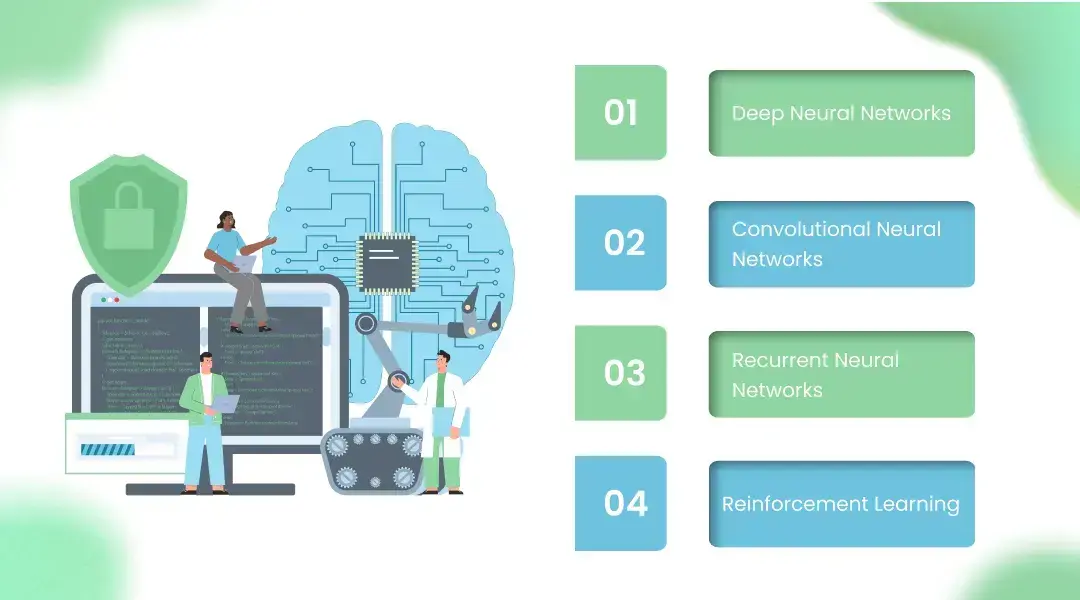
Not all neural networks are created equal. If you're evaluating a data science services company or building in-house, here's what you need in your stack:
The foundational architecture. Multiple hidden layers that process data in progressively abstract ways. Think of them as the "general intelligence" layer.
Specialized for visual data. If your autonomous system involves cameras, sensors, or any spatial data (medical imaging, satellite analysis, defect detection), CNNs are mandatory. They excel at recognizing patterns regardless of position or scale.
Built for sequential data - time series, language, sensor logs. If your system needs to remember context over time (like predicting equipment failure based on 90 days of vibration data), you need RNNs or their more sophisticated cousin, Long Short-Term Memory networks.
This is where autonomy gets really interesting. Instead of learning from labeled examples, the system learns by trial and error, optimizing for a goal. This is how AlphaGo beat world champions and how warehouse robots learn optimal picking routes.
At KriraAI, we've deployed reinforcement learning for dynamic pricing systems that adapt to competitor moves in real-time. No human analyst could move that fast.
Autonomy dies in latency.
A self-driving car that takes 3 seconds to recognize a pedestrian isn't autonomous—it's a lawsuit waiting to happen. Deep learning services must be architected for real-time inference, which means:
The system doesn't just react. It anticipates. Fraud detection models don't wait for a transaction to complete—they score risk during the transaction and block it if thresholds breach.
The moment a model detects drift (new patterns that don't match training data), it flags uncertainty and can route decisions to fail-safes or trigger retraining pipelines automatically.
I've seen this save a fintech client $400K in fraud losses in a single quarter. Their old rule-based system would've taken weeks to catch the new attack pattern.
Theory is cheap. Let's talk deployments.
Autonomous diagnostic systems analyzing radiology scans, identifying tumors with accuracy that rivals (and sometimes surpasses) human radiologists. These systems learn from every new scan they process.
Real-time quality control using computer vision. Predictive maintenance systems that anticipate machine failures before they happen, scheduling repairs during planned downtime.
This is the poster child, but it's harder than anyone admits. Full autonomy (Level 5) is still years away, but Level 3-4 systems using deep learning for autonomous systems are already on roads.
Algorithmic trading, fraud detection, credit risk modeling. Any system where speed + adaptation = competitive advantage.
Demand forecasting that adapts to black swan events (remember COVID's toilet paper shortage?), autonomous warehouse robots, dynamic pricing engines.
Let's talk ROI, because your CFO doesn't care about neural networks. They care about numbers.
Not eliminating humans—augmenting them. Your analysts stop babysitting models and start solving strategic problems.
Decisions made in milliseconds, not days. In high-frequency environments (trading, fraud detection, manufacturing), this is the difference between profit and obsolescence.
Once trained, deep learning development services can scale horizontally. One model architecture can process millions of transactions or images with minimal marginal cost.
I promised transparency, so here's the uncomfortable truth.
"Garbage in, garbage out" becomes "garbage in, autonomous garbage out." If your training data has biases, blind spots, or errors, your autonomous system will amplify them at scale.
Compute costs for training large deep learning models can hit six figures. This is why many companies partner with deep learning services providers who've already absorbed that infrastructure cost.
Autonomous systems make mistakes. And when they do, who's liable? The engineer? The company? The vendor? We're still figuring this out as an industry.
Here's what I tell prospects during discovery calls:
Building autonomous AI systems in-house is possible. But ask yourself:
Do you have the GPU infrastructure?
Can you attract (and retain) the specialized ML talent?
Do you have the institutional knowledge to avoid the 47 ways these projects fail?
If the answer is "yes" to all three, build in-house. If not, a partner like KriraAI gives you:
No off-the-shelf nonsense. We architect deep learning solutions for your specific data, your specific problem, your specific constraints.
We build with production in mind from day one. No Jupyter notebook prototypes that collapse under real-world load.
Autonomous systems aren't "set and forget." They need monitoring, retraining, and continuous improvement. We're in it for the long haul.
Autonomy isn't a buzzword. It's an engineering discipline.
If you're serious about building AI autonomous systems that don't just automate tasks but actually think, adapt, and decide, you need deep learning. Not as a feature. As the foundation.
And if you've been burned before by vendors who sold magic and delivered disappointment, I get it. We've cleaned up those messes.
At KriraAI, we don't do magic. We do engineering. Transparent, human-centric, ROI-focused deep learning services that actually work when you deploy them.
Traditional AI executes predefined rules or learns from static datasets. Autonomous AI continuously learns, adapts to new data, and makes decisions without human intervention—even in scenarios it's never seen before.
Deep learning enables hierarchical pattern recognition, continuous learning, and generalization beyond training examples. Traditional ML can't handle the complexity and adaptability true autonomy requires.
Honest answer? 4-12 months for most enterprise deployments, depending on data availability, complexity, and integration requirements. Anyone promising faster is either oversimplifying or overselling.
Any domain with high-frequency decisions, complex pattern recognition, or environments that change faster than humans can adapt: manufacturing, healthcare diagnostics, finance, autonomous vehicles, and supply chain optimization.
Look for three things: (1) Specific case studies in your industry, (2) Transparency about failure modes and limitations, (3) Post-deployment support models. If they promise 100% accuracy or "plug-and-play AI," run.
Founder & CEO
Divyang Mandani is the CEO of KriraAI, driving innovative AI and IT solutions with a focus on transformative technology, ethical AI, and impactful digital strategies for businesses worldwide.