
Build vs Buy AI: Should You Use an AI Development Agency or an In-House Team
Harbourline Logistics, the 600-person freight forwarder we will follow through this piece, has 14 weeks before peak season and a board that wants software checking every bill of lading against its customs invoice before filing. Before anyone opens a code editor, the COO has to choose who builds it, and comparing AI developer hiring models is usually the first homework on that list. That sourcing choice is the build vs buy AI question, and it decides the budget, the launch date and who controls the system three years from now.
Harbourline is illustrative, but its constraints are common. It has a two-person BI team, five clerks who check roughly 9,000 documents a month by hand, and offices in Mumbai and Rotterdam with different paperwork habits. Every Harbourline number below is an example to replace with your own.
What the Build vs Buy AI Decision Actually Covers
For a firm like Harbourline, choosing between building and buying AI means picking one of three routes: staffing its own AI team, licensing a ready-made product, or paying a development partner to build a custom checker that Harbourline owns. Most writing on the subject squeezes the last two into one bucket called buy. That hides the difference Harbourline cares about most, which is whether it rents a vendor's roadmap or holds code it can change.
Route
Harbourline hires its own AI team
What Harbourline would do
Recruit an ML engineer, a data engineer and an MLOps lead to sit beside the BI pair
Where it tends to fit
Firms whose AI logic is the thing they sell, unlike a freight checker that supports operations
Route
Harbourline licenses a document AI subscription
What Harbourline would do
Map the tool's extracted fields onto its freight forms and accept the vendor's release schedule
Where it tends to fit
Paperwork the vendor already reads for hundreds of customers with near-identical bills of lading
Route
Harbourline contracts a partner for a custom build
What Harbourline would do
Have a development firm build the checker inside Harbourline's cloud account, then take over the code
Where it tends to fit
A custom workflow facing a cutoff, like the 14-week peak season, shorter than a hiring cycle
Harbourline's rules depend on carrier quirks, such as one Rotterdam shipping line that prints container weights on page two. A rented product works only if its vendor already handles that quirk or lets you add it. If neither holds, the real choice narrows to the first and third rows.
How an Outsourced AI Project Moves From Brief to Production

A partner engagement for a system like the Harbourline checker usually runs through seven stages, from a short paid discovery sprint to a monitored live system. Each stage should leave behind something you can inspect. An in-house team follows the same seven, but only after it has been hired.
Two-week discovery sprint at Harbourline: partner engineers sit with two of the five clerks and turn each mismatch they catch by eye into a testable rule.
Audit of 1,500 archived document pairs: scan quality is graded and files with no recorded outcome are counted before any fixed quote.
Prototype limited to Rotterdam bills of lading: one document type is read and scored against decisions the clerks already made.
Frozen evaluation set: smudged stamps, two-page invoices and consignee names in Dutch become a fixed exam for every later change.
Integration into the Mumbai team's existing freight screen: flags appear where clerks already work, not on a new dashboard.
One-office launch in Rotterdam: a clerk reviews every flag for a set period before reviews drop to a sample.
Handover and drift monitoring: code, prompts, the evaluation set and runbooks move into Harbourline's repository, and accuracy alerts go to a named owner.
What 2025 Research Says About Success Rates
Studies published in 2025 point toward partnering or buying for most companies, although each measures something different and none decides Harbourline's case alone. In MIT NANDA's study The GenAI Divide: State of AI in Business 2025, efforts run with external vendors or partners succeeded in about 67% of cases, roughly double the rate the researchers saw when companies built alone. The same work counted only about one pilot in twenty producing a measurable profit-and-loss effect (the other 95% did not), so a narrow, measurable problem matters as much as the route.
Roughly three in four enterprise AI deployments in 2025 were bought from outside rather than developed internally (76%, up from 53% a year before), according to the December 2025 State of Generative AI in the Enterprise report from Menlo Ventures. Buying carries its own trap, though. Gartner forecasts that over two in five agentic AI initiatives (more than 40%) will be scrapped before 2028 as costs climb, value stays unclear or risk controls fall short, and its June 2025 estimate put genuine agentic capability at roughly 130 vendors out of the thousands using the label. Treat all of these figures as direction rather than proof, since a 40-person software firm with strong ML engineers could reasonably see the opposite pattern.
AI Agency vs In House: Six Factors Side by Side
For a first project like the Harbourline checker, a development agency usually wins on time to launch and access to specialists, while an internal team usually wins on control, domain knowledge and cost once AI work becomes a steady stream. The table applies six factors to Harbourline's situation. Read each row against your own deadline and project queue.
Factor at Harbourline
Weeks until the first live flag in Rotterdam
Harbourline's own AI team
Recruiting 3 specialists could eat most of the 14-week window
A contracted development partner
A partner with a document AI bench can start discovery 3 or 4 weeks after signing
Factor at Harbourline
Spending in years 2 and 3
Harbourline's own AI team
Payroll for 3 engineers runs whether or not a second AI project is queued
A contracted development partner
A retainer that creeps upward if each new carrier layout needs vendor hours
Factor at Harbourline
Access to narrow specialists for 2 weeks
Harbourline's own AI team
Harbourline gets only the people it managed to hire, gaps included
A contracted development partner
An OCR specialist cleans scans of the 1,500 archived pairs, then rolls off
Factor at Harbourline
Where Harbourline's freight know-how accumulates
Harbourline's own AI team
Inside the company, as engineers sit beside clerks each week
A contracted development partner
Partly with the vendor, unless Harbourline makes runbooks contract deliverables
Factor at Harbourline
Ownership of Harbourline's code and model weights
Harbourline's own AI team
Owned by Harbourline by default
A contracted development partner
Owned only if IP is assigned and repositories live in Harbourline accounts
Factor at Harbourline
Biggest single risk for Harbourline
Harbourline's own AI team
A key engineer resigns in month 5 with the half-finished pipeline in their head
A contracted development partner
The partner moves its best people elsewhere, or ships a checker Harbourline cannot run alone
Cost Over 36 Months, Not the First Quarter
Total cost of ownership, meaning everything Harbourline pays to build the checker and keep it running, is the fairest yardstick, because launch costs flatter the agency and year-three costs often flatter the internal team. Harbourline's finance lead should price both routes across 36 months, including inference fees, retraining when a carrier redesigns its forms, and hours spent reading accuracy reports. Salaried AI talent also gets pricier each year: a March 2025 Bain & Company analysis put the rise in pay for AI skills at roughly 11% a year since 2019.
Location moves these totals as much as the sourcing route does, since engineering rates vary widely between markets and coordinating Mumbai with a partner several time zones away eats into any saving. For a market-specific look at how pricing is usually structured, see our explainer on AI development cost in India. Use it to fill the partner column of your 36-month model.
The Hiring Clock Runs Before the Project Clock
An internal build cannot start until the people exist, and in 2025 the AI specialist became one of the hardest hires in technology. Just over half of the 2,015 technology leaders across 62 countries polled for the 2025 Nash Squared and Harvey Nash Digital Leadership Report (51%) said AI talent was in short supply at their organisation, compared with 28% in the previous edition. Bain & Company separately reported that 44% of executives name thin internal AI know-how as something holding back their generative AI plans, so Harbourline's 14-week deadline is close to impossible on the build route.
When Building Your Own AI Team Is the Better Bet
An internal team is usually the stronger choice when AI is the product you sell, when at least three AI projects are funded over the next 24 months, or when data cannot leave your walls under any vendor agreement. A lending startup whose credit model is its whole valuation should own every line of it, and it also needs a senior ML lead who can judge whether a model scoring 92% in testing is good enough to ship. Harbourline meets none of these tests today, so its board should be wary of an all-in hiring plan for one document checker.
When It Makes Sense to Outsource AI Development
Companies like Harbourline tend to bring in an outside firm when the deadline is shorter than a hiring cycle, when the first project is a test of whether AI pays off, or when the work needs specialists for weeks rather than years. Harbourline meets all three conditions. Its peak season will not move, its board has not seen proof, and scan cleanup is a two-week job for an OCR expert.
Early-stage firms face a sharper version of the same trade-off, because one wrong senior hire can consume a seed round's engineering budget. Founders at the Seed or Series A stage usually shortlist partners on track record with companies their size. Our guide to the Best AI software development company for startups covers what to look for.
Offshore partners add a cost lever and a coordination cost at the same time, which Harbourline would feel in its Rotterdam office first. India is a frequent choice because of its deep engineering pool and working hours that overlap with both Europe and much of Asia. The trade-offs are set out in Benefits of hiring an AI development company in India.
The Staged Hybrid: A Partner Builds, Your Team Inherits
For a mid-size company like Harbourline, the realistic answer is often a planned handover, sometimes called build-operate-transfer, where a partner ships version one while you hire the people who will own it. It costs more than either pure route for a few overlap months. Here is how Harbourline could stage it.
Weeks 1 to 14: the partner runs discovery through the Rotterdam launch, with Harbourline's BI pair attending every evaluation review.
Months 2 to 4: Harbourline hires one ML engineer, who shadows the partner and fixes at least two production bugs.
Month 6: repositories, cloud accounts and runbooks are confirmed in Harbourline's name, and the new engineer takes over on-call duty.
Months 7 to 9: the partner stays on a small retainer, then exits on a date written into the contract.
The plan fails if the partner treats documentation as an afterthought, so Harbourline ties the final payment to a handover checklist. Done well, it meets the 14-week deadline without giving up ownership. Neither pure route manages both for Harbourline.
Limitations: What a Development Partner Cannot Do for Harbourline
An outside partner can supply engineers and process, but it cannot create labels Harbourline never recorded, replace its clerks' judgement, or change how the Mumbai and Rotterdam teams work. If a third of the 1,500 archived pairs lack a record of which ones clerks rejected, someone at Harbourline must label them. That time comes out of operations, not the vendor's hours.
Adoption and accountability stay in-house as well. A checker is useless if Mumbai clerks keep filing without reading its flags, and only a Harbourline manager can make reading them part of the job. When a customs filing goes wrong, the authorities contact Harbourline, not its vendor. Many custom builds also rely on third-party model APIs whose prices and behaviour can change, a risk that neither Harbourline's own staff nor any agency fully controls.
Contract Terms That Decide Who Owns the System
Much of the long-term gap between a good and a bad agency engagement is settled in the contract, before Harbourline's first file is shared. Confirm each of these points in writing before signing. Vague wording on any of them usually resurfaces at handover.
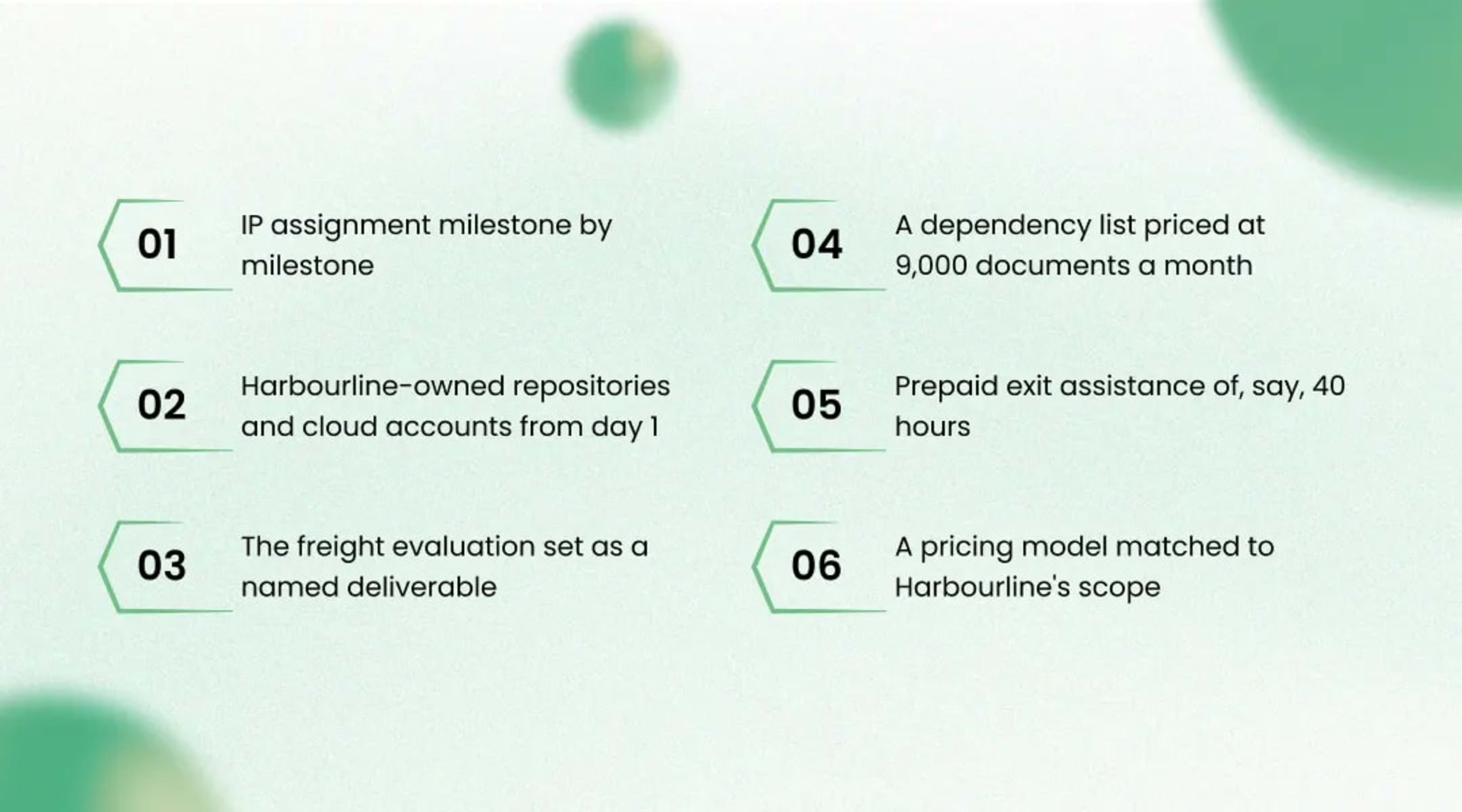
IP assignment milestone by milestone: source code, prompts, fine-tuned weights and training scripts transfer to Harbourline as each payment clears.
Harbourline-owned repositories and cloud accounts from day 1: the partner works inside them, so nothing needs migrating at exit.
The freight evaluation set as a named deliverable: the exam of smudged and two-page documents arrives with its scoring script.
A dependency list priced at 9,000 documents a month: every outside model API and paid service the checker uses, with its expected monthly cost.
Prepaid exit assistance of, say, 40 hours: handover help priced in advance, so leaving does not become a fresh negotiation.
A pricing model matched to Harbourline's scope: a fixed bid caps the budget but tempts narrow scope, time and materials needs weekly oversight, and an accuracy-linked fee works only with an agreed scoring method.
Questions to Settle Before Your AI Partner Decision
Answer these six questions in order, as Harbourline did, to narrow the field before you talk to a single vendor. Its answers appear in brackets as a worked example. If yours diverge sharply, the build route may suit you better.
Which one number proves the checker worked? (Share of mismatches caught before filing, against last quarter's rejected customs entries.)
How many AI projects will you fund over 24 months? (One confirmed and two speculative at Harbourline, which points away from a full team.)
Are Harbourline's archived documents labelled and reachable? (About a third of the 1,500 sample pairs lack a recorded outcome.)
What does each route cost across 36 months? (Harbourline prices inference, retraining and monitoring hours, not launch fees alone.)
Will 2 shortlisted partners each run a paid discovery sprint on Harbourline files? (Yes, and each must show a system still live for a client after 12 months, given Gartner's warning about rebranded agent products.)
Who owns the system in month 13? (A named Harbourline engineer, hired during the build.)
Choosing Your Route
Every company's answer depends on its deadline, its data and how many AI projects sit behind the first one, just as Harbourline's did. A partner tends to win the first project, while a team wins the fifth. If a partner-led build or a staged handover looks like the right fit, you can explore KriraAI's AI & Software Development Services and start with a scoped discovery conversation about your first use case.
FAQs
Building means your own employees design, code and run the system, while Harbourline-style buying means licensing a product or paying a partner to build one. The partner route still yields a custom checker when the contract assigns ownership. The real difference over 36 months is who carries hiring, upkeep and freight know-how.
For one project, like Harbourline's single checker, a partner is often cheaper across 36 months because there is no permanent payroll. Once a company funds 3 or more AI projects at a time, an internal team usually wins on cost per project. Price both routes over the full 36 months with inference, retraining and monitoring included.
Yes, and it is often the healthiest setup, since internal staff keep business context while the partner adds specialists such as an OCR engineer. Harbourline's two BI analysts attend every evaluation review so they can support the checker later. Write this into the statement of work, as Harbourline would.
You can if the code, model weights, prompts and evaluation set already sit in your own repositories, as Harbourline requires from day 1. Trouble starts when a partner builds on private tooling inside its own cloud, which Harbourline's contract rules out. Put exit hours, like the 40 in the Harbourline plan, and a handover date in the original contract.
A narrow first release often lands within 4 to 16 weeks, depending on data readiness, integration depth and how quickly staff review prototypes. Harbourline's 14-week plan works only because its first release covers a single Rotterdam document type. A 2-week paid discovery sprint gives a sturdier estimate than any proposal.
The contract decides ownership, and Harbourline's version assigns IP as each milestone is paid. Repositories should sit in your accounts from day 1 so nothing has to be transferred later. Ask the vendor to list in Appendix A any component it only licenses to you rather than transfers.
Many can, but Harbourline would still check where data is stored, who can access it and whether it is reused for other clients. A firm with Indian and European offices must respect both India's Digital Personal Data Protection Act and the EU's GDPR. Put residency, access and deletion terms in writing before sharing a single Harbourline shipment file.
With a planned handover, a named internal owner receives the accuracy alerts and works from the partner's runbooks, which is why Harbourline hires its engineer by month 4. Without one, you either rehire the original vendor at short notice or pay a new firm for weeks of learning the Harbourline codebase. A retainer covering months 7 to 9 is cheap insurance.
Founder & CEO
Divyang Mandani is the CEO of KriraAI, driving innovative AI and IT solutions with a focus on transformative technology, ethical AI, and impactful digital strategies for businesses worldwide.