If you are a CTO or founder planning to hire AI developers in India, finding talent is the easy part. Choosing the staffing model is harder, because that choice decides how fast you ship, who owns the code, and who carries the risk when an engineer leaves. This guide compares in-house hiring, agency teams, and freelancers on cost, risk, and skill coverage, then gives you a decision matrix you can score in about ten minutes.
Build in-house when AI is a permanent core capability, use an agency's dedicated team when you need production results within months, and use a freelancer for small, well-defined tasks with low stakes. Most of the nuance sits in the edges between those three. A seed-stage startup testing one use case, a mid-market company adding an AI feature to a mature product, and an enterprise building a platform will each land on different answers.
The rest of this guide explains why each situation leads somewhere different. You will see the real cost components behind each model, the skill gaps that stall AI projects, the risks that grow under India's new data protection rules, and a scoring matrix that turns all of it into a decision. Read it in order if you are new to AI hiring, or jump to the matrix if you already know your constraints.
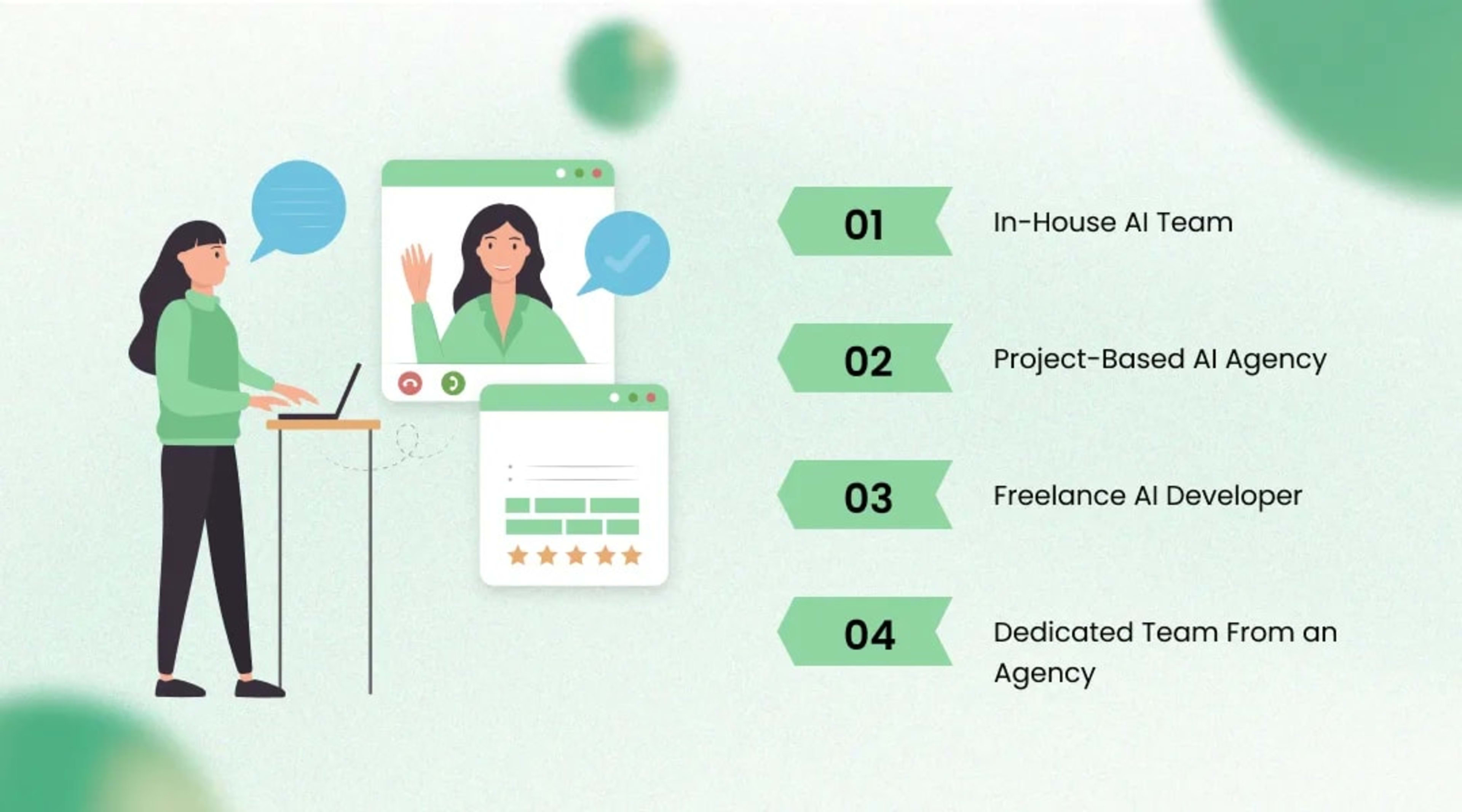
There are four practical ways to staff AI work in India: in-house employees, a project-based agency, freelancers, and a dedicated team supplied by an agency. The labels get used loosely in sales conversations, so it helps to pin them down before comparing costs. Each one shifts control, risk, and management effort to a different place.
An in-house AI team is made up of employees on your payroll who report to your leadership and work only on your products. You control priorities, culture, and long-term knowledge, and the expertise compounds inside your company over time. You also carry recruiting, salaries, statutory benefits, tooling, cloud spend, and the cost of replacing anyone who leaves.
A project-based agency takes a defined scope, staffs it from its own bench, and delivers against milestones or a fixed price. You are buying an outcome rather than people, which suits work with clear requirements and a fixed finish line. The trade-off is that scope changes usually become change requests, and the engineers may rotate to other clients once the project closes.
A freelance AI developer is an independent contractor you engage directly, often through a marketplace, for hourly or per-milestone work. Freelancers can start within days and suit narrow tasks such as a proof of concept, a single integration, or a model benchmark. The weak points are continuity and availability, and you become the project manager, the code reviewer, and the backup plan.
A dedicated team is a group of engineers employed by an agency but assigned full-time to your work, taking direction from you much like internal staff. It sits between staff augmentation, where you rent individual developers, and project outsourcing, where the vendor runs everything. You get continuity and day-to-day control without running payroll, while the vendor handles recruiting, benefits, and replacement.
Demand for AI skills in India is growing faster than the supply of engineers who can ship them, which makes senior AI hires slow and expensive. Bain & Company projected in March 2025 that AI job openings in India could pass 2.3 million by 2027, while the AI talent pool grows to roughly 1.2 million. The same Bain research found AI-related job postings rising about 21 percent a year since 2019, with salaries in the field climbing around 11 percent annually.
Pay for AI developers in India also varies widely by skill. Indeed India listed an average base salary of about ₹11.4 lakh a year for machine learning engineers as of September 2026, though that figure rests on a small sample of 49 reported salaries. Engineers with hands-on experience shipping LLM applications, retrieval pipelines, or MLOps platforms typically command well above a generalist average, depending on city and seniority.
Time to start is the other hidden constraint. Instahyre's May 2026 guide to Indian notice periods lists 90 days as typical at large IT services firms and 60 to 90 days at large product companies. If your preferred candidate is serving that notice, your project start can slip by a full quarter before onboarding even begins.
Most stalled AI projects are missing one specific skill rather than general engineering talent. Hiring managers often notice the symptom long before they name the missing role. The table below maps the roles a production AI system usually needs and what tends to go wrong when each one is absent.
Role
LLM or AI engineer
What they own
Prompting, retrieval-augmented generation (RAG), fine-tuning, agent logic
Common symptom when missing
Demos work, but answers drift or hallucinate on real queries
Role
Machine learning engineer
What they own
Model selection, training, feature work, classical ML
Common symptom when missing
Wrong model for the problem, or no baseline to compare against
Role
Data engineer
What they own
Pipelines, data quality, access to source systems
Common symptom when missing
The project waits weeks for clean, usable data
Role
MLOps engineer
What they own
Deployment, monitoring, model drift detection, cost control
Common symptom when missing
The model works on a laptop but fails or overspends in production
Role
Evaluation or AI product lead
What they own
Test sets, success metrics, acceptance criteria
Common symptom when missing
Nobody can say whether version two is better than version one
Smaller companies often hire one strong LLM engineer and expect that person to cover data pipelines, deployment, and evaluation as well. That can work for a prototype. It holds up far less often once real users, real data volumes, and uptime expectations arrive, which is why skill coverage matters as much as headcount.
Many AI candidates can build an impressive demo, but far fewer can explain how their system fails and how they measured it. Stack Overflow's 2025 Developer Survey of more than 49,000 developers found that 80 percent use AI tools in their workflows, yet trust in the accuracy of AI output fell to 29 percent. The top frustration, named by 45 percent, was AI solutions that are almost right but not quite.
The engineers you want are the ones who build evaluation sets and guardrails to catch that gap. A portfolio of demos does not show whether a candidate does this. Ask for evidence of measurement, such as accuracy before and after a change, latency budgets, or cost per thousand requests.
The cheapest model on paper is often not the cheapest route to a working production system, because each option hides different costs. Salaries, hourly rates, and monthly team fees cover different things, so comparing them directly misleads. The table below lists what each model actually includes.
Cost component
How you pay
In-house team
Monthly salary plus statutory costs
Agency dedicated team
Monthly fee per team or role
Freelancer
Hourly, daily, or per milestone
Cost component
Recruiting and notice periods
In-house team
Your cost and your delay
Agency dedicated team
Vendor's cost
Freelancer
Your search and vetting time
Cost component
Statutory benefits
In-house team
Provident fund, gratuity, insurance
Agency dedicated team
Included in the fee
Freelancer
Not applicable
Cost component
Replacement if someone leaves
In-house team
You rehire and re-ramp
Agency dedicated team
Vendor replaces, ideally under a set timeline
Freelancer
You start the search again
Cost component
Management and review
In-house team
Your engineering leaders
Agency dedicated team
Shared with a vendor project lead
Freelancer
Almost entirely yours
Cost component
Tooling, GPUs, and cloud
In-house team
Yours
Agency dedicated team
Usually billed to you, sometimes bundled
Freelancer
Yours
Cost component
Ramp-up to productive work
In-house team
Weeks to months after joining
Agency dedicated team
Days to weeks, depending on the provider
Freelancer
Days for small tasks
In-house costs in India shifted recently as well. HUB International's January 2026 bulletin on India's labour reforms notes that the four consolidated labour codes came into force in late November 2025, and that allowances above 50 percent of total remuneration must now be added back to wages for statutory calculations. The bulletin expects this to raise employer costs for provident fund, gratuity, and state insurance, and it notes that fixed-term employees now qualify for gratuity after one year instead of five.
When companies hire AI developers in India through an agency, the monthly fee usually bundles recruiting, benefits, replacement cover, and some project management. That is why a team fee looks higher than the equivalent salaries until you add those overheads back. The fair comparison is a full year of in-house cost against a full year of the engagement.
Freelancers look cheapest per hour, and for a contained task they often are. The extra cost appears later, when you spend your own time vetting, briefing, and reviewing code, or when the freelancer moves on and someone new has to learn an undocumented system. Put that management time into the budget before comparing rates.
Budgets for the build itself depend on scope, data readiness, and integration depth more than on headcount alone. For project-level estimates, KriraAI's breakdown of AI development cost in India walks through the main cost drivers by project type. Pair it with the table above so you compare total cost to production instead of a rate against a salary.
Each model concentrates risk in a different place: in-house hiring risks slow starts and key-person loss, agencies risk vendor quality and lock-in, and freelancers risk continuity. Knowing where your risk sits tells you which contract terms and checks matter most. The table compares the six risks that come up most often in AI staffing decisions.
Risk
Key-person risk
In-house team
High in small teams
Agency dedicated team
Lower, since the vendor holds bench depth
Freelancer
Very high
Risk
Speed to start
In-house team
Slow because of hiring and notice periods
Agency dedicated team
Fast once scoped
Freelancer
Fastest for small work
Risk
Code and IP ownership
In-house team
Clear by default
Agency dedicated team
Depends on the contract
Freelancer
Depends on the contract
Risk
Quality control
In-house team
Depends on your leadership
Agency dedicated team
Depends on the vendor's process
Freelancer
Depends on your review
Risk
Data protection exposure
In-house team
Inside your controls
Agency dedicated team
Shared, governed by contract
Freelancer
Hardest to enforce
Risk
Vendor lock-in
In-house team
None
Agency dedicated team
Moderate without a handover clause
Freelancer
Low, but knowledge leaves with them
Who builds the system also appears to affect whether it reaches production. MIT NANDA's report The GenAI Divide: State of AI in Business 2025, as reported by Fortune in August 2025, found that purchasing AI tools from specialized vendors and building partnerships succeeded about 67 percent of the time, while internal builds succeeded only about one-third as often. Critics have questioned the study's narrow definition of success, so read it as a signal that experienced external teams can shorten the path to production rather than proof that outsourcing wins by default.
Vendor quality is the counterweight. Gartner predicted in June 2025 that over 40 percent of agentic AI projects could be canceled by the end of 2027 because of escalating costs, unclear business value, or inadequate risk controls. Gartner also estimated that only about 130 of the thousands of vendors marketing agentic AI offer genuine agentic capabilities, a practice it calls agent washing, so vetting the agency matters as much as choosing the model.
If your AI system handles personal data of people in India, outsourcing development does not outsource your legal responsibility. The Digital Personal Data Protection Rules, 2025 were notified on 13 November 2025, and most operational obligations phase in by May 2027, according to Taxmann's analysis of the Act and Rules. Under the Act, the data fiduciary (usually you) remains responsible for compliance even when a data processor such as an agency or freelancer handles the data.
Taxmann's analysis also notes that your contract with a processor should require reasonable security safeguards. Failing to take such safeguards can attract a penalty of up to ₹250 crore under the Act. In practice, this favors partners who can work inside your cloud environment, restrict data access to named engineers, and sign a proper data processing clause, which is much harder to enforce with a loosely contracted individual.
Hire in-house when AI is a permanent core capability you will build on for years, and choose a dedicated agency team when you need production results within months or lack senior AI leadership to hire and manage engineers. Many companies eventually run both. The question is which one should come first for your current stage.
An in-house team pays off when the AI itself is part of what customers buy from you. If your models, data, and evaluation methods are your competitive advantage, that knowledge should live with employees who will stay. It also helps if you already have a senior AI or ML leader who can hire, review work, and set technical direction.
AI is a core product capability, not a supporting feature
You have a committed multi-year budget and roadmap
You already have a senior technical leader for AI
You can absorb a hiring and onboarding cycle of several months
A dedicated team fits when speed and skill coverage matter more than building headcount. You get a ready combination of LLM, data, and MLOps skills on day one, which is hard to assemble quickly through individual hires. It also gives you a working system and documentation to hand to future employees if you later decide to build internally.
You need a production release within a quarter or two
You need several specialist skills but cannot justify several full-time hires yet
You lack an internal AI leader to recruit and review candidates
You want the option to scale the team up or down by project phase
One honest caveat applies here. If nobody in your company can describe what a successful output looks like, an external team will build quickly in an unclear direction. Assign an internal owner for product decisions and acceptance criteria before you sign, whichever model you pick.
For a small, clearly scoped task with low stakes, a freelancer is usually the faster and cheaper choice, while anything that will run in production, touch customer data, or need ongoing support is safer with an agency. The dividing line is less about budget and more about what happens after delivery. A one-off benchmark ends on handover, whereas a customer-facing assistant needs monitoring, retraining, and someone on call.
Freelancers work best when you can review their output yourself. If you have an experienced engineer who can read the code, test the model, and own it afterwards, a freelancer is a sensible way to add capacity. Founders who hire AI developers as freelancers without that reviewer often end up paying twice, once for the build and again for a rescue.
Early-stage companies without engineers face a sharper version of this choice, because there is no one internal to review the work. KriraAI's guide on AI for startups without a tech team covers how founders can scope and launch a first use case in that situation. The short version is that the less technical oversight you have, the more you need a partner that brings its own review process.
Mark one column for each factor below, and the column with the most marks is your starting model. Treat it as a structured conversation starter rather than a formula. Two factors deserve double weight, as explained in the steps after the table.
Factor
Time to first production release
Points to in-house
9 months or more is acceptable
Points to dedicated team
Within 3 to 6 months
Points to freelancer
Within weeks, small scope
Factor
Scope stability
Points to in-house
Evolving, long-term roadmap
Points to dedicated team
Evolving, but with near-term milestones
Points to freelancer
Fixed and well-defined
Factor
AI as core IP
Points to in-house
Central to your product
Points to dedicated team
Important but not your main moat
Points to freelancer
Peripheral or experimental
Factor
Internal AI leadership
Points to in-house
Senior AI lead already in place
Points to dedicated team
Limited or none
Points to freelancer
Strong reviewer available
Factor
Budget horizon
Points to in-house
Multi-year commitment
Points to dedicated team
6 to 18 months, flexible
Points to freelancer
Single task or short sprint
Factor
Data sensitivity
Points to in-house
Highly sensitive, strict residency
Points to dedicated team
Sensitive, manageable by contract
Points to freelancer
Low or synthetic data
Factor
Ongoing maintenance
Points to in-house
Continuous, in-house ownership
Points to dedicated team
Continuous, external support acceptable
Points to freelancer
Little after delivery
Factor
Hiring capacity
Points to in-house
Recruiting team and employer brand ready
Points to dedicated team
Little time to recruit
Points to freelancer
Not relevant
Read each row and mark the column that best matches your situation today, not your situation in two years.
Count internal AI leadership and data sensitivity twice, because they decide who can review the work and who carries legal risk.
Total the marks per column and treat the winner as your starting model.
If two columns tie, pick the one that is easier to exit, and plan a review after the first production release.
Teams that hire AI developers in India for regulated products, such as healthcare or lending, should pay special attention to the data sensitivity row. A strict residency requirement can rule out freelancers entirely and push you toward partners who deploy inside your own cloud account. It can also tip a close score toward in-house hiring if your regulator expects direct employee accountability.

A dedicated team engagement typically moves through six stages, from scoping to handover, and knowing them helps you spot a vendor who skips one. The order matters because each stage produces something the next one depends on. A vendor that jumps straight to building usually pays for it later in rework.
Discovery and readiness. The team maps your workflows, data sources, and constraints, then agrees on one or two use cases with measurable success criteria.
Team design. Roles are chosen to match the work, for example an LLM engineer, a data engineer, and an MLOps engineer under a project lead, instead of a generic headcount.
Onboarding and access. Accounts, repositories, and cloud environments are set up with least-privilege access, and the data processing terms are signed before real data moves.
Sprint delivery with evaluation. Work ships in short sprints, and each release is tested against an evaluation set and business metrics, not only against a demo.
Deployment and monitoring. The system goes live with logging, guardrails, and monitoring for accuracy, model drift, latency, and cost.
Scale, support, or transfer. The team grows, shrinks to a support role, or hands over to your employees with documentation and recorded walkthroughs.
KriraAI's dedicated team model assigns engineers, data scientists, and a project lead to work as an extension of your team, inside a five-stage delivery process that runs from discovery to post-launch monitoring. KriraAI is an AI development and consulting company headquartered in Surat, Gujarat, founded in 2022, and it reports more than 100 delivered projects for clients in India, the USA, and other markets. The dedicated team is one of three engagement options it publishes, alongside a fixed-scope pilot and an ongoing support and optimization arrangement.
The process follows five stages: discovery and AI readiness, solution architecture with cost estimates, development and training on real data, integration and deployment, and monitoring and optimization. KriraAI states that most projects take 4 to 16 weeks from discovery to deployment, and that pilots move faster because they focus on a single use case. Pricing is quoted after discovery, so the scope is defined before you commit to a budget.
For data protection, KriraAI states that only the team building your system can access your data, and that models can run inside your own cloud environment on AWS, Google Cloud, or Azure. Each engagement has a dedicated account manager, and communication is aligned to the client's time zone. The engineering stack it lists includes PyTorch, Hugging Face, LangGraph, and CrewAI, which covers most current LLM, agent, and classical ML work.
Outsourcing AI work is the wrong choice when the AI itself is your main competitive moat, when your data cannot leave your own controlled environment under any arrangement, or when no one internal can own product decisions. External teams are strong at building and operating systems. They are weaker at substituting for strategy, data quality, or leadership that the client has to supply.
Strategy and ownership. A vendor cannot decide what your product should do or which trade-offs your customers will accept.
Poor data. No team can make a model accurate on data that is incomplete, mislabeled, or inaccessible, and data cleanup often takes longer than the model work.
Long-term cost. Over a stable, multi-year roadmap, a well-run in-house team can cost less than a permanent external team.
Knowledge retention. Without documentation and a handover clause, important knowledge about your system can stay with the vendor.
Time-zone friction. India's working hours overlap well with Europe and the Middle East but only partly with the Americas, so US clients may need agreed overlap windows.
In-house and freelance models have their own ceilings, covered in the risk table above. The point of this section is narrower: an agency team is a delivery tool, and it will not compensate for a missing product owner or unusable data. Fix those two gaps first, and any of the three models becomes easier to run.
The fastest way to vet an AI developer or agency is to ask how they measure and fix failures, and then check the contract for ownership, data, and exit terms. A credible team answers with specific numbers and named methods. Vague answers about using the latest models are a warning sign.
Show me a system you shipped that real users still rely on, and tell me what broke in the first month.
How did you build the evaluation set, and what accuracy did you reach before and after your last major change?
How do you detect model drift or rising cost per request after launch?
When would you recommend not using an LLM for this problem?
Who replaces an engineer who leaves, and how long does that take?
What does your handover package include if we bring the work in-house?
Many disputes with AI vendors and freelancers trace back to terms that were never written down. Settle these before work starts. Have your own counsel review the final draft, since this guide is not legal advice.
IP assignment of code, prompts, model weights, fine-tuning data, and evaluation sets to your company
Confidentiality and a data processing clause that requires reasonable security safeguards, in line with the DPDP Rules
Access controls naming who can touch production data and where it is stored
Replacement terms for departing engineers, including a target timeline
Knowledge transfer and documentation obligations at each milestone, not only at the end
Exit clause with a notice period and a defined handover of repositories and credentials
Many companies change staffing models as AI moves from experiment to core product, and the switch goes smoothly only when documentation and ownership were planned from the start. A freelancer-built prototype that proves value often moves to a dedicated team for production hardening. A dedicated team that has shipped a stable platform may later hand parts of it to an internal team.
A hybrid setup is common at the middle stage. An internal AI lead owns architecture, priorities, and evaluation, while an external team supplies specialist capacity such as data engineering or MLOps. This keeps strategic knowledge in-house and keeps hiring pressure manageable while the roadmap is still changing.
Plan the exit on day one, even if you never use it. Ask for architecture decision records, runbooks, and recorded walkthroughs as part of normal delivery. That way, moving the work in-house becomes a scheduled transition rather than a rescue project.
The right way to hire AI developers in India is the model that matches your timeline, your internal leadership, and your data risk today, with a clear path to change later. Score the decision matrix honestly, settle IP and data terms before anyone writes code, and make sure someone inside your company owns the product decisions. If the matrix points to a dedicated team, start with a scoped pilot so you can judge the partner on real output.
Partners differ widely in process, access controls, and the skills they can staff. If you want a team that covers LLM engineering, data, and MLOps under one project lead, explore KriraAI's AI & Software Development Services and request a discovery session. You will get a defined scope and a quote before you commit to a budget.
A dedicated team is a full group assigned to your work, usually with a project lead and complementary skills, while staff augmentation adds individual developers to a team you already manage. With augmentation, you own all coordination and technical direction. With a dedicated team, the vendor shares delivery management and handles replacements.
Direct hiring of a senior AI engineer can take several months once you include sourcing, interviews, and notice periods, which Instahyre lists as typically 90 days at large IT services firms. An agency team can often begin within days to weeks after scoping, depending on the provider. Freelancers can usually start fastest, but only for narrow tasks.
For short or uncertain timelines, an agency is often cheaper once you count recruiting, statutory benefits, replacement costs, and management time. For a stable, multi-year roadmap with an internal AI leader already in place, an in-house team can cost less over time. Compare a full year of total cost for each option rather than a monthly fee against a salary.
A skilled freelancer can build one, but running it in production also needs monitoring, retraining, security reviews, and on-call support. Those ongoing duties are hard for one independent contractor to guarantee. Freelancers fit production work best when you have an internal engineer who can review and own the system afterwards.
Many Indian providers offer agreed overlap hours with clients in Europe, the Middle East, and North America. Overlap with Europe is usually easy, while US clients often settle on a shared window of a few hours each day. Confirm the overlap hours, meeting rhythm, and escalation contacts in writing before the engagement starts.
Ownership depends entirely on the contract, so the agreement should assign code, model weights, prompts, training data, and evaluation sets to your company. Without an explicit IP assignment clause, ownership can be unclear or disputed later. Ask for this clause before any work begins, not at handover.
Yes, and many companies plan it that way from the start. The transition works best when the contract requires ongoing documentation, recorded walkthroughs, and a defined handover of repositories and credentials. Some teams hire their first internal AI lead during the engagement so that person can shadow the external team.
An outsourced team can work with sensitive data if access is restricted, the work runs inside your controlled environment, and a data processing agreement is signed. Under India's DPDP framework, your company remains responsible for compliance even when a vendor processes the data. Choose a partner that can deploy inside your own cloud account and limit access to named engineers.
A small team usually needs an LLM or ML engineer, a data engineer, and someone who owns deployment and monitoring, even if one person covers two roles at the start. An internal owner for success metrics and acceptance criteria matters just as much. Skipping data engineering or evaluation is a frequent reason AI prototypes stall before production.
With an agency, the vendor normally replaces the engineer from its bench, and the contract should state a target timeline for that replacement. Good documentation and shared code reviews reduce the knowledge lost during the change. With freelancers or a very small in-house team, the same departure can pause the project entirely.
Ridham Chovatiya is the COO at KriraAI, driving operational excellence and scalable AI solutions. He specialises in building high-performance teams and delivering impactful, customer-centric technology strategies.
