AI development cost in India runs from about ₹1 lakh for a short discovery sprint to well over ₹2 crore for an enterprise platform, and most business projects land somewhere between ₹5 lakh and ₹40 lakh. The spread is wide because "AI" covers everything from a website assistant that answers FAQs to a camera system that inspects parts on a production line. This guide breaks the numbers down by project type, shows which costs sit outside a vendor's quote, and gives you a way to turn any proposal into a realistic first-year budget.
The price bands below are compiled from rate cards and pricing guides that Indian AI development firms published during, cross-checked against each other. They are indicative ranges, not quotes, and your final figure will move with your data, your integrations and how much damage a wrong answer can do. Use them as a sanity check for the proposals on your desk rather than as a price list.
In India, a typical AI build in India costs ₹3 lakh to ₹10 lakh for a simple assistant, ₹10 lakh to ₹40 lakh for a production system wired into your business tools, and ₹50 lakh or more for multi-model or on-premise platforms. The table gives you the starting band for each common project type. Find the row closest to what you want to build, then read the cost drivers section to see where in that band you are likely to land.
Project type
Discovery sprint or proof of concept
Typical build cost (INR)
₹1L to ₹6L
Typical timeline
2 to 6 weeks
Best fit for
Testing feasibility before a large commitment
Project type
FAQ or customer support chatbot
Typical build cost (INR)
₹3L to ₹10L
Typical timeline
3 to 8 weeks
Best fit for
Website or WhatsApp query handling
Project type
AI agent (multi-step workflow)
Typical build cost (INR)
₹8L to ₹30L
Typical timeline
4 to 12 weeks
Best fit for
Tasks that read, decide and update other systems
Project type
RAG knowledge assistant
Typical build cost (INR)
₹10L to ₹35L
Typical timeline
6 to 12 weeks
Best fit for
Staff questions answered from internal documents
Project type
Predictive machine learning model
Typical build cost (INR)
₹10L to ₹40L
Typical timeline
8 to 20 weeks
Best fit for
Forecasting, churn, fraud and pricing
Project type
Document AI
Typical build cost (INR)
₹12L to ₹35L
Typical timeline
8 to 14 weeks
Best fit for
Invoices, KYC files, claims and purchase orders
Project type
Voice AI agent
Typical build cost (INR)
₹15L to ₹40L
Typical timeline
8 to 16 weeks
Best fit for
Inbound and outbound calls in Indian languages
Project type
Computer vision system
Typical build cost (INR)
₹20L to ₹60L
Typical timeline
10 to 24 weeks
Best fit for
Quality inspection and safety monitoring
Project type
Enterprise or on-premise AI platform
Typical build cost (INR)
₹50L to ₹2Cr+
Typical timeline
4 to 12 months
Best fit for
Several AI capabilities under strict data control
All figures exclude 18% GST and ongoing running costs, both covered further down. The ranges overlap on purpose, because a tightly scoped agent can cost less than a sprawling chatbot with six languages and four integrations. Project type sets the starting band, and the cost drivers decide your position inside it.
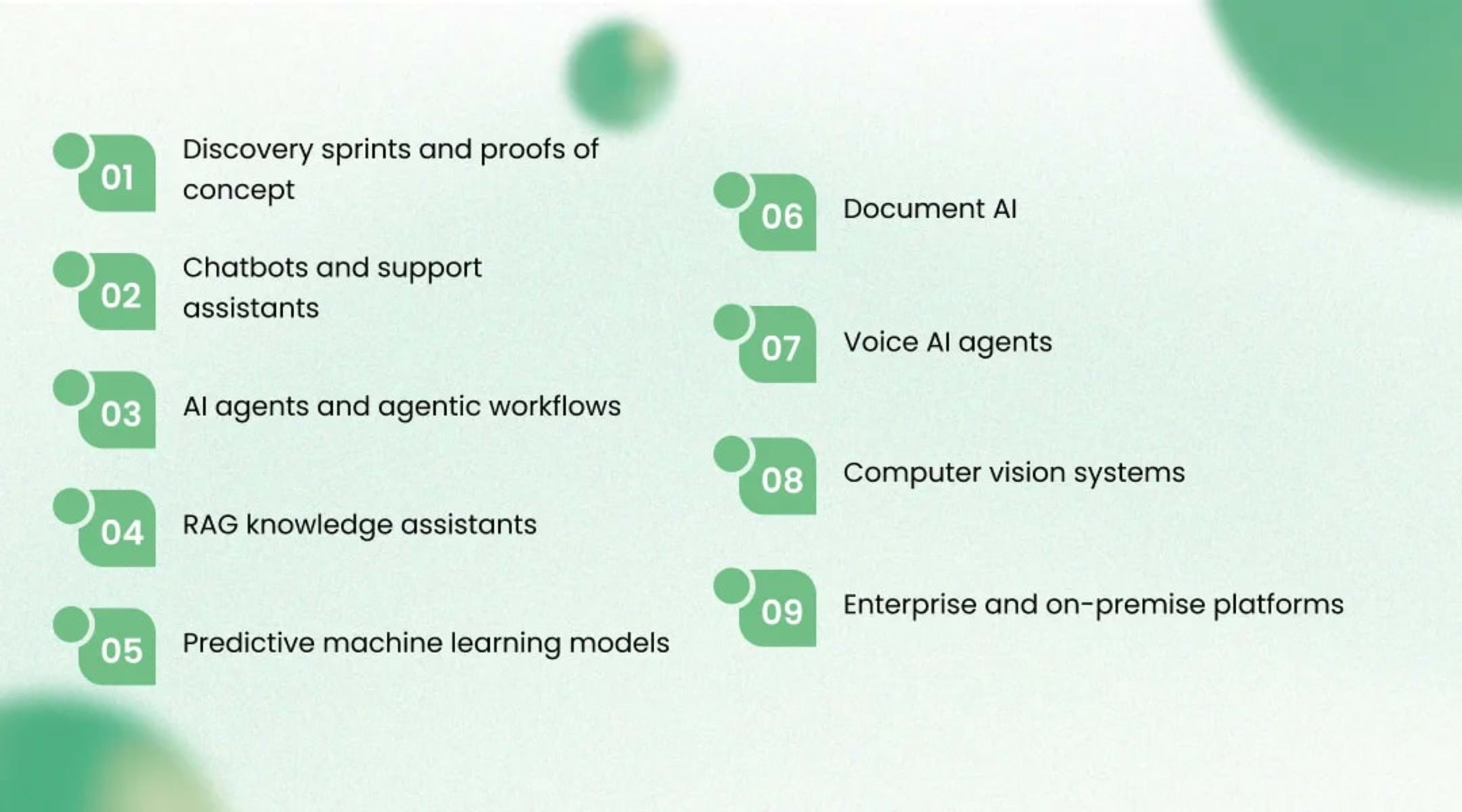
The kind of system you build sets your starting price, so it helps to know what each band actually pays for. The sections below follow the table, from the smallest commitment to the largest. Each one explains what pushes a build toward the bottom or the top of its range.
A proof of concept (PoC) is a small, time-boxed build that checks whether AI can solve your problem with the data you actually have. It usually touches one data source, runs on sample inputs rather than live traffic, and ends with a written go or no-go recommendation. Some vendors fold a readiness assessment into this phase, which is why the lowest quotes start near ₹1 lakh.
This is the cheapest insurance you can buy in AI. Gartner predicted in July 2024 that at least 30% of generative AI projects would be abandoned after the proof-of-concept stage by the end of 2025, pointing to poor data quality, weak risk controls, rising costs and unclear business value. Learning that your idea does not work for ₹4 lakh is far better than learning it for ₹40 lakh.
Most business chatbots today run on a large language model (LLM) accessed through an API and grounded in your own FAQs, policies and product data. At the lower end you get one channel, English only, and a handoff to email when the bot is unsure. The upper end adds WhatsApp alongside the website, Hindi or a regional language, CRM integration, lead capture and live escalation to a human agent.
An AI agent does more than answer questions, because it takes actions such as updating a CRM record, raising a support ticket or drafting a quotation. Every action needs guardrails, which means permission checks, confirmation steps for risky moves, activity logs and a way to undo mistakes. The number of systems the agent can act on is the single biggest driver of where your quote lands.
Retrieval-augmented generation (RAG) means the assistant searches your own documents first and answers from what it finds, which cuts down on invented answers. The budget goes into cleaning and splitting documents, setting up a vector database for search, building access controls so staff only see what they are cleared to see, and creating a test set to check answer quality. A shared drive full of outdated policy versions with nothing marking the current one will push you toward the top of the range.
Predictive models are the classic side of AI: demand forecasting, churn prediction, credit scoring and fraud detection built on your historical, structured data. Cost depends on how clean and how long that history is, how many data sources need joining and how often the model must be retrained. Retraining matters because customer behaviour shifts over time, and a model that is never refreshed slowly loses accuracy, a problem known as model drift.
Document AI combines optical character recognition (OCR) with extraction logic to pull fields out of invoices, bank statements, KYC files or insurance claims and push them into your ERP. Each new document layout adds engineering and testing work, and scanned or handwritten pages cost more than clean digital PDFs. The accuracy target matters too, since moving from 95% to 99% field accuracy usually needs more training examples, more edge-case handling and a human review step for low-confidence fields.
A voice agent chains speech-to-text, a language model, text-to-speech and a telephony connection, and all four have to respond fast enough that callers do not talk over the bot. Indian languages and code-mixed speech such as Hinglish need extra tuning and testing with real call recordings. For voice, the per-minute running cost after launch can matter as much as the build fee, so ask for both numbers together.
Computer vision systems detect defects, missing safety gear, stock levels or vehicle movements from camera feeds. They are expensive mainly because they need thousands of labelled images that reflect your real lighting, angles and camera quality. Edge hardware to run models next to the cameras is usually quoted separately, so confirm whether your figure includes it.
Enterprise platforms bundle several AI capabilities on shared data pipelines, with central monitoring, governance and access control. On-premise deployments, where models run on your own servers, add GPU hardware and a longer setup but keep sensitive data inside your network. Banks, hospitals and government bodies often choose this route because their regulators or internal policies limit where data can go.
Almost every AI project moves through the same six stages, and data preparation plus integration usually absorb more of the budget than the model itself. Knowing the stages lets you check whether a proposal has funded each one. Here is the pipeline in the order the work happens.
Discovery and scoping. The team defines the problem, agrees on a measurable success metric, lists every system involved and audits a sample of your data.
Data preparation. Data is collected, cleaned, deduplicated and labelled. Pricing guides published by Indian AI vendors estimate this stage at anywhere from 20% to 60% of the total when data is not already in good shape.
Model selection and build. The team picks an approach (an API model, a fine-tuned open-source model or a custom-trained model), then builds the prompts, retrieval layer or training pipeline.
Integration. The AI is connected to your CRM, ERP, WhatsApp, telephony or databases, with authentication, error handling and retry logic.
Evaluation and testing. A test set built from real questions or real records measures accuracy, then edge cases, security and load are tested.
Deployment and monitoring. The system goes live with logging, cost tracking, drift alerts and a retraining schedule, a discipline usually called MLOps.
If a proposal spends most of its money on stage three and almost nothing on stages two and five, it is probably pricing a demo rather than a working system. A demo uses curated inputs and a friendly audience, so it hides exactly the problems that cost money later. Ask the vendor to show you the effort allocated to each stage before you compare totals.
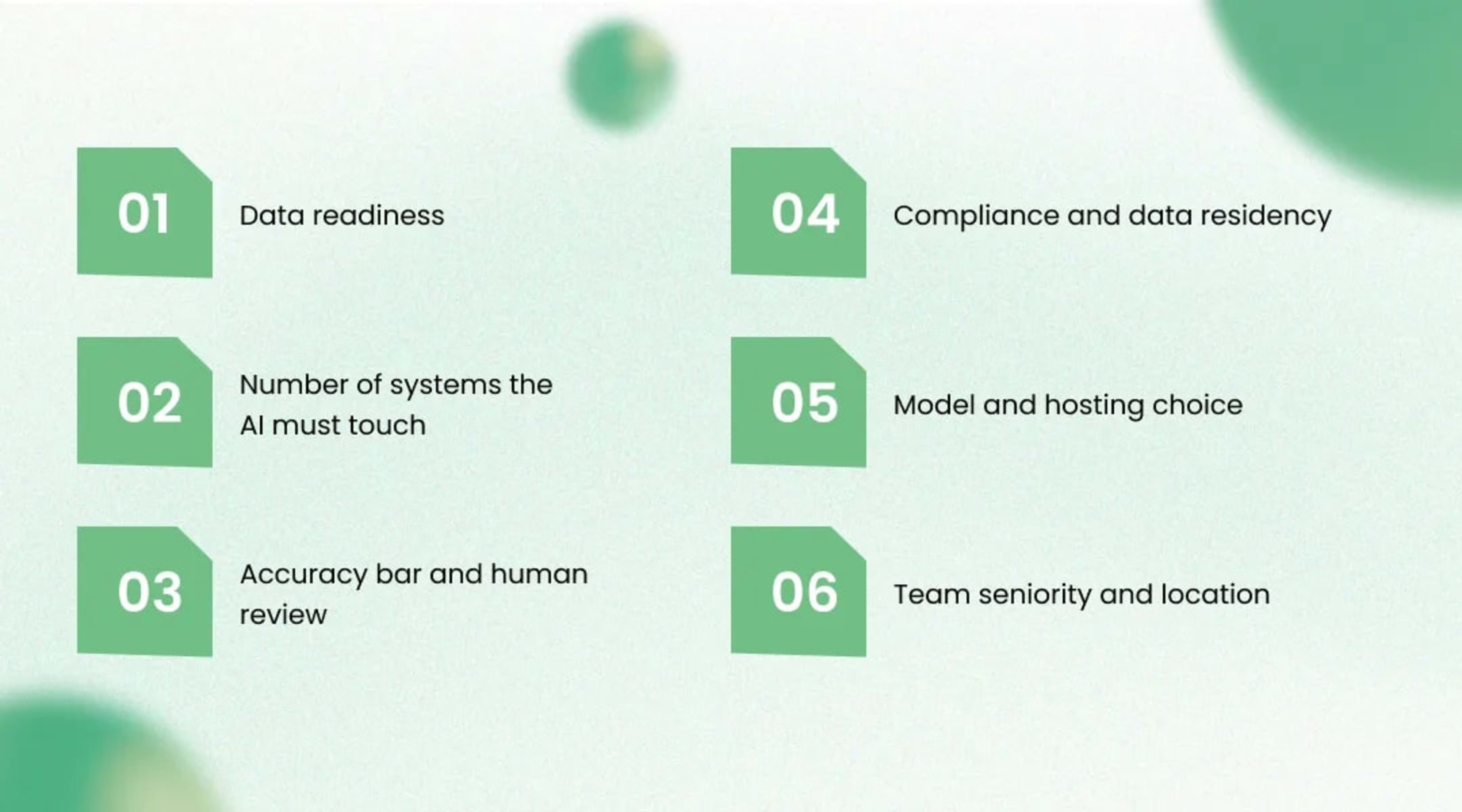
Six factors explain most of the gap between a ₹5 lakh quote and a ₹50 lakh quote: data readiness, the number of systems involved, the accuracy bar, compliance, hosting choice and team seniority. Most of them can be assessed internally before you speak to any vendor. Working through them first gives you a much sharper sense of which band you belong in.
"We have the data" usually means the data exists somewhere, not that it is complete, current, labelled and consistent. Duplicate customer records, scanned PDFs with no text layer and three versions of the same policy all add weeks of preparation. A quick internal audit of one representative data source will tell you more about your eventual price than any calculator.
Each system your AI reads from or writes to brings its own login method, data format, failure modes and internal owner whose sign-off you need. Pricing guides from Indian vendors suggest that connecting to older systems such as legacy ERPs can add 15% to 30% to a build. Two integrations make a straightforward project, while six make a different project altogether.
A tool that drafts internal summaries can tolerate the odd mistake, but one that approves refunds or flags fraud cannot. Higher accuracy targets need larger test sets, more edge-case engineering and a human-in-the-loop step where a person checks low-confidence outputs. Decide early which decisions the system may take alone and which it must escalate, because that boundary shapes both build and running costs.
The Ministry of Electronics and Information Technology notified the Digital Personal Data Protection (DPDP) Rules on 14 November 2025, with an 18-month phased rollout that brings the main consent, security and breach-reporting duties into force around May 2027. Separately, the Reserve Bank of India's April 2018 directive on payment system data requires that data to be stored only in India. Designing consent records, deletion across every data store and India-based hosting in from day one costs far less than retrofitting them, and vendor guides suggest regulated projects run 20% to 40% above the base estimate.
Calling a commercial model through an API is the fastest and cheapest way to build, but you pay for every request after launch. Self-hosting an open-source model costs more upfront and needs GPU infrastructure, yet it can lower per-request costs at high volume and keeps data inside your boundary. The right answer depends on your expected traffic and your data rules, so ask vendors to model both options over two or three years.
Rate cards published by Indian development firms put AI engineers at roughly ₹1,500 to ₹8,000 per hour depending on seniority and specialisation. A senior architect who scopes the problem correctly in week one can save more money than a cheaper team that discovers the hard parts in month three. Look at who will actually work on your project, not just the blended rate on the proposal.
The build fee is rarely your full bill, because GST, model usage, hosting, monitoring and human review all arrive after the contract is signed. Budget owners who plan only for the build tend to run short within the first year. These are the lines to add before you take a number to your finance team.
Under India's GST law, custom software development and other IT services fall under SAC heading 9983 and are taxed at 18% when the client is in India. Services supplied to clients outside India are treated as exports and zero-rated, so overseas buyers do not pay this tax. If your business is GST-registered and uses the system for business purposes, you can generally claim input tax credit on the GST paid, which means the tax hits cash flow more than final cost.
Every live AI system has recurring costs, and the table below lists the usual lines. Pricing guides from Indian vendors put annual running costs at roughly 15% to 40% of the original build, depending on usage and how critical the system is. Ask each vendor for a month-by-month estimate at your expected volume, not a single annual figure.
Running cost line
Model inference
What it covers
API token charges or GPU time for each request
What makes it grow
More users, longer conversations, larger models
Running cost line
Hosting and storage
What it covers
Servers, vector database and backups
What makes it grow
Bigger document libraries and higher traffic
Running cost line
Monitoring and support
What it covers
Error alerts, bug fixes and uptime checks
What makes it grow
Stricter uptime targets and more integrations
Running cost line
Retraining and updates
What it covers
Refreshing models as data and policies change
What makes it grow
Fast-changing products, prices or rules
Running cost line
Human review
What it covers
Staff checking outputs the system escalates
What makes it grow
Higher-risk decisions and stricter accuracy needs
If your project involves training or self-hosting models, GPU time can become a major cost line. Under the IndiaAI Mission, which the government approved with an outlay of ₹10,371.92 crore, eligible startups, MSMEs, researchers, academic institutions and government bodies can apply for subsidised GPU access through the IndiaAI Compute Portal. Business Standard reported in June that this compute is available at around ₹65 per GPU-hour, with vouchers typically covering 40% to 60% of compute costs.
Not every company qualifies, and allocation depends on eligibility and the hours requested. For most projects built on commercial APIs, GPU time is not the main expense anyway. It is worth checking, though, if you plan to fine-tune or host your own models.
How you contract the work changes your final bill almost as much as what you build, because each engagement model shifts risk between you and the vendor. A fixed price feels safe, but vendors protect themselves with padding when scope is unclear. The table summarises the four common structures.
Engagement model
Fixed price
How billing works
One price tied to agreed milestones
Works best when
Scope is clear and data has been checked
Who carries the risk
Vendor, who prices in a buffer
Engagement model
Time and materials
How billing works
Hourly or per sprint
Works best when
Requirements will evolve during the build
Who carries the risk
You, so tracking matters
Engagement model
Dedicated team
How billing works
Monthly fee per team member
Works best when
AI is a long-term roadmap, not one project
Who carries the risk
Shared, with you directing the work
Engagement model
Phased hybrid
How billing works
Fixed-price discovery, then capped sprints
Works best when
Most first AI projects
Who carries the risk
Shared, with exit points at each phase
For a first project, the phased hybrid is often the most balanced option. You pay a small fixed fee to inspect your data and confirm feasibility, then fund the build in capped stages with clear exit criteria. If the discovery phase shows the idea will not work, you stop with a written report instead of a half-built system.
Dedicated teams suit companies that see AI as an ongoing capability rather than a one-off purchase. You keep control over priorities while the partner handles hiring, retention and replacement. Wondering how to set that up without overpaying for the wrong profiles? Our walkthrough, Hire AI developers in India, covers that route in more detail.
For comparable work, AI developer rates in India sit well below those in the US and Western Europe, which is the main reason global companies build AI here. The table uses hourly rate ranges published by outsourcing firm SunTec India in its 2025 AI cost breakdown. Treat these as broad ranges, since rates within each region vary widely by city, seniority and specialisation.
Region | Typical AI developer rate (USD per hour) |
United States and North America | $100 to $250 |
Western Europe | $80 to $200 |
Eastern Europe | $50 to $120 |
India and Southeast Asia | $25 to $70 |
A lower rate buys more engineering hours for the same budget, but it does not buy a shorter path. Lower rates are why AI development cost in India looks attractive, but the budget still has to cover data work, evaluation and monitoring, and a vendor offering both a low rate and a compressed timeline is usually skipping one of them. Quality also varies sharply between Indian vendors, so the rate gap only pays off if you choose the team carefully.
In the three illustrative scenarios below, first-year spend lands at roughly 1.75 to 1.9 times the headline build fee once GST, support, usage and internal review time are added. These are hypothetical examples built from the price bands in this guide, not client figures or quotes. They exist to show how the extra lines stack up against the headline figures for AI development cost in India.
The first scenario is a retail brand adding a support assistant on its website and WhatsApp, in English and Hindi, linked to its store platform. The second is a mid-sized manufacturer automating invoice and purchase-order capture into its ERP, with a person checking low-confidence fields. The third is a non-banking financial company (NBFC) running a bilingual voice agent for payment reminders, hosted entirely in India to meet its data policies.
Line item
Build fee
Retail support assistant
₹6,00,000
Manufacturer document AI
₹22,00,000
NBFC voice agent
₹32,00,000
Line item
Year-one support retainer
Retail support assistant
₹90,000
Manufacturer document AI
₹3,96,000
NBFC voice agent
₹6,40,000
Line item
GST at 18% on vendor fees
Retail support assistant
₹1,24,200
Manufacturer document AI
₹4,67,280
NBFC voice agent
₹6,91,200
Line item
Model usage, hosting and telephony
Retail support assistant
₹2,40,000
Manufacturer document AI
₹4,80,000
NBFC voice agent
₹12,00,000
Line item
Internal review and QA time
Retail support assistant
Nil
Manufacturer document AI
₹3,00,000
NBFC voice agent
₹4,00,000
Line item
First-year total
Retail support assistant
₹10,54,200
Manufacturer document AI
₹38,43,280
NBFC voice agent
₹61,31,200
Line item
Multiple of build fee
Retail support assistant
1.76x
Manufacturer document AI
1.75x
NBFC voice agent
1.92x
The voice agent carries the highest multiple because call minutes, speech processing and telephony charges grow with every conversation. If all three businesses are GST-registered and claim input tax credit, the GST line moves back off the final cost, though it still affects cash flow. Run this same exercise on any proposal you receive and you will rarely be surprised by month six.
No budget, however large, buys guaranteed accuracy, a fix for data you do not have or a system that never needs human oversight. These limits apply across vendors and price bands. Knowing them upfront protects you from proposals that promise otherwise.
Accuracy cannot be promised in advance. Accuracy is measured against a test set built from your data, so any percentage quoted before that test set exists is borrowed from someone else's project.
Money does not replace missing data. If the records needed to train or ground a system do not exist, no amount of engineering will invent them, and the honest first step is collecting them.
Human review shrinks but rarely disappears. Systems that make consequential decisions need a person checking the uncertain cases, and that time is a permanent budget line.
Price bands age quickly. Model pricing, exchange rates and hardware costs shift every few months, so any figure for AI development cost in India, including the ones in this guide, needs rechecking against fresh quotes.
AI is sometimes the wrong tool. Many problems are solved more cheaply by rule-based automation or an existing SaaS product with a monthly subscription.
That last point deserves weight. If an off-the-shelf tool already handles your scheduling, transcription or standard invoice capture, building a custom version spends lakhs reproducing something that already has a support team behind it. Custom AI makes sense when your process is unusual, your systems are specific to you, your data cannot leave your infrastructure or a regulator sets the accuracy bar.
A trustworthy AI quote itemises data work, integration, evaluation, deployment and post-launch support separately, and states clearly what is out of scope. A single lump sum tells you nothing about where the money goes or where change requests will come from. Use the questions below to compare proposals on equal terms.
What share of the budget goes to data preparation, and what happens if our data turns out to be messier than expected?
How will accuracy be measured, on whose test set, and what threshold counts as failure?
Which systems are included in the integration scope, and which are explicitly excluded?
What are the monthly running costs at our expected volume, and who pays the model and hosting bills?
Who owns the code, prompts, trained models and data pipelines at the end of the engagement?
What does post-launch support include, and how is retraining priced?
Watch for red flags as well. A fixed price offered before anyone has seen your data, an accuracy figure promised upfront, no line for evaluation or monitoring, and a discount that expires this month all suggest the price was not derived from the work. Any one of these is worth a direct question before you sign.
Price is only one part of choosing a partner. Delivery track record, clarity on ownership and the seniority of the people actually assigned to your project matter just as much. For a fuller vendor checklist, read How to choose an AI company before you shortlist anyone.
The safest savings come from shrinking scope and risk, not from squeezing the vendor's hourly rate. Cutting the rate usually cuts the evaluation and data work first, which are the parts that keep a system useful. These tactics reduce the bill while protecting quality.
Start with a paid proof of concept. A few lakh spent confirming feasibility protects a much larger build budget.
Buy before you build. Check whether a SaaS product or a pre-built model covers most of the need, and build only the part that is genuinely specific to you.
Use the smallest model that does the job. Route simple requests to smaller, cheaper models and reserve large models for the hard cases.
Fix the data first. Cleaning and labelling one key dataset before development starts reduces rework during the build.
Phase your integrations. Launch with the one or two systems that deliver most of the value, then add the rest once the core works.
Check IndiaAI eligibility. If you plan to train or host models and qualify, subsidised GPU compute can cut a significant cost line.
Pay against milestones. Tie payments to working deliverables such as a live data pipeline, a tested model and a production deployment.
The fastest route to a reliable number is a short scoping exercise against your real data, your full system list and one clear success metric. Published ranges for AI development cost in India are a useful starting point, but only your data and systems can turn them into a firm figure. Bring a sample of the data, the names of every tool the AI must touch and the outcome you want to measure. A capable partner should return a phased estimate with every line item visible, including GST and first-year running costs.
If you want one team to scope, build and run the system end to end, that phased estimate is the place to start. Explore KriraAI's AI & Software Development Services and request a breakdown for your project. You will know which band you are in, what the first year really costs and where the risks sit before you commit a rupee to the build.
A focused proof of concept or readiness assessment can start at around ₹1 lakh to ₹3 lakh in India. A production-ready system with at least one integration usually starts closer to ₹5 lakh. Anything cheaper is typically a prototype that will not cope with real-world inputs.
An AI chatbot for FAQs or customer support typically costs ₹3 lakh to ₹10 lakh to build in India. The price rises with each extra channel, language and system integration. Monthly model and hosting charges are billed on top once it goes live.
Most Indian vendors quote prices exclusive of GST, which is charged at 18% on IT services for clients in India. Clients located outside India are generally not charged GST because the service counts as an export. Always confirm whether a quote is inclusive or exclusive of tax before comparing.
Annual running costs typically fall between 15% and 40% of the original build cost, according to pricing guides published by Indian AI vendors. The main lines are model usage, hosting, monitoring, retraining and human review. High-volume systems such as voice agents sit at the upper end.
A fixed-price contract protects you only when scope is clear and the vendor has already inspected your data. On vague scope, vendors either pad the price or raise change requests later. A phased contract with a fixed discovery stage and capped build sprints is usually safer for a first project.
Yes, provided compliance is designed in from the start, including consent records, deletion across all data stores and India-based hosting where required. The DPDP Rules notified in November 2025 phase in their main obligations by around May 2027. Regulated projects usually cost 20% to 40% more because of this extra work.
Eligible users include startups, MSMEs, researchers, academic institutions and government bodies that apply and are approved through the IndiaAI Compute Portal. Business Standard reported compute at around ₹65 per GPU-hour under the scheme. Allocation depends on eligibility and the number of hours requested.
Simple chatbots can go live in three to eight weeks, while most production systems take two to four months. Computer vision and enterprise platforms often need four to twelve months. Data readiness and integration count affect timelines more than the model choice does.
Accuracy can drop when real-world data drifts away from the data the model was built on. A good support plan includes monitoring that flags the drop and a retraining process to restore performance. Confirm before signing whether retraining is covered by the retainer or billed separately.
Ridham Chovatiya is the COO at KriraAI, driving operational excellence and scalable AI solutions. He specialises in building high-performance teams and delivering impactful, customer-centric technology strategies.
