How to Build a Chatbot With AI: Step-by-Step From Use Case to Launch
Picture a rooftop solar installer in Pune with a three-person desk handling about 2,400 chats a month. The owner wants to know how to build a chatbot that takes the routine half off that desk. Smaller teams still weighing adoption can start with AI agents for small businesses; this page covers the build itself.
We will call the installer Brightrooftop Solar, an invented business with illustrative numbers. In this example, 55% of chats ask about installation dates and 25% ask about quotes. The last 20% report faults, such as an inverter flashing an E-14 code after a cloudy week.
One rule shapes every decision below: write Brightrooftop's failure plan before its happy path. That plan then decides the use case, the stack, the buy-or-build call and when Brightrooftop hires outside help.
Chatbot or Conversational AI: What Brightrooftop Actually Needs
When a customer taps a Track my installation button, a rule-based chatbot follows the script you drew. However, a customer might instead type that the technician never showed up on Tuesday. Making sense of that sentence is the job of conversational AI.
Brightrooftop needs both, because its questions arrive in both shapes. Before you build a chatbot of either kind, compare them on the chats you already receive:
What you compare
How Brightrooftop's incoming message gets read
Rule-based chatbot
Matches a tap on Track my installation, or exact keywords, against a hand-drawn flow
Conversational AI built on language models
Interprets free text from Pune customers, including typos and Hindi mixed into English
What you compare
What adding one new Brightrooftop topic costs
Rule-based chatbot
A new topic like subsidy status means drawing and testing one more branch
Conversational AI built on language models
New warranty terms often mean updating the PDF the model reads from
What you compare
How each approach lets a Pune customer down
Rule-based chatbot
Sends someone reporting an E-14 code back to a menu that never fit
Conversational AI built on language models
Can give a fluent, confident warranty answer that is simply wrong
What you compare
Best job at Brightrooftop
Rule-based chatbot
Looking up an installation date from a job number
Conversational AI built on language models
Making sense of warranty complaints worded a hundred different ways
Many production assistants mix the two. At Brightrooftop, scripted flows would guard dates, money and promises, while the AI layer handles open wording around them.
How to Build a Chatbot Around One Expensive Conversation
Start with the one conversation that eats most of Brightrooftop's support week, not a wish list. Here, that is the installation-date question, which arrives about 1,320 times a month.
Teams that build a chatbot for every topic at once often ship one that handles none of them well. So export a month of chats, tag each by topic, and score every topic on three tests:
Volume: how often the question lands each month; at Brightrooftop, status chats lead at 1,320.
Answerability: whether the correct reply already lives somewhere the bot can read, like Brightrooftop's job tracker.
Risk: what a wrong reply would cost; a bad E-14 inverter answer is the worst case here.
Pick the topic that scores high on the first two and low on the third. Installation dates win at Brightrooftop. Fault reports stay with people, because a wrong answer about a live inverter is a safety problem.
Next, choose one number that proves success before anyone writes code. Containment rate works well, meaning the share of Brightrooftop's status chats the bot closes without a person. Pair it with a weekly wrong-answer rate, so speed never hides mistakes.
Plan What Brightrooftop's Bot Says When It Doesn't Know
Before drawing a single flow, decide which Brightrooftop topics the bot refuses and when it hands over. Also decide what the customer hears while a person picks up the thread.
This step carries legal weight. In Moffatt v. Air Canada, a British Columbia tribunal held the airline responsible for its chatbot's refund advice.
The bot had promised a bereavement refund after travel, which the airline's policy did not permit. The February 2024 ruling awarded CA$650.88 in damages. It also dismissed the argument that the bot answered for itself.
In other words, if you build a chatbot, its words count as your company's words. Hiding the human route backfires, too. When Gartner surveyed 3,566 customers in early 2026, 87% wanted guaranteed access to a person whenever GenAI handles service.
Disclosure is now a legal matter in Europe as well. Since 2 August 2026, Article 50 of the EU AI Act generally requires telling users they face an AI.
For Brightrooftop, the whole failure plan fits on one page:
Refuse: subsidy eligibility questions, since paperwork and changing state rules decide the real answer.
Hand over: inverter error codes, roof leaks, and any message that mentions sparks, smoke or burning.
Hold: promise that a named Brightrooftop team member replies within two working hours, then keep it.
Log: store each handover in the customer's own words, so Friday reviews show where the bot slipped.
Inside the Build Stack: How a Message Travels Through the Bot
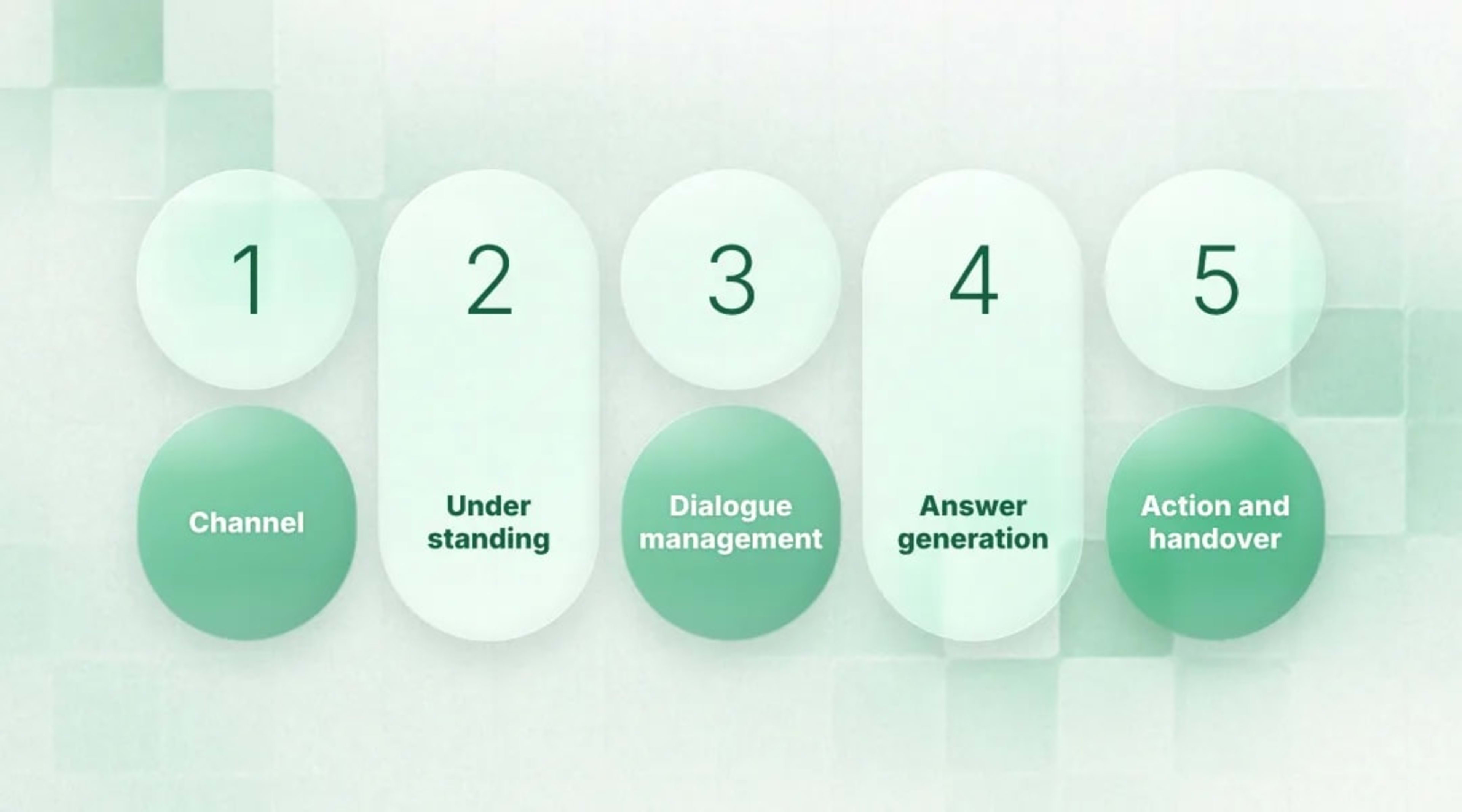
Whether you build a chatbot on a platform or in custom code, each Brightrooftop message crosses five layers. Here is the path one status chat takes:
Channel: a Pune customer's WhatsApp message arrives through the WhatsApp Business API and reaches your server by webhook.
Understanding: the NLU layer tags the intent as installation status and picks out job BR-4471.
Dialogue management: the conversation tracker notices the site postcode for BR-4471 is missing and asks for it.
Answer generation: a large language model drafts the reply from Brightrooftop's documents or live job data.
Action and handover: the bot reads the job tracker or CRM, replies, and escalates anything on Brightrooftop's risk list.
Each layer can be bought, built or rented separately. For that reason, the four subsections below shape your budget more than the choice of model.
What the Language Layer Does With a Messy Sentence
Suppose a customer writes that the panels are up but the app still shows pending for job BR-4471. The system must clean that text, label the goal as installation status, and lift out BR-4471. That chain of steps, from raw text to usable labels, is what teams call an NLU pipeline.
Two routes exist for the labelling step. A classic intent classifier learns from a few hundred tagged examples per topic, so it runs fast and cheap. A prompted language model, by contrast, needs no training set, although each call costs more and varies more.
For Brightrooftop's 1,320 monthly status chats, a trained classifier often pays off. Mixed-language Pune chats are where intent labels break most often, though. A partner offering Natural language processing services can help tune this layer on your own transcripts.
Dialogue Management: Remembering What the Customer Already Said
This layer keeps track of the conversation, so a Brightrooftop customer never repeats themselves. Suppose someone gives job BR-4471 and then asks about their quote. The bot should not ask for that job number again.
The tracker also handles detours. A customer might ask about the install date, switch to billing, and come back. Slot filling records each detail as it arrives, while the tracker remembers which question is still open.
Here is a useful split for decision makers. Keep anything that changes Brightrooftop's money or bookings in fixed, testable flows. Let the language model handle wording and small talk, where a slip costs little.
LLM Plus RAG: Answering From Brightrooftop's Documents
A language model alone answers from patterns learned in training, not from Brightrooftop's files. As a result, it may invent a Brightrooftop warranty term that merely sounds right. Retrieval-augmented generation reduces that risk by searching your own knowledge base before the model writes anything.
In practice, Brightrooftop's warranty PDF, install checklist and price sheet get split into chunks. Those chunks are stored as embeddings in a vector database. When a question arrives, the closest chunks reach the model with an instruction to answer only from them.
This is where most of the effort goes when you build a chatbot for paying customers. If the warranty PDF still lists last year's terms, the bot will quote them confidently. So add one guardrail: when no passage matches closely, Brightrooftop's bot hands over instead of guessing.
Channels: Where the Conversation Happens Changes the Build
Most of Brightrooftop's 2,400 monthly chats arrive on WhatsApp, and that channel brings its own rules. For example, WhatsApp requires pre-approved templates for any message your business starts. A website widget, by contrast, gives you full control over buttons, layout and photo uploads of roof damage.
Voice wraps speech-to-text and text-to-speech around the same core, with tighter timing. Callers notice a two-second pause far more than chat users do. If calls outnumber chats for your team, read Build a conversational AI voice bot from scratch before choosing.
Buy, Build or Blend Your Chatbot
Buy when your answers already sit in public FAQs. Build when the bot must act inside private systems. Blend when you need both, which describes Brightrooftop.
The table below scores each route against what a founder must manage after launch:
Route you could take
Buy a hosted chatbot platform such as Intercom or Zendesk
Fits when
You need a help-centre bot within 3 to 4 weeks, answering from public FAQ pages
Watch out for
A monthly invoice that jumps once 1,320 status chats count as billable resolutions
Verdict for Brightrooftop
Too shallow alone, since install dates sit in a private job tracker
Route you could take
Build all 5 layers as your own custom code
Fits when
The bot must write into Tally, send Razorpay payment links, or hold regulated data
Watch out for
Your team owns hosting, model upgrades and every 2 a.m. bug after launch
Verdict for Brightrooftop
Too heavy for a three-person desk with no engineers on staff
Route you could take
Blend a hosted platform with 1 or 2 custom connectors
Fits when
A platform runs WhatsApp and the chat window, while your code owns the job tracker link and guardrails
Watch out for
Two suppliers to manage, so each of the 5 layers needs one named owner
Verdict for Brightrooftop
Best fit, with one custom connector into the job tracker
Founders who build a chatbot fully in-house often underestimate the upkeep after launch. For many first projects, the easiest way to build conversational AI is the blend. Vendor choice still matters, so read How to choose the right AI agent platform before signing.
What Brightrooftop's Bot Would Cost, Line by Line
The money to build a chatbot like Brightrooftop's depends more on the job tracker connector than on the model. The bill splits into a one-time build and a monthly running cost, and founders tend to underestimate the second.
One-time costs usually cover these four pieces of work:
Discovery and conversation design, including Brightrooftop's failure plan and its list of refused topics.
A connector into the job tracker, CRM or ticketing tool the bot must read from.
Cleaning the warranty PDF, price sheet and install checklist before they enter the knowledge base.
A replay set of 150 real past chats, graded by someone who knows the business.
Running costs, on the other hand, arrive every month. They include platform fees, language-model usage per message, vector database hosting and staff time for weekly reviews.
Now run a rough test with illustrative numbers. Suppose the bot fully closes 900 of the 1,320 monthly status chats. If each closed chat saves four minutes, that frees about 60 staff hours.
Compare those 60 hours with the monthly running bill, not the build cost. Below a few hundred chats a month, a sharper FAQ page and a shared inbox may beat any bot.
Testing and Launch: Release the Bot to Customers in Stages
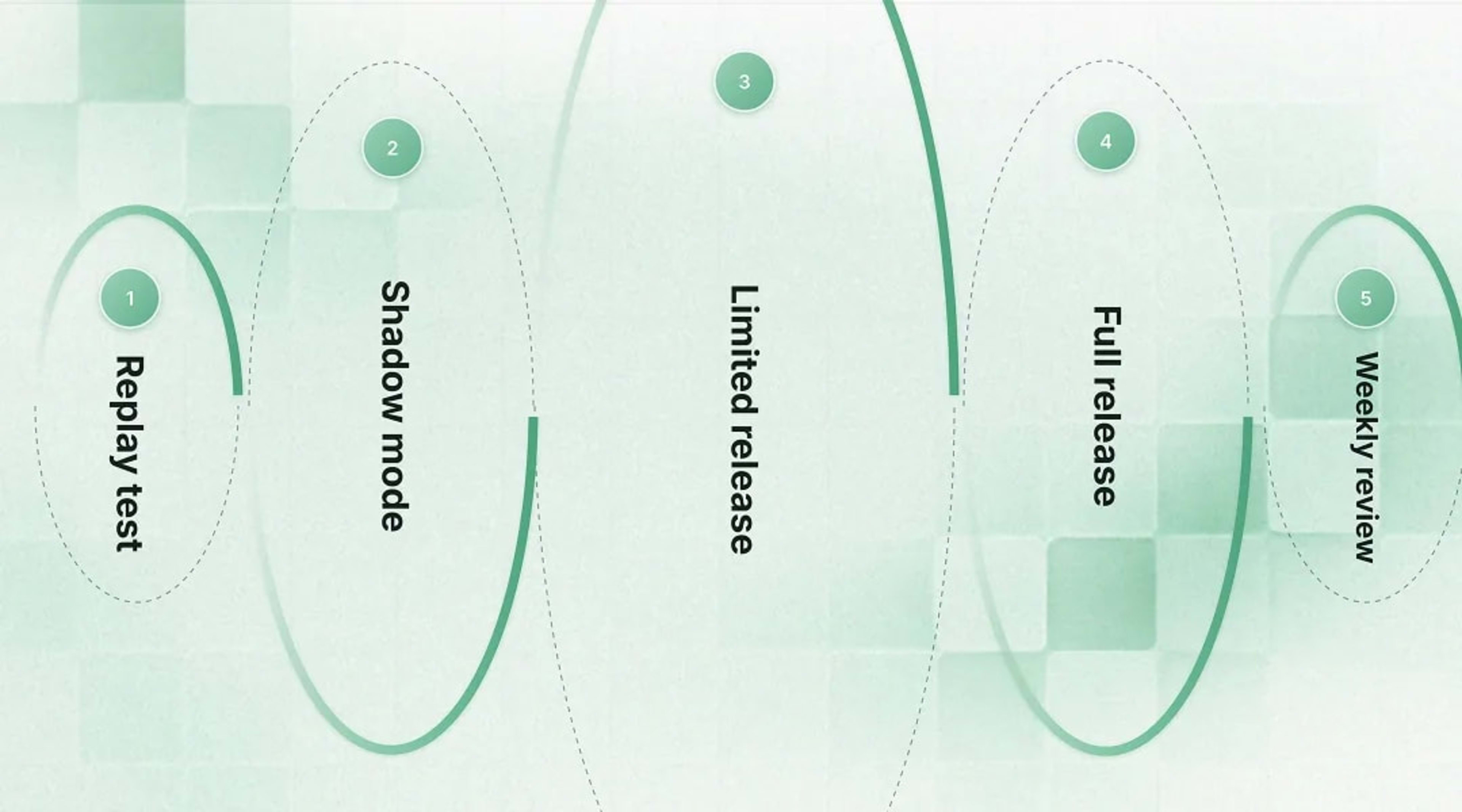
A staged release catches wrong answers while only a few Brightrooftop customers can see them. Teams that build a chatbot and switch it on for everyone at once often hear about errors from complaints. The rollout would run in this order:
Replay test: feed 150 real past chats through the bot and grade every reply by hand.
Shadow mode: for one week, the bot drafts replies while Brightrooftop staff review, edit and send them.
Limited release: route roughly one in ten new chats to the bot and read the handover log daily.
Full release: switch on for everyone once the wrong-answer rate stays below the threshold you set.
Weekly review: read every handover and refresh documents whenever a price, policy or panel model changes.
Keep the replay set after launch. Every time you change the model, prompt or documents, rerun those 150 chats first.
Where Chatbots Still Fall Short
Even Brightrooftop's carefully tested bot will sometimes be ignored, distrusted or confidently wrong. Knowing how to build a chatbot well includes budgeting for all three from day one.
Adoption is the first gap. In a Gartner survey from September 2026, 49% of customers said they would have used an offered chatbot.
Yet only 7% used one in their latest service contact. Just 27% would retry a bot after a bad experience.
Your bot also competes with the assistant already on the customer's phone. In July 2026, Gartner reported customers are three times likelier to use third-party GenAI than a company's chatbot.
Scale does not settle quality, either. Klarna said its assistant handled 2.3 million chats in its first month in early 2024. That was about two-thirds of its chat volume.
By May 2025, though, Klarna was hiring human agents again. Its CEO had said a cost-first focus lowered quality.
Beyond those numbers, a few limits show up in most real deployments:
Grounded answers still go wrong when Brightrooftop's warranty PDF is outdated or contradicts the price sheet.
Long, emotional complaints, like a roof leak after installation, need a person with judgment and authority.
Accuracy can drop for code-mixed Hindi, Marathi and English messages unless you test with Pune transcripts.
Every new panel model or subsidy rule creates upkeep, because the bot only knows what someone updated.
When a Development Partner Is Worth Hiring
Bring in a partner when the bot must touch systems like Brightrooftop's job tracker. The case gets stronger when nobody in-house will own the code. Regulated data or several languages strengthen it further, since mistakes then cost more.
These four signals usually mean in-house effort will stall:
The bot needs live read or write access to a job tracker, ERP or payment system.
Customers write in two or more languages, as Brightrooftop's Pune customers do, often in one message.
You hold personal data, such as ID copies for subsidy forms, that must stay in an Indian hosting region.
No engineer can own monitoring, model updates and the 150-chat replay test after launch.
If you decide not to build a chatbot in-house, the partner becomes your biggest decision. Strong conversational AI development partners ask about handover rules before they ask about models. So, in a first call, ask each one how they measure wrong answers and who fixes them.
Treat any promise of zero wrong answers as a red flag. A credible partner will show you their replay method and a failure plan instead.
Start With One Conversation and One Exit
For Brightrooftop, version one stays narrow: 1,320 status chats, one success number and one route to a person. Once those three are on paper, the stack choices get much easier. To turn that page into a working build, explore KriraAI's Generative AI Development services and scope your first bot.
FAQs
Yes, if those 2 files feed it through retrieval-augmented generation instead of model memory. You still want around 150 real past chats, though, to grade answers before launch.
No. An NLU model sorts a message into labels you defined, such as installation status for job BR-4471. A model like GPT-5 writes fresh text, so it adapts well but needs grounding in your documents.
Sometimes. If you build a chatbot on a hosted platform for one topic, shadow mode can start within weeks. Bots that write into internal systems usually take months, mostly because of integration and the replay test.
Only if it has API access to the system holding that status, like a Zoho or Salesforce CRM. Without that link, it can only quote a vague 3-to-6-week window to someone waiting on a real date.
Customers mostly get annoyed by dead ends, such as a bot that loops 3 times without offering a person. Open with one line, under 15 words, saying an AI assistant is replying. Then show a Talk to a person button in that same first message.
Yes, when the conversation logic sits apart from all 3 channels. A Pune installer's WhatsApp line and website can then share one dialogue manager. Voice still adds speech layers and stricter timing, so pilot it with its own 150-call test set.
OpenAI, Anthropic and Google each publish deprecation schedules, and older models do get switched off. Keep the model behind one connector in your code, then rerun your 150-chat replay set before switching.
Ridham Chovatiya is the COO at KriraAI, driving operational excellence and scalable AI solutions. He specialises in building high-performance teams and delivering impactful, customer-centric technology strategies.