A recent survey by Gartner found that 72% of businesses with fewer than 50 employees that deployed AI voice agents reported measurable cost savings within the first six months, yet fewer than 18% of small businesses in this size range have adopted voice AI in any capacity. That gap represents both a risk and an opportunity. If you run a company with 10 to 50 employees and you have been watching larger competitors roll out AI voice agents while wondering whether the technology is realistic at your scale, this blog was written specifically for you. Not for solopreneurs looking for a cheap chatbot, and not for enterprises with dedicated AI teams and seven-figure budgets. This is for the business owner or operations manager who has a real team, real customers, real overhead, and a genuine need to do more with less. Over the next several sections, this guide will walk you through exactly which AI voice agent applications make practical sense at your size, Over the next several sections, this guide will walk you through exactly which AI voice agent applications make practical sense at your size and how businesses successfully implement . what they actually cost, how to implement them without hiring a data science team, and what measurable results you can realistically expect within your first year. The AI voice agent landscape is evolving fast, and the decisions you make in the next 12 months will shape your competitive position for the next decade.
Small businesses with 10 to 50 employees occupy a uniquely challenging position in any industry, but the pressure is especially acute in sectors where customer communication is a core function. At this size, your team typically includes a handful of customer-facing staff, perhaps a small sales team, one or two people managing operations, and a founder or general manager who still touches nearly every function. You do not have a CTO. You likely do not have a dedicated IT department. Your technology stack probably consists of a CRM (possibly HubSpot or Salesforce Essentials), a phone system (possibly VoIP through RingCentral or Grasshopper), and a collection of SaaS tools chosen more for affordability than integration.
Your annual technology budget for non-core tools likely falls between $15,000 and $75,000, depending on your revenue. That budget has to cover everything from your project management platform to your email marketing software, and the idea of carving out a meaningful portion for AI feels risky when you are already stretched. Decision-making at this size is faster than in an enterprise, which is an advantage, but it also means that bad technology bets hit harder because there is no cushion of unused budget to absorb the loss.
The pressure you face is distinct from that of both smaller and larger companies. A solo operator can get by with a personal touch on every call. A 500-person company can staff a call center. But at your size, you have too many inbound calls, appointment requests, and customer inquiries for your team to handle manually without dropping the ball, and too little budget to simply hire more people. Every missed call is a missed opportunity, and every hour your team spends on repetitive phone tasks is an hour not spent on work that actually grows the business. This is the exact pain point where AI voice agents for small businesses become not a luxury but a practical necessity, and companies like KriraAI have built their solutions around this specific reality.
The biggest mistake small business owners make when researching AI voice agents is reading content written for enterprises and trying to scale it down. Enterprise AI voice deployments typically involve custom natural language processing models trained on millions of proprietary call recordings, integration with complex ERP and CRM ecosystems, months of testing with dedicated QA teams, and budgets that start at $200,000 and climb into the millions. That world has almost nothing in common with yours.
At the other end, solo operators and micro businesses tend to adopt simple, templated voice bots with limited conversational ability, essentially glorified IVR menus with slightly better voice recognition. These tools cost $30 to $100 per month and require almost no setup, but they also deliver a customer experience that feels robotic and impersonal. They work for a one-person operation where any automation is better than a missed call, but they are not sophisticated enough for a company that has built its reputation on responsive, quality service.
Your sweet spot lies in a category of AI voice agent solutions that did not meaningfully exist three years ago. These are platforms that offer pre-trained voice models capable of natural, multi-turn conversations, integrate with mid-market CRM and scheduling tools through standard APIs, and price their services on a per-minute or per-interaction basis that aligns with your call volume. The implementation timeline for a company your size is typically four to eight weeks from initial setup to live deployment, compared to six to twelve months for an enterprise rollout.
The internal skill requirements are also manageable. You do not need a machine learning engineer. You need someone on your team, often an operations manager or tech-savvy office administrator, who can dedicate roughly five to eight hours per week during the setup phase to define call flows, review conversation logs, and tune responses. After the initial deployment, ongoing management typically drops to two to three hours per week. The voice AI implementation for growing companies at this scale is less about building technology and more about configuring it intelligently for your specific business context.
Vendor options available to you have expanded significantly. Platforms such as Bland.ai, Vapi, Retell AI, and Air AI offer solutions specifically priced and designed for businesses with monthly call volumes between 500 and 10,000 interactions. KriraAI works with businesses in this range to evaluate these platforms, customize conversation flows, and integrate voice agents into existing workflows so that the technology fits the business rather than the other way around. The key difference at your scale is that you need a solution that works reliably on day one with minimal customization, because you cannot afford a six-month R&D phase.
Not every AI voice agent application makes sense at your scale. The most hyped use cases, such as real-time sentiment analysis across thousands of simultaneous calls or AI-driven dynamic pricing negotiation, require data volumes and integration complexity that do not match your reality. The applications below are chosen specifically because they deliver the highest return relative to the investment a company your size can realistically make.
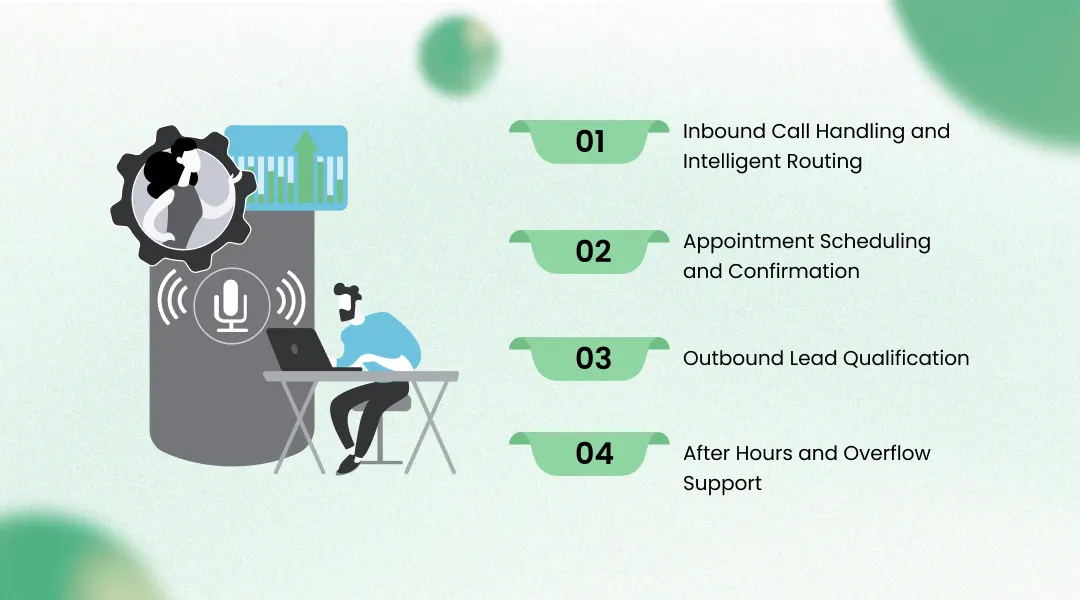
This is the highest-impact, lowest-risk starting point for most small businesses. An AI voice agent answers every incoming call instantly, 24 hours a day, with a natural, conversational tone. It identifies the caller's intent, answers common questions (business hours, pricing, service availability), and routes complex inquiries to the right team member. For a company with 15 to 40 employees, this typically handles 40% to 60% of inbound calls without any human involvement. The cost ranges from $200 to $800 per month, depending on call volume. The result is that your team stops losing leads to voicemail and stops spending two to three hours daily on calls that could have been resolved automatically.
If your business involves scheduled appointments, consultations, or service calls, this application alone can justify the entire investment. The AI voice agent handles scheduling through natural conversation, integrates with your calendar system, sends confirmation messages, and manages rescheduling and cancellation calls. For businesses in service industries such as healthcare clinics, legal practices, home services, and consulting firms, this eliminates the need for a dedicated scheduling coordinator. Typical cost at this scale is $150 to $500 per month, and businesses report reducing no-show rates by 25% to 35% through automated reminder calls.
For companies with sales teams of three to ten people, especially in Retail & E-commerce, AI voice agents can automate lead qualification and customer engagement. This is particularly valuable when your sales team is too small to call every lead promptly. An AI voice agent can contact new leads within 60 seconds of form submission, which research shows increases contact rates by up to 400% compared to waiting even five minutes. The cost for outbound voice AI at this scale runs $300 to $1,000 per month, and businesses typically see a 20% to 30% increase in qualified pipeline volume.
This application addresses one of the most painful realities for small businesses: you cannot afford 24/7 staffing, but your customers expect availability beyond business hours. An AI voice agent handles all calls outside your staffed hours, resolving what it can and collecting detailed messages with context for everything else. It also activates during peak periods when your team is fully occupied, ensuring that no call goes to voicemail during your busiest hours. This is often the first application that pays for itself, as businesses at this scale report that 15% to 25% of their total call volume occurs outside business hours, and converting even a fraction of those into booked appointments or resolved inquiries generates immediate revenue.
The AI voice agent ROI for SMBs is not theoretical. It is measurable within the first quarter of deployment, and the returns compound as the system learns from more interactions. Here is what companies with 10 to 50 employees are actually experiencing.
A 22-person home services company handling approximately 1,200 inbound calls per month deployed an AI voice agent for after-hours and overflow handling. In the first 90 days, the system handled 38% of all calls autonomously, converted 14% of after-hours calls into booked appointments that would have previously gone to voicemail, and freed up the equivalent of 1.5 full-time employees' worth of phone time. The total cost was $650 per month, against an estimated $4,800 per month in labor savings and new revenue from captured leads.
For a 35-person professional services firm, AI-powered customer service automation costs roughly $900 per month. The firm reduced average call handling time by 45%, improved first call resolution rates from 62% to 81%, and decreased the time between lead inquiry and first response from 4.2 hours to under 90 seconds. Over 12 months, the firm attributed $127,000 in additional revenue directly to leads that would have been lost under the old system.
These numbers matter specifically because of the scale at which they occur. When a company with 5,000 employees saves $127,000, it barely registers as a line item. When a company with 35 employees saves that amount, it can fund two new hires, a marketing campaign, or a significant equipment upgrade. The impact per employee at this company size is roughly 8x to 12x greater than the same technology deployed in an enterprise, which is why AI voice agents for small businesses represent one of the most efficient technology investments available today. According to a 2025 McKinsey analysis, small businesses that adopt AI voice automation see a median productivity gain of 23% within the first year, compared to 11% for enterprises implementing similar technology at a larger scale.
The process of deploying an AI voice agent in a company with 10 to 50 employees does not need to be complicated, but it does need to be deliberate. Rushing into deployment without proper preparation is how small businesses end up with voice bots that frustrate their customers and waste their investment. If you're planning a tailored deployment, read How to Create a Custom AI Voice Agent for Your Needs before selecting a platform.
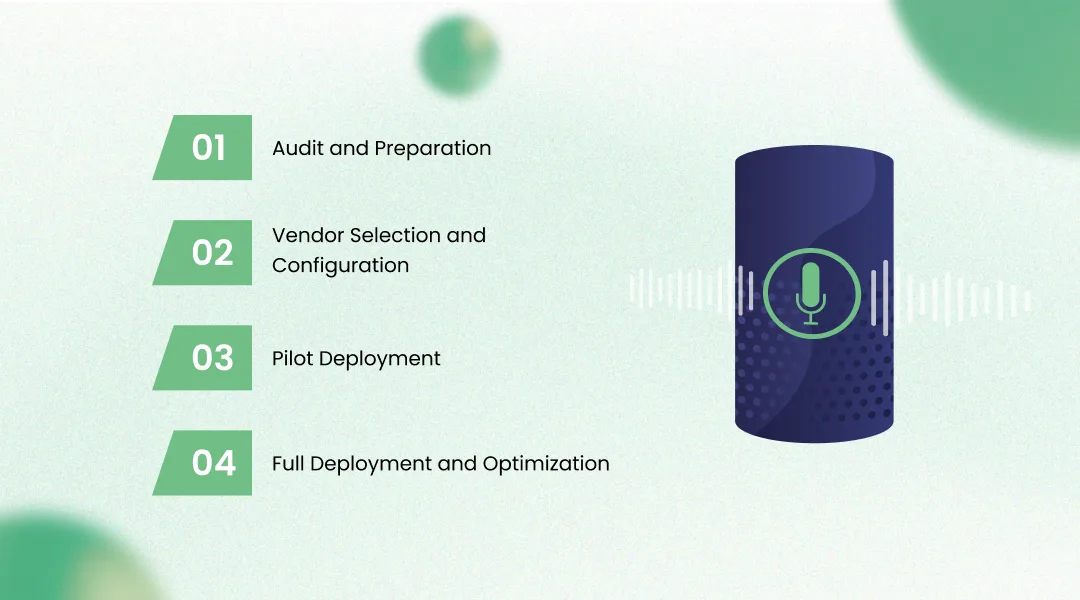
Before you evaluate a single vendor, you need to understand your own call patterns. This phase involves three core activities.
Pull your call data from the past 90 days and categorize calls by type: scheduling, general inquiries, support issues, sales inquiries, billing questions, and transfers. Identify which categories have the highest volume and the most repetitive patterns.
Document the five to ten most common call scenarios in detail, including the questions callers ask, the information your team needs to collect, and the actions that result from each call type. These scenarios become the foundation of your AI voice agent's conversation flows.
Assess your current technology stack for integration readiness. Confirm that your CRM, calendar, and phone system offer API access or pre-built integrations with the voice AI platforms you plan to evaluate.
Evaluate three to four platforms against criteria that matter at your scale: per-minute pricing transparency, ease of conversation flow design (no-code or low-code), quality of pre-built integrations with your existing tools, and the availability of a sandbox environment for testing before going live. Request a trial focused specifically on youhighest-volumeme call scenario and evaluate the voice quality, conversational accuracy, and integration reliability.
During this phase, KriraAI recommends that small businesses allocate most of their configuration time to the first two call scenarios rather than trying to cover every possible interaction at launch. Getting two scenarios working flawlessly creates more value than getting ten scenarios working adequately.
Deploy the AI voice agent on a limited basis, typically handling only after-hours calls or only one call category during business hours. Monitor every interaction during this phase, reviewing transcripts daily and adjusting conversation flows based on real performance data. Set clear success metrics before the pilot begins: target a minimum 80% caller satisfaction rate, a maximum 15% transfer-to-human rate for the targeted call type, and zero critical errors (such as booking appointments at incorrect times or providing wrong information).
Expand the AI voice agent to handle all targeted call scenarios. Establish a weekly review cadence where someone on your team spends one to two hours reviewing conversation logs, identifying edge cases, and updating responses. After 90 days, conduct a full performance review comparing your pre-deployment call metrics to current performance.
The first mistake is trying to automate every call type at once. Companies that attempt to launch with full coverage across all call scenarios almost always deliver a poor experience in at least some categories, which damages caller trust and makes it harder to expand later. Start with two scenarios and expand only after they perform reliably.
The second mistake is choosing a vendor based on the demo rather than on integration depth. A voice agent that sounds impressive in a sales demo but cannot push appointment data directly into your calendar or update your CRM in real time creates more work than it eliminates. The integration layer is where value is created or destroyed at your scale.
The third mistake is setting and forgetting. AI voice agents improve over time, but only if someone is reviewing performance data and making adjustments. Companies that treat the deployment as a one-time project instead of an ongoing optimization effort plateau quickly and often conclude that the technology "doesn't work" when the real problem is neglect.
The most significant challenge at this company size is the trust barrier with your existing customers. Unlike an enterprise where callers already expect to interact with automated systems, your customers may have a personal relationship with your team. Introducing an AI voice agent can feel jarring if it is not handled transparently. The solution is proactive communication: inform customers that you are introducing an AI assistant to ensure they can always reach you, position it as an enhancement to service rather than a replacement for your team, and always offer an easy path to reach a human. This shift is one of the reasons Why Small Businesses Are Switching to AI Voice Agents across customer-facing industries.
Budget allocation presents a different kind of challenge. At your size, every dollar in the technology budget competes directly with other pressing needs, from hiring to marketing to equipment. The key to overcoming this is structuring your voice AI investment so that it produces measurable returns within 60 to 90 days. If you cannot demonstrate clear ROI within one quarter, the investment will lose internal support regardless of its long-term potential. This is why starting with high-impact, easily measurable applications like after-hours call capture is so important.
Skill gaps also present a real but manageable obstacle. While you do not need a developer to deploy modern voice AI platforms, you do need someone comfortable working with conversation flow builders, reviewing analytics dashboards, and making data-informed adjustments. If no one on your team fits this profile, the most cost-effective solution is engaging a partner like KriraAI that specializes in helping companies of your size deploy and optimize voice AI without requiring internal technical expertise. This is meaningfully different from hiring a consultant for a six-month engagement; it is about having a partner who understands how to deploy voice AI in small teams and can get you operational quickly.
Three years from now, the competitive dynamics in every customer-facing industry will be fundamentally different for companies in the 10-to-50-employee range. AI voice agents will not be a differentiator; they will be table stakes. The companies that deploy voice AI now will have three years of optimized conversation data, refined call flows, and integrated workflows. The companies that wait will be starting from zero while their competitors operate with mature systems that convert more leads, resolve more issues, and cost less per interaction.
The compounding advantage is significant. Every month that an AI voice agent operates, it generates data that improves its performance. A system that has handled 50,000 calls over three years will outperform a newly deployed system handling the same call types by a measurable margin in accuracy, caller satisfaction, and resolution rates. This creates a switching cost advantage: your customers become accustomed to instant, effective service, and moving to a competitor that cannot match that experience becomes increasingly unattractive.
By 2028, industry analysts project that 65% of small businesses in customer-facing sectors will use some form of voice AI. The remaining 35% will compete for a shrinking pool of customers who tolerate slower, less responsive service. The question is not whether voice AI will become standard at your company's size. The question is whether you will be among the companies that shaped the standard or among those scrambling to catch up. The cost of delay is not measured only in lost efficiency today; it is measured in competitive position lost permanently.
Three points stand out from everything covered in this guide. First, AI voice agents are not only accessible at the 10- to 50-employee scale, but they are disproportionately impactful at this size, delivering per-employee productivity gains that significantly exceed what enterprises achieve with the same technology. Second, the implementation path for a company your size is measured in weeks rather than months, and the internal resource requirements are manageable for any team that can designate one capable person to own the project. Third, the competitive window for early adoption is closing, and the companies that deploy AI voice agents for small businesses now will build data and performance advantages that late adopters will struggle to match.
KriraAI works with businesses in the10-to-50-employeee range to design, deploy, and optimize AI voice agent solutions that fit real-world budgets and team structures. Rather than offering enterprise platforms stripped down to a lower price point or consumer tools stretched beyond their capabilities, KriraAI builds implementations around the specific call patterns, integration requirements, and growth objectives of each client. The approach is practical: start with the use case that delivers the fastest measurable return, prove the value, and expand from a position of demonstrated success rather than speculative investment. If you are ready to explore what AI voice agents can do for a company your size, reaching out to the KriraAI team for an initial assessment is a good first step toward making that decision with clarity and confidence.
The total cost of deploying an AI voice agent for a small business with 10 to 50 employees typically ranges from $200 to $1,500 per month, depending on call volume, the number of use cases deployed, and the platform selected. Most platforms in this range charge on a per-minute basis, with rates between $0.05 and $0.15 per minute of AI-handled conversation. Setup costs vary from zero (for platforms with self-service configuration) to $2,000 to $5,000 for guided implementation with a partner. At this company size, the investment should be compared not to enterprise AI budgets but to the cost of the part-time or full-time employee whose phone-related tasks the AI voice agent will absorb, which typically ranges from $2,500 to $4,500 per month in loaded labor costs.
Modern AI voice agents designed for the small business market can handle multi-turn conversations that go well beyond simple question and answer interactions. They can navigate branching dialogue flows, collect multiple pieces of information in a natural conversational sequence, handle objections, and make contextual decisions based on caller responses. For a company with 10 to 50 employees, the practical limit is not the AI's conversational ability but the complexity of the backend integrations needed to act on the information collected. A voice agent can expertly guide a caller through a scheduling process, but only if it is connected to your actual calendar system. The technology has advanced to the point where 70% to 80% of typical inbound call scenarios for small businesses can be handled without human intervention, provided the conversation flows are properly designed and tested.
For a company with 10 to 50 employees, a realistic deployment timeline from initial audit to live operation is four to eight weeks. The first two weeks involve analyzing your call data and documenting your most common call scenarios. Weeks three through five focus on vendor selection, platform configuration, and conversation flow design. Weeks five through seven are a controlled pilot phase where the AI handles a limited subset of calls while you monitor performance. Full deployment across all targeted call types typically occurs between weeks seven and twelve. This timeline assumes that one team member dedicates five to eight hours per week to the project during the setup phase. Companies that engage an implementation partner like KriraAI often compress this timeline by one to two weeks because the partner brings pre-built templates and configuration expertise specific to their industry.
Customer acceptance of AI voice agents has increased dramatically over the past two years, with recent surveys showing that 63% of consumers are comfortable interacting with AI voice systems when the experience is smooth and the option to reach a human is clearly available. For small businesses specifically, the key to positive customer reception is transparency and quality. Inform your callers that they are speaking with an AI assistant, ensure the voice quality and conversational flow feel natural, and always provide an easy, immediate path to reach a human team member. Companies at your size often find that customers are more frustrated by long hold times, missed calls, and voicemail than they are by a well-designed AI interaction. The businesses that receive the most negative feedback are those that try to disguise their AI as human or that make it difficult to reach a person when needed.
The best starting point for most small businesses with 10 to 50 employees is after hours and overflow call handling. This use case carries the lowest risk because it applies to calls that are currently going to voicemail or being missed entirely, meaning any successful AI interaction is a net gain over the status quo. It also provides immediate, easily measurable ROI: you can count exactly how many after hours calls were handled, how many resulted in booked appointments or resolved inquiries, and calculate the revenue impact directly. Starting with after hours calls also gives your team time to build confidence with the technology before expanding to live business hours deployment, where the stakes feel higher. Once after hours handling is performing reliably, the natural next step is to add appointment scheduling and then inbound call routing during business hours.
Ridham Chovatiya is the COO at KriraAI, driving operational excellence and scalable AI solutions. He specialises in building high-performance teams and delivering impactful, customer-centric technology strategies.