A founder asked me something last month that stuck with me.
"Everyone says AI agents are the future, but how do I know which platform isn’t just marketing?"
Fair question.
Because right now the market is in chaos.
Hundreds of tools claim to be the best AI agent platform. Every demo looks impressive. Every landing page promises automation miracles.
But here’s the uncomfortable truth.
Most companies choose the wrong platform.
Not because they’re careless. Because the decision itself is confusing.
I have spent the last decade helping companies design AI systems through hands-on AI agent development services, everything from customer service automation to operational AI agents. Some projects worked beautifully. Others taught expensive lessons.
So in this guide, I will walk you through how to choose AI agent platform solutions that actually work for your business.
No hype. Just experience.
Three years ago, most companies were experimenting with chatbots.
Today?
They’re deploying AI agents for business automation across entire departments.
Let’s break down why.
AI agents excel at routine tasks.
Ticket routing. Lead qualification. Data analysis. Workflow approvals.
Tasks that used to consume human hours now run quietly in the background.
And employees? They focus on work that actually requires thinking.
Customer expectations changed.
People want answers instantly.
That’s why many businesses now deploy AI voice agent systems and conversational agents to handle first-line support.
These agents can:
Answer common questions
Route complex cases
Schedule appointments
Resolve issues instantly
And customers rarely notice the difference.
Sometimes they prefer it.
Good AI agents don’t just respond.
They analyze.
They monitor customer behavior, internal data, and workflow patterns to suggest improvements.
I’ve seen companies discover operational bottlenecks they didn’t even know existed.
Let’s be honest.
Cost savings are a big driver.
AI agents can reduce support costs, operational overhead, and manual labor requirements.
But here’s the nuance most vendors don’t tell you.
Cost reduction only happens when the platform fits your workflow correctly.
Otherwise, the platform becomes another expensive tool nobody uses.
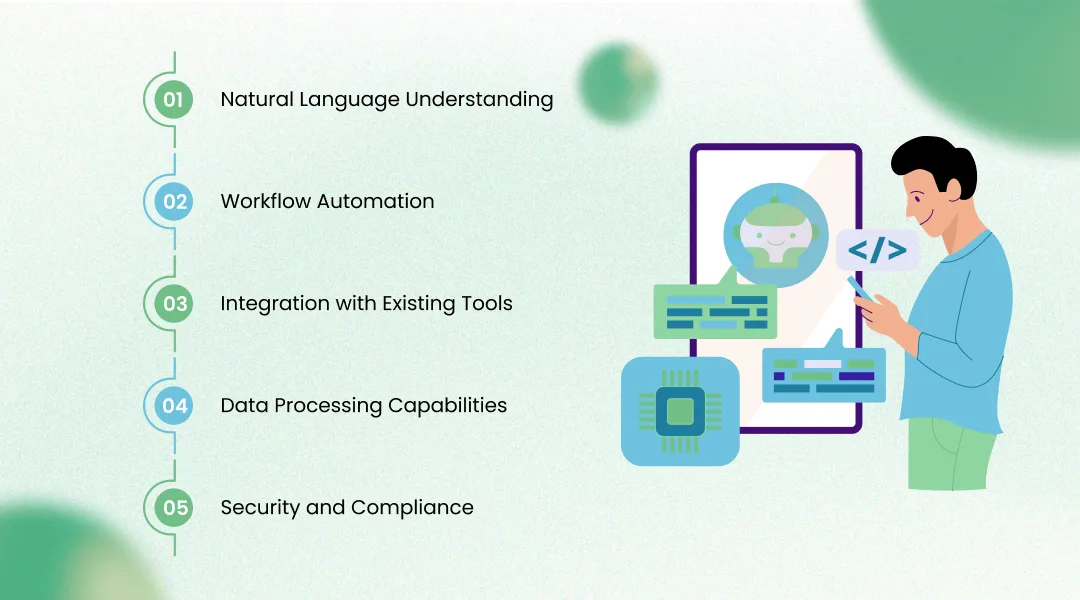
When companies ask me how to evaluate an AI agent development platform, I start with five fundamentals.
Miss any of these, and you’ll feel it later.
If your AI agent can’t understand human language properly…
Everything breaks.
Good platforms support:
context awareness
conversation memory
multilingual communication
Without this, the agent becomes frustrating very quickly.
A real enterprise AI agent platform does more than chat.
It executes tasks.
That means triggering workflows like:
updating CRM data
processing requests
triggering alerts
initiating approvals
This is where real productivity gains happen.
Here’s a question many leaders forget to ask.
Can this AI agent talk to our systems?
Your platform should integrate with:
CRM systems
databases
helpdesk software
ERP tools
Without integrations, your AI agent becomes isolated.
And isolation kills automation.
AI agents rely on data.
A strong platform can:
analyze structured data
interpret documents
extract insights from conversations
This is where AI transitions from a simple assistant to an operational asset.
If your platform handles sensitive data, security matters.
Look for:
enterprise authentication
encryption standards
audit logs
compliance frameworks
This is especially important for healthcare and finance AI compliance needs, where audit trails and encryption are not optional.
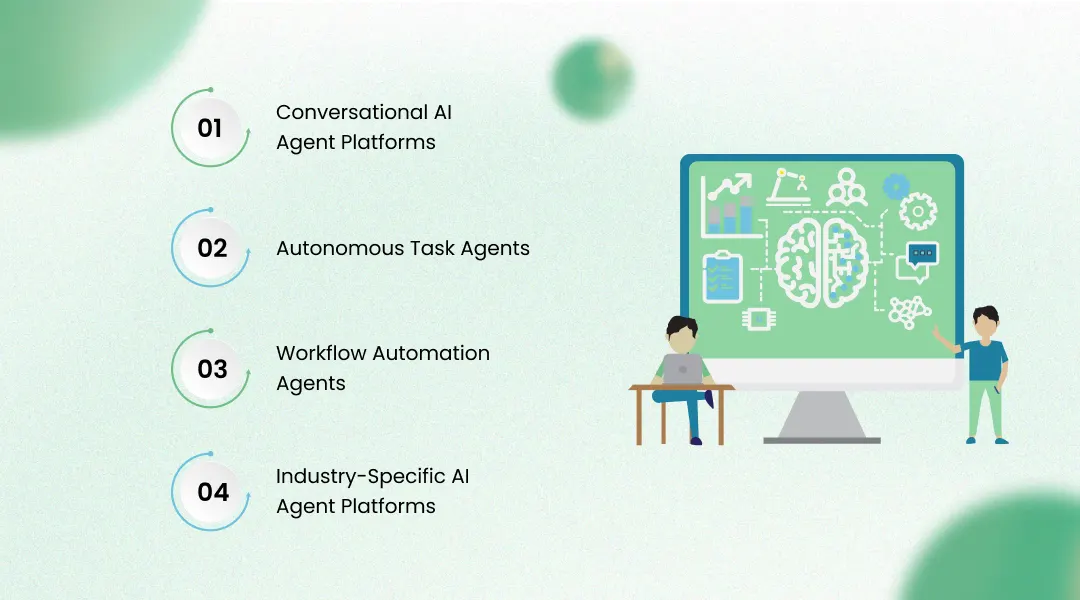
Not all AI agent platforms for business are built the same.
Let’s simplify the landscape.
These platforms specialize in communication.
Examples include:
customer service bots
AI voice agent systems
virtual assistants
They’re excellent for support, sales, and engagement.
Autonomous Task Agents perform tasks automatically, a shift we've covered in depth in how AI agents are reshaping business process automation, where they act as digital employees handling workflows behind the scenes.
Examples:
supply chain monitoring
automated reporting
operational data processing
These platforms integrate deeply with internal systems.
They automate business processes such as:
HR operations
document processing
internal approvals
Companies with complex operations benefit greatly here.
Some platforms focus on specific sectors.
For example:
healthcare agents
finance compliance agents
e-commerce AI assistants
These tools come with pre-trained models tailored for the industry.
Let’s talk about the real decision framework.
When a company asks me how to choose AI agent platform solutions, I usually walk them through five questions.
Start here.
What problem are you solving?
Customer support? Sales automation? Internal workflows?
Your use case determines which AI agent platform will actually work best.
Your company will grow.
Your platform must grow with it.
Check whether the platform supports:
large user volumes
multi-agent deployments
enterprise data loads
Off-the-shelf tools work for simple cases.
But most businesses eventually require customization.
Look for:
API access
model customization
workflow editing
Otherwise you’ll hit limitations quickly.
This is one of the most overlooked factors.
AI agents must connect to your business stack.
CRM. ERP. Analytics tools. Databases.
Without integration, the automation breaks.
Here’s a blunt truth.
The cheapest platform is rarely the best.
Focus on:
total operational savings
time saved by employees
improved customer experience
Those metrics reveal real ROI.
Let me share a few mistakes I’ve seen repeatedly.
A flashy demo doesn’t mean real performance.
Many platforms shine in presentations but struggle in real workflows.
Always test with real business scenarios.
Some tools work well for small teams but collapse under enterprise usage.
Ask about performance under heavy workloads.
AI agents require good data.
If your company’s data is messy, incomplete, or inaccessible, the agent will struggle.
Clean data. Always.
Many companies deploy a single AI agent and stop there.
But the real value comes when multiple agents collaborate across departments.
Think bigger.
Now we reach a strategic question.
Should you use a platform… or build your own?
Platforms work well when:
Automation needs are simple
workflows are standardized
deployment speed matters
For many startups, this is the fastest way to start.
Custom development becomes valuable when:
workflows are unique
Integrations are complex
scale is massive
This is where working with the Best AI development Company can help design agents specifically for your systems.
Experienced teams design:
custom AI agent architectures
enterprise integrations
automation pipelines
At KriraAI, we often combine AI agent platforms for business with custom components to create flexible solutions.
The result?
Companies get the speed of platforms and the flexibility of custom development.
The next wave of AI agents will look very different. We've mapped out what the future holds for AI agents in the workplace in detail, and three trends are already emerging here too.
Companies will deploy networks of AI agents working together.
Sales agents. Support agents. Operational agents.
Each specialized.
Agents will communicate with each other to solve problems collectively.
Imagine customer support agents coordinating with logistics agents to resolve shipping issues automatically.
This is already happening in advanced deployments.
Marketing teams will have AI copilots.
Finance teams, too.
Operations departments as well.
AI agents will become everyday collaborators.
Not just tools.
Eventually, most organizations reach a realization.
AI agents are powerful… but complex.
This is where experienced partners help.
Development teams build agents tailored to specific workflows.
Not generic tools.
Actual operational systems.
Agents must connect to databases, internal APIs, CRMs, and operational tools.
Professional teams ensure those integrations are stable and secure.
AI systems evolve.
Models improve. Data grows. Workflows change.
Companies working with an AI development company ensure their agents continue delivering value long after deployment.
At KriraAI, this long-term partnership approach is central to how we build AI solutions.
Because AI isn’t a one-time installation.
It’s an evolving system.
Choosing an AI agent platform in 2026 isn’t just a technology decision.
It’s a strategic one.
The right platform can automate operations, improve customer experiences, and unlock entirely new efficiencies.
The wrong one?
Becomes another abandoned software subscription.
So start with clarity.
Define the business problem. Evaluate platform capabilities carefully. Growthplan.
And if the automation vision becomes larger than any single platform…
That’s when custom AI agent development becomes the next logical step.
An AI agent platform is software that allows businesses to create and deploy intelligent agents capable of automating tasks, analyzing data, and interacting with users across digital systems.
The best AI agent platform depends on your use case, integration needs, scalability requirements, and automation goals. Businesses should evaluate features, customization options, and long-term ROI.
AI agents automate tasks such as customer support, workflow management, reporting, and data processing, reducing manual effort and improving operational efficiency.
If automation needs are simple, using an existing platform is often enough. For complex workflows and deep integrations, custom AI agent development may be more effective.
Yes. Most modern AI agent platforms support integration with CRM systems, databases, analytics tools, and enterprise software through APIs and connectors.
Founder & CEO
Divyang Mandani is the CEO of KriraAI, driving innovative AI and IT solutions with a focus on transformative technology, ethical AI, and impactful digital strategies for businesses worldwide.