
Best LLM for Enterprise Use: GPT vs Claude vs Gemini vs Open-Source Models
Picture a mid-size insurer in Pune, call it Tavi Insure, that gets 40,000 claim emails a month. Before shortlisting vendors, its CTO has to settle the build question covered in OpenAI vs custom AI models. After that, the best LLM for enterprise use stops being one name and becomes a short routing table.
Every price below was checked on 4 November 2026. The yardstick throughout is cost per correct answer, not cost per token. After all, a cheap model that misreads a policy number stops being cheap once an adjuster fixes it.
Why the best LLM for enterprise claims work changes across Tavi's four jobs
No single model wins Tavi's whole inbox, because its four jobs reward different strengths. A frontier model is wasted on sorting a windscreen claim. Yet a small model can stumble over a 300-page policy wording.
So for Tavi, the best enterprise LLM is really four answers. Here is how its monthly workload splits:
Sorting each email into one of nine claim types, which is short, repetitive and easy to verify.
Pulling policy numbers, loss dates and claimed amounts from attached PDFs into the claims system.
Drafting a first reply in English or Hindi that an agent edits before it goes out.
Checking a disputed claim against long policy wording, where one missed exclusion costs real money.
Large buyers already split work this way. Andreessen Horowitz (a16z) surveyed 100 Global 2000 CIOs, with results reported in spring 2026. In it, 81% were testing or running three or more model families, up from 68% the year before.
Six LLM selection criteria, each scored against Tavi's inbox
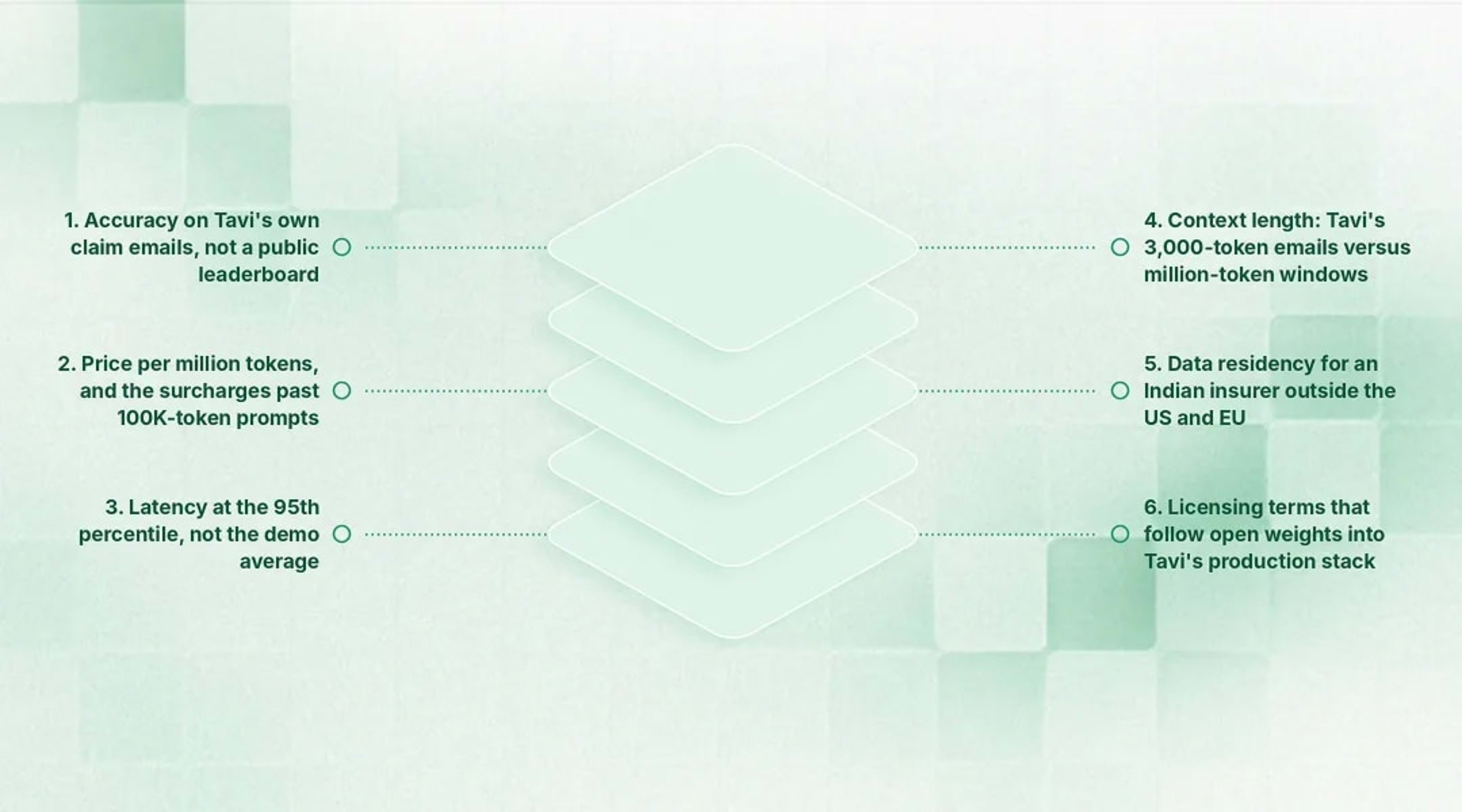
Score every candidate on six criteria, then fold the results into cost per correct answer. That means monthly spend divided by emails handled right. It also turns choosing the best enterprise LLM into arithmetic rather than taste.
Accuracy on Tavi's own claim emails, not a public leaderboard
Leaderboards reward puzzle solving and code, while Tavi's real risk is a misread excess amount. So accuracy here means the share of 50 test emails a senior adjuster would accept as written.
Public benchmark items can also leak into training data, which tends to flatter scores over time. So a leaderboard winner is only a candidate for the best LLM for enterprise claims.
Price per million tokens, and the surcharges past 100K-token prompts
Sticker prices hide tier jumps that only bite on inputs like Tavi's 300-page policy wording. Three verified examples matter for any team picking the best LLM for enterprise documents:
GPT-5.6 Sol bills the whole request at double input and 1.5 times output past 272K prompt tokens.
Claude Haiku 5.5 moves from $0.10 to $0.50 per million input tokens once a prompt passes 100K tokens.
Gemini 3.1 Pro rises from $2 to $4 per million input tokens beyond 200K tokens on Google's price sheet.
The 272K rule comes from OpenAI's model page. On the other hand, Tavi could easily miss a discount. Anthropic's Batch API halves input and output prices for work that can wait, which suits Tavi's overnight re-check.
Latency at the 95th percentile, not the demo average
A Tavi agent waiting on a claim reply remembers the slow request, not the typical one. So measure time to first token and total response time at p50 and p95. Run it from Tavi's own cloud region during the Monday-morning claim rush.
Say a model drafts claim replies in two seconds but stalls past fifteen once in twenty calls. To a Tavi agent with a customer on the line, that model feels broken.
Context length: Tavi's 3,000-token emails versus million-token windows
Every frontier model in the table below offers roughly one million tokens, far beyond a claim email's needs. However, Tavi's triage emails use about 3,000 tokens each. That headroom only matters for the policy-wording job, so pay for long context only where you send long inputs.
Data residency for an Indian insurer outside the US and EU
This is where Indian buyers like Tavi get caught out. OpenAI added per-request region selection on 21 August 2026, according to an analysis by ECORPIT. Only its US, EU and UAE regions process inference locally, and India gets storage without in-country processing.
The same analysis notes a 10% uplift on residency endpoints. It applies to models released from 5 March 2026 onward.
Anthropic takes a different route. Its inference_geo setting offers US-only processing at 1.1 times standard rates, or global routing, per Anthropic's data residency docs. There is no India-only value.
So residency can quietly decide the best LLM for enterprise data that must stay in one country. Then Tavi's cleanest route is running open weights on servers it controls in India.
Licensing terms that follow open weights into Tavi's production stack
Each open-weight family Tavi might host carries different conditions. Tavi's lawyers should clear these before launch week:
OpenAI's gpt-oss-120b ships under Apache 2.0, so Tavi could modify and deploy it with standard notices.
DeepSeek has published recent weights under the MIT license, so Tavi mainly keeps the copyright notice intact.
Under Meta's Llama community license, crossing 700 million monthly active users means negotiating directly with Meta.
Some Qwen and Mistral checkpoints use vendor licenses that limit commercial or production use, so read each one.
Enterprise LLM comparison, priced on 4 November 2026
For Tavi's triage, the dearest option costs forty times the cheapest. The table assumes 120 million input and 16 million output tokens monthly. Rates for Tavi's table come from provider pricing pages and model cards, plus Together AI for open weights.
Model
GPT-5.6 Sol
Input / output per 1M tokens
$4 / $20 promo to 21 November
Context window
1,050,000 tokens
Tavi's monthly triage bill
$800 at promo rates
Role in Tavi's inbox
Tavi's hardest disputed policy clauses
Model
GPT-5.4 mini
Input / output per 1M tokens
$0.75 / $4.50
Context window
See OpenAI's model page
Tavi's monthly triage bill
$162
Role in Tavi's inbox
Drafts for an OpenAI-only team
Model
Claude Opus 5.5
Input / output per 1M tokens
$4 / $20
Context window
1M tokens
Tavi's monthly triage bill
$800
Role in Tavi's inbox
Escalated disputes and blurry claim-form scans
Model
Claude Sonnet 5.5
Input / output per 1M tokens
$2 / $10
Context window
1M tokens
Tavi's monthly triage bill
$400
Role in Tavi's inbox
Claim reply drafts an agent edits before sending
Model
Claude Haiku 5.5
Input / output per 1M tokens
$0.10 / $0.50 below 100K tokens
Context window
1M tokens
Tavi's monthly triage bill
$20
Role in Tavi's inbox
Sorting into nine claim types
Model
Gemini 4 Argon
Input / output per 1M tokens
$2 / $10 to 30 November, then $4 / $20
Context window
1,048,576 tokens
Tavi's monthly triage bill
$400, then $800
Role in Tavi's inbox
Long-document checks on a Google Cloud stack
Model
Gemini 3.8 Flash
Input / output per 1M tokens
$0.75 / $3.75
Context window
See Google's model card
Tavi's monthly triage bill
$150
Role in Tavi's inbox
Field extraction from claim PDFs
Model
gpt-oss-120b (Together AI)
Input / output per 1M tokens
$0.15 / $0.60
Context window
128K tokens
Tavi's monthly triage bill
$27.60
Role in Tavi's inbox
Triage on weights Tavi could later host
Model
DeepSeek V4-Pro (Together AI)
Input / output per 1M tokens
$1.32 / $3.96
Context window
1M tokens
Tavi's monthly triage bill
$221.76
Role in Tavi's inbox
Open weights for 300-page policy wording
The best LLM for enterprise budgets is rarely the cheapest row once adjuster fixes are counted.
Two price changes due before December, and why they matter
Two rows in Tavi's table will be wrong within a month. OpenAI lists GPT-5.6 Sol's $4 and $20 rates as a promotion ending 21 November 2026. Before the cut, the model cost $5 and $30.
Meanwhile, Gemini 4 Argon's introductory $2 and $10 pricing doubles on 1 December 2026. That change alone would lift Tavi's triage bill from $400 to $800 overnight. Treat any price table as a snapshot, and re-run the cost math every month.
GPT vs Claude vs Gemini: what each platform changes for a claims team
For Tavi, the real gaps among the three flagships are pricing structure, regional controls and the cheap tier underneath. Raw intelligence matters less here, because all three handle most claims well. Here is what each platform offers a team weighing the best LLM for enterprise rollout:
OpenAI's long window: GPT-5.6 Sol accepts 1,050,000 tokens, and cached input costs $0.40 per million.
Anthropic's shared window: Opus, Sonnet and Haiku 5.5 all accept one million tokens, which eases tier changes.
Google's new flagship: Gemini 4 Argon reached general availability on 13 October 2026, beside a cheaper Flash tier.
That OpenAI cache discount helps when every claim prompt repeats the same policy preamble. None of these facts says which model reads Tavi's claim forms best, though. Only a test on Tavi's own emails can answer that, and it comes two sections below.
Open source LLM for business: when owning the weights pays off for an insurer
Owning the weights pays off for an insurer like Tavi in three cases. Your data must never leave your network, your volume is high and steady, or you need deep fine-tuning. Otherwise a hosted API usually wins once you count the engineers who keep GPUs running.
For Tavi's triage, the hosted gpt-oss-120b bill is only $27.60 a month. That bill is too small to beat by buying GPUs. Tavi would run its best enterprise LLM in-house only for control.
Hardware is less of a barrier than many CTOs expect. In its 4-bit MXFP4 format, gpt-oss-120b runs on a single 80 GB GPU, per Hugging Face's launch notes. It has 117 billion total parameters but activates only 5.1 billion per token.
Its 128K context, however, rules out the full 300-page wording without chunking or retrieval. GPU supply is the other constraint, since dedicated cards can take months to secure in some regions. That planning problem is covered in our note on AI compute shortage enterprise strategy.
Fine-tuning is where an open model can beat a hosted giant on house tone. Training on two years of adjuster-approved replies, for example, teaches the phrasing Tavi's customers already trust. Teams without in-house ML engineers can bring in KriraAI's LLM development and fine-tuning services for that step.
Multi-model routing: how one claim email moves through an enterprise LLM stack
A router is a small decision layer that picks the cheapest model likely to answer each request correctly. When confidence is low, it escalates. For Tavi, this is how the best LLM for enterprise traffic becomes several models working in sequence:
A gateway receives the claim email, strips signatures, and masks Aadhaar and bank numbers first.
A lightweight classifier labels each claim email as routine triage, PDF extraction, reply drafting or policy dispute.
Routing rules map each claim label to a model, a region and a token budget, all kept in config.
The chosen model answers in a fixed JSON schema, and a validator checks fields such as policy-number format.
Failed validation or low model confidence sends the same claim one tier up for a second attempt.
Every call logs the model, latency, tokens and the verdict an adjuster gave, feeding next month's re-test.
Worked numbers: one flagship everywhere versus a two-tier router
Assume each wrong answer costs Tavi $1.50 of adjuster time to catch and fix. That $1.50 figure is illustrative, as are the accuracy rates below.
Next, compare a single flagship at 94% accuracy on Tavi's inbox with a two-tier router. The router sends 30,000 routine emails to Claude Haiku 5.5 and 10,000 harder ones to Claude Opus 5.5.
Setup
Opus 5.5 handles all 40,000 emails at 94%
Token bill per month
$800
Wrong answers
2,400
Cost of fixing errors
$3,600
Total monthly cost
$4,400
Setup
Haiku 5.5 on 30,000 routine emails at 96%
Token bill per month
$15
Wrong answers
1,200
Cost of fixing errors
$1,800
Total monthly cost
$1,815
Setup
Opus 5.5 on 10,000 harder emails at 90%
Token bill per month
$200
Wrong answers
1,000
Cost of fixing errors
$1,500
Total monthly cost
$1,700
Setup
Router total for the same 40,000 emails
Token bill per month
$215
Wrong answers
2,200
Cost of fixing errors
$3,300
Total monthly cost
$3,515
The router saves about 20% in this example. Roughly $585 of that comes from tokens and $300 from fewer errors.
Yet adjuster time still dominates both totals, so accuracy decides which tier gets which job. Misrouting erodes Tavi's gain quickly, too. If the classifier sends hard disputes to Haiku, the error column climbs, so audit routed samples weekly.
Running your own 50-sample benchmark in one sprint
Fifty real, labelled cases are enough to drop clearly weak models and price the rest. They cannot split two close finalists. Still, it is how Tavi will find its best LLM for enterprise claims within one sprint:
Pull 50 recent emails: 30 routine, 12 tricky, and 8 that triggered customer complaints.
Make the tricky dozen genuinely hard, such as handwritten scans or emails mixing Hindi and English.
Ask a senior adjuster to write each accepted answer before any model runs, so nobody grades toward a favourite.
Freeze one claim-handling prompt per model, allow small format tweaks, and use the lowest randomness allowed.
Score claim triage and PDF extraction as pass or fail, then grade drafts on accuracy, tone and completeness.
Record tokens and p95 latency per case, then project cost per correct answer at 40,000 emails.
Re-run the same 50 cases whenever a vendor ships a new version or changes its price.
Watch the statistics, though. With 50 cases, a 90% score carries a margin of about eight points either way at 95% confidence. So a 92 against an 88 is a tie, and the tie should break on cost, latency or residency.
Sometimes every model fails the same policy-specific cases. In that situation the gap is missing knowledge, not weak reasoning, and switching vendors will not fix it. That is the moment to weigh fine-tuning vs RAG for Tavi's policy library.
Five guards that stop Tavi getting locked to one LLM vendor
For Tavi, lock-in is cheap to prevent on day one and costly to unwind in year two. Gemini 4 Argon's 1 December price doubling shows why, because a team hardwired to one model can only pay. These five guards keep Tavi's exit open:
Route every claim through one internal interface, so a vendor swap edits config instead of forty services.
Store each model's claim prompts in version control, because wording tuned for Claude can read differently to Gemini.
Keep the 50-case eval set and call logs in Tavi's own storage, since they prove a cheaper model works.
Keep core claims logic off one vendor's proprietary agent features unless a rival offers an equivalent.
Negotiate price-change notice and data-deletion terms before Tavi's first renewal email arrives.
In short, the best LLM for enterprise claims this quarter may lose that spot next quarter. Design Tavi's stack so that losing it costs a day, not a migration.
What a 50-case test and a router cannot tell Tavi
A 50-case bake-off and a router answer the cost and accuracy question well. Still, they leave real blind spots that Tavi's CTO should plan around:
A failure that happens once in 500 calls will probably never appear in a 50-case test.
The router adds a few hundred milliseconds and a second component that can fail on its own.
Running three vendors means three security reviews, three contracts and three sets of rate limits for Tavi's team.
Compliance duties for a claims business sit outside any accuracy score, and model tests ignore them.
On that last point, EU transparency obligations under the EU AI Act applied from 2 August 2026. Standalone high-risk obligations were pushed to 2 December 2027, according to Hunton's Data Protection Report. Any firm serving EU customers needs counsel on those dates, not a benchmark.
Routing also isn't for every claims team. Below a few thousand claim emails a month, the setup work outweighs the savings. In that case, the best enterprise LLM is simply one mid-tier model you revisit each quarter.
Which LLM to use first, matched to workloads like Tavi's
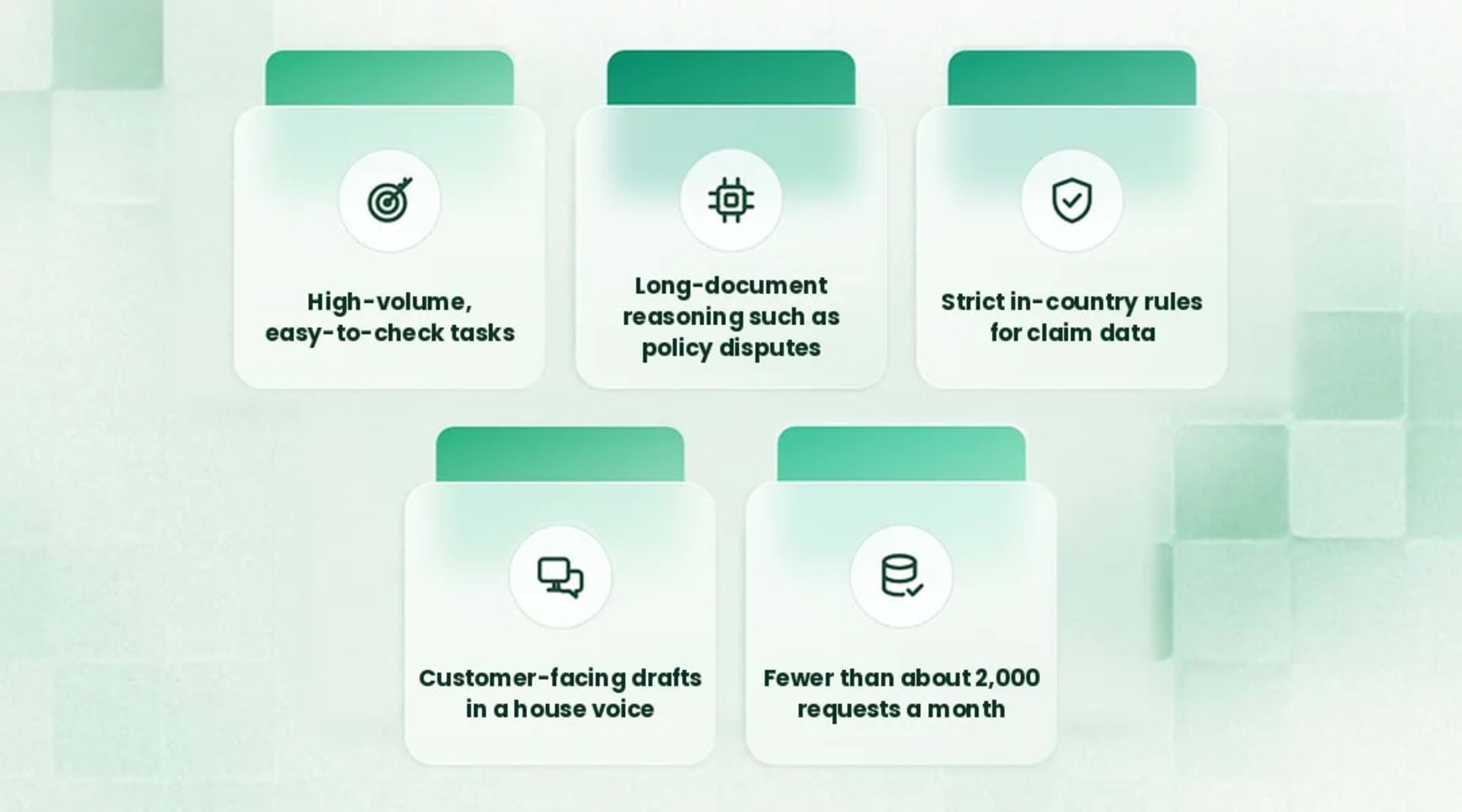
Start from the workload, then pick the cheapest tier that passes your 50-case test. The best LLM for enterprise pilots is usually one tier lower than teams first assume. These starting points map common jobs to a tier:
High-volume, easy-to-check tasks: begin with Claude Haiku 5.5, Gemini 3.8 Flash or GPT-5.4 mini.
Long-document reasoning such as policy disputes: use a frontier tier and watch long-prompt surcharges.
Strict in-country rules for claim data: host open weights yourself, or confirm local processing.
Customer-facing drafts in a house voice: pair a mid-tier model with fine-tuning or retrieval over approved claim replies.
Fewer than about 2,000 requests a month: standardise on one mid-tier model and skip the router.
From a 50-email shortlist to a routed stack in production
Choosing a model for a claims inbox takes about two weeks, but running three reliably is ongoing engineering. If Tavi's situation looks like yours, KriraAI's generative AI development services can build the router and eval set. Start with the 50 emails, and let the numbers name your best LLM for enterprise use.
FAQs
It can, but Tavi would overpay on windscreen claims or under-serve disputes. In the worked example above, a single flagship cost about $885 more each month than a two-tier router.
It is enough to narrow Tavi's search for the best enterprise LLM to two finalists. If those two land within about eight points, extend the test to 200 cases before a multi-year commitment.
OpenAI lists $4 input and $20 output as promotional through 21 November 2026, down from $5 and $30. Check the model page in the week Tavi signs, because promotions can be extended or dropped.
As of November 2026, OpenAI's India region stores data but processes it elsewhere. Anthropic's inference_geo offers only US or global values, with no India setting. Self-hosting open weights on Indian infrastructure is the most direct way to keep processing in the country.
On tightly defined jobs like sorting into nine claim types, it often can. Only your own test will settle it, and gpt-oss-120b's 128K context cannot take a 300-page wording in one prompt.
The validator catches a malformed policy number and escalates that email automatically. A wrong but well-formed answer can still slip through, so weekly human review of routed claims matters.
Re-run the 50 cases whenever a vendor changes a model version or price, and at least quarterly. Gemini 4 Argon's 1 December price change is exactly the kind of event that should trigger a fresh run.
No, because stuffing every policy into the prompt raises cost and latency on each call. Claude Haiku 5.5, for instance, charges five times more per input token once a prompt passes 100K tokens.
Ridham Chovatiya is the COO at KriraAI, driving operational excellence and scalable AI solutions. He specialises in building high-performance teams and delivering impactful, customer-centric technology strategies.