
Fine-Tuning vs RAG: Which Custom AI Approach Fits Your Use Case
Your team has a working prototype on top of a general-purpose large language model, and the demo went well. Then real users arrive, and the model invents a refund policy, misses last week's pricing change, or answers in a tone your compliance team will not approve. The fine-tuning vs RAG question usually shows up at exactly this point, and it deserves a better answer than "it depends."
The short answer for most teams is to start with retrieval and add fine-tuning only when a behavior problem survives good prompting and good retrieval. That position rests on research evidence and on how the two approaches age once they are in production. What follows compares them on freshness, cost, control, and data volume, then gives you a decision tree you can run in one meeting.
Fine-Tuning vs RAG at a Glance
Fine-tuning changes how a model behaves by updating its weights with training examples, while RAG changes what a model knows at answer time by retrieving relevant documents and adding them to the prompt. One reshapes the model itself. The other reshapes the information the model reads before it responds.
That single distinction drives almost every other difference between the two. The table below summarizes how they compare on the factors that matter most in an enterprise build.
Factor
What changes
RAG
Nothing inside the model; the prompt gets retrieved context
Fine-tuning
The model's weights
Factor
Strongest at
RAG
Facts, documents, information that changes
Fine-tuning
Tone, output format, narrow tasks, domain phrasing
Factor
Knowledge freshness
RAG
Updates as soon as a document is re-indexed
Fine-tuning
Frozen at training time until you retrain
Factor
Upfront cost
RAG
Low to moderate (pipeline and vector database)
Fine-tuning
Moderate to high (data preparation, training, evaluation)
Factor
Ongoing cost
RAG
Grows with query volume and context length
Fine-tuning
Lower per query on a small hosted model; retraining recurs
Factor
Data you need
RAG
Documents, ideally clean and well structured
Fine-tuning
Labeled input and output examples
Factor
Traceability
RAG
Answers can point to source passages
Fine-tuning
Hard to trace why a given output appeared
Factor
Latency
RAG
Retrieval adds a step to each request
Fine-tuning
No retrieval step at inference
Factor
Typical failure
RAG
Retrieves the wrong or incomplete passage
Fine-tuning
Confidently wrong when inputs drift from training data
Factor
Switching base models
RAG
Usually a configuration change
Fine-tuning
Requires retraining on the new base model
What Is Fine-Tuning?
Fine-tuning is the process of continuing to train a pretrained model on a smaller, task-specific dataset so that a new behavior becomes part of the model's default output. In supervised fine-tuning, you supply pairs of inputs and ideal outputs, and the training process nudges the model's weights until its responses look more like your examples. Once trained, the model produces that behavior without needing long instructions in every prompt.
Few teams retrain every weight anymore. Parameter-efficient fine-tuning (PEFT) methods freeze the original model and train a small set of added parameters instead. The best-known method, LoRA, came out of Microsoft in 2021, and its authors reported that, measured against full fine-tuning of GPT-3 175B with Adam, it cut the number of trainable parameters by about 10,000 times and GPU memory requirements by about three times, while matching or beating full fine-tuning on model quality.
A 2023 follow-up pushed costs down further. QLoRA, presented at NeurIPS 2023, paired LoRA adapters with a 4-bit quantized base model and showed that a 65-billion-parameter model could be fine-tuned on a single 48GB GPU while keeping the task performance of standard 16-bit fine-tuning. That shift is why fine-tuning an open-weight model is now realistic for teams without a research lab budget.
What Is RAG?
RAG, short for retrieval augmented generation, is an architecture that searches an external knowledge source for passages relevant to a user's question and hands those passages to the model as context before it writes an answer. The model's weights stay untouched. Updating what the system knows means updating the documents, not the model.
The term traces back to a 2020 NeurIPS paper from Facebook AI Research. Lewis and colleagues paired a pretrained sequence-to-sequence model with a dense vector index of Wikipedia that a neural retriever could search, and they found the combined system produced more specific, diverse, and factual text than a model relying on its parameters alone. Production systems today use the same core idea with more components around it.
A useful way to picture the difference: fine-tuning is like sending an employee on a training course, while RAG is like giving that employee a well-organized filing cabinet and asking them to check it before answering. The course changes habits. The filing cabinet changes what facts are within reach today.
How Each Approach Actually Works
Both approaches are multi-step pipelines, and most production problems trace back to one weak component rather than to the choice of approach itself. Seeing the steps side by side also makes the cost and staffing differences easier to judge. Here is what each pipeline looks like from raw data to a live system.
The RAG pipeline, step by step
Ingest and clean. Pull content from wikis, PDFs, ticketing systems, and databases, strip boilerplate, and attach metadata such as owner, date, and access group.
Chunk. Split documents into passages small enough to retrieve precisely but large enough to keep one complete idea together.
Embed. Convert each chunk into a vector (a numeric representation of its meaning) using an embedding model.
Index. Store vectors and metadata in a vector database, often alongside a keyword index so the system can run hybrid search.
Retrieve. At query time, embed the question, fetch the closest chunks, and filter out anything the user is not permitted to see.
Rerank. Use a reranking model to reorder candidates by relevance and drop weak matches.
Assemble and generate. Build a prompt containing instructions, the retrieved passages, and the question, then let the model answer with references to its sources.
Evaluate and monitor. Log which passages were retrieved, score answer quality, and track queries that returned nothing useful.
The fine-tuning pipeline, step by step
Define the target behavior. Write down exactly what "good" looks like and build an evaluation set before any training starts.
Collect examples. Gather input and output pairs that demonstrate the behavior, drawn from real traffic where possible.
Clean and balance. Remove contradictory examples and make sure rare but important cases are represented.
Choose a base model and method. Decide between full fine-tuning and PEFT methods like LoRA, and between a hosted service and a model you run yourself.
Train. Run training while holding back a validation set the model never sees.
Evaluate for gains and regressions. Compare the tuned model against the base model with a strong prompt, and check that general skills did not degrade (a problem known as catastrophic forgetting).
Deploy and version. Ship the model with a clear version label and a path to roll back.
Plan retraining. Schedule new training runs for when your data, your task, or the underlying base model changes.
Knowledge Problem or Behavior Problem? Diagnose Before You Choose
The most reliable way to choose between the two approaches is to identify whether your model fails because it lacks information or because it behaves the wrong way. Teams that skip this diagnosis often fine-tune to fix a missing-facts problem, which is the expensive mistake. Framed this way, fine-tuning vs RAG stops being a technology debate and becomes a question about symptoms.
There is solid research behind that framing. A Microsoft study by Ovadia and colleagues compared unsupervised fine-tuning with RAG across a range of knowledge-intensive tasks and found that RAG consistently came out ahead, for facts the model had seen during pretraining and for entirely new facts alike. The authors also observed that models had difficulty absorbing new factual information through fine-tuning unless training exposed them to many different phrasings of the same fact. In practice, that makes fine-tuning a poor default for teaching a model your product catalog or policy library.
Use the table below to map what you are seeing to the right first fix.
Symptom you observe
"It doesn't know our current pricing."
Problem type
Missing knowledge
First fix to try
RAG over the pricing source
Symptom you observe
"It quotes a policy we retired last quarter."
Problem type
Stale knowledge
First fix to try
RAG with document versioning and expiry
Symptom you observe
"It ignores our JSON schema on a small share of requests."
Problem type
Behavior
First fix to try
Structured output settings and prompt fixes, then fine-tuning
Symptom you observe
"It misuses our internal jargon."
Problem type
Mixed
First fix to try
Retrieve a glossary first; fine-tune if the issue persists
Symptom you observe
"It is too slow or costly at our volume on one narrow task."
Problem type
Efficiency
First fix to try
Fine-tune a smaller model on that task
Symptom you observe
"It finds the right document but still answers badly."
Problem type
Reading behavior
First fix to try
Retrieval-aware fine-tuning (covered below)
Four Decision Criteria: Freshness, Cost, Control, and Data Volume
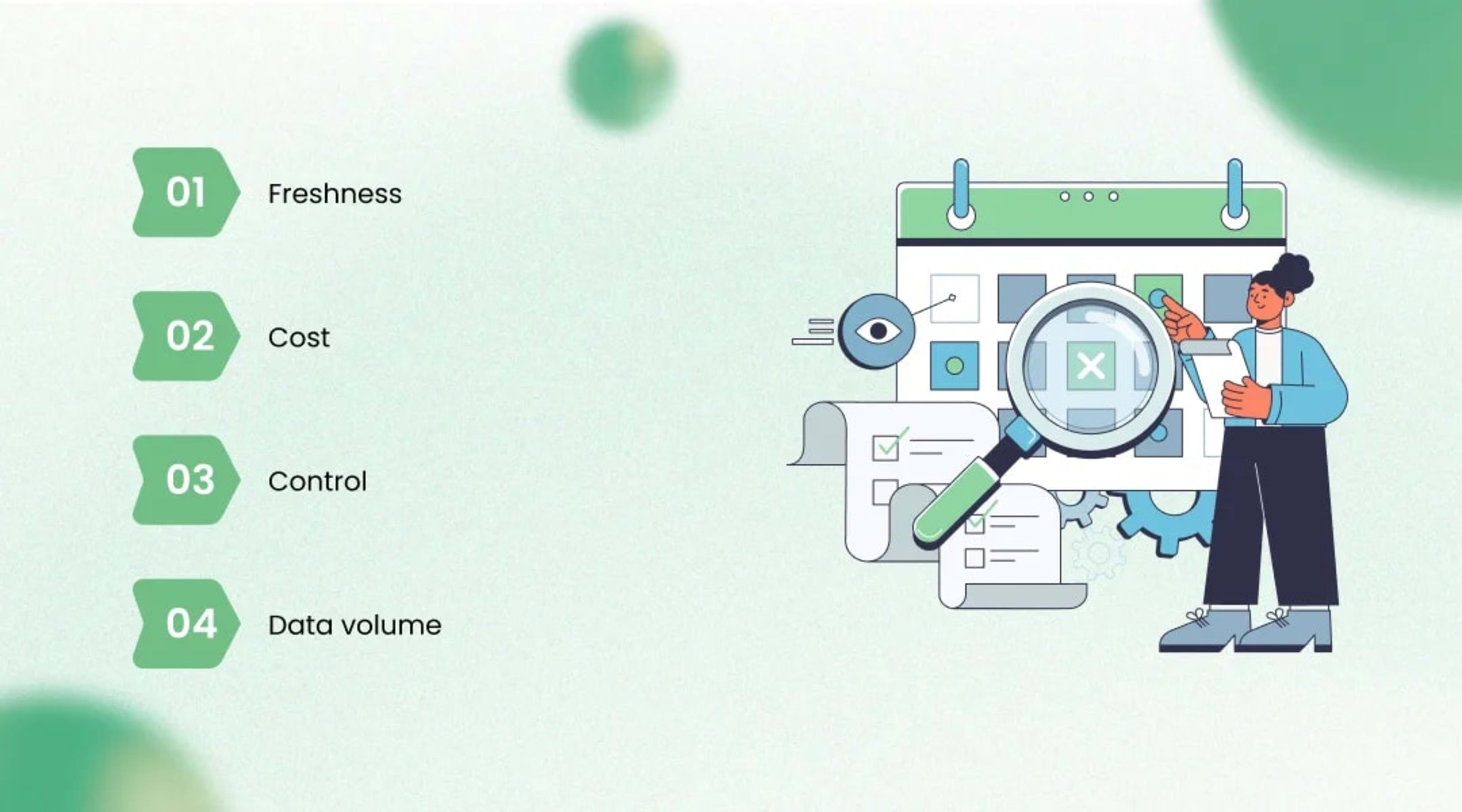
Four criteria settle most of these decisions: how often your information changes, how you want to spend money over time, how much control you need over behavior and data, and what kind of data you actually have. Weigh them in that order, because freshness alone rules fine-tuning out for many knowledge-heavy use cases. The sections below cover each one.
Freshness
If the facts your users ask about change weekly or monthly, RAG is the practical choice. A fine-tuned model's knowledge is a snapshot of its training data, so every pricing update or policy revision means another training run, another evaluation, and another deployment. With retrieval, the same update is an edit to a document and a re-index that can run in minutes.
Cost
The two approaches have different cost shapes rather than one being cheaper in every case. RAG spends less to launch and more per query, while fine-tuning spends more to launch and can spend less per query on a narrow task. The full breakdown appears in the next section.
Control
Control comes in two forms, and each approach wins one of them. Fine-tuning gives stronger control over behavior, such as a strict output schema or a regulated tone that prompting cannot hold steady across thousands of requests. RAG gives stronger control over data: you can restrict retrieval by user permissions, show the source behind each answer, and remove a document the moment it should no longer be used, whereas removing something a model learned in training means retraining it.
There is also control over your vendor roadmap to consider. In a May 8, 2026 update, OpenAI said it is winding down its fine-tuning platform, which is now closed to new users, with existing users able to create training jobs only for the coming months. If fine-tuning sits at the center of your plan, owning the base model and adapter weights (typically with open-weight models) reduces your exposure to a single provider's product decisions.
Data volume
RAG needs documents, while fine-tuning needs labeled examples, and that difference often decides the matter on its own. OpenAI's fine-tuning documentation sets a minimum of 10 examples, notes that improvements typically appear with 50 to 100, and advises starting with around 50 well-crafted demonstrations; if those show no effect, it suggests rethinking the task or prompt before adding more data. Complex behaviors usually need far more than that, and consistency of the examples matters more than raw count.
Corpus size points the other way. Retrieval scales comfortably with thousands of documents, while fine-tuning a model to memorize a large, growing knowledge base is impractical. If your raw material is a large document library with no labeled examples, retrieval is where you start.
Cost Comparison: Where the Money Actually Goes
RAG usually costs less to launch and more to run per query, while fine-tuning costs more to launch and can cost less per query on a narrow, high-volume task, especially when it lets you move to a smaller model. The cost side of fine-tuning vs RAG is where most budget surprises happen, because the hidden lines are rarely in the first estimate. The table below separates the lines that tend to matter.
Cost line
Build
RAG
Ingestion, chunking, embedding, vector database setup, retrieval tuning
Fine-tuning
Dataset creation and labeling, training compute, evaluation
Cost line
Run
RAG
Vector storage, retrieval calls, longer prompts on every request
Fine-tuning
Inference on the tuned model; hosting costs if self-hosted
Cost line
Update
RAG
Re-embedding changed documents
Fine-tuning
Retraining, re-evaluating, and redeploying
Cost line
Team
RAG
Data and search engineering
Fine-tuning
Machine learning engineering with model operations experience
Cost line
Often missed
RAG
Extra context tokens, duplicate and outdated document cleanup, permission syncing
Fine-tuning
Labeling time, model versioning, regression testing, base model retirement
Context tokens are the line that grows quietly. Suppose each query retrieves five chunks of about 400 tokens; that adds roughly 2,000 input tokens to every call, so a system handling one million queries a month pays for about two billion additional input tokens. Trimming chunk count with a good reranker is often the single biggest lever on RAG running costs.
The crossover point for fine-tuning arrives when three conditions line up: high query volume, a narrow and stable task, and a smaller model that can match a large model's quality on that one job. Without all three, retraining and evaluation costs tend to eat the per-query savings. This isn't a universal rule, so run the numbers against your own traffic before committing.
When RAG Is the Better Fit
RAG is the better fit when answers depend on information that is large, changing, private, or needs to be traceable to a source. It also suits teams that want to ship quickly without first building a labeled training set. These are the situations where it tends to win clearly:
Your knowledge base changes more often than you could reasonably retrain a model.
Users or auditors need to see which document an answer came from.
Different users are allowed to see different content, so access rules must apply at query time.
You want the freedom to swap the underlying model as pricing and quality shift.
Your content runs to thousands of documents and keeps growing.
The most common first project is an assistant that answers employee or customer questions from existing documentation. It makes a good pilot because the documents already exist and success is easy to measure against real support tickets. Curious how that would apply to your own document set? See how a RAG chatbot on your own data is put together.
When to Fine-Tune Instead
Fine-tuning earns its cost when the failure you need to fix is about behavior that prompting cannot hold steady, and the task is narrow and stable enough that your training data will stay relevant. Notice that each case below is about how the model responds rather than what facts it knows. That pattern is the clearest signal you have.
Strict, repeatable output. Every response must follow an exact schema or template, and occasional misses break downstream automation.
Narrow classification or extraction. Routing tickets into fixed categories, tagging clauses by risk level, or pulling specific fields from forms.
Specialized language. Your domain uses terminology or writing conventions that a general model consistently gets wrong.
Cost and latency at volume. A large model is overkill for one repetitive task, and a smaller tuned model could handle it faster and more cheaply.
Offline or on-device use. The model must run in a constrained environment without calling external services.
Fine-tuning is not the right move for every team that wants a custom model. If you lack an evaluation set, cannot produce at least a few dozen clean examples, or expect the task definition to change every month, the training data will go stale before it pays off. For a wider view of what building a model around your own data involves, see our guide to Custom AI model development.
Hybrid Approaches: Using RAG and Fine-Tuning Together
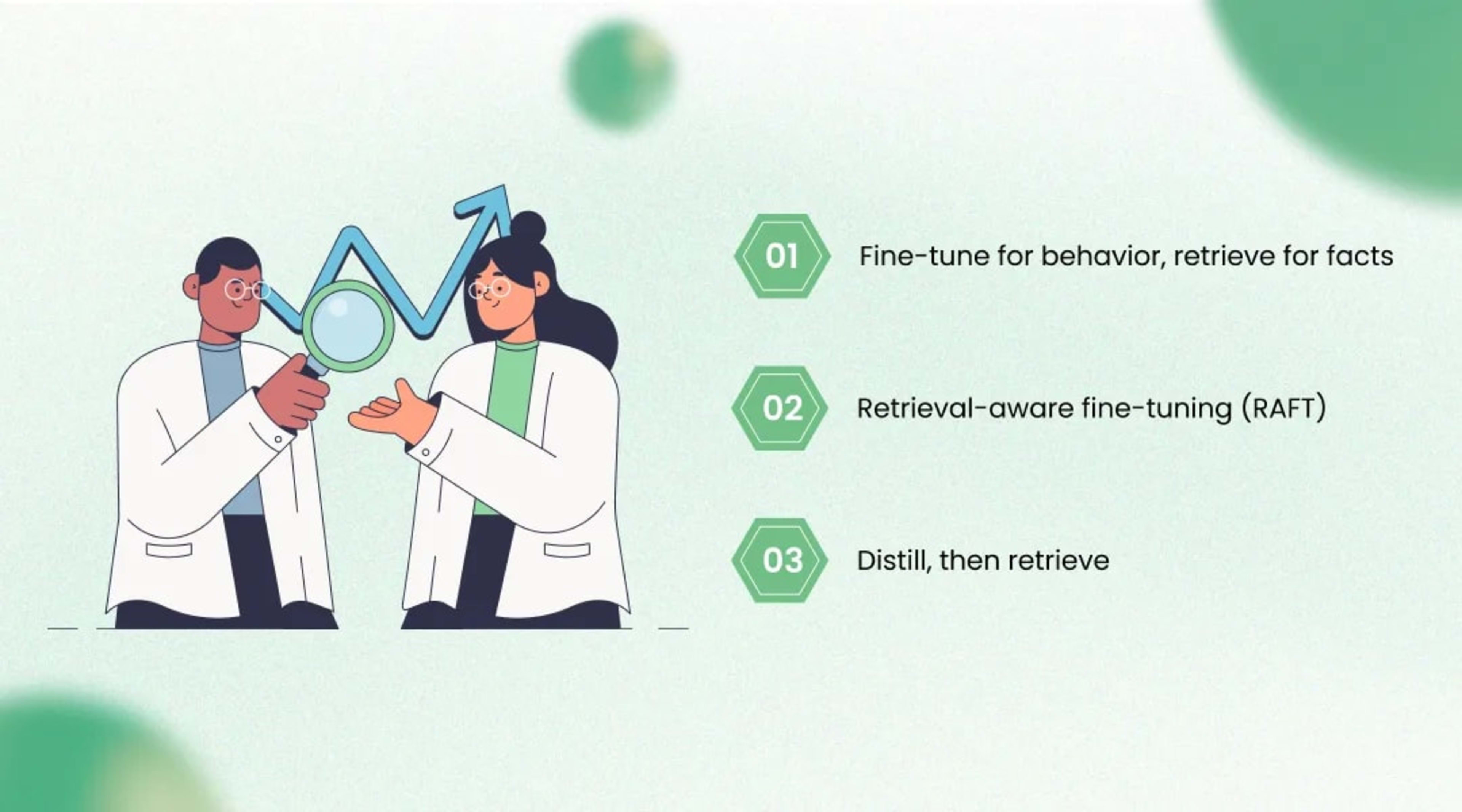
A hybrid system uses fine-tuning to control how the model responds and RAG to control which facts it responds with. Each technique then covers the other's weak spot, which is why mature products often end up here. There are three hybrid patterns worth knowing.
Fine-tune for behavior, retrieve for facts
This is the most common pattern. Picture an insurance claims assistant: a light fine-tune teaches it the approved response structure and regulatory phrasing, while retrieval supplies the current policy wording for each customer's plan. When a policy changes, you update the document store and leave the model alone.
Retrieval-aware fine-tuning (RAFT)
Sometimes retrieval finds the right document but the model still gets distracted by irrelevant passages sitting next to it. Researchers at UC Berkeley proposed Retrieval Augmented Fine Tuning (RAFT), which trains a model on questions paired with a set of retrieved documents so it learns to disregard the unhelpful ones and quote the relevant passage directly; in domain-specific settings it improved results across the PubMed, HotpotQA, and Gorilla datasets. RAFT is worth considering when your retrieval layer returns noisy results that you cannot fully clean.
Distill, then retrieve
The third pattern targets cost. You use a large model to generate high-quality outputs for a narrow task, train a smaller model on those outputs, and place that smaller model behind your retrieval layer. OpenAI's own documentation describes distilling a large model's outputs as one way to build a training set for a smaller model.
On sequencing, our view is to build retrieval first. A retrieval baseline is cheaper to evaluate, and it shows you which failures remain once the model has the right facts in front of it. Those remaining failures define the scope of any fine-tuning effort, which keeps it small and measurable.
Limitations of RAG and Fine-Tuning
Neither approach, on its own, guarantees a reliable system: RAG is limited by what it retrieves and how well the model reads it, and fine-tuning is limited by its training data and the moment training stopped. Knowing these limits upfront helps you set honest expectations with stakeholders. They also explain why evaluation matters more than the choice of technique.
Where RAG falls short
Retrieval quality sets a ceiling on answer quality. A chunk boundary that splits an instruction in half, three conflicting versions of the same policy, or a missing permission filter will each produce bad answers from an otherwise capable model. RAG also adds infrastructure to maintain and a retrieval step that increases response time.
Packing more context into the prompt is not a complete fix either. A study led by Stanford researchers found that language models often perform best when the relevant information sits at the start or end of the input and perform noticeably worse when it is buried in the middle of a long context, including models built for long inputs. RAG also does little for tone or format problems, since it changes inputs rather than behavior.
Where fine-tuning falls short
Fine-tuning is an unreliable way to add new facts, as the Microsoft comparison above showed. Whatever it does learn is frozen at training time, and aggressive training on a narrow dataset can degrade skills the base model used to handle well. Tracing why a tuned model produced a specific output is difficult, and removing information it absorbed requires another training run.
There is also dependency risk. A tuned model is tied to its base model, so if a provider retires that base model or its fine-tuning service, your investment may need to be rebuilt on something else. Planning for portability from day one keeps that risk manageable.
What neither approach can fix
Poor source data, an undefined task, and the absence of an evaluation set will undermine either approach. Neither one raises the base model's reasoning ceiling in any dependable way, and neither eliminates hallucinations entirely. Both reduce specific kinds of errors, which is why measuring those errors comes first.
A Practical Decision Tree for Choosing Your Custom LLM Approach
Run these questions in order and stop at the first branch that resolves your problem, because each step is cheaper and more reversible than the one after it. Most teams settle the fine-tuning vs RAG choice by step four. Keep your evaluation results next to you as you go.
Do you have an evaluation set of real questions with expected answers? If no, build one first (a few hundred representative cases is a sensible target), since every later step depends on measuring improvement.
Does better prompting fix most failures? Try clear instructions, a few examples, and structured output settings. If failures drop to an acceptable level, ship that and stop.
Does all the relevant content fit comfortably in the context window, and does it rarely change? If yes, consider placing it directly in the prompt and skipping a retrieval pipeline for now.
Are the remaining failures mostly missing, outdated, or private facts? If yes, build RAG and re-run your evaluation set.
After RAG, do failures concern format, tone, terminology, or accuracy on a narrow task? If yes and you have at least 50 clean examples for a stable task, fine-tune with a PEFT method and keep retrieval in place. If you lack the data, collect it while relying on prompting and structured outputs.
Is cost or latency at high volume the main problem on one narrow task? If yes, distill that task into a smaller fine-tuned model.
Does retrieval find the right documents while the model still misuses them? If yes, consider retrieval-aware fine-tuning such as RAFT.
How to Start Without Overcommitting
The lowest-risk way to start is to build the evaluation set and a basic RAG baseline first, because both are reusable whichever direction you take next. The evaluation set tells you whether any change helped. The baseline tells you which failures are left once the model can see the right facts.
This order also matches vendor guidance. OpenAI's documentation advises investing in fine-tuning only after evaluations are in place. Without that measurement, you cannot tell whether a tuned model beats a well-prompted base model, and you risk paying for training that changes nothing.
Be honest about scale as well. If your entire knowledge base is a short handbook that changes twice a year, you may not need retrieval or fine-tuning yet, and a carefully written prompt could carry the first release. Starting small is a legitimate engineering choice, not a shortcut.
Choosing the Right Path for Your Use Case
The right choice comes from diagnosing your failures first: use RAG for missing or changing knowledge, fine-tuning for stubborn behavior problems on stable tasks, and a hybrid when you need both. Build an evaluation set, set up a retrieval baseline, and let the remaining failures tell you whether fine-tuning is worth its cost. That sequence keeps spending tied to measured results instead of assumptions about which technique sounds more advanced.
Every organization's data, compliance requirements, and traffic patterns differ, so the same decision tree can lead to different answers. A partner who has run both approaches in production can shorten the path from prototype to a dependable system. If you want help scoping that work, talk to KriraAI's AI Services / Custom AI team about your use case.
FAQs
Fine-tuning updates a model's weights with training examples so it behaves differently by default. RAG leaves the model unchanged and instead retrieves relevant documents at query time to include in the prompt. In short, fine-tuning shapes behavior and RAG supplies current knowledge.
No, the two approaches solve different problems and are often combined. A common setup uses fine-tuning for tone and output format and RAG for up-to-date facts. Many teams start with RAG and add fine-tuning later for the specific gaps their evaluations reveal.
RAG is usually cheaper to launch because it requires no training run or labeled dataset. Fine-tuning costs more upfront but can lower per-query costs on a narrow, high-volume task, especially when it allows a smaller model. Which one costs less overall depends on your query volume, how often your data changes, and how narrow the task is.
Fine-tuning can add some knowledge, but it is an unreliable method for teaching new facts. A Microsoft study comparing the two found that RAG outperformed unsupervised fine-tuning on knowledge-intensive tasks, and that models struggled to learn new facts through fine-tuning. For facts that change or need citing, retrieval is the more dependable choice.
It depends on the task, but small, well-defined tasks can improve with surprisingly few examples. OpenAI's documentation reports typical improvements with 50 to 100 examples and recommends starting with about 50 high-quality ones. Complex behaviors usually need far more, and consistent, accurate examples matter more than sheer volume.
RAG reduces hallucinations by grounding answers in retrieved sources, but it does not remove them entirely. The model can still misread a passage, and retrieval can return the wrong or outdated document. Regular evaluation and clean, current source content are what keep error rates low.
Yes, a fine-tuned model can sit behind a retrieval pipeline like any other model. This hybrid pattern lets fine-tuning handle format and tone while retrieval supplies current facts. Techniques such as retrieval-aware fine-tuning go further by training the model specifically to use retrieved documents well.
RAG can enforce permissions if the retrieval layer filters documents by each user's access rights before passing them to the model. This needs to be designed in from the start, because a retrieval system without permission filtering may surface content a user should not see. Fine-tuned models have no comparable per-user control over what they learned in training.
Fine-tuning can reduce latency because it removes the retrieval step and often allows shorter prompts. The biggest speed gains usually come from fine-tuning a smaller model to replace a larger one on a specific task. A fine-tuned model of the same size as the original will not necessarily respond faster on its own.
A fine-tuned model depends on its base model, so a retirement can force you to retrain on a different model. OpenAI announced in May 2026 that it is winding down its fine-tuning platform, which shows this risk is real. Using open-weight models and keeping your training data and adapter weights under your own control limits that exposure.
Founder & CEO
Divyang Mandani is the CEO of KriraAI, driving innovative AI and IT solutions with a focus on transformative technology, ethical AI, and impactful digital strategies for businesses worldwide.