A midsize biotech running its own Phase II study loses close to $40,000 for every single day that the trial slips. Industry cost analyses put the mean daily delay cost of a Phase II or III trial in that range. For a company with 50 to 500 employees and a fixed cash runway, that figure is not an abstraction. It is often the gap between reaching a data readout before your next financing round and running out of money first. This article is written for exactly that company, the midsize biotech, and deliberately not for the eight-person discovery startup or the global pharma giant. AI for midsize biotech companies is a genuinely different problem than AI for either extreme, because your budget, your data maturity, and your decision speed all sit in an awkward middle. Over the following sections, we will break down what AI actually costs at your scale, which applications return the most for a constrained research budget, and how a team of your size adopts it with the right AI consultancy partner instead of building a thirty-person data science organization. The goal is practical AI biotech ROI, not a wish list you cannot fund.
A midsize biotech usually sits between its first meaningful validation and its first commercial return. You likely have one or two lead programs in the clinic or late preclinical stage, a wet lab team, a small computational or bioinformatics group, and a lean clinical and regulatory function. Your headcount looks nothing like a startup and nothing like Big Pharma. That middle position shapes every technology decision you make.
Budgets at this scale are real but bounded. Annual R&D spend typically runs from the low tens of millions into the low hundreds of millions, and software and data budgets are a thin slice of that. A dedicated AI or analytics budget of $500,000 to a few million per year is common, and every dollar of it competes directly with lab reagents, headcount, and clinical costs. You cannot absorb a failed platform purchase the way a Fortune 100 pharma can.
Your technology stack tends to be fragmented rather than immature. Most midsize biotechs already run an electronic lab notebook, a LIMS, some cloud storage, and a pile of spreadsheets that live in individual scientists' folders. The problem is rarely a total absence of data. The problem is that data sits in silos, lacks consistent structure, and was never captured with machine learning in mind.
Decision-making is faster than at a large enterprise and slower than at a startup, a dynamic typical of the biotechnology industry at this stage of growth. A single scientific founder or CSO can often greenlight a pilot in weeks, but board and investor scrutiny mean you must justify spending against runway. The pressures you feel are specific to your size. You are expected to show pipeline progress before your next raise, compete for scientific talent against both tech companies and big pharma, and do it all while the clock on your cash burns. That combination of real budget, fragmented data, investor pressure, and finite runway is the exact context in which AI has to earn its place.
AI for midsize biotech companies is fundamentally a resource allocation problem, not a capability problem. A global pharma can staff an internal AI center of excellence, license multiple discovery platforms at once, and treat a failed initiative as a rounding error. You cannot. Your entire AI strategy has to survive on a fraction of that budget and produce a visible return inside a single funding cycle.
The budget difference is the first and largest gap. Big pharma routinely commits tens or hundreds of millions to AI programs and internal tooling. A midsize biotech is usually working with a fraction of one percent of that. This means your realistic path is to buy and configure proven tools, not to build foundation models in-house.
Implementation complexity also scales down in a specific way. A startup can bolt one AI tool onto a clean, single-purpose dataset and move on. An enterprise can afford long custom integrations across dozens of systems. You are stuck between those, with enough system sprawl to make integration real work but not enough engineering headcount to brute force it. This is why implementing AI in biotech at your scale succeeds or fails on scoping discipline, not on ambition.
Vendor options at your scale have improved dramatically, part of a broader wave in which AI in biotechnology is accelerating drug discovery and research industry-wide, and that is good news. A large and growing market of specialized platforms now sells AI drug discovery for midsize biotech on a subscription or per-project basis. You can access predictive chemistry, literature mining, and trial optimization without building any of it, and without the multiyear enterprise contracts that used to gate these tools. The tradeoff is that you must choose carefully, because you cannot run five vendors in parallel to see which wins.
Internal skill requirements are lighter than executives fear but heavier than vendors admit. You do not need a large machine learning research team. You do need one or two scientifically literate people who can own data quality, evaluate vendor claims, and translate model output into experimental decisions. This is precisely the layer that a focused implementation partner like KriraAI, which builds practical AI systems around real operational constraints rather than selling a generic platform, is designed to supply, so you do not have to hire it all permanently. The timeline to return is the last major difference. A midsize biotech should expect early efficiency gains within one to two quarters and program-level impact over the following year, not a five-year transformation horizon.
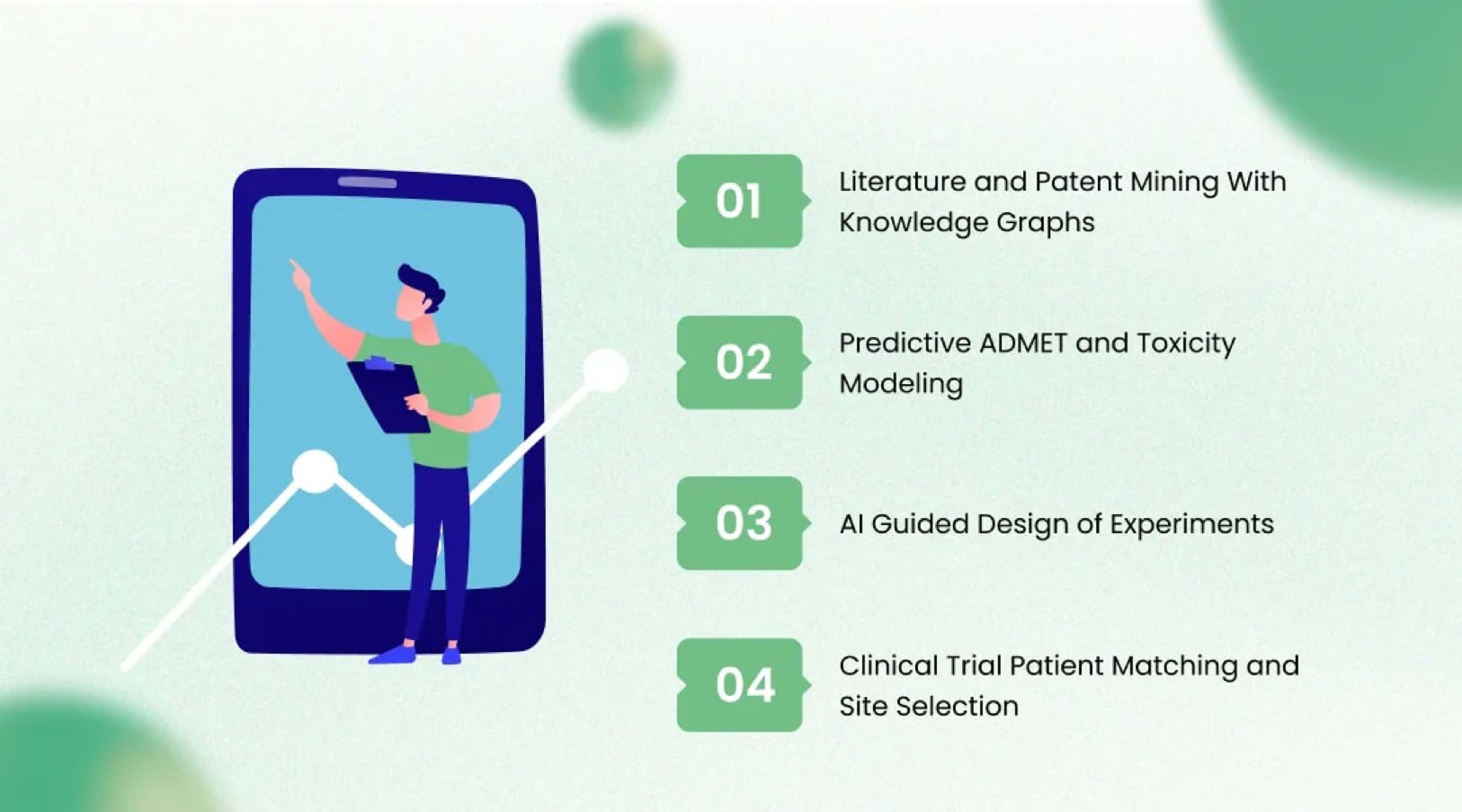
The best AI investments for a midsize biotech are the ones with the shortest path from spend to measurable savings, not the most advanced ones on a conference stage. Your constraint is capital efficiency, so the right applications reduce wasted wet lab cycles, kill weak candidates earlier, and free scientists' time. Below are the four applications that most reliably deliver biotech R&D efficiency with AI on your budget.
The fastest payback for most midsize biotechs comes from AI that reads the literature and patent landscape for you. A small scientific team cannot manually track the tens of thousands of relevant papers, preprints, and filings published each year. Knowledge graph and natural language tools ingest that corpus and surface targets, mechanisms, competitors, and prior art in hours instead of weeks.
These tools are typically sold as software subscriptions in the range of roughly $20,000 to $150,000 per year. The result that a company your size can expect is concrete. Your scientists reclaim days per month, your competitive intelligence sharpens, and you avoid dead-end programs that a broader literature view would have flagged early.
Predictive property modeling is the highest leverage way for a midsize biotech to fail bad molecules cheaply. Late-stage failures are what destroy capital-efficient pipelines, and many of them trace back to absorption, distribution, metabolism, excretion, or toxicity problems that surface too late. AI models trained on chemical and biological data, a clear example of how AI in biotechnology is reshaping drug discovery and beyond, can predict these liabilities before you commit to reagents and animal studies.
At your scale, these platforms run roughly $50,000 to $250,000 per year or on a per-project basis. The realistic outcome is a meaningfully higher-quality shortlist entering synthesis. When you only advance compounds with clean predicted profiles, you spend your limited lab budget on fewer, better bets, which is the core of AI biotech ROI at this size.
AI-guided experimental design compresses the number of wet lab cycles you need to reach a decision. Traditional screening tests thousands of candidates in broad sweeps. Active learning models instead recommend the most informative next experiments, so you learn more from each round and run fewer rounds overall.
The public benchmark here is striking. One AI native program reportedly nominated a preclinical candidate after screening only 78 molecules rather than the thousands typically required, and did so in roughly 18 months at under 10 percent of the average cost per approved drug. A midsize biotech will not fully replicate that, but the direction is the point. Fewer cycles at $50,000 to $200,000 in tooling can shift your burn rate materially.
For any midsize biotech with an asset in the clinic, trial optimization is often the single largest source of AI biotech ROI. Recruitment alone accounts for close to 40 percent of trial costs, screen failure rates can exceed 80 percent for complex studies, and around 80 percent of trials miss their enrollment timelines. Every one of those failures burns your runway directly.
AI patient matching and site selection tools attack that waste. One documented deployment cut screen failure rates from 54 percent to 14 percent, a 73 percent reduction, and dropped manual chart review from 36 hours to 2.5 hours per month. At the $40,000 per day delay cost cited earlier, shaving even a few weeks off enrollment pays for the tooling many times over. This is where a partner like KriraAI, which designs AI implementations sized to a company's actual budget and data, tends to concentrate first for clinical-stage clients.
The return from AI at your scale is measured in runway extension, not in slide deck percentages. A ten percent efficiency gain means something very different for a 200-person biotech than for a 20,000-person pharma. For you, it can be the extra quarter of cash that lets you reach a value inflection point before raising again.
AI-driven approaches have been shown to compress the preclinical phase substantially. Industry analyses report timeline reductions moving target to preclinical candidate work from three to five years down toward roughly 13 to 18 months, and preclinical cost reductions in the range of 30 to 70 percent. A midsize biotech capturing even the lower end of that range on a single program frees capital that would otherwise fund another year of the same discovery cycle.
On the clinical side, the math is even more direct because the waste is so large. A contemporary Phase III trial averages around $19 million and six to seven years, and roughly 37 percent of investigational sites fail to recruit even one participant. Trimming that failure rate with better site selection and patient matching does not just save money. It protects the timing of your data readout, which is the event your valuation actually hinges on.
Operational savings compound quietly across a small team. When literature mining reclaims several scientists' days per month, and 80 percent of the clinical data buried in unstructured records becomes searchable, your existing headcount effectively does more. For a company where every hire is scrutinized, letting current staff cover more ground is worth as much as a direct cost cut. Taken together, realistic AI adoption at this scale can extend runway by a full quarter or more, which for a midsize biotech is frequently the difference between negotiating a raise from strength and doing so from desperation.
Implementing AI in biotech at your scale works best as a narrow, staged sequence rather than a broad transformation. You do not have the headcount to run parallel experiments, so each phase must prove value before the next begins. The whole path from audit to full adoption is realistic in nine to fifteen months for a focused team.
Start by auditing your data and picking one painful, measurable use case. Most midsize biotechs discover their data is fragmented across an ELN, a LIMS, and spreadsheets, and that cleanup is the real first project. KriraAI approaches this by mapping where usable data actually lives and scoring candidate use cases on expected return before any model is selected. This audit typically takes four to eight weeks and prevents the most expensive mistake, which is buying a platform your data cannot feed.
Next, select one vendor for one use case and run a time-boxed pilot with a predefined success metric. At your scale, you buy and configure rather than build, so evaluate vendors on data compatibility, validation evidence, and support, not on demo polish. A pilot should run 8 to 12 weeks against a clear target, for example, reducing screen failure rate or cutting a synthesis round. Only after a pilot clears its metrics do you expand to a second use case and integrate it into the standard workflow.
Three specific mistakes derail AI adoption at this company size more than any others, and each is avoidable.
Buying the platform before fixing the data leaves an expensive tool starved of usable inputs and produces no return. Fix this by completing the data audit first and budgeting for cleanup as a real line item.
Scoping too broadly and trying to transform discovery, clinical, and operations at once, which stretches a lean team past the breaking point. Fix this by committing to one use case with one owner until it demonstrably works.
Treating AI as a pure headcount replacement rather than a scientist multiplier, which erodes trust and adoption internally. Fix this by framing tools as decision support and keeping a scientifically literate owner in the loop on every output.
The internal resource picture is lighter than most executives assume. You need one accountable internal owner, part-time input from your bioinformatics staff, and defined access to your data systems. Everything else, from model configuration to validation to integration, can be outsourced to a specialist partner during the build, then handed back to your team to run.
The hardest challenges at your scale come from being caught in the middle, with more complexity than off-the-shelf tools handle but less budget than custom builds require. A small business can run one simple tool on clean data. An enterprise can fund bespoke systems. You have enough system sprawl and regulatory exposure to make things genuinely hard, without the resources to brute-force a solution.
Data readiness is the first friction point, and it is more stubborn than a vendor pitch admits. Because roughly 80 percent of your clinically relevant information sits in unstructured notes and records, real preparation work stands between you and any model. Underfunding that step is the most common reason midsize AI projects stall.
Talent is the second constraint, and it is structural. You are competing for machine learning and data engineering talent against tech firms and big pharma that outbid you on compensation. Building a full internal team is rarely viable at your budget, which is why a hybrid model, keeping a thin internal owner and outsourcing the heavy build, tends to be the only sustainable path. This is a specific gap KriraAI is built to fill, supplying the implementation depth a midsize team cannot justify hiring permanently.
Regulatory and validation demands add a layer that lighter industries never face. Any AI touching data destined for a regulatory submission must be validated, documented, and auditable under GxP expectations. That overhead is real, and it must be budgeted from the start, not discovered late. The honest summary is that these challenges are all solvable, but only if you scope narrowly, budget for data work, and refuse to pretend an enterprise playbook will fit your team.
Within three to five years, the midsize biotech field will visibly split between companies that operationalized AI early and those that waited. The advantage compounds because AI at this scale is primarily a capital efficiency engine. A company that extends its runway and sharpens its pipeline decisions each cycle reaches more value inflection points on the same money.
The early movers will run leaner discovery and smarter trials as a matter of routine. They will kill weak candidates before synthesis, enroll trials faster, and reach readouts ahead of comparably funded rivals. Because these gains recur in every program, a two-year head start becomes a structural lead, not a one-time bump.
The companies that delay will feel the gap most acutely at the negotiating table. When two midsize biotechs pitch similar science, the one that reaches clean data faster and demonstrates AI-enabled efficiency will attract capital and partnership on better terms. Investors already track AI adoption as a proxy for operational discipline. The specific capability that will separate winners from losers at this scale is not owning the fanciest model. It has clean, connected data and a repeatable process for turning AI output into faster, cheaper scientific decisions.
Three points matter most for any midsize biotech weighing AI. First, AI at your scale is a capital efficiency tool, so its return should be measured in extended runway and faster readouts, not in generic transformation language. Second, the winning applications are the practical ones: literature mining, predictive property modeling, smarter experiments, and trial optimization, each chosen for short payback rather than novelty. Third, success depends on scoping narrowly, fixing data first, and pairing a thin internal owner with outside implementation depth.
This is exactly the gap KriraAI was built to close for companies of your size. KriraAI builds practical, scalable AI systems designed around real business constraints, which means implementations sized to a 50- to 500-person biotech's actual budget, data maturity, and growth stage rather than enterprise systems scaled down or startup tools scaled up. The work starts with a focused data and use case audit, moves through a contained pilot with a measurable target, and ends with a workflow your own team can run. If you want to see what practical AI biotech ROI could look like against your specific pipeline and runway, reach out to KriraAI to explore an implementation built for your stage.
Founder & CEO
Divyang Mandani is the CEO of KriraAI, driving innovative AI and IT solutions with a focus on transformative technology, ethical AI, and impactful digital strategies for businesses worldwide.