The cost of bringing a single new drug to market now routinely exceeds $2 billion, and the journey from initial research to regulatory approval stretches across 10 to 15 years. For an industry built on scientific breakthroughs, biotechnology has long been shackled by a paradox: the very rigor that ensures patient safety also creates staggering inefficiency at every stage of development. Yet the landscape is shifting rapidly. The AI in biotechnology market reached $1.94 billion in 2025 and is projected to grow to $16.49 billion by 2034, reflecting a compound annual growth rate of 27 percent. This is not speculative enthusiasm. Over 200 AI discovered drugs are currently in clinical development worldwide, with 15 to 20 entering pivotal trials in 2026 alone, and the first fully AI designed drug approval is anticipated within the next 12 to 18 months.
AI drug discovery is no longer a fringe experiment conducted by startups with more ambition than evidence. It has become a strategic imperative for organizations ranging from multinational pharmaceutical companies to mid stage biotech firms, with approximately 81 percent of pharmaceutical companies now deploying AI in some capacity across their research and development pipelines. This blog provides a comprehensive analysis of how AI is transforming biotechnology, the quantified business impact companies are achieving, a practical implementation roadmap, and an honest assessment of the challenges that remain.
The biotechnology industry sits at a crossroads defined by escalating costs, compressed timelines, and intensifying global competition. Understanding these pressures is essential before exploring how AI addresses them, because the technology is only as valuable as the problems it solves.
Drug development productivity has been declining for decades. The number of approved drugs per billion dollars of R&D spending has roughly halved every nine years since 1950, a trend researchers have termed "Eroom's Law." Despite massive increases in research budgets, the pharmaceutical industry's return on investment has fallen below the cost of capital for many large organizations. The average clinical trial failure rate remains above 90 percent, meaning fewer than 10 percent of drugs entering clinical testing ever reach regulatory approval.
Patient recruitment compounds these difficulties. Clinical trials frequently fail to meet enrollment targets on schedule, with upwards of 30 percent of enrolled patients dropping out before completion. Delays in recruitment alone can cost sponsors between $600,000 and $8 million per day depending on the therapeutic area.
Regulatory complexity is also increasing, with the FDA, EMA, and other global regulatory bodies raising the evidentiary bar for approval. Meanwhile, the competitive landscape is intensifying as China's biotechnology sector grows rapidly and venture capital funding, while still robust at over $8 billion annually flowing into AI biotech ventures, concentrates among companies that can demonstrate tangible efficiency gains.
The convergence of these pressures creates an environment where incremental improvements to traditional processes are no longer sufficient. The industry needs a fundamentally different approach to how drugs are discovered, developed, and brought to market.

The application of AI in biotechnology is not a single technology solving a single problem. It is a constellation of machine learning techniques, each mapped to specific bottlenecks across the drug development lifecycle. Understanding these mappings is critical for any organization considering AI adoption.
The first stage of drug discovery involves identifying biological targets, typically proteins or genes, whose dysfunction contributes to disease. Traditional target identification relies on painstaking literature review, hypothesis driven experimentation, and years of iterative validation. Machine learning genomics approaches are compressing this timeline dramatically by analyzing vast datasets of genomic, proteomic, and phenotypic data to identify novel targets with higher confidence.
Knowledge graph technologies aggregate data from published research, patent databases, clinical records, and molecular interaction databases to surface relationships that no human researcher could identify manually. Recursion Pharmaceuticals' merger with Exscientia in 2025 created an integrated platform combining phenomic screening with automated chemistry, establishing the first true end to end AI drug discovery system. KriraAI works with biotechnology firms at this stage to build custom AI pipelines that integrate proprietary datasets with public biological databases, enabling target identification workflows tailored to each organization's therapeutic focus.
Once a target is validated, the next challenge is designing molecules that interact with it effectively. Traditional medicinal chemistry involves synthesizing and testing thousands of compounds, a process that can consume two to three years and tens of millions of dollars. Generative AI models are now capable of proposing novel molecular structures optimized for binding affinity, selectivity, metabolic stability, and synthetic accessibility simultaneously.
Insilico Medicine demonstrated the power of this approach with rentosertib, a drug candidate designed entirely by AI for idiopathic pulmonary fibrosis. In Phase IIa clinical trials published in Nature Medicine, rentosertib showed a 98.4 milliliter improvement in forced vital capacity at the 60 milligram dose compared to a 62.3 milliliter decline in the placebo group over 12 weeks. This represents the first time an AI designed molecule has demonstrated both safety and efficacy in human clinical trials, a watershed moment for the entire field of AI drug discovery.
A significant proportion of drug candidates fail in clinical trials due to poor absorption, distribution, metabolism, and excretion (ADME) properties, or unexpected toxicity. Predictive analytics biotech applications now use deep learning models trained on millions of molecular data points to forecast these properties before a single experiment is conducted in a laboratory. These models can predict liver toxicity, cardiac safety risks, and metabolic liabilities with increasing accuracy, allowing researchers to eliminate problematic candidates before committing resources to synthesis and testing.
However, adoption of AI for ADME prediction remains relatively low at approximately 29 percent across the industry, according to the 2026 Benchling Biotech AI Report. This gap represents both a challenge and an opportunity for companies willing to invest in these capabilities ahead of competitors.
Clinical trial design and execution represent the most expensive phase of drug development, and AI clinical trials optimization is producing some of the most measurable efficiency gains. AI systems can simulate trial designs using digital patient populations, testing different endpoint selections, dosing strategies, and inclusion criteria before a single patient is enrolled.
Patient recruitment, the single largest driver of clinical trial delays, is being transformed by natural language processing and predictive modeling. AI systems can scan electronic health records, insurance claims databases, and other sources to identify patients who meet eligibility criteria. According to IQVIA research, one clinical research site used AI powered technology to streamline feasibility survey completions, achieving a 90 percent reduction in time required.
AlphaFold and its successors have fundamentally changed structural biology. Tasks that previously required years of experimental work using X ray crystallography or cryo electron microscopy can now be completed in hours through computational prediction. The 2026 Benchling report found that protein structure prediction has reached 71 percent adoption among biotech organizations actively using AI. This capability accelerates rational drug design by providing accurate three dimensional models of target proteins against which candidate molecules can be computationally evaluated.
The transition from theoretical potential to measurable results separates the current wave of AI adoption from earlier cycles of technology hype. Companies implementing AI across their operations are reporting concrete improvements that directly affect financial performance.
Timeline compression is the most consistently reported benefit. Traditional drug discovery from target identification to clinical candidate nomination typically takes four to six years. AI native companies have demonstrated the ability to advance candidates into clinical trials in approximately half that time, with some programs reaching first in human studies within 18 to 24 months.
Cost reduction across the preclinical phase ranges from 30 to 70 percent depending on the therapeutic area and the extent of AI integration. Overall drug development costs, including clinical trials, show reductions of 25 to 40 percent when AI is embedded throughout the pipeline. A study by the Tufts Center for the Study of Drug Development, conducted in collaboration with the Drug Information Association, assessed 36 clinical trial case examples and found an average 18 percent cycle time reduction when AI and ML approaches were applied across trial planning, execution, and regulatory submission.
Clinical trial success rates tell an equally compelling story. AI designed drugs entering Phase I clinical trials show success rates between 80 and 90 percent, compared to 40 to 65 percent for traditionally discovered compounds. Phase I success rates for AI candidates range from 65 to 75 percent versus 30 to 45 percent for conventional programs. These improvements matter enormously because late stage failures are the most expensive events in drug development, often consuming hundreds of millions of dollars before a program is terminated.
KriraAI helps biotechnology companies establish the measurement frameworks necessary to track these improvements. Without proper baseline metrics and ongoing monitoring, organizations risk investing in AI without the ability to demonstrate its return on investment. KriraAI's approach ensures that every AI deployment is tied to specific, quantifiable business outcomes from day one.
In specific therapeutic areas, the results are particularly striking. AstraZeneca, through its partnership with Immunai, reduced oncology trial durations by up to 25 percent by optimizing dose selection and improving biomarker identification. Another biopharmaceutical company shortened rare disease trial durations by 15 to 30 percent by using AI to substitute traditional endpoints with biomarkers measurable through blood tests.
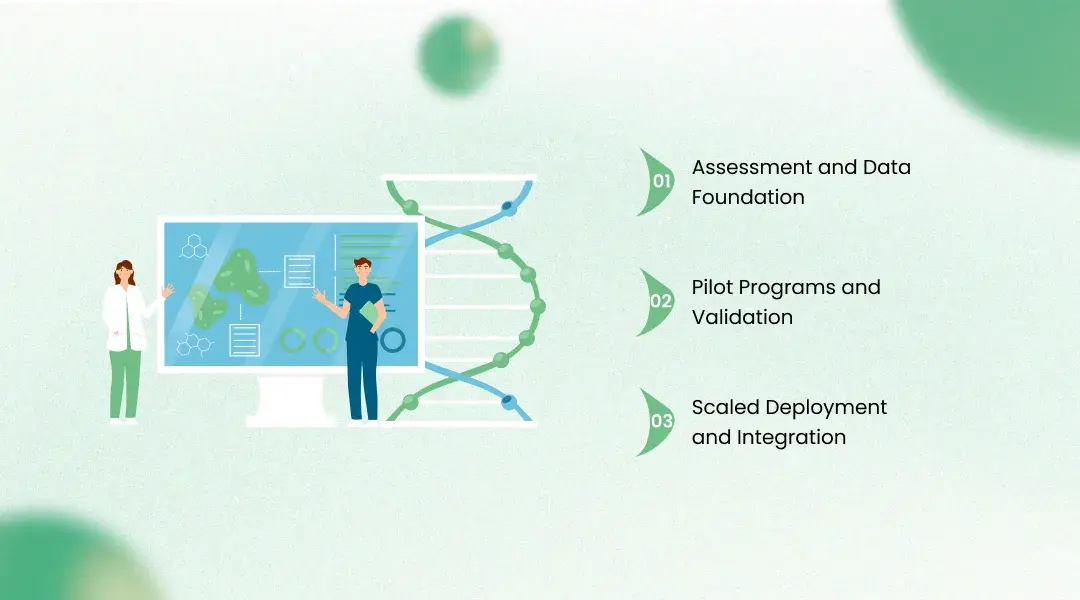
Implementing AI in biotechnology requires deliberate organizational change, infrastructure investment, and a phased approach that builds capability progressively.
The first phase focuses on understanding the organization's current state and building the data infrastructure that every subsequent AI application will depend on.
Conduct a comprehensive audit of existing data assets, including experimental records, clinical data, genomic databases, and operational metrics, assessing quality, completeness, and accessibility.
Evaluate current computational infrastructure against the requirements of planned AI workloads, identifying gaps in storage, processing capacity, and integration capabilities.
Map the organization's drug development pipeline to identify specific bottlenecks where AI can deliver the highest impact relative to implementation complexity.
Establish data governance policies that address quality standards, access controls, privacy requirements, and regulatory compliance obligations.
Hire or designate an AI integration lead who bridges the gap between data science expertise and domain specific scientific knowledge.
Data quality deserves particular emphasis. Machine learning genomics models and predictive analytics biotech applications are only as reliable as the data they are trained on. Organizations with fragmented data systems or inconsistent labeling practices will struggle to extract value from even the most sophisticated AI tools.
With a data foundation in place, the second phase involves deploying AI in controlled environments where results can be measured against established baselines. The most common pilot applications include literature review and knowledge synthesis (76 percent adoption among AI active biotech companies), protein structure prediction (71 percent), scientific reporting (66 percent), and target identification (58 percent).
Effective pilot programs target processes with clear, measurable outcomes. They involve both data scientists and domain experts in design and evaluation. They establish success criteria before deployment, not after. The output of this phase should be a validated understanding of which AI applications deliver measurable value in the organization's specific context.
Scaling from pilot to production requires organizational changes that extend well beyond the technology itself. This phase involves integrating AI tools into standard operating procedures, retraining existing staff, and building cross functional teams where technologists and scientists collaborate as equal partners. The most successful biotech organizations are cultivating hybrid scientists who can navigate both computational modeling and wet lab experimentation, a talent profile that remains scarce across the industry.
Starting with the wrong use case, typically choosing a high visibility but complex application instead of a high impact, data ready process where quick wins build confidence.
Neglecting change management, leading to scientist resistance when AI tools are perceived as replacing human judgment.
Underinvesting in data infrastructure, deploying AI models on unreliable data that erode trust rather than build it.
Failing to establish regulatory alignment early, producing AI generated insights that cannot meet evidentiary standards for submissions.
Treating AI as a standalone project rather than integrating it into the organizational operating model.
Honest engagement with the difficulties of AI adoption is essential for organizations making investment decisions. The technology's potential is real, but so are the barriers that prevent many companies from realizing it.
Data quality remains the most persistent challenge. Biotechnology data is inherently complex, multimodal, and often unstructured. Experimental results vary across laboratories, instruments, and protocols. Historical data may lack the standardization required for effective machine learning training. The 2026 Benchling report identified data quality and connectivity as the primary barrier to advanced AI adoption, ahead of even talent and regulatory concerns.
The talent gap is acute. The hybrid scientist profile, someone equally comfortable designing experiments and building machine learning models, is extraordinarily rare. Competition for these individuals is intense, with technology companies, pharmaceutical giants, and AI startups all pursuing the same limited pool.
Regulatory uncertainty, while diminishing, still creates hesitation. The FDA's January 2025 draft guidance on AI in drug development provided the first comprehensive framework, with final guidance expected in 2026. Until the regulatory pathway is fully clarified, some organizations remain cautious about relying on AI for decisions that will face scrutiny. Integration complexity should also not be underestimated, as biotechnology companies often operate with legacy systems that were never designed to interoperate with modern AI tools.
The biotechnology industry is entering what has been described as the "builder phase," where organizations move from running isolated AI pilots to constructing AI native discovery systems. This transition will reshape the competitive landscape in ways that are already becoming visible.
Within three to five years, AI integration across the drug development lifecycle will move from a competitive advantage to a baseline requirement. Companies that have not embedded AI into their processes will face structural cost and speed disadvantages that cannot be overcome through traditional means.
Closed loop discovery systems represent the most transformative near term development. In these systems, AI models design experiments, robotic platforms execute them, results are automatically fed back into the models, and the next round of experiments is designed with refined hypotheses. This continuous cycle will compress discovery timelines beyond what AI augmented but human driven workflows can achieve.
Generative biology will extend beyond small molecule drug design into biologics, cell therapies, and gene therapies. AI models are already being used to design novel proteins, optimize antibody sequences, and predict the behavior of engineered cell populations. Machine learning genomics will enable increasingly precise patient stratification, matching individual patients to therapies based on their unique genetic and metabolic profiles rather than broad disease categories.
The regulatory landscape will also evolve significantly. As the FDA and other agencies finalize their AI frameworks, organizations with established governance practices and transparent model validation will have a first mover advantage. KriraAI anticipates that regulatory readiness will become a key differentiator, and works with clients to build AI systems with documentation and auditability designed in from the outset.
Three themes emerge clearly from the evidence presented in this analysis. First, AI in biotechnology has moved decisively from experimental potential to clinical validation, with measurable improvements in timelines, costs, and success rates across every stage of drug development. Second, the organizations capturing these benefits are those that invest in data infrastructure and cross functional talent before deploying AI tools, recognizing that technology without organizational readiness produces disappointing results. Third, the competitive window for meaningful AI adoption is narrowing, as early movers build compounding advantages that will be increasingly difficult for laggards to overcome.
The path forward requires both ambition and pragmatism. Companies must pursue AI integration aggressively enough to keep pace while maintaining the scientific rigor and regulatory discipline that biotechnology demands.
KriraAI partners with biotechnology companies to bridge this gap, delivering AI solutions purpose built for drug discovery and development. Rather than offering generic machine learning tools, KriraAI builds integrated systems that connect to existing laboratory workflows, meet regulatory documentation requirements, and produce measurable improvements. From initial data audits through scaled deployment, KriraAI's team combines technical AI expertise with deep understanding of biotechnology's unique challenges. If your organization is ready to move beyond AI experimentation and into systematic integration, explore how KriraAI can help you design an implementation roadmap tailored to your pipeline and competitive goals.
AI is used across multiple stages of drug discovery, from identifying biological targets to designing molecular candidates to optimizing clinical trials. Machine learning models analyze genomic and proteomic datasets to identify disease related targets with higher precision than traditional approaches. Generative chemistry models propose novel molecular structures optimized for binding affinity, selectivity, and metabolic stability simultaneously. In clinical development, AI systems simulate trial designs, predict patient outcomes, and optimize recruitment strategies. The most advanced application is Insilico Medicine's rentosertib, an AI designed molecule that demonstrated both safety and efficacy in Phase IIa clinical trials, marking a historic milestone for AI drug discovery.
The cost of implementing AI in a biotechnology company varies significantly based on the organization's size, data readiness, and scope of deployment. Initial investments in data infrastructure typically range from $500,000 to $5 million depending on the complexity of existing systems. Pilot programs for specific applications such as target identification or literature review can be launched for $200,000 to $1 million, while full scale AI integration across the R&D pipeline may require $5 million to $20 million over three to five years. However, these costs must be evaluated against potential savings of 30 to 70 percent in preclinical costs and 25 to 40 percent in overall drug development expenditure. Companies that approach implementation with clear measurement frameworks consistently achieve faster returns.
AI cannot and will not replace scientists in biotechnology research. The technology functions as a powerful augmentation tool that amplifies human expertise rather than substituting for it. AI excels at processing vast datasets, identifying patterns in complex biological information, and generating hypotheses that would take human researchers years to formulate independently. However, the design of meaningful experiments, the interpretation of results within broader scientific contexts, and the creative leaps that drive novel discoveries remain fundamentally human capabilities. The most successful biotechnology organizations are building hybrid teams where data scientists and bench researchers collaborate as equal partners. The industry's biggest talent challenge is cultivating researchers who can work effectively alongside AI systems.
AI driven drug development has demonstrated the ability to compress traditional timelines by 40 to 60 percent across the preclinical and clinical phases. Where conventional drug discovery typically requires four to six years from target identification to clinical candidate nomination, AI native pipelines have advanced candidates to first in human studies within 18 to 24 months. In clinical trials specifically, AI optimization has produced an average 18 percent reduction in cycle times according to a Tufts Center assessment of 36 case examples. Some individual applications show even greater compression, with feasibility assessments reduced by up to 90 percent. These gains require substantial upfront investment in data infrastructure and organizational change management before the technology delivers its full impact.
The biggest risks of using AI in biotechnology fall into five categories: data quality failures, regulatory uncertainty, model interpretability limitations, intellectual property ambiguity, and organizational resistance. Poor quality or biased training data can lead AI models to generate misleading predictions, potentially directing research toward dead end targets or unsafe molecular candidates. Regulatory frameworks for AI generated evidence are still evolving, and submissions relying heavily on AI without transparent validation may face scrutiny. Many advanced AI models function as black boxes whose decision making processes are difficult to explain to regulators or investors. The legal status of AI generated inventions remains unclear in several jurisdictions. Perhaps most significantly, organizational resistance from scientists who view AI as a threat can undermine adoption even when the technology is sound. Addressing these risks requires deliberate governance frameworks, transparent validation practices, and sustained investment in change management.
Krushang Mandani is the CTO at KriraAI, driving innovation in AI-powered voice and automation solutions. He shares practical insights on conversational AI, business automation, and scalable tech strategies.