A July 2025 study from MIT's NANDA initiative examined 300 real enterprise deployments. It found that 95 percent of generative AI pilots delivered no measurable impact on profit and loss. Only 5 percent created significant business value. For anyone funding an enterprise AI assistant today, that number should stop you cold. Technology is not the problem. The models work. The deployments fail.
This matters because doing nothing is no longer a safe option. The global AI assistant market was worth roughly 5 billion dollars in 2024. Analysts expect it to reach 30.2 billion dollars by 2030, growing at about 35 percent each year. Your competitors are spending. The question is whether that spending turns into results or sunk cost.
This blog explains why most enterprise AI assistant projects stall. It also shows how the winning 5 percent operate differently. We will cover the real problem these systems solve and the technologies behind them. We will look at the measurable results companies are achieving today. We will walk through a practical implementation roadmap and confront the genuine challenges honestly. Finally, we will look at where this category is heading through 2030.
Before any discussion of automation, it helps to name the underlying problem. Large organizations run on information that nobody can find. Knowledge lives in scattered documents, old email threads, and the heads of people who left. Employees spend a striking share of every week just searching for answers. The work itself often waits while the searching continues.
This fragmentation carries a real and rising cost. Enterprises now run dozens of disconnected software tools across departments. Each tool holds a slice of the truth, and none of them talk to each other cleanly. Customer support teams answer the same questions thousands of times. Finance teams rebuild the same reports every month. Onboarding a single new hire can take weeks of repeated explanation.
Consider what this status quo costs in plain terms. Knowledge workers can lose close to a full day each week to searching and duplicate effort. Support teams answer identical questions tens of thousands of times a year. Skilled staff spend their hours on retrieval instead of judgment. None of this shows up as a single clean line on a budget. That invisibility is exactly why the problem persists for so long.
The competitive pressure on this problem keeps growing. Margins are tighter, customers expect instant answers, and headcount is harder to justify. Leaders are told that intelligent software can fix all of this overnight. The market reflects that hope. The broader enterprise AI market sat at 114.87 billion dollars in 2026, according to Mordor Intelligence. It is forecast to reach 273.08 billion dollars by 2031.
So the demand is real and the budgets are flowing. Yet the spending rarely lands where it should. MIT found that more than half of generative AI budgets went to sales and marketing tools. The biggest returns were sitting untouched in back office automation. This gap between where money goes and where value lives is the heart of the problem. It is also the first thing a serious deployment has to correct.
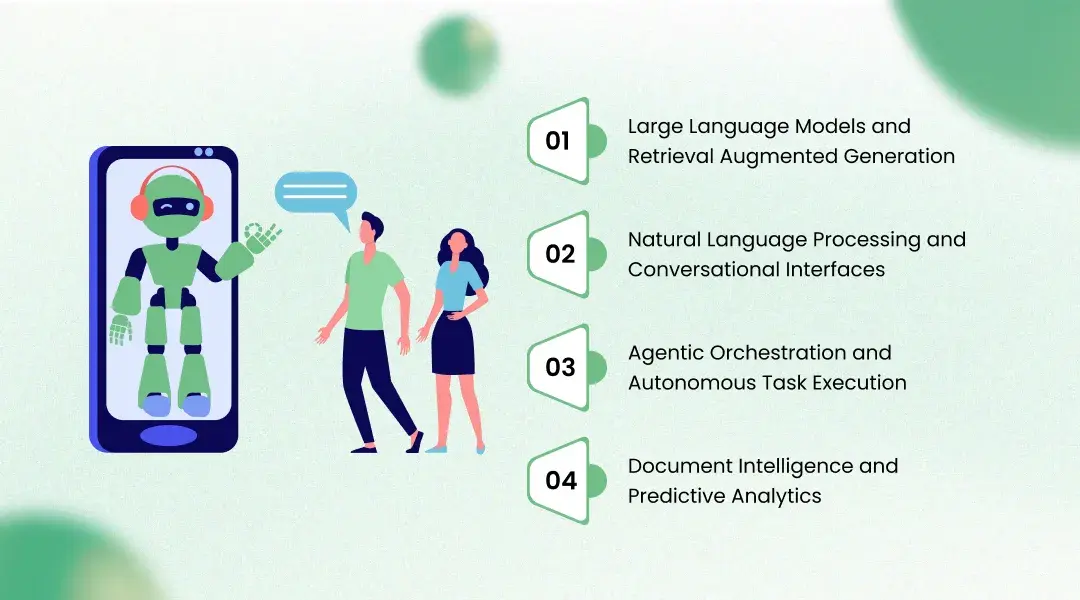
An enterprise AI assistant is not one technology. It is a stack of several technologies working together against a specific business problem. Understanding that stack is what separates a buyer from a victim of marketing. Below, each core technology is mapped to the exact enterprise pain it addresses. The point is precision, not buzzwords.
The model itself handles language. Retrieval augmented generation, often shortened to RAG, handles truth. A raw language model can write fluently but will invent facts under pressure. RAG fixes this by forcing the model to answer only from your approved internal documents. The assistant first retrieves the relevant policy, contract, or record. Then it generates an answer grounded in that source.
This single technique solves the knowledge fragmentation problem directly. An employee asks a question in plain language. The system searches every connected document store and returns a sourced answer in seconds. This is precisely the kind of system KriraAI builds for enterprises. KriraAI embeds assistants inside existing workflows rather than bolting a generic chatbot on top. That grounding in real company data is what makes an answer trustworthy enough to act on.
Natural language processing lets the assistant understand intent, not just keywords. A user does not need to learn a query syntax or click through menus. They simply ask, the way they would ask a colleague. The system parses the request, resolves ambiguity, and routes it correctly. This removes the training barrier that kills most internal tools.
Conversational interfaces also preserve context across a discussion. The assistant remembers what was asked two questions ago. It can refine, clarify, and follow up without starting over. For support and operations teams, this turns a clunky tool into something people actually use.
The newest and most important shift is from answering to acting. An agentic AI assistant does not just respond. It plans a multi step task and executes it across systems. Gartner predicts that 40 percent of enterprise applications will feature task specific AI agents by 2026. That is up from less than 5 percent in 2025.
In practice, an agentic AI assistant can pull data from a CRM, draft a report, and file it. It can process an invoice, flag an anomaly, and route it for approval. The human sets the rules and keeps final authority. The agent handles the repetitive execution in between. This is where the largest efficiency gains in the category now sit.
Document intelligence, often built on computer vision, reads unstructured files at scale. Contracts, scanned forms, and PDFs become searchable, structured data. Predictive analytics then layers forecasting on top of that data. The assistant can surface which deals are at risk or which invoices will likely slip. Together these turn passive archives into active decision support. The practical payoff here is large for document heavy teams. Legal, finance, and operations functions drown in unstructured files every day. An assistant that reads and structures them turns days of manual review into minutes. Predictive signals then let teams act before a small issue becomes a crisis.
The honest answer to "does this actually work" is yes, when it is done right. The 5 percent that succeed report results that are specific and large. These are not vendor slides. They are documented outcomes from named deployments across 2025 and 2026. The pattern is consistent. Narrow, well integrated assistants produce hard numbers. A strong AI copilot for enterprise teams combines several technologies, not just one.
Here are measurable results that enterprises have publicly reported:
Klarna's AI assistant handled two thirds of all customer service chats. It did the work of 853 full time agents and saved an estimated 60 million dollars in 2025.
The same Klarna assistant cut average response times from 11 minutes down to under 2 minutes.
Vodafone employees using a copilot saved an average of 3 hours per week, reclaiming roughly 10 percent of their workweek.
AtlantiCare deployed a clinical assistant that cut documentation time by 42 percent, freeing about 66 minutes per clinician each day.
One Fortune 500 firm cut reporting time from 15 days to 35 minutes. It also dropped the cost per report from 2,200 dollars to 9 dollars.
Unilever saved more than 1 million dollars per year in recruiting and reduced time to hire by 75 percent.
In a controlled study of 4,800 developers, GitHub Copilot users completed coding tasks 55 percent faster.
A few themes connect every one of these wins. Each targeted a single high volume, well defined workflow. None tried to transform the whole company at once. Each measured a baseline before launch and tracked against it afterward. This discipline is exactly what the failed 95 percent skipped. Productivity at the individual level is well established here. A Microsoft backed study found AI assistance lifted output by 21 percent in complex knowledge work. The challenge, as the next sections show, is turning individual gains into organizational ones.
Deploying an enterprise AI assistant is a sequence, not a switch. The order matters more than the tool you pick. Rushing to buy a model before understanding your data is the most common fatal error. A disciplined rollout moves through clear, gated stages. KriraAI approaches every enterprise AI assistant project this way, starting with readiness before any model is selected.
The following stages reflect how successful deployments are actually sequenced:
Run a readiness and data audit to assess where your knowledge lives and how clean it is.
Select one narrow, high volume workflow as the first target rather than a broad ambition.
Build a pilot with a measured baseline so you can prove impact against real numbers later.
Add an integration and governance layer that connects the assistant to systems with proper access controls.
Scale the deployment gradually while keeping a human in the loop for high stakes decisions.
Establish continuous evaluation so the assistant keeps learning from real usage and feedback.
The single most important principle hides inside stage two. MIT found that buying from specialized vendors and building partnerships succeeded about 67 percent of the time. Internal only builds succeeded at roughly one third of that rate. The lesson is not to outsource everything. The lesson is to partner where the expertise gap is widest. An enterprise AI assistant platform built by people who have done this before will reach production faster.
Timing the rollout also protects the budget. A staged approach means you spend real money only after the pilot proves value. Each gate is a decision point where you can stop, adjust, or scale. This keeps a failed experiment cheap and a successful one repeatable. It is the difference between a controlled investment and a blind bet.
Most failures repeat the same handful of errors. Knowing them in advance is the cheapest insurance you can buy. Each mistake below has cost real companies real money in the past two years.
Watch for these specific traps during rollout:
Spreading the first pilot across too many workflows, which dilutes focus and hides whether anything worked.
Treating the assistant like static software with no feedback loop, so it never adapts to how people actually work.
Pouring most of the budget into sales and marketing, where MIT found the return on investment is consistently lowest.
Building entirely in house when vendor partnerships succeed roughly three times as often in practice.
Launching without security sign off, when WRITER found 35 percent of executives cannot immediately stop a rogue agent.
The fix for all five is the same underlying habit. Start narrow, measure honestly, integrate deeply, and govern from day one. Enterprise AI adoption fails when it skips these in the name of speed. The companies that move deliberately almost always finish faster.
This category deserves honesty, not hype. The challenges are real and several are getting harder, not easier. The biggest one is data quality. An assistant grounded in messy, contradictory, or outdated documents will produce confident nonsense. Most enterprises badly underestimate how poor their internal data actually is. Cleaning and governing that data is often the largest hidden cost of the project.
Security and governance form the second major barrier. A 2026 Gravitee survey found 88 percent of organizations confirmed or suspected an AI agent security incident. Only 14.4 percent reported all their agents going live with full security approval. WRITER's 2026 research found 67 percent of executives believe an unapproved AI tool has already caused a data leak. KriraAI treats governance and security as the foundation of any production assistant, not a feature added at the end.
The remaining obstacles are organizational rather than technical. Talent gaps are severe, since few teams have deployed production AI before. Integration with brittle legacy systems breaks more pilots than model limitations ever do. Regulation adds another layer, with the EU AI Act and India's DPDP framework raising the compliance bar. Change management is the quiet killer. Gartner expects more than 40 percent of agentic AI projects to fail by 2027. The main reason is that organizations underestimate the human change required.
The next five years will reshape who competes and who fades. The clearest shift is from assistants that answer to agents that act. Deloitte found that 74 percent of companies plan to deploy agentic AI moderately or more extensively within two years. That figure stood at just 23 percent at the time of the survey. By 2028, analysts expect roughly a third of enterprise software applications to carry built in agentic capabilities. In 2024 that share was under 1 percent.
Standards are maturing fast enough to make this safe. The Model Context Protocol is becoming a common way for agents to access tools and data securely. Open frameworks for agent governance and identity are emerging in parallel. These foundations will let agents coordinate across systems without becoming an uncontrolled attack surface.
There is also a clear shift in how value gets measured. Forrester describes 2026 as the hard hat phase of enterprise AI. Cost control, governance, and reliability now matter more than impressive demos. It even predicts a quarter of planned AI spending will slip to 2027 as leaders demand proof. The era of funding pilots on faith is ending. Boards now want the same evidence that any other major investment must show.
The competitive divide will widen sharply. Companies that built clean data foundations and governance early will compound their advantage. Their assistants will keep learning, while latecomers restart from scratch each year. An AI copilot for enterprise teams will move from a perk to a baseline expectation. The firms left behind will not lose to better technology. They will lose because they treated AI as a demo instead of an operating discipline. Speed without structure will keep producing the same 95 percent failure rate.
Three points matter most from everything above. First, the technology behind an enterprise AI assistant already works, and the failures come from integration, not the models. Second, the wins are real and measurable. Klarna saved 60 million dollars, and one clinic cut documentation time by 42 percent. Third, success follows a discipline, where you start narrow, measure honestly, integrate deeply, and govern from day one. The 95 percent that fail ignore that discipline. The 5 percent that win build it in from the start.
This is exactly the gap KriraAI exists to close. KriraAI builds practical, production grade AI solutions for enterprises, grounded in real company data and designed for measurable outcomes. Rather than selling a generic tool, KriraAI starts with a readiness audit. It targets a high value workflow and embeds the assistant securely into your systems. The aim is an enterprise AI assistant platform that is practical, measurable, and built to scale. It is built to reach production, not to stall as a pilot. If you want your AI investment in the winning 5 percent, explore KriraAI's solutions. You can also reach out to start a readiness assessment.
An enterprise AI assistant is a software system built on large language models and retrieval. It helps employees find information and complete tasks inside a company. Unlike a consumer chatbot, it connects securely to internal systems such as a CRM, ERP, document stores, and knowledge bases. It answers questions using approved company data rather than the open internet, which reduces errors. Modern versions can also take actions, such as drafting reports or processing requests, under human oversight. The goal is to reduce time spent searching, repeating work, and waiting on answers across the organization.
Most enterprise AI assistant projects fail because of poor integration, not weak technology. A July 2025 MIT study of 300 deployments found 95 percent delivered no measurable profit impact. The core issue was what researchers called a learning gap, where generic tools never adapted to specific company workflows. Failed projects also spread effort too thin, pointed budgets at low return areas like marketing, and skipped measurement. They treated AI as static software instead of a system that must learn. The successful 5 percent did the opposite. They picked one narrow workflow, integrated deeply, measured against a baseline, and governed the deployment carefully from the start.
A well deployed enterprise AI assistant can deliver large and measurable returns, though results vary by use case. Documented examples from 2025 and 2026 are specific. Klarna's assistant handled two thirds of customer chats and saved an estimated 60 million dollars in one year. AtlantiCare cut clinical documentation time by 42 percent, freeing about 66 minutes per clinician daily. Vodafone employees saved roughly 3 hours each week. One Fortune 500 firm cut report cost from 2,200 dollars to 9 dollars. The common thread is narrow scope and honest measurement. Returns appear when the assistant targets a high volume workflow rather than the entire organization at once.
A chatbot responds to questions, while an agentic AI assistant plans and executes multi step tasks across systems. A chatbot waits for you to ask and then replies with text. An agentic assistant takes a goal, breaks it into steps, and acts on your behalf. For example, it can pull data from one system, draft a document, and file it in another. Gartner predicts 40 percent of enterprise applications will include task specific agents by 2026. That is up from under 5 percent in 2025. The human still sets the rules and keeps final approval authority. The difference is autonomy, where agents handle execution rather than only conversation.
You deploy an enterprise AI assistant securely by treating governance as the foundation rather than an afterthought. Start by grounding the assistant only in approved internal data using retrieval, which limits invented answers. Give the system scoped access controls so it can only reach what each user is permitted to see. Treat any autonomous agent as a distinct identity with its own permissions and audit trail. Require security sign off before production. A 2026 Gravitee survey found only 14.4 percent of agents launch with full approval. Build an off switch so a misbehaving agent can be stopped instantly. Finally, monitor usage continuously and align with frameworks like the EU AI Act and DPDP.
Founder & CEO
Divyang Mandani is the CEO of KriraAI, driving innovative AI and IT solutions with a focus on transformative technology, ethical AI, and impactful digital strategies for businesses worldwide.