I’ve seen this pattern too many times.
A company invests in automation. Expectations are high. The dashboards look impressive. For a few months, everything feels… controlled.
Then reality creeps in.
Edge cases break the system. Customer behavior shifts. Data becomes messy. And suddenly, that “automated” system starts needing more human intervention than before.
Let me ask you something.
If your automation needs constant babysitting… is it really automation?
This is exactly where deep learning in business changes the equation. Not by adding more rules, but by removing the need for them.
Traditional automation is built on rules. If X happens, do Y.
Sounds logical. Until reality refuses to behave logically.
I once worked with a logistics company where their automation failed simply because delivery addresses weren’t standardized. Same city. Different formats. The system got confused. Humans stepped in.
Again.
And again.
Rule-based systems don’t learn. They don’t improve unless someone manually updates them.
Which means your system is always reacting… never evolving.
Here’s the harsh truth: traditional systems are slow thinkers.
They process predefined logic. But they don’t interpret the context. They don’t predict. They don’t understand.
And in modern business, that’s a problem you can’t afford.
Now we’re talking about something fundamentally different.
Not smarter rules.
Smarter systems.
Deep learning automation is built on models that learn from data.
Not once. Continuously.
They observe patterns, detect anomalies, and refine decisions over time. No manual rewrites. No constant supervision.
(And yes, this is where most businesses underestimate the shift.)
Unlike traditional systems, AI automation using deep learning doesn’t just process inputs, it interprets them.
Text. Images. Voice. Behavior patterns.
This is why deep learning applications in business are becoming central to serious digital transformation efforts.
Most business data is messy.
Emails. Customer chats. Voice calls. PDFs.
Traditional systems choke on this.
Deep learning? It thrives here.
Here’s my favorite part.
The system gets better over time.
Not because someone updated it—but because it learned.
That’s the real answer to why deep learning is the future.
Let’s strip away the hype and talk about outcomes.
Not just operational cost.
Hidden cost.
Errors. Delays. Rework. Missed opportunities.
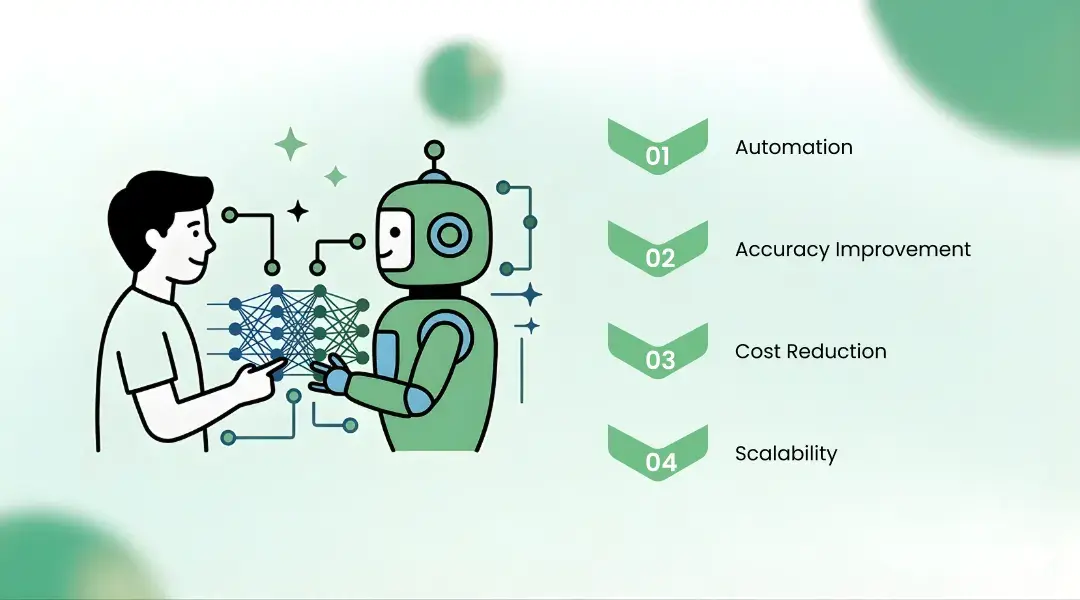
Deep learning systems reduce all of it.
Decisions that took hours now happen in seconds.
Sometimes milliseconds.
Because decisions are based on patterns across massive datasets, not gut instinct.
Or outdated reports.
Once trained, these systems scale without proportional cost increase.
That’s rare.
Every customer interaction can be tailored.
Individually.
At scale.
And if you’re wondering how businesses actually build this, this is where working with a Best AI development Company or investing in Deep learning development services becomes critical. Because execution matters more than intent.
Let’s make this real.
AI voice agents. Chatbots.
Not the frustrating ones.
The kind that actually understand context and resolve issues.
Patterns invisible to humans?
Deep learning spots them instantly.
Predicting what customers will buy… before they do.
Yes, it sounds ambitious.
It’s also happening.
Machines don’t just fail.
They give signals.
Deep learning reads those signals early.
From imaging analysis to disease prediction, this is where deep learning in business crosses into life-saving territory.
Pause for a second.
This isn’t automation anymore.
This is intelligence.
This part confuses a lot of people.
Let’s simplify it.
Machine learning works well with structured data and defined patterns.
Deep learning handles complexity. Unstructured data. Ambiguity.
It’s like comparing a skilled analyst to a system that can read, see, and hear simultaneously.
Use machine learning when:
Data is clean
Problem is well-defined
Use deep learning when:
Data is messy
Decisions require context
Machine learning improves processes.
Deep learning transforms them.
That’s the difference.
This is where things get interesting.
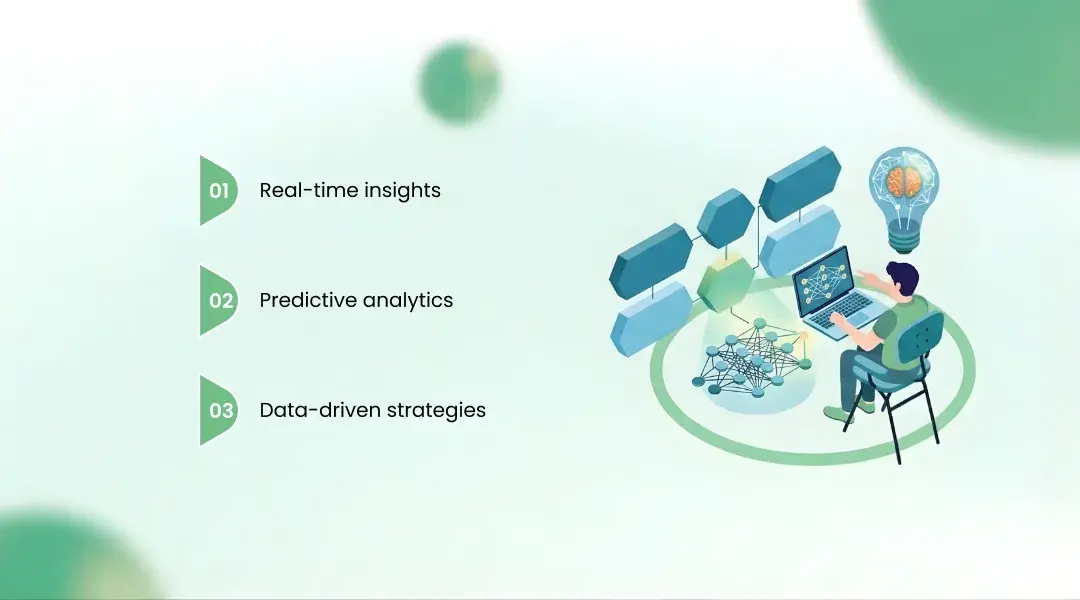
No delays. No waiting for reports.
Decisions happen instantly.
Not just “what happened.”
But “what will happen next.”
And I mean actually data-driven.
Not just dashboards that look impressive but change nothing.
Let’s not pretend this is easy.
Deep learning needs data.
A lot of it.
And it needs to be relevant.
Initial setup can be expensive.
But here’s the catch, most businesses look at cost, not ROI.
That’s a mistake.
Good AI engineers are rare.
Great ones? Even rarer.
This is why choosing the right technology partner matters more than the technology itself.
Now let’s look ahead.
Systems that don’t just assist, but act.
Independently.
Everything that can be automated… will be.
And deep learning will be at the center of it.
Not companies that “use AI.”
Companies that run on it.
There’s a difference.
And it’s massive.
I’ll leave you with this.
Most businesses think automation is about efficiency.
It’s not.
It’s about intelligence.
If your systems can’t learn, adapt, and evolve, you’re not building for the future. You’re maintaining the past.
And in a world driven by deep learning for business automation, that’s a dangerous place to be.
So the real question isn’t:
“Should we adopt deep learning?”
It’s:
“How long can we afford not to?”
Deep learning improves efficiency by learning from data patterns, reducing manual intervention, and making faster, more accurate decisions in real time.
Industries like healthcare, finance, manufacturing, retail, and logistics benefit significantly due to their reliance on large, complex datasets.
Yes, because it adapts, learns, and handles unstructured data—unlike traditional rule-based systems that require constant manual updates.
It depends on the use case, but generally, large and diverse datasets are needed for accurate model training and performance.
Costs vary based on complexity, data, and infrastructure, but the long-term ROI often outweighs the initial investment.
Founder & CEO
Divyang Mandani is the CEO of KriraAI, driving innovative AI and IT solutions with a focus on transformative technology, ethical AI, and impactful digital strategies for businesses worldwide.