I’ve watched too many leadership meetings start the same way.
Someone says, “We need AI copilots.” No process map. No baseline metrics. Just hope.
That’s how bad automation decisions are born.
AI copilots can transform operations. I’ve seen it happen. I’ve also seen businesses burn six figures chasing demos that never survived real workflows. This guide exists to prevent the second outcome.
Not theory. Not vendor promises. Just what works when AI meets messy, human business processes.
AI services for businesses are not tools. They’re systems.
When we talk about AI automation services, we're talking about software that observes, decides, and acts, often without human nudging exactly what our AI agent development services deliver for end-to-end business operations. This includes AI workflow automation, AI decision automation, and intelligent orchestration across tools your teams already use.
Think of AI copilots as operational co-workers. They don’t replace teams. They reduce friction. They remove repetition. They make decisions faster than humans should.
Traditional automation follows scripts. AI for operational automation follows context.
Here’s the difference I explain to every CTO I work with:
Traditional automation asks: “If X happens, what should I do?”
Business process automation using AI asks: “Why did X happen, and what should I do next?”
That shift changes everything.
Rule-based systems break when reality changes. AI solutions for business operations adapt. Learn. Improve. That’s why AI-powered automation services scale while traditional tools stall.
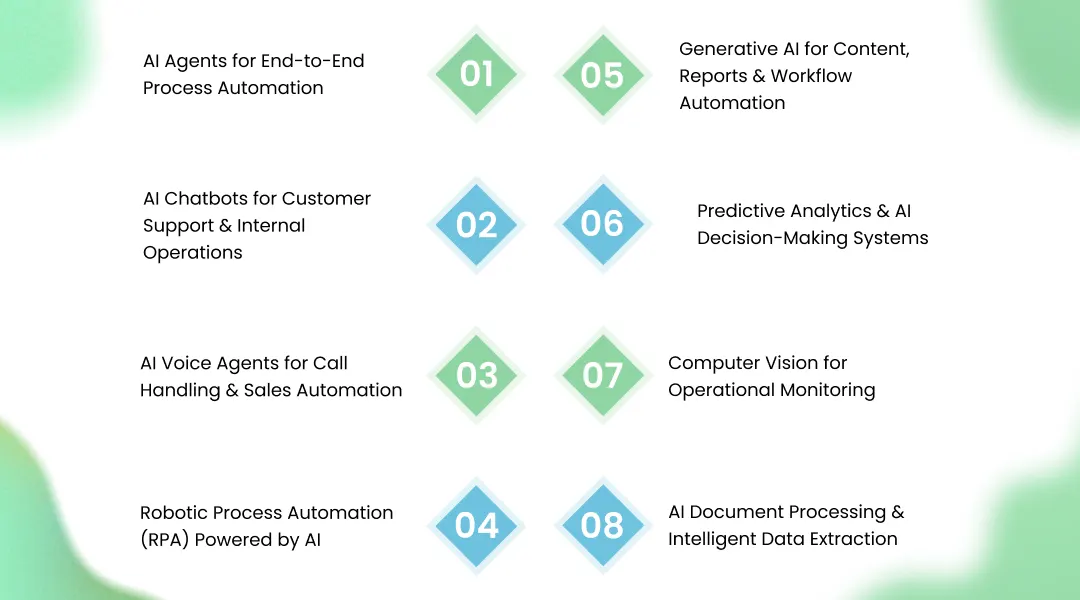
AI agents for business automation don’t automate tasks. They automate outcomes.
I’ve deployed autonomous AI agents for operations that handle procurement cycles, incident escalation, and internal approvals, start to finish. No hand-holding.
This is where automation stops being helpful and starts being strategic, especially with AI customer support automation that resolves queries before they reach human teams.
Modern chatbots aren’t FAQ machines. They’re process routers.
Used internally, they reduce HR and IT ticket volume. Externally, they resolve issues before humans even see them. That’s AI workflow automation doing quiet, valuable work.
AI voice agents don’t get tired. Or impatient. Or inconsistent.
We’ve implemented them for appointment booking, follow-ups, and inbound qualification. The result? Faster response times and cleaner sales pipelines.
RPA alone copies clicks. AI-enhanced RPA understands documents, screens, and intent.
This combination is lethal - in a good way - for finance ops, compliance, and legacy system workflows.
Generative AI for business automation isn’t about writing blogs. It’s about drafting reports, summarizing meetings, and generating operational documentation accurately.
AI decision automation helps leaders act before problems escalate.
Inventory forecasting. Demand prediction. Risk alerts. This is where AI stops reacting and starts advising a shift explored in depth in our post on AI agents for business automation and their role in intelligent process automation.
Manufacturing defects. Warehouse safety. Quality control.
Computer vision replaces manual monitoring with constant awareness. It doesn’t blink. Ever.
Invoices. Contracts. Forms.
AI turns unstructured chaos into structured action. This alone has saved clients thousands of human hours per year.
Here’s the checklist most companies skip and regret later:
Cost: Not just build cost. Maintenance. Retraining. Scaling.
Scalability: Will this still work at 10× volume?
Integration: Can it live inside your existing systems?
Security: Especially with sensitive operational data.
If your vendor can’t answer these clearly, walk away.
Cost Reduction: Fewer manual hours. Fewer errors.
Faster Decision-Making: AI doesn’t wait for meetings.
Reduced Human Dependency: Teams focus on judgment, not repetition.
24/7 Scalability: Operations don't sleep. AI doesn't either,r which is why businesses looking to reduce manual work with AI automation see ROI within months, not years.
AI copilots will stop being tools and start becoming infrastructure.
Businesses that treat AI as a side experiment will fall behind. Those that embed AI into operations will quietly dominate.
That gap is already forming.
At KriraAI, we don’t sell templates.
We design AI solutions for business operations around how your teams actually work. That’s why clients trust us as a Best AI development Company - not because of buzzwords, but because our systems survive real-world friction.
AI copilots aren’t magic. They’re mirrors.
They reflect how well your processes are designed. Fix the process. Then automate it. In that order. At KriraAI, we design AI solutions around how your teams actually work not templates, but systems that survive real-world friction.
An AI copilot assists teams by automating decisions, workflows, and repetitive tasks across business processes.
Costs vary by complexity, integrations, and scale. Most ROI-driven projects recover costs within 6–12 months.
Yes, when designed correctly. Integration strategy matters more than the tools.
They can be, with proper access controls, data governance, and monitoring.
High-volume, rule-heavy, decision-based workflows with clear business impact.
Founder & CEO
Divyang Mandani is the CEO of KriraAI, driving innovative AI and IT solutions with a focus on transformative technology, ethical AI, and impactful digital strategies for businesses worldwide.