I’ve sat in too many boardrooms where someone says, “We need AI.” No context. No problem definition. Just a vague sense that everyone else is doing it and they’re falling behind.
That’s usually where things go wrong.
I’m a Senior AI & Automation Consultant at KriraAI. For over a decade, I’ve helped businesses automate operations - not demos, not pitch decks, but real workflows with real consequences. Finance approvals. Customer support escalations. Inventory planning. Compliance checks. The unglamorous stuff that quietly drains money and morale.
Here’s the uncomfortable truth most vendors won’t say out loud: AI services for business automation don’t fix chaos. They amplify whatever already exists.
So this article isn’t about hype. It’s about clarity. What AI automation services actually are, where they work, where they don’t, and how businesses use them to reduce operational drag without gambling the company.
Let’s get precise.
Machine Learning, in the context of automation, is simple at its core: systems that learn patterns from data and improve decisions without being explicitly reprogrammed every time something changes.
In enterprise environments, this means automation solutions using AI that don’t just follow rules, but adapt when reality refuses to behave.
And reality always does.
Traditional automation is brittle. “If X happens, do Y.”
It works until X changes. Or exceptions pile up. Or humans start creating workarounds (they always do).
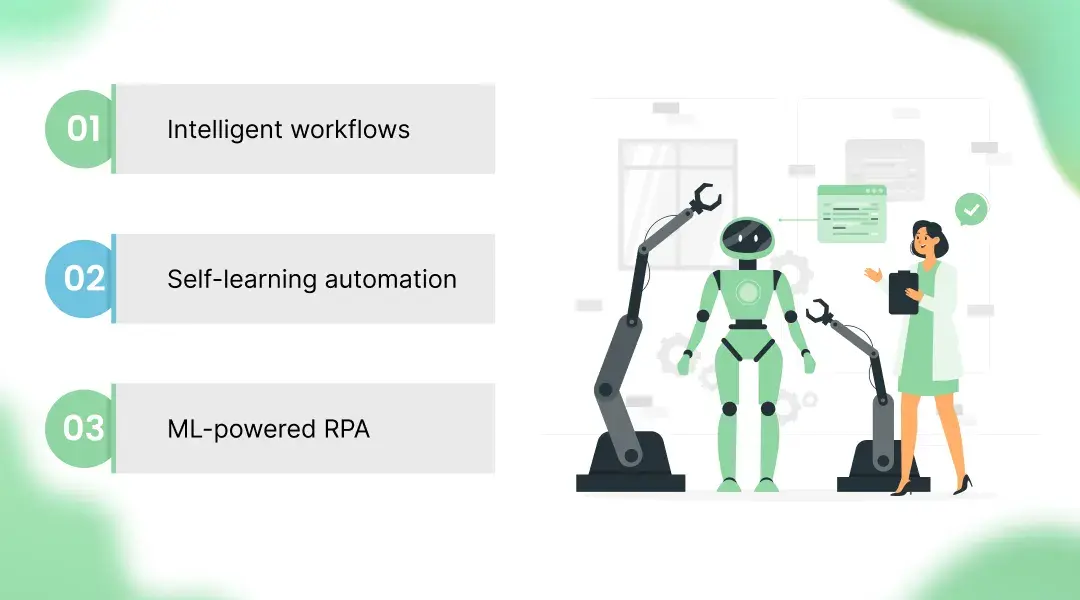
Intelligent automation for business adds learning to the loop. Models observe outcomes. They adjust thresholds. They flag anomalies. They get better with use.
That difference? It’s the gap between automating a task and automating a system.
Most businesses still live in the past. Dashboards tell them what already happened.
Machine learning shifts analytics forward. Predictive. Sometimes prescriptive. It answers questions like:
What’s likely to break next?
Which customers are about to churn?
Where will costs spike before finance sees it?
That’s where AI-driven process automation becomes operationally dangerous - in a good way.
ML models ingest historical and live data, identify relationships humans miss, and surface insights faster than manual analysis ever could.
Not magic. Math. At scale.
And when analytics feeds automation, decisions stop waiting for meetings.
I’ve seen approval workflows that once took days reduced to minutes, not by removing humans, but by routing only uncertain cases to them.
AI-powered business automation shines here. Clear cases flow through. Edge cases get attention.
Efficiency without recklessness.
The best AI automation for operations improves quietly. Error rates drop. Recommendations sharpen. Exceptions decrease.
No fanfare. Just compounding gains.
Robotic Process Automation was never the final answer. It was a stepping stone.
Add ML, and RPA stops breaking every time an interface changes or data format shifts. Enterprise AI automation services today blend both and that blend is where ROI hides.
Decisions used to rely on rules. Then dashboards. Now models.
Credit scoring. Fraud detection. Demand forecasting. Pricing adjustments.
I’ve watched leadership teams go from reactive to proactive simply because decisions stopped lagging reality by weeks.
Traditional systems wait. Batch jobs. Monthly reviews.
ML-enabled systems react. Continuously.
That shift alone explains why AI services for operational efficiency are now board-level priorities.
Let me be clear: fully automated decisions without oversight are rare and risky.
The real win is collaboration. AI narrows choices. Humans apply judgment.
That balance matters more than any model architecture.
Here’s what businesses actually get when things are done right:
Faster decision-making without waiting for reports
Higher accuracy and fewer manual errors
Predictive insights instead of historical explanations
Cost optimization through early intervention
Scalable operations that don’t collapse under growth
AI services to reduce operational costs don’t slash budgets overnight. They stop leaks before they become floods.
This is where theory meets consequences.
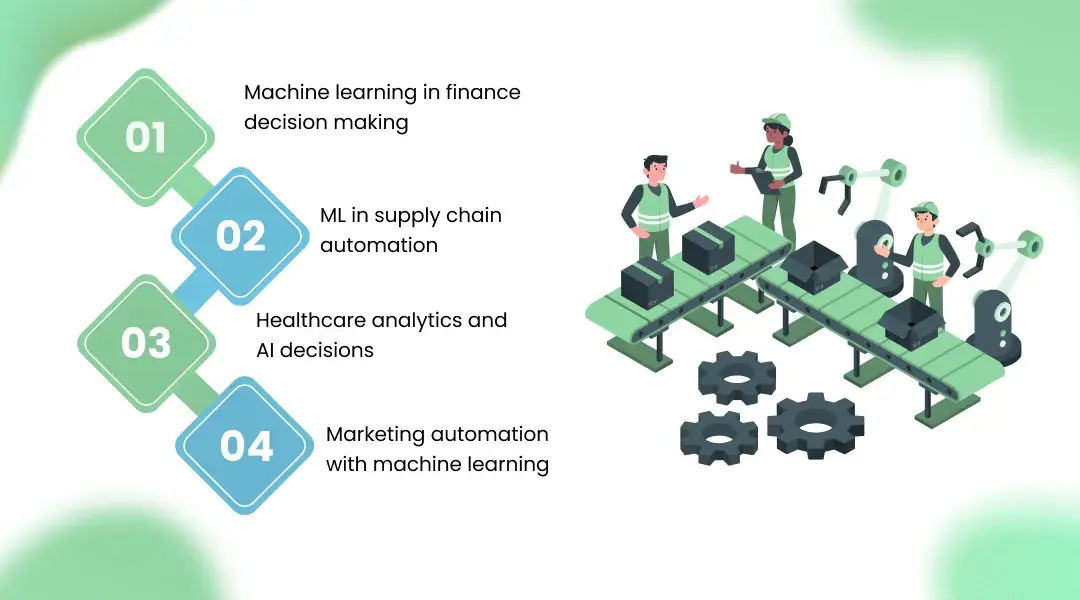
Fraud detection, risk scoring, reconciliation. AI tools for business automation in finance flag anomalies humans would never see in time.
Demand forecasting. Inventory optimization. Supplier risk scoring.
One logistics client reduced stockouts by double digits simply by letting models guide reorder timing. No new warehouses. No heroics.
Patient triage. Readmission prediction. Operational scheduling.
Business process automation using AI here saves time and sometimes lives. That responsibility changes how carefully systems are designed.
Lead scoring. Campaign optimization. Personalization at scale.
When marketing automation learns, waste shrinks. Relevance improves. Budgets stretch further.
This is the part most blogs skip. I won’t.
Bad data trains bad models. Period.
AI solutions for business automation fail quietly when inputs are unreliable.
Bias isn’t theoretical. It’s operational. And it can damage trust fast.
Legacy systems resist change. APIs break. Processes collide.
This is where many AI projects stall.
Automation amplifies risk if governance is weak. Especially in BFSI and healthcare.
Ignore this, and nothing else matters.
After dozens of projects, patterns emerge.
If data isn’t owned, structured, and governed, stop here.
Who monitors drift? Who approves changes? Silence here is expensive.
Humans need to trust systems before they rely on them. Communication beats code.
This is where many companies stumble.
A Best AI development Company isn’t defined by tools, it’s defined by restraint, honesty, and accountability. Someone willing to say “not yet” when the data isn’t ready.
Some decisions will run end-to-end without human input. Low risk. High volume.
Systems that sense, decide, and act continuously—not episodically.
Generative models will explain decisions, not just make them. Transparency will finally catch up to complexity.
And no, this isn’t science fiction. I’m already seeing early versions in production.
AI services for business automation aren’t about replacing people. They’re about respecting their time.
When done right, automation removes noise. It gives leaders space to think. It gives teams room to breathe.
When done wrong? It becomes an expensive theater.
The difference isn’t technology. It’s judgment.
And judgment is earned, project by project.
They analyze patterns in operational data and automate decisions, workflows, and exceptions that would otherwise require manual intervention.
Yes, when scoped correctly. Mid-sized companies often see faster ROI due to fewer legacy constraints.
It can be, but cost depends more on data readiness and integration complexity than on model sophistication.
Typically 3–9 months for well-scoped use cases tied to operational metrics.
Look for transparency, domain experience, and willingness to challenge assumptions—not just technical credentials.
Founder & CEO
Divyang Mandani is the CEO of KriraAI, driving innovative AI and IT solutions with a focus on transformative technology, ethical AI, and impactful digital strategies for businesses worldwide.