I’ve lost count of how many times a founder has told me, “We’re using AI… but it’s not really working.”
When I dig deeper, the problem is almost never the idea. It’s the tools.
Wrong platform. Wrong framework. Wrong expectations.
AI development tools can either accelerate you or quietly drain six months of runway while everyone pretends progress is being made. I’ve seen both outcomes up close. This article exists to help you land on the first one.
Not hype. Not vendor worship. Just a grounded AI development tools list based on real-world usage.
AI development tools are software frameworks, platforms, and services that help developers and businesses build, train, deploy, and manage AI models and applications.
That’s the textbook version.
In practice? They’re the difference between an idea that stays in a Notion doc and an AI system that survives production traffic.
Developers use AI programming tools to train models faster
Product teams use AI tools for software development to integrate intelligence into apps
Businesses use AI tools for machine learning to predict, automate, and personalize
Same category. Wildly different outcomes.
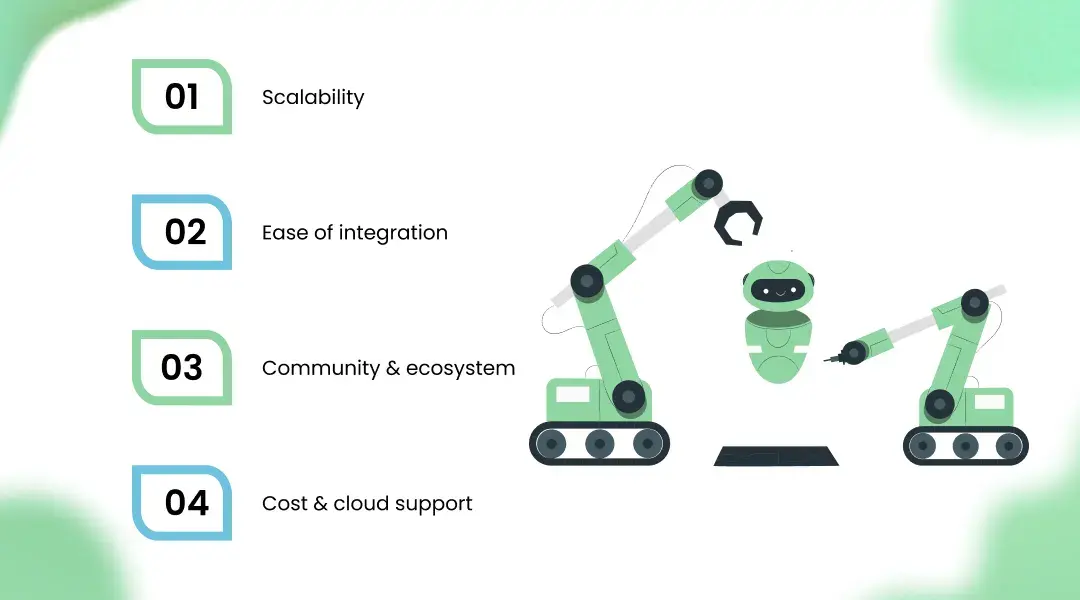
Before we talk tools, we talk judgment.
If it only works on a demo dataset, it’s not a solution. AI tools for enterprises demand scale. AI tools for startups demand survival.
If your engineers hate it, it won’t ship. Period.
Strong communities mean faster debugging and fewer dead ends. This matters more than most people admit.
Some cloud AI development platforms look affordable—until inference bills arrive. I’ve seen that panic. It’s not fun.
Best for: Deep learning & enterprise-grade AI
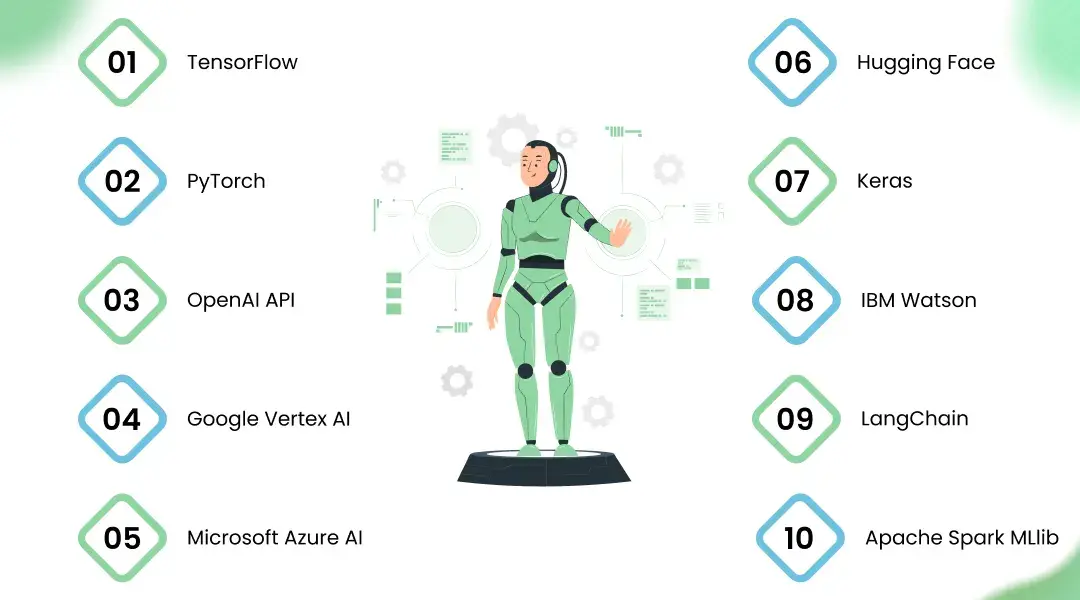
TensorFlow remains a backbone for serious AI systems. It’s powerful, structured, and battle-tested. When we build large-scale AI platforms for regulated industries, this is often the foundation.
Best for: Research-friendly and flexible development
If TensorFlow is disciplined, PyTorch is expressive. ML engineers love it for experimentation. I’ve seen faster innovation cycles here than almost anywhere else.
Best for: Generative AI & LLM-powered applications
For teams building chatbots, copilots, or AI agents, OpenAI sits at the center of modern generative AI development tools. The real skill isn’t using it—it’s controlling it.
Best for: End-to-end managed AI development
Vertex AI shines when teams want infrastructure handled without sacrificing customization. Strong choice among cloud AI development platforms.
Best for: Enterprise-ready AI services
Azure AI integrates cleanly with existing Microsoft ecosystems. For enterprises already living inside Azure, this is a practical call.
Best for: NLP models and transformers
Hugging Face made open-source AI tools usable at scale. If you’re touching NLP, you’re touching this ecosystem - know it well.
Best for: Beginner-friendly deep learning
Keras lowers the barrier for teams starting with AI tools for building AI applications. Clean syntax. Faster onboarding.
Best for: Business automation & analytics
Watson isn’t flashy. It’s structured, governed, and enterprise-focused. That’s intentional.
Best for: AI agents & LLM workflows
LangChain sits at the intersection of logic and language. We’ve used it extensively when building multi-step AI agents that actually behave.
Best for: Scalable machine learning on big data
When data volume explodes, Spark MLlib steps in. Still essential for serious AI tools for enterprises.
I’ll keep this grounded.
AI chatbots: OpenAI API + LangChain
Predictive analytics: TensorFlow + Spark MLlib
Automation & personalization: Azure AI + custom pipelines
At KriraAI, this stack thinking is what separates a proof-of-concept from production. It’s why clients come to us as a Best AI development Company, not just another vendor.
Lower upfront cost
Faster iteration
Bias toward open-source AI tools
Governance matters
Security isn’t optional
Cloud AI development platforms dominate
Choosing wrong here doesn’t slow you down—it stalls you.
I’m seeing three things clearly:
AI agents replacing brittle automation
AutoML reducing manual tuning
No-code / low-code AI widening adoption
This will reshape how AI platforms for developers are evaluated. Fast.
Tools don’t make AI successful. Decisions do.
The best teams I’ve worked with didn’t chase shiny platforms. They chose AI software development tools that matched their constraints, talent, and timelines.
If you’re serious about building AI that survives contact with reality, choose wisely or work with a Best AI development Company that’s already made the mistakes for you.
Open-source AI tools like PyTorch, Hugging Face, and Keras work well due to flexibility and cost control.
Azure AI, Google Vertex AI, and TensorFlow are strong choices for scale and governance.
Neither is universally better. Cloud platforms simplify ops; open-source offers control.
OpenAI API, LangChain, and Hugging Face dominate this space.
By aligning tools with business goals, team skills, and long-term scalability.
Founder & CEO
Divyang Mandani is the CEO of KriraAI, driving innovative AI and IT solutions with a focus on transformative technology, ethical AI, and impactful digital strategies for businesses worldwide.