I’ve sat in too many executive rooms where the real bottleneck wasn’t capital, talent, or even strategy.
It was attention.
The CEO had 14 meetings. The COO had 300 unread emails. The CTO was making architectural decisions between Slack pings.
And everyone was exhausted.
Not physically. Cognitively.
This is the quiet crisis modern leadership doesn’t talk about: decision fatigue. Context switching. Mental fragmentation. The workplace didn’t get harder - but noisier.
That’s where the AI executive assistant enters the conversation. Not as a digital secretary. Not as a glorified chatbot. But as something closer to a thinking layer between executives and chaos.
And yes, I’ve seen both the promise and the nonsense up close.
Let’s separate the two.
A traditional virtual assistant follows instructions.
An AI executive assistant understands intent.
That difference changes everything.
When people hear AI virtual executive assistant, they often imagine a smarter calendar tool. Or voice commands. Or auto-replies.
That’s… small thinking.
A true AI-powered executive assistant sits across data, behavior, priorities, and patterns. It learns how decisions are made, not just what tasks exist.
In practice, this means:
It doesn’t just schedule meetings. It questions whether the meeting should exist.
It doesn’t just summarize emails. It flags risk, urgency, and political context.
It doesn’t just remind. It nudges. At the right moment. For the right reason.
This is where virtual assistant vs AI executive assistant stops being semantics and starts being strategic.
One executes. The other thinks with you.
Let me ask you something uncomfortable.
When was the last time you had an uninterrupted hour to think?
Not respond. Not review. Not approve.
Think.
Most executives I work with can’t answer that cleanly.
Modern workplaces reward availability, not clarity. And the result is leadership teams stuck reacting instead of steering.
AI executive assistants in the workplace exist because human attention has become the scarcest resource in business.
This isn’t about speed. It’s about cognitive relief.
Executives don’t need more tools. They need fewer decisions per day. Fewer trivial choices. Fewer interruptions disguised as urgency.
That’s the gap AI assistants for business are beginning to fill.
A basic assistant finds time.
An intelligent executive assistant understands cost.
Cost of context switching. Cost of back-to-back decisions. Cost of unnecessary presence.
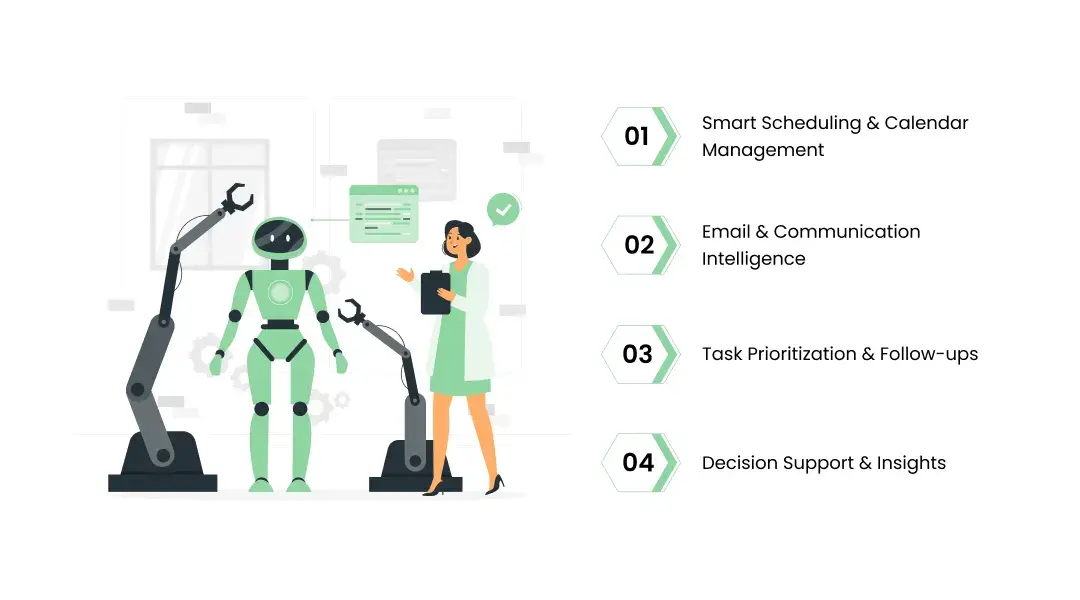
Modern AI assistant for meetings and scheduling tools analyze:
Decision density across the day
Energy patterns (yes, this matters)
Stakeholder importance
Meeting outcomes over time
I’ve seen calendars redesigned not to look efficient, but to feel humane. That alone improves executive performance more than most productivity hacks.
Inbox zero is a myth.
Relevance zero is the real goal.
An advanced AI executive assistant software doesn’t just filter emails. It understands:
Who this message is really from
What decision it’s trying to trigger
Whether delay creates risk
It drafts responses aligned with executive tone. It escalates quietly. It suppresses noise without missing landmines.
This is where AI assistants for productivity stop being personal and start becoming political.
Humans are terrible at remembering follow-ups. Especially verbal ones.
An enterprise AI assistant listens across meetings, chats, and docs. It connects loose ends automatically.
You didn’t assign the task explicitly, but you implied it.
The assistant noticed.
This is executive assistant automation done right. Invisible. Reliable. Slightly uncanny.
This is the part most vendors overpromise and underdeliver.
True AI decision support tools don’t make decisions for executives. They frame decisions better.
They surface:
What changed since last time
What assumptions no longer hold
What similar decisions led to historically
For an AI assistant for CEOs, this isn’t about answers. It’s about sharper questions.
That’s the difference between automation and augmentation.
Here’s the shift most people miss.
Productivity isn’t output per hour. It’s judgment per decision.
The executives using AI tools for executive productivity effectively aren’t doing more work.
They’re doing less unnecessary work.
They enter meetings pre-briefed. They leave with actions captured. They delegate with context, not instructions.
Over time, something subtle happens.
They get calmer.
And calm leaders make better calls.
This is always the wrong question.
It’s not replacement. It’s redistribution.
Human executive assistants excel at:
Emotional intelligence
Relationship management
Nuance no system can model yet
AI executive assistants excel at:
Memory without fatigue
Pattern recognition
Relentless consistency
Together?
That’s leverage you can feel.
In every successful deployment I’ve led at KriraAI, the human EA became more strategic, not obsolete.
The future of AI assistants isn’t louder interfaces or smarter voices.
It’s silence.
Assistants that intervene less - but better. Systems that wait until the moment truly matters.
We’re moving toward:
Deeper personalization at the executive level
Assistants that understand risk tolerance
Systems embedded inside decision workflows, not layered on top
At KriraAI, we’re seeing enterprises move away from generic tools and toward custom-built assistants, often guided by a Best AI development Company mindset rather than product shopping.
Because leadership isn’t generic. Why should the assistant be?
AI executive assistants aren’t about doing less work.
They’re about doing better thinking.
For leaders willing to approach this thoughtfully—not blindly—the payoff isn’t efficiency.
It’s clarity.
And clarity, in leadership, is everything.
No. It complements human EAs by handling memory, patterns, and follow-through while humans focus on relationships and judgment.
They can be, if built with strong data controls, access boundaries, and enterprise-grade architecture.
Context. Learning. Intent awareness. Chatbots respond; executive assistants anticipate.
Both, but the value increases with decision complexity, not company size.
Typically 8–16 weeks, depending on integration depth and personalization needs.
Founder & CEO
Divyang Mandani is the CEO of KriraAI, driving innovative AI and IT solutions with a focus on transformative technology, ethical AI, and impactful digital strategies for businesses worldwide.