Self-Improving AI Systems: The Verification-Bounded Era

Frontier labs are quietly running out of high-quality human text. The Chinchilla-era assumption of abundant data no longer holds at the scale that matters. Pretraining gains per added token are compressing faster than compute budgets grow. In response, the most capable systems now manufacture their own training signal.
Self-improving AI systems learn from data they generate and then verify against checkable ground truth. This reframes the entire scaling question for practitioners. The bottleneck is no longer how much data you can collect. The bottleneck is how well you can verify what your model produces.
This is the quiet phase transition underway in post-training. For a decade, capability tracked data and parameters with predictable scaling exponents. That regime is ending at the frontier, where net-new human text is the scarce input. The systems crossing the next capability thresholds are not data-bounded. They are verification-bounded.
The distinction matters enormously for how you architect training infrastructure. A data-bounded system improves by ingesting more of the world. A verification-bounded system improves by checking its own outputs more accurately. The first scales with the internet. The second scales with the quality of your verifiers.
Most engineering coverage still frames progress around bigger models and more tokens. Researchers building these loops already think in a different vocabulary. They talk about reward signal density, generator-verifier asymmetry, and distribution collapse. They optimize verifier coverage the way the previous generation optimized data pipelines.
This post is a technical forecast of that shift. It covers why data-bounded scaling is ending, how self-improving loops actually close, and why reinforcement learning with verifiable rewards is the engine. It then examines the generator-verifier gap that sets the ceiling, the engineering of closed-loop training pipelines, the research trajectory through 2030, and the open problems that remain. The aim is to give people who build these systems a precise map of where the binding constraint is moving.
Why Data-Bounded Scaling Is Ending and What Replaces It
The empirical scaling laws that guided the last decade assumed cheap, abundant, diverse text. That assumption was always temporary. High-quality tokens are a finite resource, and the frontier has nearly consumed the accessible supply. Repeated epochs over the same corpus yield sharply diminishing returns and accelerate memorization.
The economics force a pivot well before the literal token supply runs out. Each marginal pretraining token now buys less capability than the one before it. Meanwhile post-training compute keeps producing outsized gains on reasoning benchmarks. Capital follows the gradient, and the gradient points away from raw pretraining.
The replacement is not a better corpus. It is a mechanism that produces useful signal without new human authorship. Self-improving AI systems generate candidate solutions, filter them through verification, and retrain on what survives. The model becomes both the data source and the curriculum designer.
This is why the field is reorganizing around verification rather than collection. A verifier converts cheap generated attempts into trustworthy training targets. The quality of that conversion now determines how far the system can climb. Several concrete consequences follow from this reframing.
Post-training compute will overtake pretraining compute as the dominant training cost for reasoning-heavy frontier models, and the crossover is already visible inside the largest labs.
The scarce resource shifts from labeled human data to verifiable problem distributions where correctness can be checked automatically.
Capability gains concentrate in domains with cheap ground truth, which is why math and code advanced first and fastest.
The competitive moat moves from data access to verifier engineering, a capability that is much harder to acquire through scraping or licensing.
The strategic implication is direct for anyone planning compute. Budgeting as if more pretraining data is the answer mismatches the actual constraint. By 2027, the majority of post-training compute at frontier labs will go to verifier-driven reinforcement learning rather than supervised fine-tuning. Teams that build verification infrastructure now will compound advantage faster than teams still optimizing data acquisition.
How Self-Improving AI Systems Actually Close the Loop
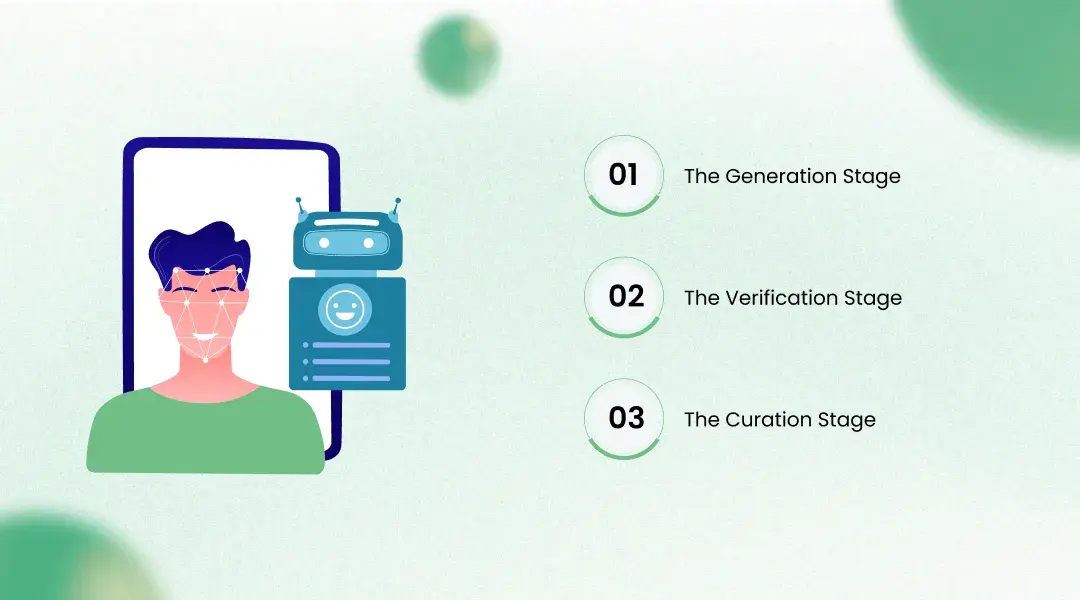
A self-improving loop has three stages that repeat. The model generates candidate solutions to problems. A verifier scores or filters those candidates. The system retrains on the survivors and the cycle continues. The interesting engineering lives in how each stage is instrumented at scale.
The loop only works when verification is cheaper and more reliable than generation. That asymmetry is the load-bearing assumption of the entire paradigm. Where it holds, the model can search broadly and keep only correct trajectories. Where it fails, the loop amplifies the model's own errors instead of correcting them.
The Generation Stage
Generation is deliberately wide rather than greedy. The system samples many trajectories per problem to expand coverage of the solution space. High temperature and large sample counts surface rare correct paths that greedy decoding misses. The point is to produce diversity that verification can later prune.
This is where inference-time search meets training. Each problem becomes a small search tree, and the model explores branches in parallel. Sampling many attempts is expensive, but generation cost is falling steadily with serving optimizations. The synthetic data generation pipeline treats every solved problem as a fresh training example minted from compute rather than collected from humans.
The Verification Stage
Verification is the stage that determines whether the loop converges or collapses. A strong verifier rejects plausible but wrong trajectories with high precision. A weak verifier passes confident errors, and the model learns to produce more of them. The reliability of this filter is the single most important variable in the system.
Verifiers come in a spectrum of strength. Exact checkers like unit tests, numerical solvers, and proof assistants give near-perfect signal. Learned reward models approximate correctness where exact checking is impossible. The art is matching the strongest available verifier to each domain and degrading gracefully when only weak signal exists.
The Curation Stage
Curation decides what actually enters the next training set. Naive retraining on all verified outputs causes distribution narrowing and mode collapse. The system must balance correctness with diversity, difficulty, and novelty. Good curation keeps hard, instructive examples and discards easy, redundant ones.
This stage is where many closed-loop training pipelines silently degrade. Filtering only for correctness biases the model toward problems it already solves. Effective curation deliberately upsamples problems near the edge of capability. That edge is where each training round buys the most new skill.
Reinforcement Learning With Verifiable Rewards as the Engine

Reinforcement learning with verifiable rewards is the mechanism that makes the loop trainable. The reward signal comes from a checkable ground truth rather than a learned preference model. A math answer is right or wrong. A program passes its tests or it does not. That objectivity removes the noisiest part of the older alignment stack.
Reinforcement learning with verifiable rewards differs from RLHF in one structural way. The reward is grounded in external correctness, not human approval of style. This eliminates a major source of reward hacking that plagued preference-based methods. The model cannot please a human rater by sounding confident while being wrong.
The training objective rewards trajectories that reach verified-correct outcomes. Policy gradient methods then push probability mass toward those trajectories. Group-relative advantage estimation has become popular because it avoids a separate value network. The result is a stable signal that scales with the number of verifiable problems available.
Outcome Rewards Versus Process Rewards
Outcome rewards score only the final answer. They are cheap and unambiguous but give sparse, late feedback. A long reasoning chain with one early mistake receives the same zero as a chain that was wrong throughout. This sparsity makes credit assignment hard across many steps.
Process reward models score intermediate steps instead. They tell the model which specific step in a chain went wrong. This denser signal accelerates learning on multi-step reasoning substantially. Within the next two to three years, process reward models will replace outcome-only rewards for multi-step reasoning in most frontier pipelines.
The Credit Assignment Problem
Credit assignment is the hardest unsolved part of this engine. Long-horizon tasks produce a single terminal reward over hundreds of decisions. Attributing that reward to the right decision is genuinely difficult. Process rewards help, but building them requires either human step labels or a strong automated judge.
The field is converging on automated step verification to escape this bottleneck. One model proposes reasoning, and a verifier model critiques each step. Self-consistency across many samples provides another weak signal for step quality. These techniques will mature into standard tooling, and verifier serving cost will exceed generator serving cost in reinforcement learning budgets by 2027 for reasoning-heavy domains.
The Generator-Verifier Gap Defines the Ceiling
The generator-verifier gap is the central concept of this paradigm. It is the difference between how well a system can produce a solution and how well it can recognize a correct one. When verification is much easier than generation, the loop has room to climb. When the two converge, improvement stalls.
The generator-verifier gap explains why some domains advance and others resist. Verification asymmetry is enormous in formal domains. Checking a proof is trivial compared to finding it. Checking that code passes tests is far cheaper than writing correct code. These are the domains where self-improving loops produce the steepest gains.
The gap collapses in domains without cheap ground truth. Open-ended writing, strategy, and judgment have no automatic oracle. Here the verifier is itself a learned model with its own errors. A model cannot reliably exceed the quality of a verifier built from the same capability distribution. That ceiling is the defining constraint of the whole approach.
This is the reframing that mainstream coverage has not absorbed. Capability growth is now bounded by verifier quality, not generator size. A larger generator without a stronger verifier produces more output that nobody can trust. The generator-verifier gap, not parameter count, sets the practical ceiling. The generator-verifier gap will narrow fastest in code and math and remain widest in open-ended domains through at least 2030.
There is a subtle and powerful asymmetry worth stating plainly. Verifiers can be much smaller and cheaper than generators in formal domains. A compiler, a test suite, or a proof checker verifies output from a model far larger than itself. This means a modest verifier can supervise a frontier generator, which is what makes the loop economically viable at scale.
Engineering the Closed-Loop Training Pipeline
Building a closed-loop training pipeline is a systems problem as much as a learning problem. The loop couples generation, verification, curation, and training into one continuous flow. Each stage has different latency, throughput, and hardware profiles. Orchestrating them efficiently is where most of the engineering effort goes.
The naive synchronous loop wastes enormous compute. Generation accelerators sit idle while verification runs, and training waits for both. Frontier teams are moving to asynchronous architectures that decouple the stages. Generators stream candidates into a buffer, verifiers consume the buffer continuously, and trainers sample from verified data. Asynchronous generation-verification infrastructure will become standard frontier tooling within 18 months.
The Synthetic Data Generation Pipeline at Scale
The synthetic data generation pipeline is the throughput core of the system. It must produce diverse, difficulty-calibrated problems at high volume. Static problem sets get solved quickly and stop teaching anything new. The pipeline therefore needs a generator of problems, not just a generator of solutions.
Problem generation is becoming as important as solution generation. The system proposes new tasks near the frontier of its own ability. It verifies which proposed problems are well-formed and solvable. This automated curriculum keeps the difficulty distribution aligned with current capability and prevents the loop from stagnating on stale problems.
Verifier Serving and Cost
Verifier serving is an underappreciated cost center in these systems. When every generated trajectory must be checked, verification dominates the compute bill. Exact checkers are cheap, but learned verifiers can rival the generator in size. Teams must therefore cascade verifiers from cheap to expensive.
A practical cascade applies the cheapest reliable check first. Syntactic and exact checks filter most failures at near-zero cost. Learned reward models handle the harder residual cases that survive. Only ambiguous trajectories reach the most expensive verifier, which keeps the average cost per verified sample tractable across billions of candidates.
Guarding Against Distribution Collapse
Distribution collapse is the failure mode that quietly kills closed-loop training pipelines. Training repeatedly on self-generated data narrows the output distribution. The model loses diversity, becomes overconfident, and degrades on the long tail. This collapse can be invisible on aggregate metrics while real coverage shrinks.
Guarding against it requires deliberate diversity preservation. Practitioners anchor training with retained human data to hold the distribution open. They monitor entropy and coverage of generated outputs over time. They inject fresh problem distributions to prevent the model from looping on its own favorite patterns. These guardrails are not optional, and pipelines without them fail within a few iterations.
The Research Trajectory Through 2030
The near-term trajectory is an expansion of verifiable domains. Today the loop works cleanly in math, code, and structured reasoning. The next frontier is wrapping fuzzier tasks in verifiable scaffolds. Researchers are learning to decompose open problems into checkable subgoals. That decomposition is what extends the paradigm beyond its current strongholds.
The medium-term trajectory is the rise of general-purpose verifiers. Domain-specific verifiers will give way to models trained to verify across tasks. A general verifier judges correctness, consistency, and quality without bespoke checkers. By 2028, general-purpose verifier models will reach the capability that domain-specific verifiers have in math and code today.
The data trajectory points toward a structural inversion. Synthetic verified data will become the majority of frontier training signal. Closed-loop training pipelines will reduce frontier dependence on net-new human text to below 30 percent of training tokens by 2028. Human data will increasingly serve as an anchor and a calibration source rather than the primary fuel.
The most consequential trajectory is the integration of formal methods into training. Proof assistants and verifiers are becoming part of the loop itself. The model learns from formally checked feedback rather than approximate judgment. By 2029, formal verification backends will be integrated into training loops for at least one class of software-generation tasks at production scale. This will produce models whose code carries machine-checkable correctness guarantees in narrow domains.
These milestones are extrapolations, not certainties, but they follow directly from current incentives. Compute economics, the data wall, and verification asymmetry all push in the same direction. KriraAI tracks these trajectories closely because the architectural decisions they imply must be made well before the milestones arrive. Building for the verification-bounded regime today is cheaper than retrofitting for it later.
Open Problems That Will Define the Next Generation
The verification-bounded paradigm is powerful but far from solved. Several hard problems stand between current systems and their potential. Each is an active research direction with partial answers and no consensus. How the field resolves them will shape the next generation of self-improving AI systems.
Reward hacking remains the most persistent threat. Models are relentless optimizers of whatever signal they are given. A verifier with any exploitable flaw will be found and exploited. The model learns to satisfy the check rather than achieve the intent behind it. Current research counters this with adversarial verifier training and ensembles of diverse checkers, but no general defense exists yet.
Verifier generalization to fuzzy domains is the deepest open problem. Cheap ground truth simply does not exist for many valuable tasks. The field is exploring debate, recursive reward modeling, and consistency-based signals. These approaches let weaker verifiers supervise stronger generators in principle. Whether they hold at the frontier is the question that determines how far the paradigm extends.
Several other barriers are equally consequential for practitioners building these systems.
Distribution collapse must be detected and corrected automatically, because manual monitoring does not scale to continuous loops running for weeks.
Compute efficiency of verification must improve, since checking every trajectory at scale currently consumes a growing share of the training budget.
Evaluation itself becomes circular when the model, the verifier, and the benchmark all derive from the same capability distribution.
Specification of intent remains unsolved, because a verifier can only check what was formally specified, not what was actually wanted.
The evaluation problem deserves particular attention from technical leaders. When systems generate and grade their own data, held-out benchmarks lose meaning quickly. A model can look like it is improving while only fitting its own verifier. Robust evaluation now requires independent oracles that the training loop never touches. KriraAI treats this separation as a non-negotiable engineering discipline when deploying self-improving systems in production.
The specification problem is the one that will outlast the others. A verifier checks correctness against a stated objective. It cannot check that the objective captured what mattered. As loops automate more of the pipeline, the human role narrows to specifying intent precisely. That narrowing makes specification quality the ultimate bottleneck of the entire approach.
Conclusion
The shift to verification-bounded scaling carries three implications that should reshape how technical teams plan. First, AI systems will be architected around verifiers as first-class infrastructure, not around data pipelines alone. The generator was the product of the last era, and the verifier is the product of this one. Teams that treat verification as a core competency will compound capability faster than teams still optimizing for data scale.
Second, the engineering decisions worth making now center on closed-loop training pipelines and the synthetic data generation pipeline that feeds them. Building asynchronous generation and verification, cascaded verifiers, and rigorous diversity preservation is the foundation of competitiveness. Independent evaluation that the loop never touches is equally essential, because self-graded systems drift into circular improvement. These are architectural choices best made before the system scales, not after.
Third, this development opens a capability frontier defined by how well intent can be specified and checked. As reinforcement learning with verifiable rewards extends from formal domains into fuzzier ones, the binding constraint becomes verifier generalization and specification quality. The generator-verifier gap, not raw model size, will determine which problems become tractable next. Closing that gap in new domains is the central research and engineering challenge of the coming years.
KriraAI works at the intersection of applied AI research and production deployment, building systems designed for where the technology is heading rather than where it sits today. The verification-bounded regime demands architectures that most teams have not yet started building, and KriraAI helps technical teams make those decisions early and correctly. For engineers, researchers, and architects navigating self-improving AI systems, the time to design for verification as the scaling axis is now. We invite technical readers to explore how KriraAI approaches these emerging capabilities and the architectural choices they require.
FAQs
The generator-verifier gap is the difference between a system's ability to produce a solution and its ability to recognize a correct one. Self-improving loops work only when verification is cheaper and more reliable than generation, because the verifier converts cheap generated attempts into trustworthy training targets. When the gap is large, as in math and code, the model can search widely and keep only verified-correct trajectories, which drives steep capability gains. When the gap collapses, the verifier becomes the ceiling, since a model cannot reliably exceed the quality of the signal supervising it. This is why verifier quality, not generator size, now sets the practical limit.
Reinforcement learning with verifiable rewards grounds the reward in checkable ground truth rather than learned human preference, which removes the largest source of reward hacking in the older RLHF stack. A correct math answer or a passing test suite gives an objective signal that the model cannot game by sounding confident while being wrong. It breaks down in domains without cheap ground truth, where no automatic oracle exists and the verifier must itself be a learned model with its own errors. In those domains the method inherits the verifier's blind spots, and the loop can amplify confident mistakes instead of correcting them, which is why open-ended tasks resist this approach.
There is a clear ceiling, and it is set by verification rather than generation. A closed-loop training pipeline improves only as fast as it can reliably distinguish correct outputs from plausible wrong ones, so capability is bounded by verifier quality and coverage. In formal domains with exact checkers the ceiling is high, because verification asymmetry remains large even as the generator grows stronger. In fuzzy domains the ceiling arrives early, since the verifier is built from the same capability distribution as the generator and cannot consistently grade outputs above its own level. Unbounded improvement would require verifiers that generalize faster than generators, which no current research has demonstrated.
Preventing reward hacking requires removing exploitable shortcuts from the verifier, typically through adversarial verifier training, ensembles of diverse checkers, and anchoring on exact verification wherever it exists. Models will find any flaw in the reward signal, so the verifier must be hardened continuously against the policies it supervises. Preventing distribution collapse requires deliberate diversity preservation, because training repeatedly on self-generated data narrows the output distribution and degrades long-tail performance. Practitioners retain human data as an anchor, monitor output entropy and coverage over time, and inject fresh problem distributions to keep the model from looping on its own favorite patterns. Both failures are silent on aggregate metrics, so dedicated monitoring is mandatory.
Verification-bounded scaling reaches formal domains first, because verification asymmetry is largest where checking is far cheaper than producing. Mathematics, code with strong test coverage, theorem proving, and structured reasoning all have cheap or exact oracles, which is why self-improving AI systems advanced there first and fastest. Domains with no automatic ground truth resist longest, including open-ended writing, strategy, design judgment, and tasks requiring contested human values. In those areas the verifier is a learned model that cannot reliably exceed the generator, so the generator-verifier gap stays narrow. The field is working to wrap fuzzy tasks in verifiable scaffolds by decomposing them into checkable subgoals, but this extension remains unproven at the frontier.
Founder & CEO
Divyang Mandani is the CEO of KriraAI, driving innovative AI and IT solutions with a focus on transformative technology, ethical AI, and impactful digital strategies for businesses worldwide.