The cost of acquiring, cleaning, and annotating high quality training data has followed a trajectory that most practitioners already feel in their infrastructure budgets but few have projected to its logical conclusion. Current estimates place the fully loaded cost of producing one million tokens of expert annotated preference data for RLHF at between $50,000 and $200,000 depending on domain complexity, annotator expertise requirements, and quality assurance overhead. Meanwhile, the frontier models consuming this data are scaling toward training runs that require trillions of tokens of increasingly specialized signal. These two curves, the escalating demand for high quality supervised signal and the fundamentally linear cost structure of human annotation, are on a collision course that synthetic data generation for AI training will resolve within the next two to three years.
What makes this moment distinct from earlier discussions of synthetic data is the convergence of three technical capabilities that were previously insufficient in isolation. First, generator models have reached a quality threshold where their outputs in constrained domains are statistically indistinguishable from human produced content on downstream task metrics, not just on surface fluency. Second, verification and filtering systems, including reward models, constitutional AI classifiers, and formal consistency checkers, have matured enough to serve as autonomous quality gates rather than mere ranking heuristics. Third, the infrastructure for running generation, verification, and selection loops at scale has been battle tested through techniques like rejection sampling, RLAIF, and iterative self-play, providing the engineering substrate on which fully closed-loop systems will be built.
The implications extend far beyond cost reduction. When a training pipeline can generate its own learning signal, verify that signal against formal or empirical quality criteria, and iteratively refine both the generator and the verifier, the resulting system occupies a fundamentally different position in the capability landscape than one constrained by a fixed human annotation budget. This blog provides a technically grounded forecast of where closed-loop data curation systems are heading, what architectural patterns will define the next generation of self-improving training pipelines, how model collapse prevention techniques will evolve from ad hoc interventions to principled engineering disciplines, and what all of this means for practitioners who are designing training infrastructure today that must remain viable as these capabilities mature.
The dominant training paradigm still treats data as a static asset. Teams spend months curating datasets, freeze them at a point in time, train against them, evaluate, and then begin a new cycle of collection. This workflow made sense when models were small enough that a fixed dataset could be reused across multiple training runs with different hyperparameters, and when the bottleneck was compute rather than data quality or diversity. Neither condition holds at the frontier today. Training runs at the scale of hundreds of billions of parameters consume their datasets in ways that make additional epochs on the same data yield diminishing or negative returns, and the quality ceiling of web-scraped corpora has become the binding constraint on capability improvement in multiple benchmarks.
The shift toward what research groups internally call "data engines" reflects a recognition that the training dataset should not be a noun but a verb. A data engine is a system that continuously produces, filters, and refreshes training signal in response to the model's current capability profile. Early versions of this concept are already visible in production. Meta's approach to training Llama models involves iterative rounds of synthetic data generation followed by quality filtering, where each round targets specific capability gaps identified through evaluation. Anthropic's constitutional AI methodology uses a model to generate critiques and revisions of its own outputs, creating preference pairs without human annotators. Google DeepMind's approaches to mathematical reasoning training involve generating millions of candidate solutions and filtering by formal verification. Each of these represents a partial implementation of the closed-loop architecture that will become the default training methodology.
The next generation of training infrastructure will be architected around continuous data generation as a first-class system component rather than a preprocessing step. This means the data generation pipeline will run concurrently with training, feeding freshly synthesized and verified examples into the training stream in near real time. The architectural pattern resembles a producer-consumer system where the producer is a specialized generator model, possibly a snapshot of the model being trained or a dedicated generation specialist, and the consumer is the training loop itself. Between them sits a verification and curation layer that serves as both quality gate and curriculum designer.
This architecture requires solving several engineering problems that current systems handle only partially. The generator must be decoupled from the trainee to avoid the tight feedback loops that cause mode collapse, but coupled closely enough that the generated data targets the trainee's actual capability gaps. The verification layer must operate at throughput levels that match the training loop's consumption rate, which for frontier models means processing millions of examples per hour. The curriculum logic must balance exploration of new data distributions against exploitation of signal that has proven effective. These are solvable engineering challenges, and the teams that solve them first will have a structural advantage in training efficiency that compounds with every subsequent model generation.
The generator side of synthetic data pipelines is already surprisingly capable. A frontier language model prompted with appropriate context and constraints can produce text that passes most automated quality metrics. The hard problem is not generation but verification: how do you know, at scale, that a synthetically generated example actually carries the learning signal you intend? This question becomes existential in closed-loop systems where verification failures compound across iterations. A generator that produces subtly incorrect reasoning chains, filtered by a verifier that cannot detect the subtle incorrectness, will train a model that reproduces those errors with increased confidence, which in turn degrades the generator and verifier in subsequent rounds. This is the technical mechanism behind model collapse, and preventing it requires verification systems that are fundamentally more rigorous than what most current pipelines employ.
Current verification approaches fall into three categories, each with characteristic failure modes. Reward model scoring uses a trained classifier to estimate example quality, but reward models are susceptible to reward hacking and distribution shift, meaning they become unreliable precisely when the generated data diverges from their training distribution. LLM-as-judge approaches use a separate language model to evaluate generated content, but these inherit all the biases and blind spots of the judge model and add a layer of evaluation variance. Rule-based filtering uses programmatic checks for format compliance, length, and surface features, but cannot assess semantic correctness or reasoning validity.
The verification stack that will underpin reliable self-improving training pipelines will be a multi-layer system combining formal methods, empirical validation, and learned quality estimation. At the base layer, formal verification will handle domains where correctness is decidable. Mathematical reasoning, code generation, logical inference, and constraint satisfaction problems can all be verified by executing the proposed solution against a formal specification. This is already the approach used in AlphaProof-style systems for mathematics, and it will expand to cover a much larger fraction of training data as more domains are formalized.
Above the formal layer, empirical validation will use execution-based testing to verify claims that are not formally specifiable but are empirically testable. Does the generated code actually run? Does the proposed API call return the expected response? Does the described chemical synthesis pathway produce a stable compound according to simulation? This layer transforms verification from a classification problem into an experimental validation problem, dramatically increasing reliability at the cost of compute. The systems being developed at KriraAI for production deployment already incorporate execution-based validation for code and structured output domains, and extending this pattern to broader knowledge domains is an active area of applied research.
The top layer will use learned quality estimation, essentially reward models, but with a crucial architectural difference from current implementations. Rather than training a single monolithic reward model, future verification stacks will use ensembles of specialized verifiers, each trained on a different aspect of quality (factual accuracy, reasoning validity, stylistic appropriateness, safety compliance) and calibrated against different ground truth sources. Disagreement between ensemble members will serve as an uncertainty signal, routing ambiguous examples to more expensive verification methods or discarding them entirely. This ensemble approach provides the throughput needed for continuous generation while maintaining the reliability needed to prevent verification failure cascades.
The term "model collapse" entered the technical vocabulary through a series of papers in 2023 and 2024 demonstrating that training on model-generated data without appropriate safeguards leads to progressive degradation of output diversity and quality. The initial characterization was largely empirical, showing that iterative retraining on synthetic data caused distribution narrowing, mode dropping, and eventual convergence to degenerate outputs. What has followed is a rapid maturation of understanding, from observation to theory to the beginning of principled prevention, that will culminate in model collapse prevention techniques becoming a standard component of training infrastructure.
The theoretical understanding of model collapse has solidified around a few key insights. The core mechanism is variance loss across generations: when a model is trained on its own outputs, each generation captures only a subset of the variance in the previous generation's distribution, leading to exponential narrowing over iterations. This is analogous to the founder effect in population genetics, where a small sample from a population carries only a fraction of the original genetic diversity. The rate of collapse depends on the ratio of synthetic to real data, the diversity of the generator's sampling strategy, and the selectivity of the filtering process. Highly selective filtering, which keeps only the "best" examples according to some quality metric, accelerates collapse by preferentially removing tail distribution examples that carry important diversity signal.
Recent theoretical work has established bounds on the number of iterative training rounds that can be sustained before significant distribution degradation occurs, as a function of model capacity, dataset size, and the mixing ratio of synthetic to real data. These bounds are pessimistic for naive approaches, suggesting that pure self-training without intervention degrades significantly within three to five generations. But they also point toward specific interventions that provably slow or prevent collapse: maintaining a reservoir of real data that is mixed into every generation, using high-temperature sampling to preserve tail distributions, applying diversity-promoting objectives during generation, and periodically resetting components of the generation pipeline to break feedback loops.
By late 2027, model collapse prevention techniques will be as standardized in training pipelines as gradient clipping or learning rate scheduling are today. The engineering practices that will emerge from current research include several specific patterns that practitioners should begin incorporating into their systems design.
Reservoir sampling with provenance tracking will maintain a curated buffer of verified high-quality real-world data that is mixed into every synthetic generation cycle at a controlled ratio. The key innovation beyond simple mixing is provenance tracking: every example in the training stream will carry metadata indicating its generation source, generation number (how many synthetic iterations it has passed through), and verification status. This metadata enables training dynamics that weight real data more heavily in later training stages and detect when the synthetic-to-real ratio in any capability domain has drifted beyond safe bounds.
Distribution monitoring will use statistical divergence measures, applied not to the full output distribution but to capability-specific slices, to detect early signs of mode collapse before they manifest as capability degradation on benchmarks. KL divergence, Wasserstein distance, and Vendi score (a diversity metric based on matrix eigenvalues) computed over rolling windows of generated data will provide the monitoring signal. When divergence exceeds calibrated thresholds for any capability slice, the system will automatically adjust generation parameters, increase real data mixing, or trigger a partial pipeline reset. This monitoring infrastructure represents a new category of MLOps tooling that does not exist today but will be essential for any team running closed-loop data curation systems.
Adversarial diversity injection will use a dedicated diversity-promoting model, trained with objectives that reward output novelty relative to the current generation buffer, to periodically inject high-diversity examples into the synthetic data stream. This is analogous to the role of mutation in evolutionary algorithms: it prevents the system from converging prematurely on a narrow optimum. The diversity injector itself must be carefully managed to avoid injecting noise rather than diversity, which requires its own verification pipeline tuned for novelty rather than quality.
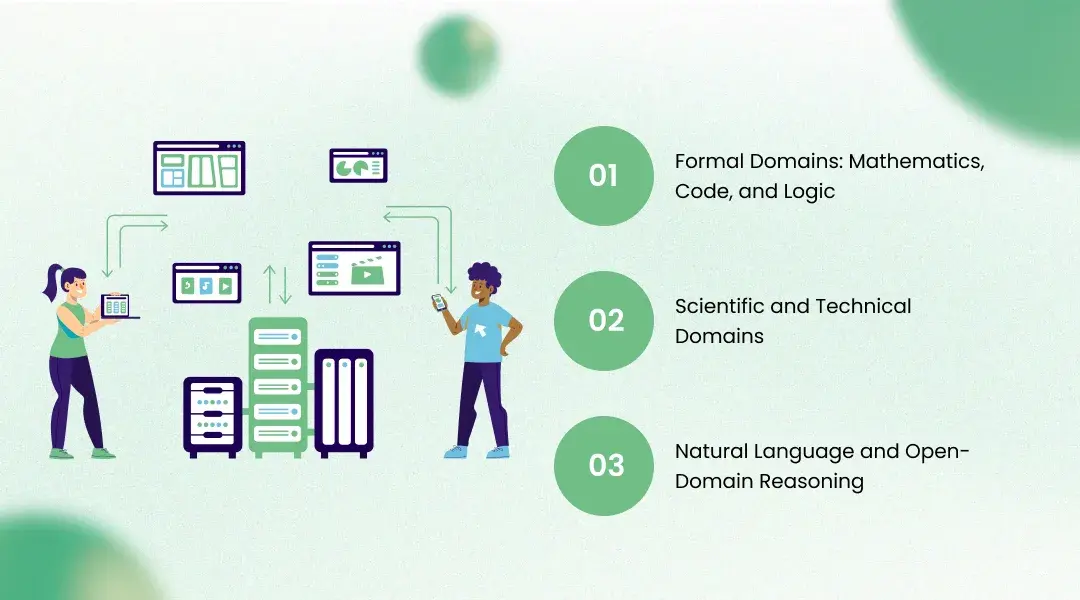
The transition to fully closed-loop training data systems will not happen uniformly across domains. It will arrive first in domains where verification is cheapest and most reliable, then expand as verification capabilities mature. Understanding this sequence is critical for practitioners making infrastructure investment decisions today.
Mathematical reasoning, code generation, and formal logic represent the lowest-hanging fruit for closed-loop data systems because verification in these domains can be fully automated with high reliability. A generated proof can be checked by a proof assistant. Generated code can be executed against test suites. A logical derivation can be verified by a SAT solver or SMT checker. This means the verification layer in these domains is essentially free in terms of human oversight, enabling loops that can run millions of iterations without human intervention.
The results already visible from this approach are striking. Systems trained on synthetically generated mathematical proofs, verified by Lean or Isabelle, have achieved capability improvements that would have required orders of magnitude more human-annotated data. Code generation models trained on self-generated solutions filtered by execution-based testing have shown similar efficiency gains. By 2028, the majority of training signal for mathematical and coding capabilities in frontier models will come from closed-loop synthetic systems rather than human annotation. This prediction is grounded not in speculation but in the observable cost curves: synthetic generation plus automated verification is already cheaper per verified example than human annotation, and the cost advantage widens as generator models improve.
Scientific domains with established simulation infrastructure, such as computational chemistry, protein structure prediction, materials science, and circuit design, represent the second wave. In these domains, verification takes the form of simulation-based validation: a proposed molecular structure can be evaluated by density functional theory calculations, a circuit design can be verified by SPICE simulation, a materials composition can be assessed by molecular dynamics. The verification is more expensive than formal checking (minutes to hours per example rather than milliseconds) but is still fully automated and highly reliable.
The bottleneck in scientific domains is the cost of verification simulation, which currently limits the throughput of closed-loop systems. However, the development of learned surrogate models, neural networks trained to approximate expensive simulations at a fraction of the compute cost, is creating a viable path to high-throughput scientific data synthesis. A generator produces candidate scientific data (molecule structures, protein sequences, material compositions), a learned surrogate provides fast approximate verification, and examples that pass the surrogate filter are periodically validated against the full simulation to calibrate the surrogate's accuracy. This two-tier verification architecture trades some reliability for dramatically higher throughput, and the tradeoff is manageable as long as the surrogate's error rate is monitored and the full simulation validation cadence is sufficient to catch systematic surrogate failures.
Open-domain natural language, the core capability of general-purpose language models, is where closed-loop data synthesis is hardest because verification is least formalized. There is no compiler for factual accuracy, no proof checker for reasoning quality, and no test suite for conversational appropriateness. This does not mean closed loops are impossible in this domain, it means they require more sophisticated verification architectures.
The approach that will mature over the next three years involves decomposing open-domain verification into a collection of verifiable sub-problems. Factual claims can be checked against knowledge bases and retrieved documents. Reasoning chains can be assessed for logical consistency even when their conclusions cannot be verified. Stylistic and safety properties can be evaluated by specialized classifiers calibrated against human judgments. The innovation is not any single verification method but the orchestration layer that decomposes a complex example into verifiable components, routes each component to the appropriate verifier, and aggregates the results into a holistic quality assessment. This decomposed verification architecture will be the enabling technology for closed-loop training in open-domain language, and its development is one of the most consequential ongoing efforts in applied AI research.
The most technically ambitious vision for synthetic data generation for AI training is the fully self-improving training pipeline: a system where the generator, verifier, and curriculum components all improve autonomously over successive iterations, creating a compounding capability trajectory without human intervention in the loop. Realizing this vision requires solving a control theory problem that the AI field has not yet fully formalized.
In a self-improving system, the generator and verifier must co-evolve in a way that maintains a productive capability gap between them. If the verifier is too far ahead of the generator, it rejects everything and the system stalls. If the generator surpasses the verifier, low-quality examples leak into the training stream and capability degrades. The optimal regime is one where the verifier is slightly more capable than the generator in the dimensions relevant to quality assessment, creating a zone of productive selection pressure.
Maintaining this productive gap across iterative improvement cycles is a control problem analogous to maintaining homeostasis in a biological system. The system must have feedback mechanisms that detect when the gap is widening or narrowing and adjust the improvement rates of each component accordingly. Concretely, this means periodically evaluating both the generator and verifier against held-out benchmarks, monitoring the acceptance rate of the verification pipeline (too high indicates a weak verifier, too low indicates an overly restrictive one or a weak generator), and applying asymmetric update schedules that slow down the faster-improving component.
One promising approach uses separate training budgets for the generator and verifier, allocated dynamically based on the measured capability gap. When the generator improves faster, more compute is allocated to verifier training. When the verifier becomes overly restrictive, the generator receives additional training signal from a wider distribution. This dynamic allocation mechanism is a form of adaptive control, and formalizing it with stability guarantees is an active research problem that will likely yield foundational results within the next two years.
A fully autonomous training pipeline must solve not only the problem of generating high-quality data but also the problem of generating the right data at the right time. This is the curriculum design problem, and in closed-loop systems it takes on a form that is qualitatively different from curriculum learning in traditional supervised settings.
In traditional curriculum learning, the difficulty progression is designed by human researchers based on intuitions about learning order. In a closed-loop system, the curriculum must be derived automatically from the model's current capability profile. This requires a capability assessment module that can identify specific weaknesses in the current model, a generation targeting module that can produce data specifically designed to address those weaknesses, and a progress tracking module that detects when a weakness has been sufficiently addressed and the curriculum should shift focus.
The capability assessment problem is itself nontrivial. Standard benchmark evaluation provides a coarse signal at fixed intervals, but effective curriculum design requires fine-grained, continuous assessment across capability dimensions that may not be well represented in existing benchmarks. The emerging approach uses a suite of probe tasks, lightweight evaluations that can be run frequently without interrupting training, to maintain a real-time capability map. The generation targeting module then uses this map to parameterize the data generator, adjusting the distribution of topics, difficulty levels, reasoning chain lengths, and other controllable attributes to concentrate data generation where the model will benefit most.
At KriraAI, research into adaptive curriculum systems for closed-loop training has identified that the most effective curricula follow a pattern of capability frontier exploration: they generate data that is slightly beyond the model's current reliable capability boundary, similar to the zone of proximal development concept in educational psychology. Too easy and the data provides no learning signal. Too hard and the model cannot extract useful gradient information. The optimal difficulty level can be estimated dynamically using the model's confidence calibration on probe tasks, creating a self-adjusting curriculum that tracks the model's improving capability frontier.
The engineering infrastructure required to run synthetic data quality verification at the throughput levels demanded by frontier training pipelines does not exist as a coherent system today. Current implementations are bespoke, cobbled together from evaluation harnesses, reward model inference servers, and custom filtering scripts. Over the next two to three years, this infrastructure will consolidate into a recognizable category of MLOps tooling with standardized interfaces, observability patterns, and operational practices.
A verification pipeline operating at training-relevant throughput must process millions of examples per hour, applying multiple verification stages to each example and making accept-reject decisions with latencies low enough to keep the training loop fed. This is a distributed systems problem with characteristics similar to high-throughput stream processing systems like Kafka or Flink, but with the added complexity that each processing stage involves neural network inference rather than deterministic computation.
The architecture that will emerge combines several established distributed systems patterns with AI-specific innovations. A streaming ingestion layer receives generated examples from one or more generator instances. A router dispatches each example to the appropriate verification pipeline based on its domain and type. Multiple verification stages execute in parallel where possible (formal checking, factual verification, and stylistic evaluation can often run concurrently) and sequentially where dependencies exist (reasoning chain validation must complete before overall quality scoring). A decision aggregation layer combines verification signals from all stages into an accept-reject decision with associated confidence metadata. A provenance and monitoring layer records the full verification trace for every example, enabling post-hoc analysis and verifier calibration.
The compute cost of running this verification infrastructure will be significant, potentially representing 15 to 30 percent of the total training compute budget for a frontier model. This cost is justified by the training efficiency gains that high-quality verified synthetic data provides, but it represents a new category of infrastructure cost that training budgets must account for. Organizations that treat verification compute as overhead to be minimized will find their closed-loop systems degrading over time as insufficiently verified data accumulates in the training stream.
One of the least discussed but most practically important aspects of self-improving training pipelines is observability. When a model trained on self-generated data exhibits unexpected behavior, the debugging process requires tracing the behavior back through potentially multiple generations of synthetic data to identify where the problematic signal was introduced. This is a fundamentally different debugging paradigm from traditional model development, where training data is static and fully inspectable.
The tooling that will support this debugging paradigm includes several categories that do not have mature implementations today. Lineage tracking systems will maintain a complete graph of data provenance, linking every training example to its generator configuration, verification trace, and the model checkpoint that generated it. Distribution drift dashboards will visualize how the synthetic data distribution evolves across generations, highlighting domains where distribution narrowing or mode dropping is occurring. Counterfactual analysis tools will enable practitioners to ask "what would have happened if this batch of synthetic data had been filtered differently?" by maintaining sufficient state to replay generation cycles with modified verification parameters.
These tools are not luxuries for well-funded labs. They are operational necessities for any team running closed-loop data systems in production. Without them, diagnosing and correcting data quality issues in self-improving pipelines becomes a process of guesswork and hope, which is incompatible with the reliability requirements of production AI systems.
The transition to closed-loop synthetic data systems will restructure the competitive landscape of AI development in ways that most strategic analyses have not yet incorporated. The fundamental dynamic is that synthetic data generation shifts the bottleneck from data acquisition (a problem where scale of human annotation operations matters) to verification engineering (a problem where technical sophistication matters). This shift favors organizations with strong research capabilities and engineering culture over those with large annotation workforces.
The concept of a "data moat," a competitive advantage derived from proprietary training data, has been a central assumption in AI strategy for the past decade. Closed-loop data curation systems will erode this moat significantly, though not uniformly. In domains where verification can be fully automated (code, mathematics, formal reasoning), data moats will dissolve almost entirely because any organization with sufficient compute and verification infrastructure can generate equivalent training signal. The competitive advantage will shift from "who has the data" to "who has the best verification pipeline," which is an engineering advantage rather than an asset advantage.
In domains where verification requires domain expertise or empirical validation, data moats will transform rather than dissolve. The advantage will accrue to organizations that have the domain knowledge to build effective verification systems, the simulation infrastructure to run empirical validation, and the real-world data to calibrate their synthetic generators and verifiers. This is still an advantage, but it is a capability advantage rather than an accumulation advantage, meaning it can be built through investment in the right engineering and research rather than through years of data collection.
The rise of self-improving training pipelines will shift the optimal allocation of training compute in ways that practitioners should anticipate. Currently, the majority of training compute goes to the forward and backward passes of the main training run. In a closed-loop system, a significant fraction (likely 30 to 50 percent at equilibrium) will be allocated to generation and verification. This means that the total compute required for a training run will increase, but the capability per unit of total compute will also increase because the training data will be of higher quality and better targeted to the model's capability gaps.
This compute allocation shift has implications for infrastructure planning. Organizations designing training clusters for systems that will be operational in 2028 should plan for generation and verification workloads that have different computational profiles from training workloads. Generation is primarily inference on a large model, requiring high memory bandwidth and moderate compute intensity. Verification involves a heterogeneous mix of neural network inference, formal checking (CPU-intensive), and potentially simulation (varies widely). The optimal hardware configuration for a closed-loop training system is not identical to the optimal configuration for a pure training workload, and infrastructure architects should begin incorporating these heterogeneous requirements into their capacity planning.
Self-synthesizing training data systems do not exist in isolation. They are converging with several adjacent research directions in ways that will amplify their impact and create new capability categories.
The connection between synthetic data generation and reinforcement learning runs deep. Self-play in RL, where an agent improves by playing against versions of itself, is conceptually identical to a closed-loop data system where the generator and verifier are the same model at different checkpoints. The key techniques from RL, including curriculum learning through self-play difficulty adjustment, population-based training for maintaining diversity, and formal reward shaping to prevent reward hacking, all transfer directly to the synthetic data generation setting.
The convergence will become explicit as training pipelines adopt RL-style optimization directly over the generation-verification loop. Rather than training the generator with supervised learning on verified examples, future systems will train the generator with policy gradient methods where the reward signal comes from the verification pipeline. This eliminates the intermediate step of creating a static dataset from generated examples and instead optimizes the generator end-to-end for producing training signal that maximizes the trainee's capability improvement. The technical challenge is credit assignment over long horizons: the impact of a generated example on model capability may not be measurable until thousands of gradient steps later, making the reward signal extremely sparse and delayed.
The integration of tool use into synthetic data generation will dramatically expand the domains where closed-loop systems are effective. A generator augmented with web search, code execution, database access, and API calls can produce training examples grounded in real-world information rather than purely parametric knowledge. A verifier augmented with the same tools can cross-reference generated claims against authoritative sources, execute proposed solutions in realistic environments, and validate complex multi-step reasoning by decomposing it into tool-assisted verification steps.
This convergence between agentic AI systems and synthetic data generation will produce a new category of training methodology where the data generation process itself is an agentic workflow. The generator does not merely sample from a learned distribution but actively researches, plans, and constructs training examples using external tools. The verifier does not merely score outputs but investigates their correctness through tool-assisted analysis. KriraAI's research roadmap includes significant investment in this convergence, recognizing that agentic data generation represents one of the highest-leverage research directions for improving training data quality in domains that resist purely parametric generation.
The relationship between test-time compute and synthetic data quality creates an interesting optimization landscape. Techniques like chain-of-thought prompting, tree search over reasoning paths, and iterative refinement all improve the quality of generated examples at the cost of increased inference compute per example. In a closed-loop system, there is an optimal test-time compute budget per generated example that balances the cost of generation against the value of higher-quality training signal. This optimum is not fixed: it depends on the model's current capability level, the difficulty of the generation target, and the selectivity of the verification pipeline.
Future systems will dynamically adjust the test-time compute allocated to each generated example based on an estimate of its expected value as training signal. Easy examples that the generator can produce reliably with minimal compute will receive a small inference budget. Hard examples at the frontier of the model's capability, where additional compute significantly improves quality, will receive a large budget. This adaptive compute allocation mirrors the curriculum learning principle but operates at the generation level rather than the training level, creating a two-level adaptive system where both what is generated and how much compute is spent generating it are optimized jointly.
The trajectory described throughout this analysis points toward a specific technical milestone that will reshape AI development: the point at which a model's ability to generate useful training signal for itself exceeds the rate at which human annotation can provide equivalent signal. This is not a speculative milestone. For formal domains like mathematics and code, it has arguably already been crossed. For broader reasoning capabilities, current research trajectories suggest it will be crossed for frontier models between 2027 and 2029. The implications of this crossing are profound for practitioners at every level of the AI development stack.
The first and most immediate implication is architectural: training pipelines will become bidirectional systems rather than linear workflows. The model is simultaneously the consumer of training data and the producer of training data, creating a feedback architecture that requires fundamentally different design patterns, monitoring strategies, and failure mode analysis than static training pipelines. Practitioners who internalize this architectural shift early will design more robust and capable systems than those who try to retrofit closed-loop capabilities onto pipeline architectures designed for static data.
The second implication is organizational: the skills and roles that matter most in AI development will shift from data curation toward verification engineering. Building effective synthetic data quality verification systems requires a rare combination of domain expertise, systems engineering capability, and understanding of ML failure modes. This skill combination is not well represented in most AI organizations today, and teams should begin developing it through targeted hiring and internal capability building.
The third implication is strategic: the competitive dynamics of AI development will increasingly favor organizations that can run effective closed-loop systems over those that rely on accumulated data assets. This means that the window of advantage from proprietary data is narrowing, while the window of advantage from superior verification engineering is opening. KriraAI's approach to production AI systems is designed around this strategic reality, building training and deployment infrastructure that treats verification and data quality as engineering disciplines rather than afterthoughts, and helping technical teams navigate the transition from static-data to closed-loop training architectures.
For practitioners reading this analysis, the most important takeaway is that synthetic data generation for AI training is not a future possibility but a present reality in early-adopter domains and an approaching inevitability for the broader field. The engineering decisions you make today about data provenance, verification infrastructure, and compute allocation will determine how smoothly your systems transition to the closed-loop paradigm. The teams that treat this transition as a core infrastructure priority rather than a research curiosity will be the ones that maintain capability leadership as the training data landscape fundamentally transforms. We invite technical leaders exploring these emerging capabilities to examine how KriraAI approaches the intersection of applied research and production deployment, building systems designed for the architectural future that current research trajectories are converging toward.
Human annotation will not disappear but will undergo a fundamental role transformation over the next three to five years. Rather than producing training examples at scale, human annotators will shift toward three higher-leverage activities: calibrating and auditing verification systems to ensure they maintain alignment with human quality standards, producing small quantities of gold-standard examples that serve as anchors for distribution monitoring and verifier calibration, and designing the specifications and constraints that guide synthetic generation in new domains. The total volume of human annotation will decrease dramatically, potentially by 80 to 90 percent for frontier model training, but the skill requirements and impact per annotation will increase correspondingly. Organizations should plan for smaller, more expert annotation teams focused on verification oversight rather than large-scale data production.
The most reliable model collapse prevention techniques currently supported by both theoretical analysis and empirical evidence combine three complementary strategies. First, maintaining a reservoir of verified real-world data that is mixed into every training iteration at a ratio of at least 10 to 20 percent prevents the complete loss of distributional grounding that causes catastrophic collapse. Second, using high-temperature sampling with nucleus sampling parameters tuned to preserve tail distributions during generation maintains output diversity across iterations. Third, monitoring distributional divergence metrics (particularly Vendi score and kernel-based maximum mean discrepancy) across generation cycles provides early warning of mode dropping, allowing intervention before collapse becomes irreversible. The combination of these three approaches has been shown to sustain stable self-training for at least 10 to 15 iterations in controlled experiments, and ongoing research is extending these bounds through more sophisticated diversity-promoting objectives and adaptive mixing strategies.
Based on current research implementations and scaling projections, a fully closed-loop synthetic data pipeline will require approximately 40 to 60 percent additional total compute compared to an equivalent training run on a static dataset. This overhead breaks down into roughly 15 to 25 percent for data generation (inference on the generator model), 15 to 30 percent for multi-stage verification (including formal checking, empirical validation, and learned quality estimation), and 5 to 10 percent for curriculum optimization and distribution monitoring. However, this comparison is misleading in isolation because the training efficiency gains from higher-quality, better-targeted synthetic data mean that the model achieves equivalent or superior capability with fewer total gradient steps. The net effect in current experiments is that closed-loop systems reach a given capability threshold with comparable or lower total compute than static-data systems, while achieving higher asymptotic capability when total compute is held constant.
The domains where fully closed-loop synthetic data generation will arrive last are those where verification requires either irreducible human judgment or expensive real-world experimentation that cannot be simulated. Creative writing quality assessment, cultural appropriateness evaluation, nuanced ethical reasoning, and tasks requiring genuine common sense about rare real-world situations all resist automated verification because there is no formal specification of correctness and no simulation environment that captures the relevant complexity. Medical and legal domains face an additional challenge: verification errors in these domains carry high real-world consequences, creating a much lower tolerance for verification pipeline failures than in domains like code or mathematics. These domains will likely maintain significant human involvement in the verification loop through at least 2030, though the human role will increasingly shift from direct annotation to oversight and audit of semi-automated verification systems.
Engineering teams should begin preparation in three concrete areas. First, instrument existing training pipelines with comprehensive data provenance tracking, recording the source, generation method, and quality assessment metadata for every training example. This metadata infrastructure is prerequisite for any closed-loop system and is independently valuable for debugging and reproducibility. Second, build or acquire multi-stage verification capabilities for your primary training domains, starting with the most automatable aspects (format compliance, factual consistency checking, execution-based validation) and progressively adding more sophisticated verification layers. Third, design your compute infrastructure for heterogeneous workloads that include generation inference, verification processing, and training in flexible proportions, rather than optimizing exclusively for training throughput. Teams that build these capabilities incrementally over the next 12 to 18 months will be positioned to adopt closed-loop methodologies as they mature, while teams that wait for turnkey solutions will face a significant capability gap.
Founder & CEO
Divyang Mandani is the CEO of KriraAI, driving innovative AI and IT solutions with a focus on transformative technology, ethical AI, and impactful digital strategies for businesses worldwide.