Let me start with something blunt.
Most businesses don’t need machine learning.
And yet, almost everyone thinks they do.
As a Senior AI Consultant at KriraAI, I’ve sat in boardrooms where founders insisted on AI because their competitor mentioned it in a pitch deck. I’ve also seen CTOs reject machine learning entirely because they thought it was “too experimental.”
Both were wrong.
The debate around Machine Learning vs Traditional Programming isn’t about which is better. It’s about which is appropriate.
And if you misunderstand that difference, you waste time. Money. Momentum.
Let’s fix that.
What is traditional programming?
It’s rule-based software.
You define explicit instructions. The computer follows them. Every time. Predictably.
If this happens → do that. If user clicks → open page. If payment fails → show error.
Clear. Deterministic. Logical.
This is hard-coded logic. You write rules manually.
For example:
If temperature > 30°C → turn on AC.
If username & password match → grant access.
This is the essence of rule-based programming vs data-driven programming. Traditional software depends on human-written rules.
Input + Rules = Output.
That’s it.
The algorithm doesn’t “learn.” It executes.
Payroll software calculating salaries
Inventory systems updating stock
Banking transaction processing
These are predictable systems. They don’t need to guess. They need to follow rules.
And when done well, traditional programming is elegant. Reliable. Efficient.
Now let’s switch gears.
Machine learning is software that learns patterns from data instead of following predefined rules.
Instead of writing rules, you feed it examples.
That’s the core difference between machine learning and traditional programming.
In data-driven AI development, you don’t tell the system what to do step-by-step.
You give it:
Data (images, text, numbers)
Expected outcomes
A learning method
And the system figures out the pattern.
This is where the conversation shifts from supervised learning vs hard-coded logic.
In supervised learning:
You provide labeled data.
The model identifies patterns.
It predicts outcomes for new data.
Input Data + Desired Output → Training → Model.
After training: Input → Model → Prediction.
That’s how machine learning works.
Notice something?
The logic isn’t explicitly written by you.
It emerges from data.
(And yes, that’s both powerful and dangerous if you don’t understand it.)
Email spam detection
Netflix recommendations
Fraud detection in finance
Medical image diagnosis
These problems can’t be solved with simple rules. They require pattern recognition.
Let’s simplify this visually.
Aspect | Traditional Programming | Machine Learning |
Logic Source | Human-written rules | Learned from data |
Input | Data + Rules | Data + Expected Output |
Output | Deterministic | Probabilistic |
Flexibility | Limited to rules | Improves with data |
Maintenance | Update code | Retrain model |
Traditional programming vs AI isn’t about intelligence.
It’s about where logic lives.
In traditional systems → logic is coded. In ML systems → logic is learned.
That’s the heart of ML model vs algorithm distinction.
An algorithm is a defined set of instructions. An ML model is a learned function shaped by data.
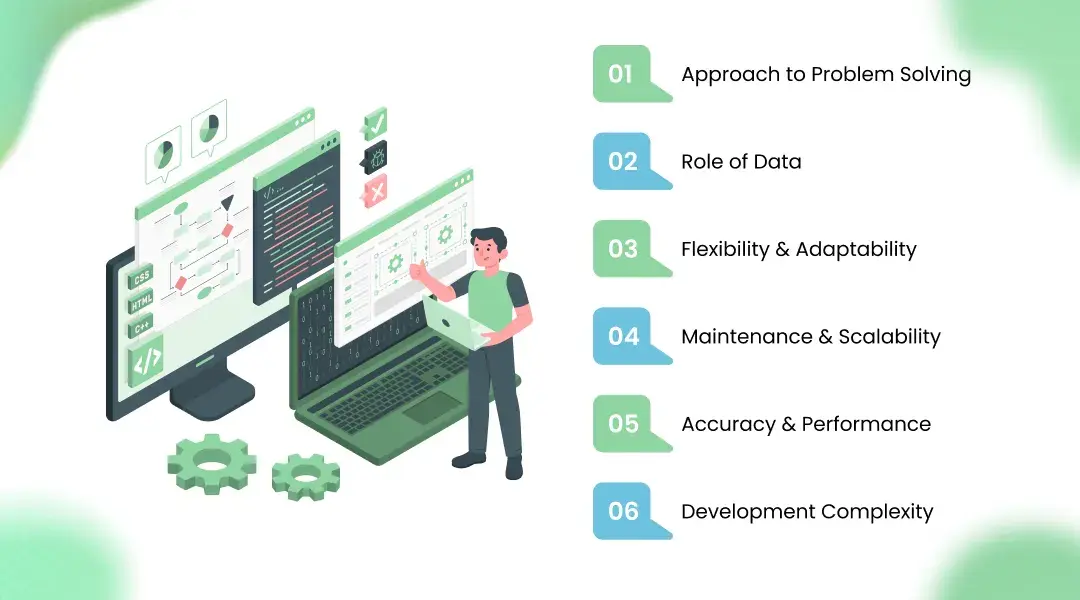
Traditional programming asks: “What are the rules?”
Machine learning asks: “What does the data say?”
If your problem can be written as clear instructions, go traditional. If not, consider ML.
In traditional systems, data is input.
In machine learning, data is the teacher.
No quality data? No results. Period.
I’ve seen companies blame ML for poor performance when the real issue was terrible datasets. Painful lesson.
Traditional systems break when new scenarios appear.
ML models adapt, if retrained.
That’s the advantage of machine learning. It evolves.
Traditional systems scale with infrastructure.
ML systems scale with data and retraining cycles.
And here’s the uncomfortable truth: ML maintenance is often underestimated.
Traditional programming is 100% predictable.
ML is probabilistic.
You’ll hear terms like “95% accuracy.”
That 5%? That’s where business risk lives.
AI vs traditional software development differs in complexity.
ML requires:
Data engineering
Model training
Evaluation metrics
Deployment pipelines
Traditional software requires:
Logic
Testing
Deployment
Different skill sets. Different costs.
Let’s respect it.
The advantages of traditional programming include:
Predictability
Easier debugging
Lower infrastructure cost
No dependency on large datasets
It works beautifully when rules are clear.
Now the advantages of machine learning:
Pattern recognition at scale
Automation of complex decision-making
Personalization
Continuous improvement
This is why machine learning for business is growing rapidly.
Because some problems are simply too complex for rules.
Use it when:
Business rules are clear and stable
Compliance requires full explainability
Data is limited
The outcome must be 100% deterministic
If you’re building payroll software, you don’t need ML.
Simple.
When to use machine learning?
Ask yourself:
Are patterns too complex to define manually?
Do outcomes depend on historical data trends?
Does the system need to improve over time?
If yes, ML might be appropriate.
Should my startup choose machine learning or traditional programming?
It depends on the problem—not the hype.
And please don’t build ML just to impress investors. I’ve watched that story end badly.
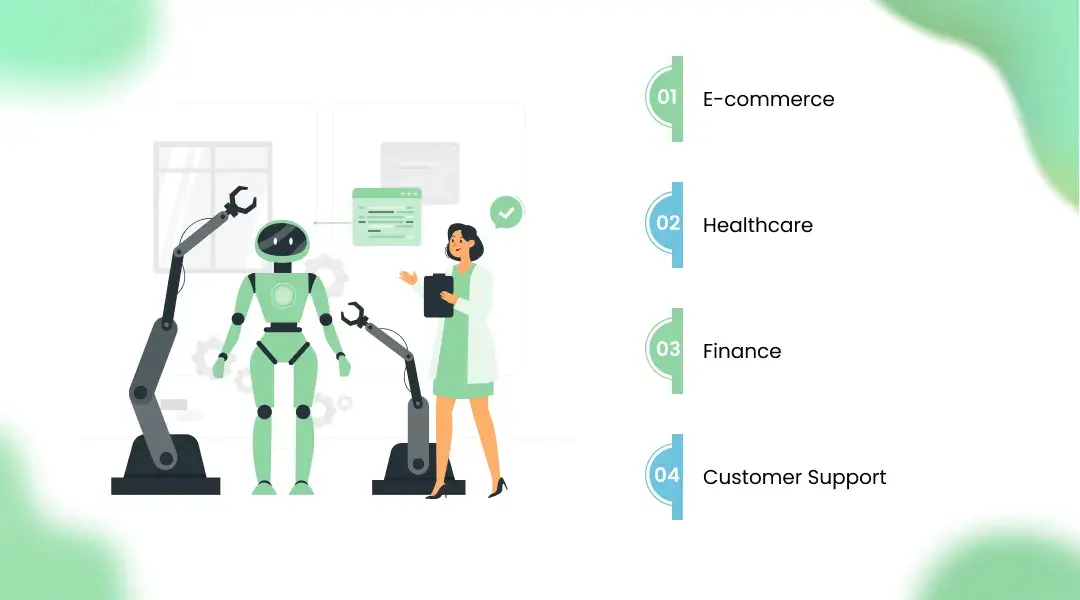
Product recommendations → ML Checkout process → Traditional programming
Medical image diagnosis → ML Patient billing → Traditional
Fraud detection → ML Transaction processing → Traditional
Chatbots with NLP → ML Ticket routing rules → Traditional
This hybrid approach is what we often implement at KriraAI. Not AI everywhere. AI where it matters.
That’s the mindset of a responsible AI development company and frankly, what separates serious firms from buzzword vendors. (If you’re evaluating partners, start there.)
Short answer?
No.
The future of machine learning in business isn't a replacement. It's a collaboration.
Traditional systems provide structure. ML provides adaptability.
Together, they create intelligent ecosystems.
Will ML reduce some coding tasks? Yes.
Will it eliminate traditional programming? Absolutely not.
Ask yourself this: Would you trust a bank system that guesses balances instead of calculating them?
Exactly.
The real debate around Machine Learning vs Traditional Programming isn’t technical.
It’s strategic.
Rule-based programming vs data-driven programming are tools.
The wrong choice wastes money. The right choice creates leverage, (not the buzzword kind, the actual ROI kind).
At KriraAI, we help businesses make that distinction carefully. Sometimes ML is necessary. Sometimes traditional architecture is smarter.
Clarity beats hype.
Always.
Traditional programming uses explicit rules written by developers, while machine learning learns patterns from data to make predictions.
Only if the problem has clear, rule-based logic. Complex pattern recognition usually requires ML.
Not always. It depends on whether the problem involves complex predictions or data patterns.
It struggles with dynamic, pattern-based problems and doesn’t improve automatically with new data.
Analyze the nature of your problem, data availability, compliance needs, and long-term scalability goals.
Founder & CEO
Divyang Mandani is the CEO of KriraAI, driving innovative AI and IT solutions with a focus on transformative technology, ethical AI, and impactful digital strategies for businesses worldwide.