I’ve sat in too many boardrooms where leaders stare at dashboards like they’re crystal balls.
Revenue graphs. Funnel charts. Forecast numbers with impressive decimals. And yet, decisions still feel like guesses.
Here’s the uncomfortable truth I’ve learned after a decade of building predictive systems: data doesn’t create clarity. Interpretation does. That’s where machine learning for predictive analytics earns its keep.
If you’re reading this, you’re probably wondering whether predictive analytics using machine learning is genuinely useful or just another shiny promise wrapped in technical jargon. Fair question. I was skeptical too, back when I was writing code instead of explaining it to CEOs.
So let’s slow this down. Strip the hype. And talk about what actually works in predictive analytics in business.
Predictive analytics is about answering one deceptively simple question:
“What is likely to happen next?”
It uses historical data, patterns, and statistical techniques to forecast future outcomes—sales, demand, churn, risk, or behavior. Not guarantees. Probabilities.
Think of it as business forecasting using machine learning instead of gut instinct.
At its core, predictive analytics solutions follow a repeatable loop:
Collect historical and real-time data
Identify patterns and relationships
Build models that estimate future outcomes
Validate predictions against reality
Improve continuously
Without machine learning analytics, this loop is slow, rigid, and fragile. With it? The system learns. Adjusts. Improves.
And that changes everything.
Traditional analytics asks: What happened? Machine learning asks: Why did it happen—and what’s next?
Traditional models rely on fixed rules. Machine learning in predictive analytics adapts as data evolves. That’s the difference between a static report and a living system.
I’ve seen businesses rely on spreadsheets for years—until market conditions shifted overnight. Their models broke. ML-based systems didn’t.
Machine learning models don’t “think.” They recognize statistical relationships at scale.
Thousands of variables. Millions of interactions. Patterns no human analyst could track consistently. This is predictive modeling in machine learning doing what it does best—finding signals in noise.
And yes, it improves over time. Quietly. Relentlessly.
Here’s where intelligent business growth with AI becomes real—not theoretical.
Machine learning for business intelligence transforms past behavior into forward-looking guidance. Sales data becomes machine learning for sales forecasting. Customer actions become churn predictions. Operational logs become risk alerts.
Suddenly, data-driven decision making isn’t reactive. It’s anticipatory.
Some of the most valuable AI-powered predictive analytics systems I’ve built operate in real time. Prices adjust. Inventory rebalances. Fraud triggers instantly.
(And yes—this is where leadership usually leans forward in their chair.)
Because decisions stop being delayed. And delay is expensive.
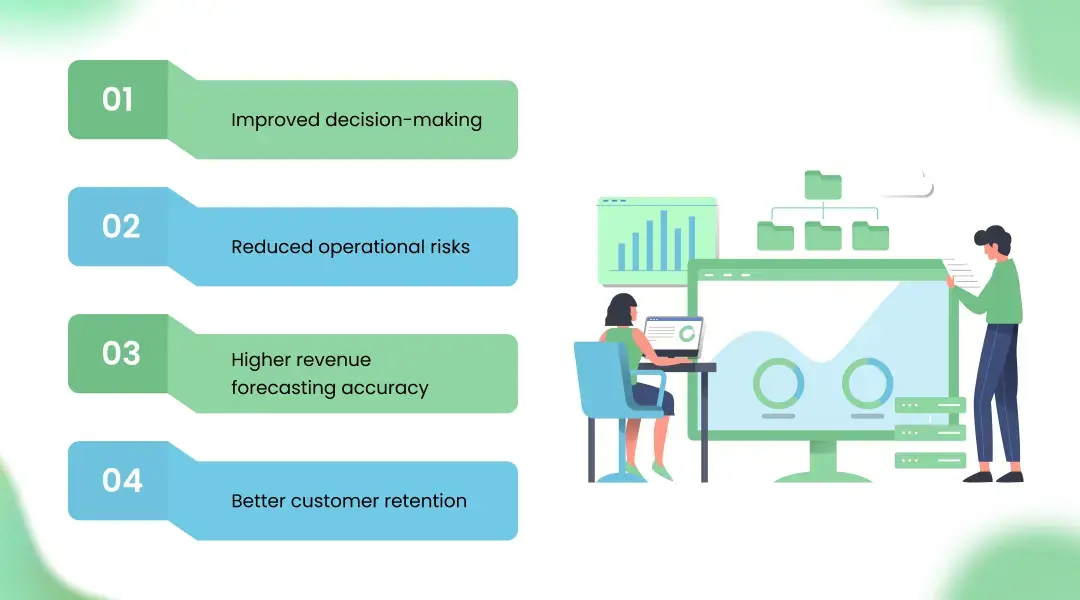
Let’s be specific. No grand promises.
Predictions backed by probability, not opinion.
Early warnings beat post-mortems. Every time.
Machine learning analytics consistently outperforms manual forecasting models—especially in volatile markets.
Predictive analytics use cases around churn routinely save companies millions by acting before customers leave.
If this sounds obvious, it should. Yet most businesses still rely on rear-view mirrors.
Machine learning for sales forecasting identifies seasonality, buying signals, and pipeline risks earlier than humans can.
Predictive analytics using machine learning flags disengagement patterns weeks in advance.
Overstock and stockouts are symptoms of poor prediction—not bad intent.
Classification models spot anomalies in milliseconds. Humans don’t.
Predictive analytics in business helps marketing teams spend less—and convert more—by targeting readiness, not demographics.
You don’t need to know the math. But you should understand the tools.
Used for numerical forecasting like revenue or demand.
Ideal for yes/no outcomes—fraud, churn, eligibility.
Critical for trend-based predictions over time.
Combines multiple models to reduce error and bias. Think “wisdom of machines.”
This is where experienced implementation matters. Choosing wrong here is costly.
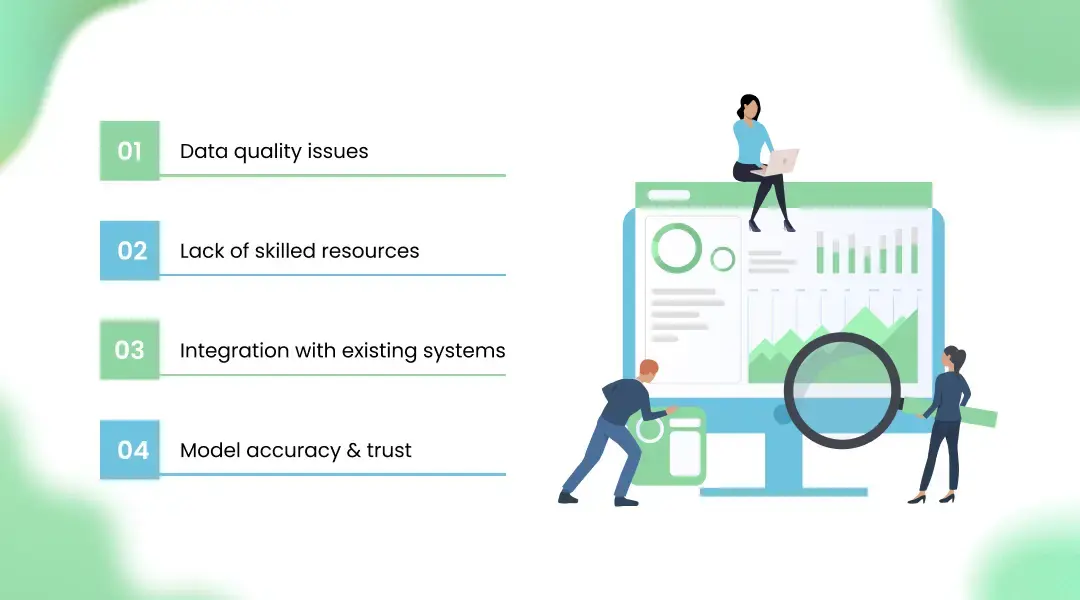
I’ve watched promising initiatives fail. Not because ML didn’t work, but because reality intervened.
Bad data poisons good models. No exceptions.
Tools don’t replace thinking. Teams do.
Predictions unused are predictions wasted.
If leaders don’t trust outputs, adoption stalls. Period.
This is why working with a proven machine learning company matters more than flashy demos. It’s also why businesses search for the Best AI development Company, not the loudest one.
Here’s the practical path I recommend, every time.
Start with a decision, not data. What do you want to predict and why?
Clean. Normalize. Validate. This step decides success.
Choose models aligned to business outcomes - not trends.
Prediction without action is theater. Monitor, retrain, iterate.
At KriraAI, this disciplined approach is why our systems survive real-world pressure—not just pilot phases.
Predictive analytics using machine learning isn’t magic.
It’s math, data, experience and restraint.
Done right, it becomes a quiet force behind confident decisions. Done poorly, it becomes expensive confusion. I’ve seen both.
If you remember one thing from this piece, let it be this: The value isn’t in prediction. It’s in preparation.
And preparedness is learnable.
Machine learning adapts to new data patterns automatically, improving prediction accuracy over time compared to static models.
Yes, when focused on clear business outcomes like forecasting, churn reduction, or risk mitigation.
Historical operational, customer, or transactional data with enough volume and consistency to reveal patterns.
Initial insights often appear within weeks; measurable ROI typically follows within 3–6 months.
Not initially. Strategic partnerships allow faster, lower-risk implementation.
Founder & CEO
Divyang Mandani is the CEO of KriraAI, driving innovative AI and IT solutions with a focus on transformative technology, ethical AI, and impactful digital strategies for businesses worldwide.