I’ve been building AI systems long enough to remember when simply saying “machine learning” could win a pitch.
Those days are gone.
Today, every second deck mentions generative AI services. Every second founder claims they’re an artificial intelligence agency. And every second business leader I speak to asks the same quiet question:
“How do I know who’s real?”
That’s the uncomfortable truth driving the future of AI agencies. Not technology speed. Not model releases. Trust erosion.
I work closely with CTOs, product heads, and enterprise leaders at KriraAI. And what I see is consistent: businesses aren’t confused about what AI can do anymore. They’re confused about who can actually deliver it responsibly, securely, and at scale.
AI agencies in 2026 will not survive on promises. They’ll survive on precision, accountability, and lived experience.
Let me show you how this shift is already unfolding.
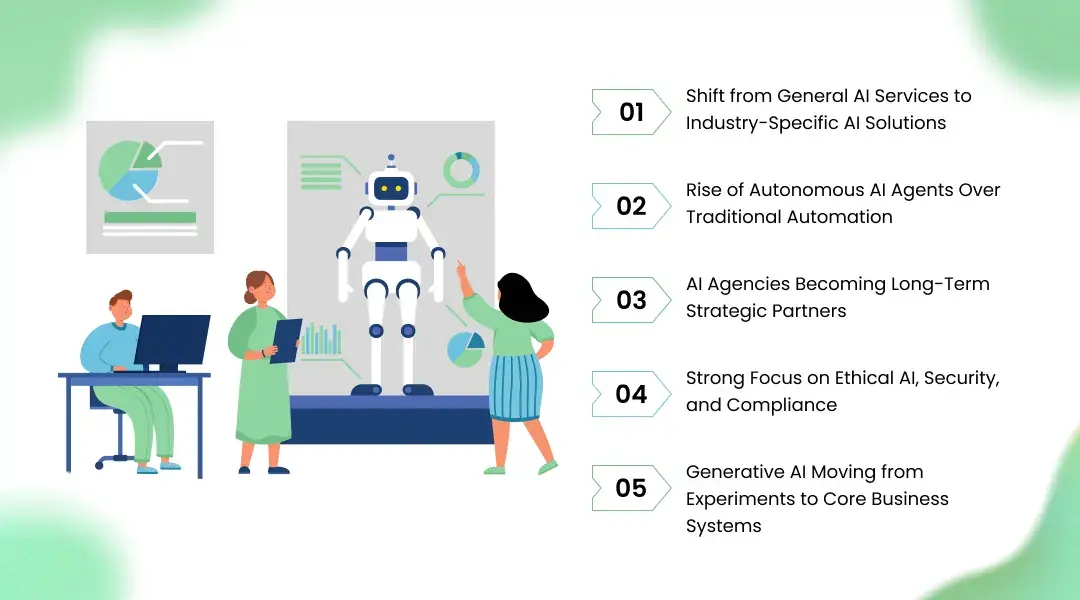
Here’s an unpopular opinion: Generalist AI agencies are becoming dangerously irrelevant.
I’ve seen companies burn months integrating “generic” AI development services that looked impressive in demos but collapsed in production. Why? Because business reality doesn’t care about abstract intelligence.
What’s replacing them are vertical AI agencies.
Agencies that understand healthcare workflows. Fintech compliance pressure. Retail inventory chaos. Manufacturing downtime economics.
Industry-specific AI solutions aren’t a branding trick. They’re a survival response.
When we design custom AI solutions for businesses, we don’t start with models. We start with constraints. Regulatory rules. Legacy systems. Human behavior. The messy stuff.
That’s why the future of AI agencies belongs to specialists who can speak business and code, without translation errors.
If an AI consulting agency can’t explain your industry risks before explaining their architecture, walk away.
Let’s clear something up.
Automation isn’t new. Scripts, bots, workflows, they’ve existed for years. But they follow instructions. They don’t think.
What’s changing everything is autonomous AI agents.
These systems don’t just execute tasks. They observe, decide, adapt, and act. In real time.
I’ve personally seen AI agents for business operations reduce response times, coordinate across systems, and make decisions humans simply can’t make fast enough. Not because humans are slow, but because context switching is expensive.
This is where AI automation agencies must evolve.
We’re moving from “if-this-then-that” logic to decision-making systems that understand outcomes. That shift demands deeper engineering, stronger AI integration services, and far more responsibility.
Quick question. Are you comfortable letting an AI make decisions that affect customers, money, or safety?
Because that’s exactly where things are headed.
Short-term AI projects are quietly dying.
I know. Some agencies won’t like hearing that. But the AI lifecycle doesn’t end at deployment. That’s where it begins.
Models drift. Data changes. User behavior mutates. Regulations evolve.
The future of AI agencies lies in long-term partnerships, not one-off builds.
We’re seeing a clear shift toward retainers, continuous optimization, and AI lifecycle management. Businesses want AI consulting for enterprises that stays accountable after launch.
At KriraAI, many of our strongest relationships started with a single use case and grew into multi-year collaborations. Not because we upsold. But because AI systems need stewardship.
If an AI product development agency disappears after delivery, that’s not a partnership. That’s abandonment.
Let me be blunt.
Any AI agency that treats ethics as a slide at the end of a pitch deck is a liability.
Ethical AI development isn’t theoretical anymore. It’s contractual. Legal. Reputational.
I’ve sat in boardrooms where AI governance and compliance mattered more than model accuracy. Because one data mishandling incident can erase years of trust.
This trend is reshaping AI consulting agencies into guardians, not just builders.
Responsible AI development now includes:
Transparent data usage
Bias detection and mitigation
Explainability
Security-first architectures
Compliance baked into design
The future of AI agencies will reward those who can say “no” when a client request crosses ethical or legal lines.
And yes, that sometimes costs deals. It also builds longevity.
Generative AI has had its honeymoon phase.
Cool demos. Internal experiments. Innovation labs.
That phase is ending.
Now comes the hard part: production.
In 2026, generative AI services will be embedded directly into workflows—customer support, internal knowledge systems, product design, analytics, and decision support.
Not as toys. As infrastructure.
This requires enterprise AI solutions that are stable, monitored, secure, and aligned with business outcomes. Not prompt experiments duct-taped into Slack.
I’ve seen companies fail here by rushing. And succeed by slowing down.
The AI agencies that win will treat GenAI like any other mission-critical system—with testing, governance, and human oversight.
No magic. Just discipline.
Let’s zoom out.
AI services industry trends point to one reality: AI agencies are becoming part of your operating system.
Choosing the wrong one won’t just waste money. It will slow teams, confuse customers, and create hidden risk.
The future of AI agencies favors:
Depth over breadth
Accountability over noise
Systems thinking over feature chasing
Businesses that understand this early will build durable AI advantages. Others will keep restarting pilots.
I’ll leave you with a practical checklist I personally use when evaluating AI partners.
Proven experience in your industry
Clear thinking around AI governance and compliance
Ability to explain trade-offs, not just features
Long-term engagement models
Comfort discussing failure as well as success
Overpromising timelines
Vague answers about data handling
No post-launch responsibility
Tool-first conversations without business context
If you’re looking for a Best AI development Company, look past awards and ask one simple question:
“What happens after go-live?”
The answer tells you everything.
The future of AI agencies isn't any louder. It’s quieter. More deliberate. More accountable.
AI agencies in 2026 will be judged not by what they claim, but by what they maintain, protect, and improve over time.
I’ve seen the difference firsthand. And I can tell you this with confidence:
The agencies that survive will feel less like vendors and more like partners who know your business almost as well as you do.
That’s the future worth building.
AI agencies will move toward industry-specific solutions, long-term partnerships, and responsible system ownership rather than short-term AI builds.
AI agents go beyond task execution by making contextual decisions, adapting in real time, and coordinating across systems.
Deeper accountability, ethical guidance, post-deployment support, and AI systems aligned with real business outcomes.
Because data misuse, bias, and security risks now carry legal, financial, and reputational consequences.
By evaluating industry expertise, governance practices, long-term commitment, and clarity around AI lifecycle management.
Founder & CEO
Divyang Mandani is the CEO of KriraAI, driving innovative AI and IT solutions with a focus on transformative technology, ethical AI, and impactful digital strategies for businesses worldwide.