I’ve spent a decade building AI systems for founders, CEOs, and business teams who just want one thing: clarity.
Not hype. Not magic. Not endless buzzwords.
They want to understand what actually happens between the moment they say, “We need AI,” and the moment the model is ready for deployment. And as someone who has personally built solutions for retail demand forecasting, fraud detection, voice automation, and workflow intelligence, I get why they’re confused.
AI can feel like a black box. A mysterious machine. A silent judge that decides things.
But here’s the truth I’ve learned after leading more than 40 AI projects at KriraAI: AI isn’t mysterious when you respect the process. The structure is what keeps projects from failing. The process is what turns chaos into clarity.
And yes, you’re about to see every step of that structure.
If you’ve ever built a house, you know there’s a sequence. Blueprint → Foundation → Bricks → Finishing → Maintenance.
AI works the same way.
The AI development lifecycle is a step-by-step workflow that takes you from identifying a business problem to deploying a working AI model and then keeping it healthy.
Think of it as the AI model development workflow that ensures things stay predictable, measurable, and business-aligned.
Let’s break it down without the technical fog.
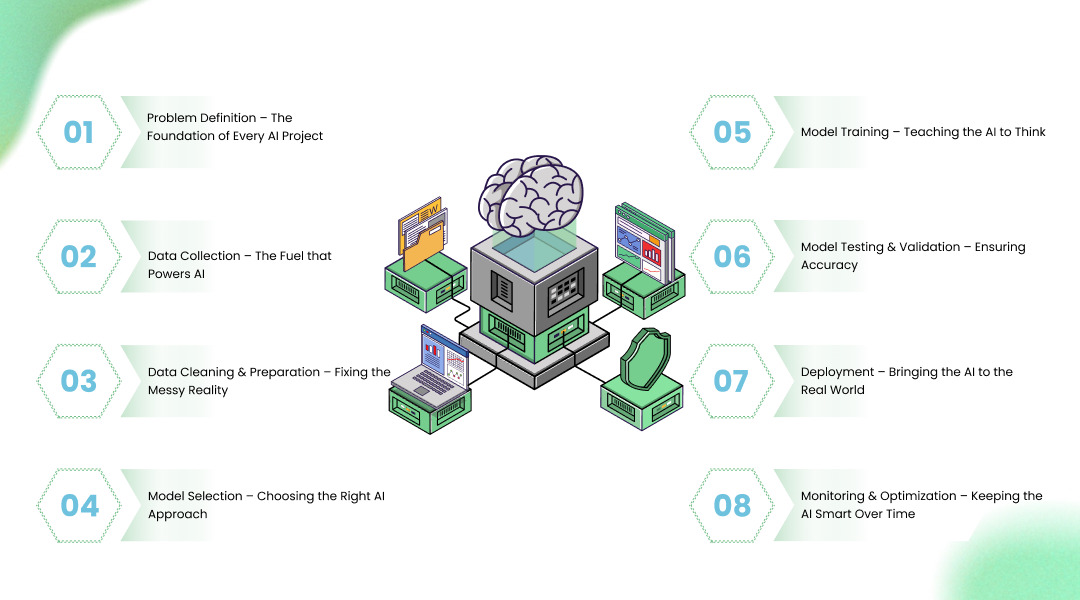
Here’s the question I ask every client within the first 10 minutes:
“Are you solving the right problem?”
Most businesses aren’t. They jump to models before understanding what they’re actually trying to fix.
My job as a Senior AI Consultant is to decode this. I map the business pain → convert it into an AI objective → convert that into measurable outcomes.
Examples:
Reduce customer wait time using AI Chatbots
Predict inventory shortages
Validate documents automatically
Build multilingual voice automation (yes, including projects linked to our AI Voice Agents Company)
A clear problem definition is the difference between a model that works and a model that becomes a very expensive pet project.
Let me ask you something directly: Do you actually have the data needed for AI?
Most companies hesitate. Some panic. A few pretend.
Data is the oxygen of AI development. No oxygen, no breathing. No data, no model.
This stage includes:
Gathering existing business data
Creating new datasets
Collecting user interactions
Integrating APIs and external sources
A founder once asked me, “Can’t we just build the model first and add data later?” My response: “Only if you want the model to be a storyteller instead of a truth-teller.”
Let me confess something: Data is almost always a mess. A beautiful, chaotic mess.
Duplicate entries. Missing labels. Half-written names. Strange anomalies that no one can explain.
I’ve seen it all — from retail stores labeling an entire month of orders as “test” to logistics companies recording distances as “very far.”
Data cleaning includes:
Removing errors
Handling missing values
Normalizing formats
Feature engineering (this is where the magic of insight happens)
This step isn’t glamorous. It’s not flashy. But it’s where real accuracy begins.
People think AI developers have one favorite model we use everywhere. Nope.
Choosing a model is like choosing the right tool for surgery - precision matters.
Depending on the problem:
Classification models
Regression models
NLP models
Vision models
Generative AI models
Hybrid architectures
At KriraAI, we never pick a model because it’s trendy. We pick what solves the business problem with the least complexity and the highest reliability.
A client once asked me, “Why not use the fancy stuff?” Because fancy doesn’t feed ROI.
This is where the machine learns patterns. Where it imitates judgment. Where it begins to “think.”
Now, I’m using “think” loosely - AI doesn’t feel or understand. It identifies patterns from statistical truth.
Model training involves:
Feeding the prepared dataset
Tweaking parameters
Running training cycles
Improving accuracy step by step
Here’s a moment where founders love to peek over my shoulder and ask, “Is it ready?”
My answer is always the same: “Training is a journey, not a button.”
Ever met an AI model that looked perfect inside the lab but fell apart in real life? Yeah, me too.
Testing prevents that.
We test for:
Accuracy
Precision
Recall
Bias
Real-world unpredictability
This stage is where the model proves it can survive outside its comfort zone. If it can’t, we go back and fix it - no shortcuts.
Deployment is where things get real. It’s where your model leaves the training environment and begins working inside your business.
Deployment methods include:
APIs
Cloud platforms
Mobile apps
Web applications
On-premise systems
This is also when teams often ask if they should “Hire AI Developer” full-time or rely on us for managed deployment. It depends, but most mid-sized businesses prefer managed support.
Deployment is not the end. It’s the ignition.
AI decays. It ages. It gets outdated.
Why? Because the world changes and the data changes.
Monitoring includes:
Tracking predictions
Measuring drift
Refining the model
Updating datasets
Improving performance
Think of this as continuous fitness training for your model - otherwise, it gets slow and sloppy.
Across projects, I’ve used a mix of:
Python
TensorFlow, PyTorch
FastAPI
LangChain
SQL & NoSQL DBs
AWS, GCP, Azure
Docker & CI/CD
Rasa for conversational workflows (especially for clients wanting Best AI Voice Agent Solutions)
Tools change. Principles don’t.
Let me be blunt. AI projects fail when teams:
Start without a clear business problem
Expect instant miracles
Have weak or noisy data
Underestimate testing
Skip post-deployment maintenance
The AI implementation process isn’t complicated, it’s just misunderstood.
When the workflow is done right, something incredible happens:
Predictable project timelines
Higher model accuracy
Reduced development rework
Faster deployment
Better ROI
Minimised operational risk
In short: structure saves money.
If there’s one thing I want you to walk away with, it’s this: AI isn’t magic. AI is a method.
The AI development lifecycle, from problem definition to monitoring - is the map. When you follow the map, the destination becomes predictable. That’s why every successful AI project I’ve led at KriraAI wasn’t built on guesswork. It was built on clarity, collaboration, and respect for the process.
If your business is planning to build AI - start with the process, not the model.
Typically 6–12 weeks depending on data quality, complexity, and deployment needs.
Most business-grade AI projects range based on scope, dataset size, and features.
Not always. Some models work with smaller datasets or generated datasets.
Only if your problem involves content, voice, automation, or decision patterns that benefit from generative patterns.
Monitoring, updates, optimization, and continuous improvements to keep the model accurate.
Founder & CEO
Divyang Mandani is the CEO of KriraAI, driving innovative AI and IT solutions with a focus on transformative technology, ethical AI, and impactful digital strategies for businesses worldwide.