I’ve sat in too many boardrooms where someone says, “We need digital transformation,” and everyone nods like they agree.
But ask what that actually means?
Silence.
Over the past eight years at KriraAI, I’ve helped companies move from scattered automation experiments to structured AI-powered digital transformation strategies. Some succeeded. Some burned money chasing buzzwords.
Here’s the truth: AI development solutions are not about technology. They’re about decision-making, efficiency, and long-term survival.
And if you’re reading this, you’re probably wondering: Is this worth it for my business?
Let’s talk honestly.
At its core, AI development solutions are structured implementations of artificial intelligence designed to solve real business problems.
Not experiments. Not hype. Solutions.
In practice, I work with four major categories:
AI automation for business – Intelligent automation solutions that reduce manual workflows.
Machine learning in digital transformation – Predictive analytics and forecasting models.
Natural Language Processing (NLP) – Chatbots, sentiment analysis, document automation.
Computer Vision – Image recognition, defect detection, medical imaging analysis.
When businesses ask about artificial intelligence solutions for business, they usually think about chatbots.
But that’s surface-level thinking.
True enterprise AI solutions integrate deeply into ERP systems, CRMs, cloud platforms, and analytics pipelines. They shift how decisions are made.
That’s the difference between tools and transformation.
Digital transformation in 2015 meant digitizing paperwork.
In 2020, it meant cloud migration.
In 2026? It means intelligence embedded into every operational layer.
Digital transformation using AI is no longer optional for enterprises competing globally. Business models are now technology-driven, data-dependent, and algorithm-informed.
If your systems can’t learn from data, predict outcomes, or automate decisions, you’re operating at a disadvantage.
And competitors won’t wait.
Let me be blunt.
Without AI, digital transformation stalls at automation.
With AI, it becomes optimization.
Here’s the role of AI in digital transformation in practical terms:
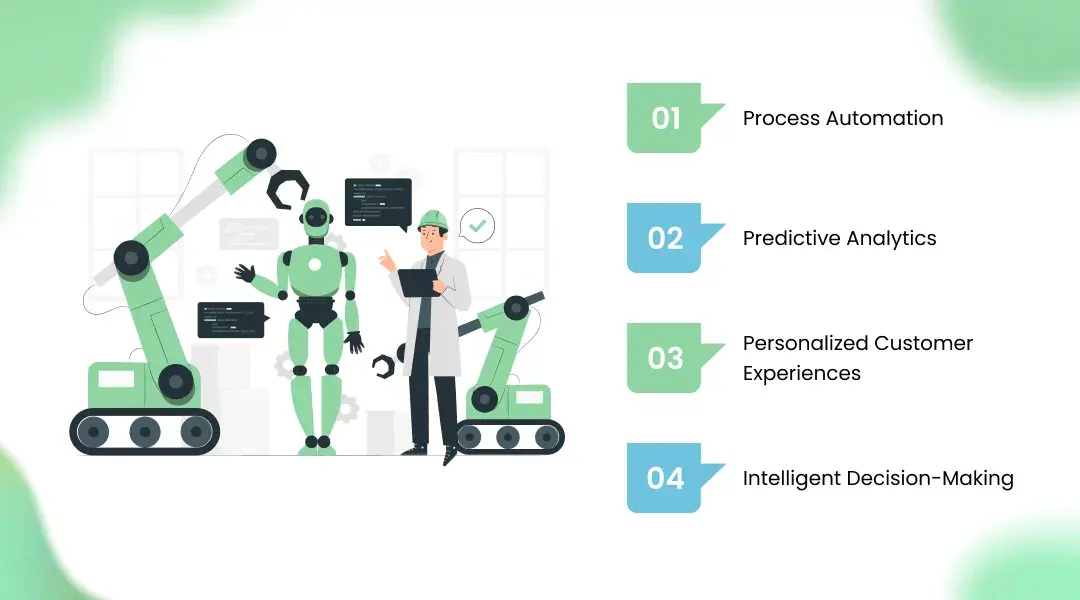
AI automation for business eliminates repetitive, rule-based tasks. Think invoice processing, inventory monitoring, compliance checks.
Data-driven decision making with AI changes leadership behavior. Instead of reacting to quarterly reports, companies predict demand, churn, or risk in real time.
Retail and fintech clients I’ve worked with increased engagement by deploying machine learning in digital transformation workflows that personalize offers dynamically.
This is where AI-powered digital transformation becomes strategic. AI systems recommend pricing strategies, production adjustments, or risk mitigation steps.
Have you ever made a decision knowing the data was incomplete?
That feeling of uncertainty?
AI reduces that gap.
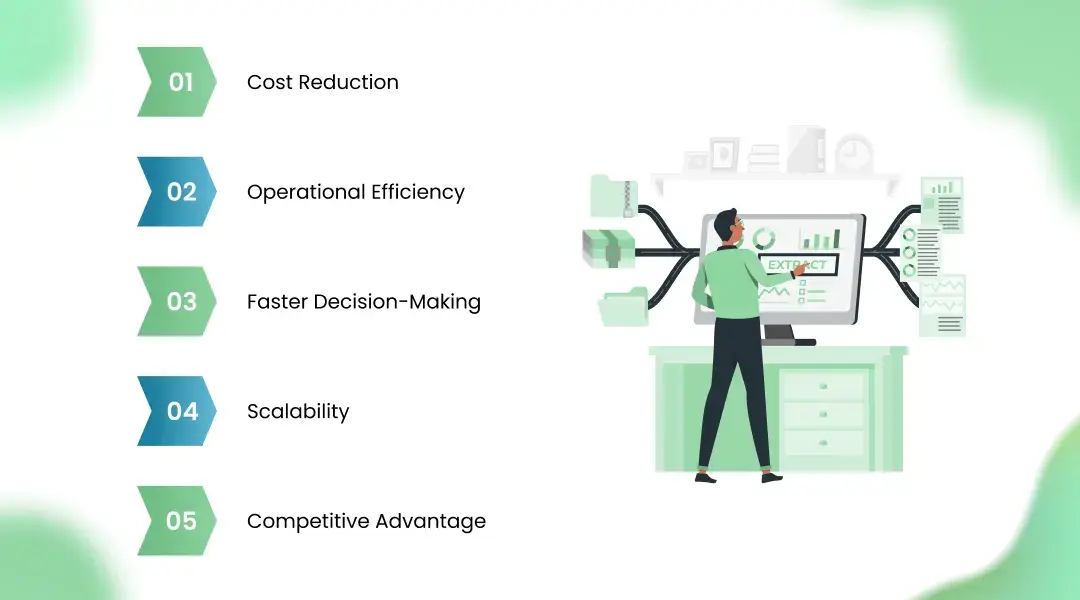
The benefits of AI in business transformation are measurable.
Not theoretical.
Automation reduces labor-intensive processes.
Enterprise AI solutions improve throughput and minimize bottlenecks.
AI software development services enable real-time analytics dashboards integrated into executive systems.
AI models don’t get tired. They scale horizontally in cloud-based AI systems.
AI-driven business growth comes from faster adaptation to market signals.
One manufacturing client reduced quality control errors by 32% after implementing computer vision. That wasn’t marketing. That was data.
Let’s ground this.
Predictive diagnostics and AI-powered triage systems improve patient prioritization.
Fraud detection models analyze transaction anomalies in milliseconds.
Recommendation engines personalize shopping journeys dynamically.
Computer vision identifies production defects instantly.
AI transformation strategy in logistics optimizes route planning and fuel consumption.
These aren’t pilot projects. These are operational systems.
Here’s where most companies fail.
They buy software instead of building strategy.
AI development services must align with enterprise architecture. At KriraAI, we approach this in three layers:
Custom AI implementation tailored to business workflows.
Cloud-based AI systems for scalability.
Integration with legacy infrastructure to avoid operational disruption.
Choosing a custom AI development company is not about price. It’s about alignment.
And yes, if you’re researching the Best AI development Company, evaluate case studies, transparency, and technical depth—not flashy claims.
Let’s shift tone for a moment.
AI transformation strategy sounds clean on slides. In reality, it’s messy.
Garbage data destroys AI outcomes.
Initial deployment requires infrastructure and expertise.
AI consulting services often need to train internal teams.
Bias, compliance, transparency. Real issues. Not theoretical ones.
I’ve personally paused deployments when data integrity was questionable. Because rushing AI into production damages trust faster than it builds efficiency.
Trust matters.
So how do you move forward?
Here’s my practical framework:
Without clean data, digital transformation using AI fails.
Are you reducing cost? Increasing retention? Improving forecasting?
Small wins build organizational confidence.
Look for expertise in AI software development services and enterprise AI solutions.
Track cost savings, operational efficiency, and AI-driven business growth metrics.
What is the ROI of AI in digital transformation projects?
It depends on execution. But when aligned correctly, I’ve seen ROI within 12–18 months.
The future of AI in digital transformation is shifting from support systems to autonomous systems.
Self-operating systems capable of managing workflows independently.
Intelligent automation solutions connecting multiple enterprise systems without manual intervention.
Organizations where data-driven decision making with AI operates continuously, not periodically.
This isn’t science fiction.
It’s already emerging in logistics and fintech sectors.
And if you’re hesitating, ask yourself:
Will your competitors wait for you to feel comfortable?
AI in digital transformation is not about chasing trends.
It’s about survival. Growth. Adaptation.
AI development solutions, when implemented strategically, reshape operations, decision-making, and customer engagement.
But success requires clarity.
Not hype.
If you’re serious about AI-powered digital transformation, start with strategy. Then execution. Then iteration.
That’s how transformation becomes sustainable.
They automate processes, enable predictive analytics, and enhance decision-making using structured AI implementation aligned with business goals.
ROI depends on use case and execution quality, but cost savings and operational efficiency gains typically appear within 12–18 months.
Evaluate technical depth, industry experience, transparency, and ability to integrate AI into existing enterprise systems.
Data quality issues, implementation costs, skill gaps, and ethical concerns are the primary barriers.
Yes. AI is central to modern digital transformation strategies, enabling intelligent automation and scalable growth.
Founder & CEO
Divyang Mandani is the CEO of KriraAI, driving innovative AI and IT solutions with a focus on transformative technology, ethical AI, and impactful digital strategies for businesses worldwide.