Picture a Monday morning in 2028. A marketing manager at a mid-sized retail company sits down at her desk. Before she had finished her first coffee, her AI assistant had already reviewed the weekend's sales data, drafted three campaign ideas based on what worked last quarter, flagged a competitor pricing change it detected overnight, and prepared a one-page brief on which customer segment is most likely to respond to a summer promotion. She did not ask for any of this. The system learned what she needed before her week started and delivered it, the way a brilliant analyst would after working with her for three years.
She does not spend her morning pulling data from spreadsheets. She does not write the first draft of the campaign brief. She does not search through last quarter's reports to find the relevant numbers. All of that is done. Her morning is now entirely about judgment, creativity, and decision-making. Should the campaign focus on loyal customers or new acquisitions? What tone fits the brand this season? Which idea has the kind of energy that will make people stop scrolling? Those are the questions only she can answer, and those are the questions she spends her morning answering.
This is not a scene from science fiction. It is a reasonable, grounded description of a workplace that is already beginning to take shape in 2025 and will be fully recognisable across most industries by 2028 to 2030. The tools that will make this possible are being built and tested right now, as detailed in our analysis on the Future of Work with AI Agents. The companies that are experimenting with these approaches today are seeing real productivity gains and are learning, in real time, what human work looks like when routine cognitive tasks are handled by AI systems.
Understanding how AI will change your job and partnering with technology leaders like KriraAI are two of the most important things you can do for your career, your business, and your financial security over the next five years. This blog is not about whether AI will affect work. That question has already been answered. The question worth understanding now is how it will affect your specific work, what the realistic timeline looks like, which parts of your job will shift and which will matter more than ever, and what you can do today to make sure you are on the right side of the change.
This blog covers the honest, grounded answer to all of those questions. It is written for professionals, business owners, and curious readers who want a clear picture of what is coming, without technical jargon and without either panic or false reassurance.
To understand where we are going, it helps to understand precisely what is already happening, not in research labs or technology conferences, but in ordinary workplaces across industries right now.
AI systems today can read large volumes of text and produce accurate summaries, draft emails and documents, analyse data and surface patterns, answer customer questions through chat, generate images and marketing copy, review legal and financial documents for standard issues, write and check code, and handle scheduling and administrative tasks. Each of these capabilities, on its own, is modest. Together, they represent something significant: AI can now handle a large portion of the routine cognitive work that fills the average professional's day.
Research from multiple workforce studies conducted between 2023 and 2025 consistently finds that between 25 and 40 percent of the tasks in most white-collar jobs involve producing first drafts, summarising existing information, formatting documents, answering routine questions, or processing standard requests. These are the tasks that consume time and attention without necessarily requiring the kind of judgment, creativity, relationship skills, or contextual understanding that humans bring at their best.
These tasks are shifting now. They are not shifting overnight, and they are not eliminating jobs overnight. They are being absorbed by AI systems in the same way that spreadsheets absorbed manual bookkeeping in the 1980s and 1990s. The people who understood what spreadsheets could do were not replaced by the spreadsheet. They became more productive, and the nature of their work shifted toward interpretation and decision-making rather than calculation.
One of the most important distinctions a professional can understand right now is the difference between task automation and job elimination. These are not the same thing, and confusing them leads to either unnecessary panic or unnecessary complacency.
When AI handles the first draft, the analyst who used to write that draft does not disappear. The analyst's time frees up to do the work that actually requires an analyst: asking the right questions, interpreting results in the context of the business, understanding what the data does not show, and translating findings into decisions. The job does not disappear. The job evolves, often in a direction that requires more skill and delivers more value, not less.
Job elimination is a real risk in specific categories of work: highly routine, highly standardised, low-complexity tasks that do not require contextual judgment. Data entry, basic document processing, certain categories of customer service scripting, and some administrative coordination roles face genuine displacement pressure. But across the broader landscape of professional work, the more likely outcome is job transformation rather than job elimination, especially for people who understand what is happening and adapt accordingly.
How AI will change your job is not a single event arriving on a fixed date. It is a progression with identifiable stages, each of which creates different pressures, opportunities, and preparation requirements. Here is an honest, grounded timeline based on observable trends and the pace of current development.
The period we are entering right now is characterised by rapid adoption of AI tools across industries. Companies that were experimenting cautiously with AI in 2023 and 2024 are now deploying these tools at scale. The primary driver is economic: AI systems that handle routine cognitive tasks cost a fraction of human labour for those specific tasks, and the quality has reached a threshold where it is genuinely useful rather than merely impressive.
During this phase, the most visible change will be in how individual professionals work. AI writing assistants will become as standard as spell-checkers. AI data analysis tools will be embedded in the software analysts already use. AI customer service systems will handle the first layer of every customer interaction before a human professional steps in for complex or sensitive cases. Professionals who have not yet integrated these tools into their daily work will begin to feel a productivity gap compared to colleagues who have.
For businesses, 2025 and 2026 are critical decision years. The companies that start understanding how to integrate AI tools into their operations now, not just for efficiency but for the new kinds of work they enable, will build a meaningful advantage that compounds over the following three years.
By 2027, enough organisations will have been using AI-assisted work processes for long enough that the evidence will be clear: some roles need to be fundamentally redesigned, not just augmented with new tools. This is the phase where job titles, job descriptions, team structures, and performance expectations begin to shift in substantial ways.
The customer service manager of 2027 will not be managing a team of agents answering routine queries. Those queries will be handled by AI. The manager will be overseeing a much smaller team of highly skilled human agents who handle complex, emotional, or escalated situations, while also overseeing the performance and quality of the AI systems. The job still exists. It looks quite different.
The financial analyst of 2027 will not spend weeks building models and gathering data. Those tasks will be handled in hours by AI systems. The analyst will spend their time on scenario interpretation, stakeholder communication, and the kind of forward-looking judgment that requires understanding both the numbers and the business context that the numbers cannot capture.
This phase will also be the period of greatest disruption for workers who have not adapted. Companies that redesign roles will naturally retain the people who have developed the human skills that complement AI rather than compete with it.
By 2030, the integration of AI into professional work will be complete enough that it will no longer feel like a transition. It will simply be the way work is done, in the same way that internet-connected computers no longer feel like a technology layer but simply like the environment of work itself.
Professionals who entered the workforce during this period, or who successfully adapted, will find a working environment where their highest-value human skills are more in demand than ever, because those skills will be the one thing that AI cannot replicate at scale. Leadership, judgment in ambiguous situations, creative problem-solving, deep customer relationships, ethical reasoning, and the ability to inspire and motivate other people will be the capabilities that define career success.
By 2030, it is reasonable to expect that productivity per professional in most knowledge-work industries will be 40 to 60 percent higher than in 2024, driven primarily by AI augmentation of routine cognitive tasks. This is not speculation. It follows the same trajectory seen in previous technology waves, and the current pace of AI capability development strongly supports it
Abstract predictions about the future of work are less useful than concrete pictures of what is actually coming in specific fields. Here is what the transformation looks like across the industries where the impact will be most significant and most visible between now and 2030.
Healthcare professionals today spend a significant portion of their working hours on documentation, administrative tasks, and information retrieval. A primary care physician operating without modern healthcare technology solutions spends between 30 and 50 percent of their working day on tasks that do not involve direct patient care: writing up notes, reviewing records, filling out forms, and searching for information.
AI will absorb almost all of this administrative burden before 2030. Ambient listening systems that turn doctor-patient conversations directly into structured medical notes are already in early deployment and will be standard by 2027. AI systems that can review a patient's full medical history and surface relevant information before the doctor enters the room will be widespread by 2028. The physician of 2029 will spend the vast majority of their working day doing the one thing AI cannot do: building the trust and understanding that is the foundation of effective healthcare, and making the nuanced human judgments that determine treatment choices when the right answer is genuinely uncertain.
Nursing will shift similarly. Much of the documentation and routine monitoring work that occupies nurses today will be handled by AI-connected systems. Nurses will refocus on the aspects of care that require physical presence, emotional attunement, and the kind of contextual judgment that develops over years of clinical experience.
The legal industry has a structural peculiarity that makes it particularly susceptible to AI transformation: a large proportion of billable hours in law firms today are charged for work that is fundamentally information retrieval and document processing. Junior lawyers and paralegals read through hundreds of documents to find relevant precedents, check contracts for standard clauses, and draft routine agreements from established templates. This work is expensive because humans do it slowly. AI can do most of it in minutes.
By 2027, the majority of legal document review, contract drafting, and case research will be handled primarily by AI systems, with human lawyers reviewing and approving rather than producing. This will compress the entry-level legal career path significantly. The junior lawyer of 2028 will need to develop judgment, advocacy, and client relationship skills far earlier in their career than was previously required, because the research-heavy work that traditionally filled junior years will no longer exist at the same scale.
Senior lawyers will find that their most valuable skills are more in demand than ever. The ability to understand a client's situation deeply, to construct an argument that accounts for human and strategic factors beyond the written law, and to navigate complex negotiations where relationships and context matter as much as legal knowledge: none of that is going away. It is becoming more central.
Marketing is already experiencing the early stages of its AI transformation, and the direction is clear. By 2026, almost every marketing team in every industry will be using AI to produce first drafts of copy, analyse campaign performance, segment audiences, and personalise communications at scale. The question will no longer be whether to use AI for these tasks. It will be whether the people in the marketing team have the judgment to direct the AI well and the creativity to push beyond what the AI produces on its own.
The future marketing professional is less a writer or analyst and more a creative director and strategist. Their value comes from having the taste, cultural understanding, and brand sensibility to know what the AI should make and what it should not, to recognise when AI output is technically competent but emotionally flat, and to bring the human insight that turns good marketing into genuinely memorable communication.
By 2028, the most valuable marketing professionals will be those who can work seamlessly with AI tools, directing them effectively, editing with strong creative judgment, and identifying the opportunities that AI optimisation alone would never find.
Accounting and finance are industries where a very large proportion of work involves structured data processing, pattern recognition in numbers, and the production of standard reports. These are precisely the kinds of tasks that AI handles extremely well. By 2027, AI systems will be handling the production of most standard financial reports, the initial review of financial statements, the detection of anomalies and discrepancies, and the modelling of standard financial scenarios.
The finance professional of 2029 will spend far less time building spreadsheets and far more time doing what the numbers require to be genuinely useful: explaining what they mean to people who need to make decisions based on them. The accountant becomes a trusted advisor. The financial analyst becomes a strategic interpreter. The value is not in producing the numbers but in understanding them deeply enough to guide good decisions.
This is an upgrade in the nature of financial work, not a downgrade. But it does require a shift in skills and in how finance professionals think about their own value. Those who define their worth by their technical ability to manipulate data will face pressure. Those who define their worth by their judgment and their ability to translate data into business insight will thrive.
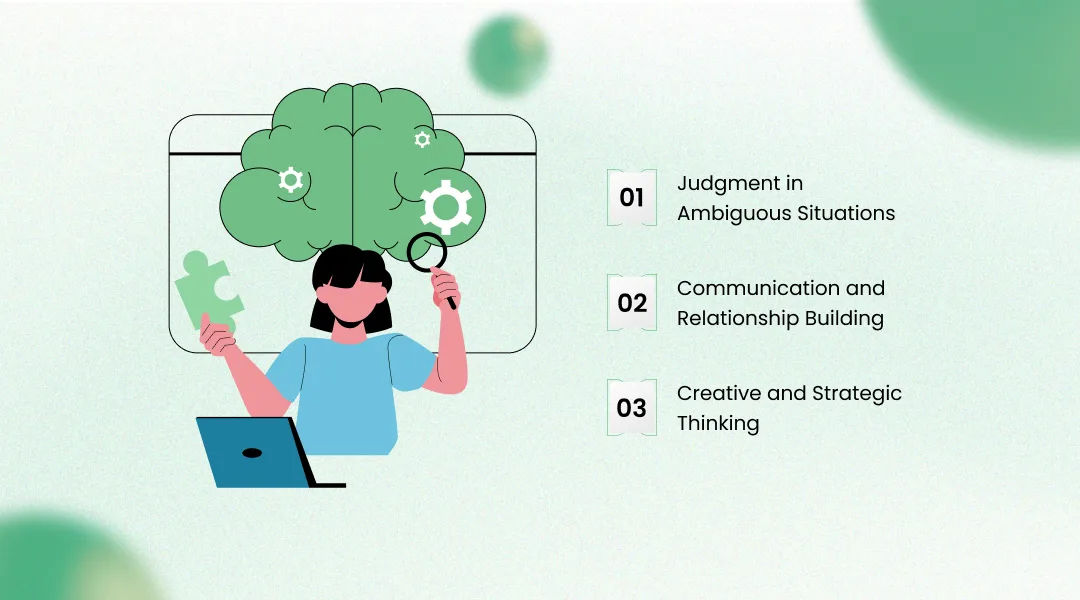
Understanding what AI will handle is only half of what you need to know. The other half is understanding which human capabilities will become more valuable, more central, and more rewarded as AI absorbs the routine cognitive work that currently fills most professional days.
AI systems are very good at tasks where the right answer can be determined from patterns in existing data. They are genuinely limited in situations where the right answer requires weighing factors that have never been systematically recorded, understanding the specific human context of a situation, and making a decision when no established pattern clearly applies. This is exactly what human professionals are asked to do at their most valuable and most consequential moments.
The ability to make good decisions when the situation is genuinely unclear, when the stakes are high, and when multiple legitimate values are in tension is a human capability that will become more important, not less, as AI takes over the routine decisions that currently occupy a large portion of professional time. By 2030, professionals who have consciously developed their judgment in complex situations will command a significant premium.
AI can produce technically accurate, well-structured written communication. It cannot build genuine trust with another person. The ability to understand what another human being actually needs, to communicate in a way that makes them feel genuinely heard and respected, and to build the kind of relationship where difficult conversations are possible and productive: this remains entirely human territory.
Sales, leadership, healthcare, education, law, and every other field where human outcomes depend on human relationships will continue to reward communication and relationship-building skills heavily. In fact, as AI handles more of the transactional and informational communication in these fields, the purely human relationship dimension will become a clearer differentiator.
AI is a powerful tool for creative production. It can generate many variations on a theme quickly; it can combine existing ideas in new configurations, and it can produce competent creative work at scale. What AI cannot do is decide which creative direction is worth pursuing, bring the fresh perspective that comes from genuine human experience, or develop the strategic vision that requires understanding a complex situation in its full human context.
By 2028, the professionals who use AI as a creative amplifier, directing it effectively and editing its output with strong creative judgment, will outperform both the professionals who refuse to use AI and the professionals who simply accept whatever AI produces. The creative skill that matters is not just having ideas. It is knowing which ideas are genuinely good and why.
For small business owners and entrepreneurs evaluating broader shifts, such as How AI Will Change Small Business in the Next Five Years, the AI transformation of work creates an opportunity that did not exist five years ago and that will be fully available within the next two to three years. That opportunity is this: AI capabilities that were previously affordable only to large enterprises with significant technology budgets will become accessible to businesses of any size.
The small accounting firm that previously could not afford a research and analysis team will have AI tools that provide that capability. The independent marketing consultant who previously could not produce content at scale will have AI tools that amplify their output dramatically. The small retailer who previously could not afford sophisticated customer segmentation and personalisation will have AI systems that provide it at low cost.
This is a genuine levelling force for small businesses. But it only creates an advantage for the business owners who understand it well enough to use it strategically, not just to save costs but to deliver better outcomes for their customers.
By 2027, a small business that is operating with effective AI augmentation will have the operational productivity of a business significantly larger in headcount. The businesses that understand this and build toward it now will be competing from a fundamentally stronger position. KriraAI works directly with businesses of all sizes through strategic AI consultancy services to build these practical AI-augmented systems, focusing on the outcomes that matter to the specific business rather than on technology for its own sake.
The risk for small businesses is not that AI will be used against them by large competitors. The larger risk is that they delay understanding and adopting it long enough that the productivity and quality gap with AI-augmented competitors becomes very difficult to close.
Any honest guide to how AI will change your job has to address the concerns that professionals and business owners genuinely have. These are not fears to be dismissed. They are legitimate questions that deserve specific, grounded answers.
For most professional and knowledge-work roles, the honest answer is no, your specific job will not disappear before 2030, but its nature will change substantially. The jobs that face the highest risk of genuine elimination are those built almost entirely around tasks that AI can now handle: data entry, basic document processing, first-level customer service scripting, and certain administrative coordination functions.
For the vast majority of professional roles, the more accurate picture is evolution rather than elimination. The work changes, the skills required shift, and the productivity expectations rise. This is not painless. But it is navigable, and the people who navigate it successfully will generally find themselves doing work that is more interesting and more valued than what they were doing before.
Over the medium term, the professionals who adapt and develop the human skills that complement AI will earn more, not less, because those skills become relatively scarcer and relatively more valuable. The professionals who do not adapt may face genuine downward pressure on earnings, particularly if their current role is heavily weighted toward tasks that AI handles well.
The business owner who asks this question from a business perspective has a different calculation to make. AI augmentation of professional work will create cost savings in some areas and require investment in others, particularly in the upskilling of people whose roles are changing. The net economic effect for most businesses that manage this transition well will be positive.
Yes. The pace of change between 2025 and 2028 will be faster than most professionals currently expect. The gap between professionals who are actively developing AI-complementary skills and those who are not will be clearly visible in the job market by 2027. The time to start building the skills and understanding that will matter is not when the change is already complete. It is now, while the transition is still early enough that early movers gain a real advantage.
KriraAI consistently finds, in its work with businesses across industries, that the organisations that engage with AI transformation early are not just better prepared. They are also better positioned to influence how that transformation happens within their specific context, rather than simply responding to changes their competitors are already implementing.
Preparation for the AI-driven transformation of work is not primarily about learning to code or becoming a technical expert. It is about developing the right mix of human skills and practical AI tool fluency that will make you effective in the workplace of 2028.
For professionals in any industry, the preparation priorities are:
Identify which tasks in your current role involve producing first drafts, summarising existing information, or processing standard requests. These are the tasks that AI will most directly affect in your role, and building your AI tool fluency around these specific tasks first gives you the most immediate productivity benefit.
Invest deliberately in the human skills that AI cannot replicate: judgment in complex situations, communication and relationship building, creative and strategic thinking. Seek out the parts of your work that require these skills and do them with more intentionality, because they will become your primary value proposition.
Spend time learning how to direct AI tools effectively. The most productive professionals in 2028 will not be the ones who know the most about AI. They will be the ones who are best at telling AI what they need and then applying their judgment to what AI produces.
Build your understanding of how AI is changing your specific industry. Industry-specific knowledge of where AI is being deployed, what it can and cannot do well in your field, and how the roles around you are evolving is a genuine competitive advantage.
For business owners, the preparation priorities are:
Map the tasks in your business that are most likely to be transformed by AI in the next two to three years, with particular attention to any processes that involve large volumes of routine information processing.
Start experimenting with AI tools in low-risk areas of your business to build practical understanding before the pressure to adopt is acute.
Begin thinking about how the roles in your organisation may need to evolve, and what skills you will need your people to develop. The businesses that handle this transition well are the ones that start having those conversations with their people early.
Seek guidance from organisations like KriraAI that specialise in helping businesses understand and implement AI in ways that are matched to their specific context and objectives, rather than generic technology adoption.
Three things are clear from everything this blog has covered. First, how AI will change your job is not a distant,t abstract question. The transformation is already underway in 2025, and it will be fully visible and widely felt across most industries by 2027 to 2028. The timeline is real, the direction is clear, and the professionals and businesses that understand it now have a genuine opportunity to navigate it on their own terms.
Second, the change is not predominantly threatening. For most professionals, it represents an opportunity to spend more of their working life on the parts of their work that are most distinctively human and most genuinely valuable: the judgment, creativity, communication, and relationship-building that AI augments but cannot replace. The work that is most at risk is work that most people find least fulfilling anyway. The work that grows in importance is the work that requires the best of what humans do.
Third, preparation matters,rs and it matters now. The gap between those who engage with this transition actively and those who wait will be clearly visible in careers and businesses by 2027. The time to build AI tool fluency, to develop human-skill depth, and to think strategically about how your role or your organisation will evolve is the period we are in right now.
KriraAI exists to help businesses navigate exactly this kind of transformation with clarity and confidence. Rather than offering generic technology adoption advice, KriraAI works with organisations to understand their specific situation, map how AI will affect their particular roles and processes, and build practical AI-augmented systems that deliver real business outcomes. The focus is always on what the technology can actually accomplish for a specific organisation, measured in the results that matter to that business, not on technology as an end in itself.
If you are a business owner or professional who wants to understand what is coming for your specific industry and your specific role, and what you can do now to be ready for it, KriraAI is a thoughtful and practical place to start that conversation. The future of work is not something that will happen to you. With the right understanding and the right preparation, it is something you can shape on your own terms.
For most knowledge workers and professionals, full job replacement by AI before 2030 is not the realistic outcome. The more accurate picture is that a significant portion of the routine tasks within most professional roles will be handled by AI systems, while the parts of the job that require judgment, creativity, relationship management, and contextual understanding will remain human and will become more central to the role's value. True job elimination is concentrated in roles that are almost entirely composed of highly standardised, low-complexity tasks: specific categories of data entry, document processing, and scripted customer service. If your current role requires you to make genuine judgment calls, build real relationships with other people, or apply creative thinking to solve problems, your job is far more likely to evolve than to disappear.
The honest answer is that the time to prepare is now, not later. The pace of AI adoption in the workplace is accelerating faster than most people outside the technology industry expect. By 2027, the gap between professionals who have developed effective AI-working skills and those who have not will be clearly visible in hiring decisions, performance evaluations, and career trajectories. The advantage of starting in 2025 is that you have time to develop skills and understanding gradually, before the pressure is acute. Waiting until AI transformation is visibly disrupting your specific field means starting from a disadvantaged position, because others will already have two or three years of practical experience ahead of you.
The skills that will matter most across nearly all industries are judgment in ambiguous or high-stakes situations, the ability to communicate effectively and build genuine trust with other people, creative and strategic thinking that goes beyond recombining existing patterns, and the practical fluency to direct AI tools effectively and evaluate their output with discernment. None of these are technical skills in the traditional sense. They are deeply human capabilities that become more valuable as AI absorbs more of the technical and procedural work that currently fills professional time. Investing in these skills is not a hedge against AI. It is the most direct path to professional relevance in the AI-augmented workplace.
For small businesses, the AI transformation of professional work is primarily an opportunity, but only for the owners who engage with it actively. AI tools that were previously accessible only to large enterprises with significant technology budgets are becoming affordable for businesses of any size. A small business that integrates AI-assisted systems for customer communication, marketing, financial analysis, and operational management by 2027 will have the productive capacity of a much larger organisation, at a fraction of the cost. The threat for small businesses is not AI itself. It is the competitive gap that opens between businesses that adopt and integrate AI effectively and those that delay. By 2028, that gap will be significant in most industries.
The most important understanding is that AI will not simply reduce the number of people a business needs. It will change what those people need to be doing, and what skills they need to have. Businesses that approach AI purely as a cost-reduction tool will save money in the short term while potentially losing the human capability they will need most in the medium term. The businesses that thrive through this transition will be the ones that think carefully about which human skills will be most valuable in an AI-augmented operation, invest in developing those skills in their people, and redesign roles thoughtfully rather than simply eliminating positions. The goal is a workforce that is smaller in number where routine work has been automated and significantly more capable on the dimensions that create real competitive advantage.
Ridham Chovatiya is the COO at KriraAI, driving operational excellence and scalable AI solutions. He specialises in building high-performance teams and delivering impactful, customer-centric technology strategies.