
How AI Will Change Jobs Over the Next Five Years and Beyond
It is a Tuesday morning in 2028. Ravi opens his laptop at a small marketing agency in Pune. The inbox that once held forty messages now holds six. Software has already read the rest, sorted them, drafted replies, and flagged the three that actually need a human decision. Ravi does not feel replaced. He feels like someone handed him back two hours of his day.
A few years ago, this scene would have sounded like science fiction. Now it sounds like a normal workday for millions of people. The work that filled the first hour of the morning, the sorting, the chasing, the copying of numbers from one place to another, has quietly moved to software. Ravi still has a job. The job simply looks different.
This is a story about how AI will change jobs over the next five years, told in plain language for people who are not technology experts. You do not need to understand how any of this works under the hood. You only need to understand what it will mean for your work, your income, and your plans. That is what this blog is about.
The honest version of this story is neither a fairy tale nor a horror film. Some work will shrink. Some work will grow. New roles will appear that do not have names yet. The people who do best will not be the ones who panic, nor the ones who pretend nothing is happening. They will be the ones who see the change early and adjust on purpose.
Over the next few thousand words, we will walk through what is actually beginning, when the big shifts are likely to land, which jobs are most exposed, which are most protected, and exactly what a smart person can do to stay ahead of it. No jargon. No hype. Just a clear, grounded picture of the future of work with AI, and what it asks of you.
What It Really Means When Software Starts Doing the Thinking
For two hundred years, machines mostly replaced muscle. The loom, the engine, the assembly line. Each one took over physical effort that a human used to supply. The new wave is different in one important way. This time the machines are taking over routine thinking, the mental tasks that fill so much of modern office life.
By routine thinking, we mean the kind of mental work that follows a pattern. Reading an email and writing a standard reply. Filling in a form. Summarising a long document. Pulling numbers together into a report. These tasks need a brain, but they rarely need deep judgment. That is exactly the kind of work software is learning to do.
[IMAGE: A split illustration showing physical machines on one side and a glowing assistant handling paperwork on the other]
The difference between routine work and judgment work
To understand what is coming, it helps to split your own job into two buckets. In one bucket goes the repeatable work. In the other goes the work that needs a human to weigh things, read a room, or take responsibility for a call. Almost every job is a mix of both.
Consider an accountant. Entering transactions and matching receipts is routine work. Advising a worried client about whether to expand the business is judgment work. The first bucket is moving to software fast. The second bucket stays human for a long time. The jobs that change the most are the ones that were almost entirely in the first bucket.
This split is the single most useful idea in this whole blog. When you hear a prediction about jobs and AI, ask which bucket the work sits in. Routine, rule following, pattern matching work is exposed. Work that needs trust, taste, care, or accountability is far safer. Most real jobs will lose the first kind and keep the second.
Why this wave is different from past automation
People often say we have heard all this before. Past technology scares came and went, and we still had plenty of work. There is truth in that, and it is a good reason not to panic. But there is one honest difference worth naming clearly this time around.
Earlier automation needed someone to spell out every step. A machine could only do exactly what it was told, in order, with no surprises. The new software is different because it can handle messy, open tasks described in plain words. You can ask it to do something it has never seen before, and it will make a reasonable attempt. That flexibility is what makes the impact wider.
How AI Will Change Jobs: An Honest Timeline
Predicting exact dates is a fool's game, so we will not pretend. What we can do is map the likely stages, because the technology and the economics point in a fairly clear direction. Think of the next several years in three phases. Each phase changes the relationship between you and the software on your desk.
2026 to 2027, the assistant years
In this first phase, the software sits beside you, not in front of you. It drafts, suggests, summarises, and waits for your approval. You stay firmly in charge of every output. The change feels helpful rather than threatening, like getting a sharp new junior teammate who never sleeps.
By 2027, most office workers will use an assistant of this kind for some part of their daily tasks. Writing, research, planning, and first drafts will speed up noticeably. A task that took an afternoon will often take an hour. The work itself will not vanish yet, but the time it consumes will shrink.
The quiet effect of this phase is rising expectations. When everyone can produce more in less time, employers begin to expect more output per person. This is the stage where headcount growth slows in routine roles, even though few people are formally let go. The change shows up as fewer new hires rather than as layoffs.
2028 to 2029, the delegation years
In the second phase, you stop reviewing every step and start handing over whole tasks. You describe the goal, and the software runs the steps, then brings you the result to check. The relationship shifts from teammate to capable assistant who reports back. This is a bigger leap than it sounds.
During these years, the AI impact on office jobs becomes hard to miss. Entire workflows, such as processing invoices, scheduling, basic customer replies, and routine reporting, will run mostly on their own. A person still owns the outcome, but the keystrokes move to software. Teams will get smaller in routine functions while output stays flat or rises.
This is also when the gap widens between two kinds of workers. Some learn to direct this software well, describing goals clearly and checking results sharply. They become far more productive and more valuable. Others wait to be told what to do, and find their old tasks slipping away. The skill of directing the work becomes the job.
2030 and beyond, the redesign years
In the third phase, companies stop bolting software onto old job descriptions and start redesigning the jobs themselves. Roles get rebuilt around what humans uniquely add. By 2030, many teams will be smaller in headcount but will produce far more per person than they do today.
This is the phase that reshapes careers, not just tasks. New roles appear to manage, check, and improve the software driven work. Old roles that were purely routine fade out. The change feels less like a sudden shock and more like a slow tide that has clearly come in.
The Jobs AI Will Replace, Reshape, and Create
Here is the honest answer most people are really asking about. Yes, some jobs will go away, but the bigger story is jobs changing shape rather than disappearing entirely. Understanding how AI will change jobs means looking at three groups at once, not just the scary one.
Work that will shrink
The most exposed work is high volume, rule based, and done at a screen. When a task is repeated thousands of times and follows clear patterns, software handles it well and cheaply. These are the jobs AI will replace first, and being honest about them helps people plan rather than get caught out.
The roles facing the heaviest pressure over the next five years include the following:
Basic data entry and document processing roles, where the core task is moving information from one place to another.
First line customer support for simple, repeated questions that follow a known script.
Routine bookkeeping and invoice matching, where the work is checking that numbers agree.
Standard content production such as product descriptions and routine summaries written to a fixed template.
Entry level research and list building, where the task is gathering and organising public information.
It is worth being clear about what shrinking means. These jobs will not all vanish overnight. Instead, one person plus software will do what five people did before. Fewer of these roles will be hired, and the ones that remain will be more about checking and exceptions than about volume.
Work that will grow
Plenty of work becomes more valuable as routine tasks fall away. When software handles the repetitive layer, human time flows toward the things software cannot do well. These are the jobs that will quietly expand even as others shrink.
The roles likely to grow in demand and pay over the next five years include the following:
Care and health roles, where physical presence, patience, and human trust cannot be automated away.
Skilled trades such as electricians and plumbers, where hands and judgment meet in the physical world.
Sales and relationship roles, where the deal turns on trust between two people.
Complex problem solving roles, where the situation is new and no script exists.
Roles that involve persuading, leading, or caring for other humans face to face.
[IMAGE: A balanced scale showing shrinking routine tasks on one side and growing human centered roles on the other]
The new roles that do not exist yet
Every major technology shift creates jobs nobody could name in advance. Few people in 1995 predicted the job of social media manager. The same will be true here, and some of these roles are already forming at the edges.
By 2030, common job titles will include people whose whole role is to direct, check, and improve software driven work. Think of a person who manages a fleet of software assistants the way a supervisor once managed a team of juniors. The work moves up a level, from doing the task to making sure the task is done well. This is where a great deal of new employment will sit.
What This Means for Specific Industries and Professions
Averages hide the real story, so let us get specific. The future of work with AI looks very different depending on where you sit. The same wave that hollows out one job will barely touch another. Here is how it lands across a few familiar worlds.
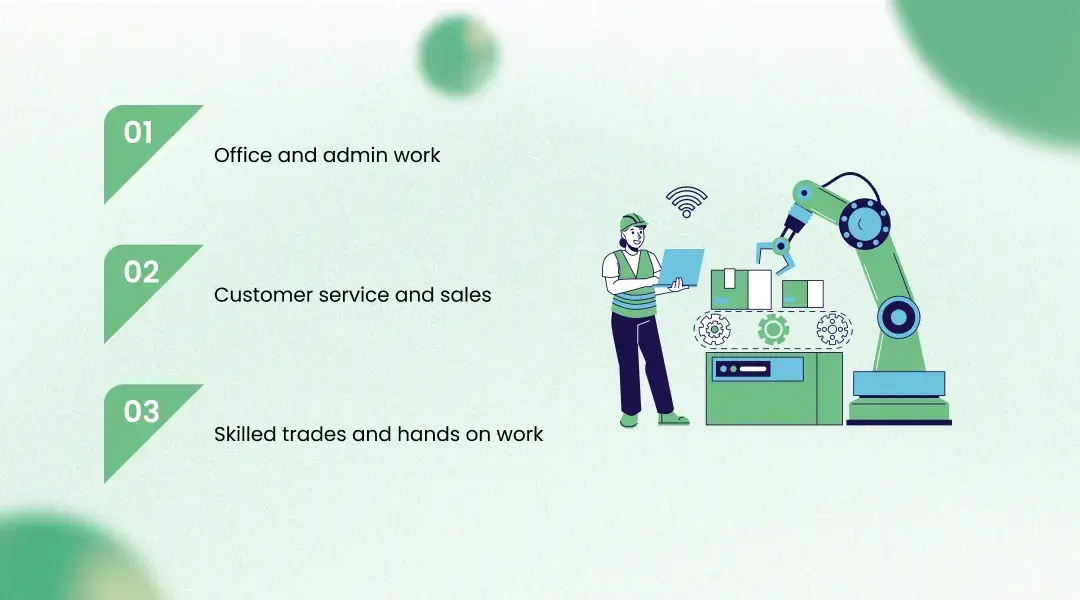
Office and admin work
This is the front line of change, because so much office work is exactly the routine thinking that software does well. Scheduling, reporting, drafting, sorting, and chasing will move heavily to software by 2029. The AI impact on office jobs will be the largest of any white collar area.
The people who thrive here will shift from doing the admin to designing and overseeing it. An office manager will spend less time arranging meetings and more time deciding what should happen and why. The role becomes more strategic and less mechanical. That is a better job for most people, but it asks for different skills than the old one did.
Customer service and sales
In customer service, simple repeated questions will be answered by software at any hour, in any language. By 2028, a large share of routine support contacts will be resolved without a human. The remaining human agents will handle the hard, emotional, or unusual cases, which is where they add real value.
Sales splits cleanly down the buckets we discussed. The routine part, finding leads and sending follow ups, moves to software. The human part, building trust and closing a deal worth real money, stays firmly human. Good salespeople will spend more time in front of customers and less time on the keyboard, which is exactly where they want to be.
Skilled trades and hands on work
Here is a point that surprises people who assume technology hits everyone equally. Plumbers, electricians, mechanics, nurses, and chefs are among the safest workers in this whole shift. Their work happens in the messy physical world and changes from job to job. Software is nowhere near able to crawl under a sink or comfort a frightened patient.
For these workers, AI mostly shows up as a quiet helper, not a threat. It will help with quotes, scheduling, diagnosis hints, and paperwork. The core of the job, the skilled hands and the human presence, stays exactly where it is. If anything, demand for these roles will rise as desk work becomes more crowded and people look for stable, hands on careers.
The Honest Concerns and What Is Actually Worth Worrying About
Anyone selling you pure optimism about this future is not being straight with you. There are real risks, and naming them clearly is the only responsible way to talk about this. The goal is not to scare you, but to point your worry at the things that actually deserve it.
The income and timing risk
The biggest danger is not that work disappears forever. It is that the change arrives faster for some people than they can adjust. A person whose entire job was routine processing may see that work shrink before they have built new skills. That gap, between the old job fading and the new skills arriving, is where real hardship lives.
This is a timing problem more than a permanent one. History suggests that new work appears, but it does not always appear in the same town, for the same person, at the same moment. The honest forecast is that the next five years will be bumpy for workers in heavily routine roles. Planning early is the single best protection against that bump.
The skills that will hold their value
The good news is that the skills which stay valuable are mostly human skills you can build. When software handles the routine layer, the premium shifts to what it cannot copy. Knowing this lets you invest your effort where it pays off.
The human strengths that will grow more valuable over the next five years include the following:
Clear judgment, meaning the ability to make a good call when the situation is unclear and no rule fits.
Communication and trust, meaning the ability to explain, persuade, and make people feel safe.
Creativity in the real sense, meaning the ability to frame a new problem, not just produce more output.
Care and empathy, meaning the ability to support real humans in ways a screen cannot.
The skill of directing software well, meaning describing goals clearly and checking results sharply.
Notice that none of these require a technical background. They are deeply human abilities, and that is the whole point. The future of work with AI rewards the things that make us human, not the things that make us machine like. That is a more hopeful picture than the headlines usually allow.
How to Prepare for AI at Work Without Panic
Knowing what is coming only helps if you act on it. The encouraging part is that preparing does not require going back to school or learning to code. It requires a handful of practical moves that anyone can start this month. Here is how to prepare for AI at work in a calm, grounded way.
The steps below are listed in a sensible order, but you can start anywhere:
Audit your own job by writing down your weekly tasks and marking each one as routine or judgment based.
Start using a good AI assistant for your routine tasks now, so you learn its strengths and limits early.
Practise the skill of giving clear instructions, since directing software well is becoming a core ability.
Invest your spare learning time in the human skills, such as communication, judgment, and relationship building.
Build at least one skill that lives in the physical or deeply human world, as a hedge against pure desk work.
Stay close to the part of your work that carries real responsibility, because that part stays human longest.
Talk openly with your manager about how your role can shift toward higher value work rather than waiting.
The aim is not to outrun the software. The aim is to move up to the work it cannot do, and to do that on purpose before you are forced to. People who start this in 2026 will be in a far stronger position by 2029 than those who wait. This is one race where starting early matters more than starting fast.
How do you prepare for AI at work if you feel behind already? Start small and start today. Pick one routine task this week and try handing it to an assistant. The confidence and clarity you build from one real attempt is worth more than months of worrying from the sidelines.
What Business Owners and Managers Should Do Now
If you run a business or lead a team, this shift is both a risk and an opening. The risk is being slow while competitors get faster and cheaper. The opening is that the same tools are finally affordable for small companies, not just giant ones. For the first time, a small team can access capability that used to need a large budget.
The smart path for business owners is neither rushing nor freezing. Rushing means firing people and bolting software onto chaos, which usually backfires. Freezing means watching faster competitors pull ahead. The grounded middle path is to redesign your work thoughtfully, keep your best people, and aim the savings at growth rather than only at cuts.
Business owners often ask where to begin, and the answer is to start with one clear, painful, repetitive process. Pick the task your team hates and that follows a pattern, and improve that first. A focused win in one area teaches your whole team what is possible. This is exactly the kind of practical, outcome focused work that KriraAI helps companies do, building systems around a real business result rather than chasing technology for its own sake.
The companies that handle this transition well will share one trait. They will treat AI as a tool to make their people more valuable, not just to make them cheaper. KriraAI works with businesses on precisely this balance, helping them understand what is coming and put practical systems in place that protect both their margins and their teams. The goal is steady, measurable progress, not a leap into the unknown.
Conclusion
If you take only three things from this blog, take these. First, AI is mostly taking over routine thinking, the repeatable mental tasks, which means your job will change shape rather than simply vanish. Second, the change unfolds in clear stages between 2026 and 2030, moving from helpful assistant to full task delegation to redesigned roles. Third, the work that grows more valuable is deeply human, built on judgment, trust, care, and creativity, none of which require a technical background to develop.
Understanding how AI will change jobs is the first step, but acting on that understanding is what actually protects your future. The people and businesses who start adjusting in 2026 will be far stronger by 2030 than those who wait for the change to feel undeniable. You do not need to predict the future perfectly. You only need to move steadily toward the work that stays human and away from the work that will not.
This is exactly where KriraAI focuses its work. KriraAI helps businesses understand the AI developments that are coming and put practical systems in place that deliver real, measurable results rather than abstract capability. The approach is grounded and outcome first, designed to make teams more valuable and operations more efficient, not to chase technology for its own sake. If you want a clear and honest partner to help your business navigate the changes ahead, it is worth exploring how KriraAI can help you prepare for the future of work with calm, practical steps.
FAQs
For most people, the honest answer is that AI will change your job far more than it will take it. Whole jobs disappearing is rarer than tasks within jobs moving to software. If your work is almost entirely routine, such as basic data entry or simple scripted support, you face real pressure and should start building new skills now. If your work involves judgment, trust, physical presence, or care, the software will help you rather than replace you. The smartest move is to assume your role will shift, not vanish, and to steer that shift on purpose.
The safest jobs combine physical work, human trust, and changing real world situations that software cannot handle. Skilled trades such as electricians, plumbers, and mechanics rank among the most protected, because their work lives in the messy physical world. Care roles such as nurses, carers, and therapists are also highly protected, since they rely on human presence and empathy. Roles built on persuasion, leadership, and complex problem solving stay valuable too. In short, the more your job depends on hands, hearts, and hard judgment calls, the safer it is over the coming decade.
The change is already starting in 2026, and it will become hard to ignore between 2028 and 2030. In the next two years, expect software to act as an assistant that drafts and suggests while you stay in charge. By 2028 and 2029, expect to hand over whole tasks and simply check the results. By 2030, many jobs will be openly redesigned around what humans uniquely add. The exact timing depends on your industry, but waiting until the change is obvious means starting your own preparation later than you should. Beginning now gives you a real head start.
You do not need any technical background to prepare well, which is the most reassuring part of this whole shift. Start by listing your weekly tasks and marking which are routine and which need real judgment. Begin using a simple AI assistant for the routine ones, so you learn its strengths and limits firsthand. Then invest your energy in human skills such as clear communication, sound judgment, and building trust, since these grow more valuable as routine work fades. Finally, stay close to the responsible, decision heavy part of your role. These steps require curiosity and consistency, not coding.
History and economics both suggest AI will create new jobs even as it removes others, but the transition will not be smooth or instant. The jobs AI will replace are mostly routine and rule based, while the new jobs cluster around directing, checking, and improving software driven work. By 2030, common roles will include people who manage software assistants much as supervisors once managed junior staff. The honest concern is timing, since new jobs may not appear in the same place or moment as the old ones disappear. Preparing early is how individuals bridge that gap successfully.
Founder & CEO
Divyang Mandani is the CEO of KriraAI, driving innovative AI and IT solutions with a focus on transformative technology, ethical AI, and impactful digital strategies for businesses worldwide.