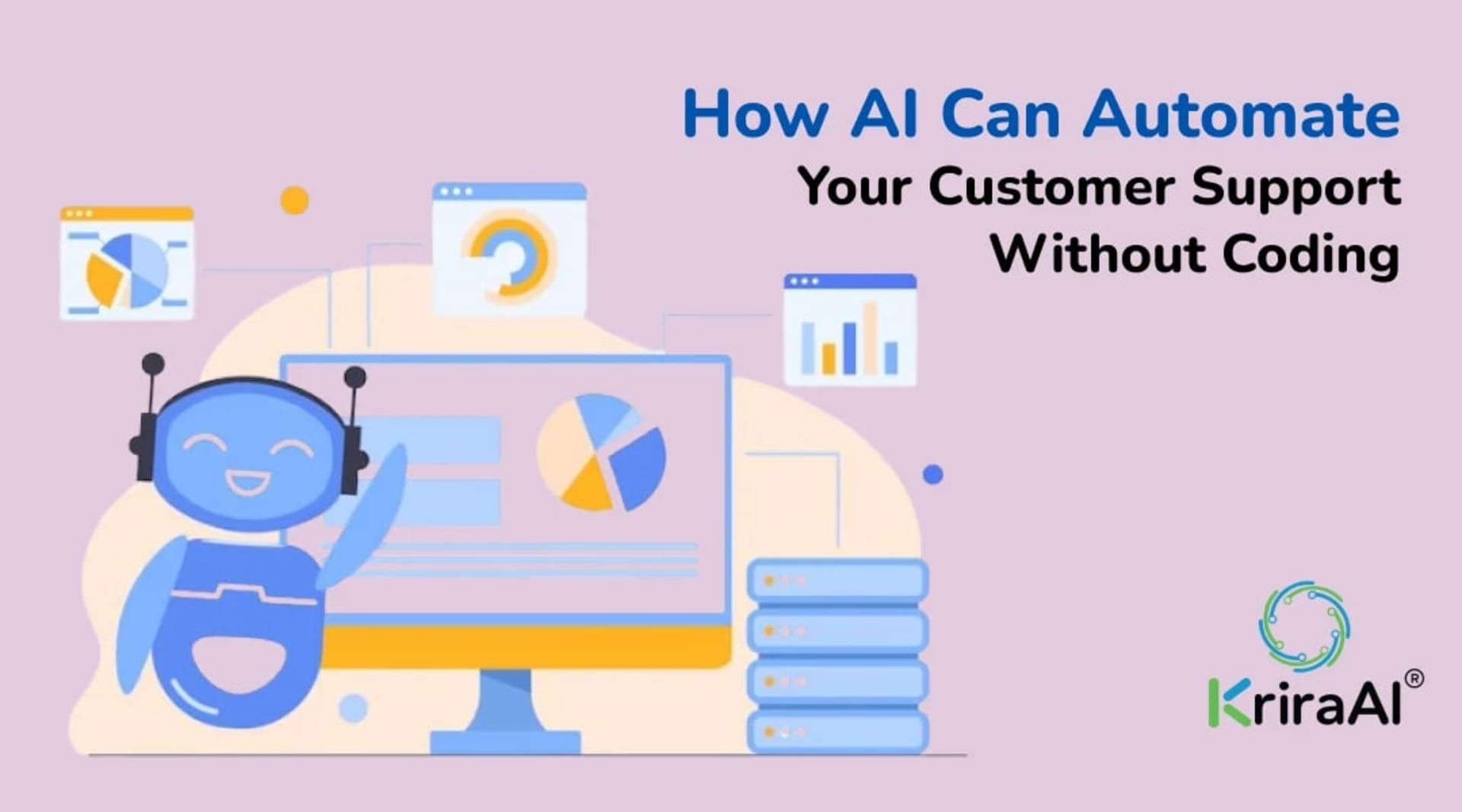
Customer support teams handle many repetitive tasks every day, from answering frequently asked questions and categorizing tickets to routing requests and checking customer information.
Many of these workflows can now be automated with AI tools that require little or no traditional coding.
No-code AI customer support does not mean removing human agents from the support process. Instead, it can help businesses automate repetitive interactions, provide faster answers, organize incoming requests, and route more complex cases to the right person.
This guide explains how businesses can approach customer support automation with no-code AI, what tasks are suitable for automation, how integrations work, and where human involvement remains important.
No-code AI customer support uses visual tools, prebuilt integrations, AI models, and workflow automation to handle selected support activities without requiring a team to develop every component from scratch.
A typical workflow may combine:
An AI chatbot
A knowledge base or FAQ repository
Ticketing software
CRM data
Workflow automation
Human escalation
Analytics and monitoring
The exact setup depends on the business, support volume, systems already in use, and the type of customer requests being handled.
AI is most useful when a support workflow contains repeatable patterns and clearly defined outcomes.
AI assistants can respond to common questions about products, services, orders, policies, account processes, or basic troubleshooting.
Instead of requiring an agent to manually answer the same question repeatedly, the system can retrieve relevant information and provide a response.
For accuracy, the underlying knowledge source should be maintained and reviewed regularly.
AI can classify incoming support requests based on their topic or intent.
For example, a support system may identify requests related to:
Billing
Technical issues
Account access
Order status
Product information
Refunds
Feature requests
Classification can help reduce manual triage and route requests to the appropriate queue.
Once a request has been categorized, workflow automation can send it to the relevant support team or agent.
A technical issue might go to technical support, while a billing request can be directed to the finance or billing team.
This creates a more organized support workflow without requiring an employee to review every incoming ticket manually.
Businesses can automate responses for simple, low-risk requests such as acknowledging a support ticket, confirming receipt of information, sharing standard instructions, or providing links to relevant resources.
The response should still follow business rules and escalation conditions.
AI can analyze language for signals that may indicate frustration, urgency, dissatisfaction, or other support-related sentiment.
This can help prioritize conversations that may benefit from human attention.
Sentiment detection should support agent decision-making rather than being treated as a perfect measure of how a customer feels.
A typical implementation can be broken into several connected layers.
The customer starts a conversation through a website chat widget, helpdesk, messaging platform, email, or another supported channel.
The AI system processes the customer message and identifies the likely intent or request.
The system searches approved business information such as FAQs, help documentation, product information, policies, or other connected knowledge sources.
The system can provide an answer, collect additional information, create a ticket, update a workflow, or trigger another approved action.
When the request is complex, sensitive, uncertain, or outside the system's scope, it should be transferred to a human agent.
The business reviews interactions, identifies failure patterns, updates its knowledge sources, and improves the workflow over time.
Businesses can approach no-code automation step by step.
Start by reviewing support tickets, chats, emails, or call summaries.
Look for requests that are:
Frequent
Predictable
Low risk
Based on known information
Easy to validate
These are generally stronger candidates for initial automation.
Collect the information the AI needs to answer customer questions.
This may include:
FAQs
Product documentation
Support articles
Policies
Troubleshooting instructions
Shipping or delivery information
Account procedures
Remove outdated information before connecting it to an automated support workflow.
The right platform depends on your existing helpdesk, CRM, communication channels, support volume, and workflow requirements.
Instead of selecting a tool because it is popular, evaluate whether it can support the specific processes you need to automate.
A simple workflow may look like:
Customer question → AI identifies intent → knowledge retrieval → response → confidence check → human escalation when required
Additional workflows can be added for ticket creation, tagging, routing, notifications, and other support processes.
Automation should have clear boundaries.
Escalation may be appropriate when:
The AI cannot confidently answer
The customer requests a human
The issue involves sensitive account information
The conversation is highly complex
A complaint requires human judgment
A financial or other high-impact decision is involved
Human handoff should preserve relevant context so the customer does not need to repeat everything.
Start with a controlled set of support questions.
Review whether the AI:
Understands customer intent
Uses the correct information
Gives accurate answers
Escalates appropriately
Maintains the expected brand tone
Use the results to improve the workflow before expanding automation.
A no-code support workflow may connect several business systems.
Depending on the platform, integrations can include:
Helpdesk platforms
CRM systems
Knowledge bases
E-commerce systems
Customer databases
Messaging platforms
Workflow automation tools
Analytics platforms
The purpose of integration is to give the support workflow the context it needs while ensuring that access to customer and business information follows appropriate security controls.
AI can respond to common customer questions without waiting for an agent to become available.
Automatic classification and routing can reduce repetitive ticket-management work.
Approved knowledge sources and defined workflows can help maintain consistent answers to common questions.
Automated systems can handle eligible support interactions outside normal business hours.
When routine work is automated, support agents can spend more time on complex conversations that require judgment or empathy.
A well-designed automation workflow can support increasing interaction volumes without making every additional request dependent on manual processing.
These benefits depend on the quality of the implementation, underlying data, system integrations, and ongoing monitoring.
Not every support interaction should be handled end to end by AI.
Human involvement may remain important for:
Sensitive complaints
Complex technical issues
Account disputes
Refund decisions
Security-related concerns
High-value customers
Situations requiring empathy or judgment
The objective should be appropriate automation, not maximum automation.
Starting with every support workflow at once makes testing and troubleshooting harder.
Begin with a narrow group of repetitive requests and expand gradually.
An AI system can only be as reliable as the information available to it.
Keep support documentation accurate and maintain a process for reviewing changes.
A support system should always provide a path to a human when automation is not appropriate.
A response that is technically correct may still be unhelpful if the system does not understand the customer's previous interactions or current issue.
Faster responses are useful, but businesses should also evaluate answer quality, resolution rate, escalation quality, customer satisfaction, and recurring failure patterns.
Useful metrics can include:
First response time
Resolution time
Automated resolution rate
Escalation rate
Ticket deflection
Customer satisfaction
Repeated-contact rate
AI answer accuracy
Human handoff rate
The most useful metrics depend on the support model and business objectives.
Yes, provided the selected AI and automation tools support the required integrations.
A business may connect its AI support workflow with an existing helpdesk to create tickets, retrieve knowledge, categorize conversations, route requests, or provide agents with additional context.
The implementation should be designed around the systems already used by the organization rather than forcing the business to replace every existing tool.
No-code tools can be a practical starting point for straightforward automation.
Custom AI development may become more appropriate when a business needs:
Complex enterprise integrations
Custom workflows
Specialized AI behavior
Domain-specific knowledge processing
Advanced security requirements
More control over infrastructure
Highly customized customer experiences
In those situations, a business may combine no-code tools with custom software and AI components instead of treating the two approaches as mutually exclusive.
A simple customer support automation process can look like this:
Customer message
↓
AI identifies intent
↓
System checks approved knowledge
↓
AI responds to routine request
↓
Workflow records the interaction
↓
Complex or uncertain requests are escalated
↓
Human agent resolves the issue
↓
Outcome is reviewed for future improvements
This approach keeps automation focused on useful repetitive work while maintaining human control where it matters.
No-code AI can make customer support automation more accessible to businesses that do not want to build every workflow from the ground up.
The strongest implementations do not try to eliminate human support. They use AI for repetitive requests, classification, routing, knowledge retrieval, and other structured tasks while giving human agents the context needed to handle more difficult cases.
Start with a small number of high-volume support workflows, use reliable knowledge sources, define clear escalation rules, measure performance, and expand automation as the system proves reliable.
For businesses that need capabilities beyond standard no-code workflows, custom AI development can extend the same approach with deeper integrations and more specialized automation.
Yes. Many modern platforms provide visual workflows, prebuilt integrations, AI assistants, and knowledge-base features that allow businesses to automate selected customer support processes without traditional software development.
Common candidates include FAQ responses, ticket classification, ticket routing, status updates, basic troubleshooting, knowledge retrieval, and support notifications.
No. A well-designed support automation workflow should handle suitable repetitive tasks while escalating complex, sensitive, or uncertain interactions to human agents.
Many platforms support integrations with CRMs, helpdesks, databases, messaging systems, and workflow automation tools. The available integrations depend on the platform and business requirements.
Maintain reliable knowledge sources, test common questions, review failed responses, establish escalation rules, and continuously update the system based on real support interactions.
Custom development becomes more relevant when the business requires specialized workflows, complex integrations, advanced controls, domain-specific AI behavior, or capabilities that standard no-code platforms cannot provide.
Founder & CEO
Divyang Mandani is the CEO of KriraAI, driving innovative AI and IT solutions with a focus on transformative technology, ethical AI, and impactful digital strategies for businesses worldwide.