Something important happened in Brussels this week that most technology news coverage is getting half right. Germany's Handelsblatt reported on May 25, 2026, confirmed by Reuters, that the European Commission is finalizing the largest fine ever imposed under the Digital Markets Act, targeting Alphabet's Google over search self-preferencing. Reporters reached for familiar framing: another EU antitrust case, another Google fine, another chapter in the decade-long regulatory conflict between Brussels and Silicon Valley. That framing misses the most consequential part of the story.
This case is not simply about Google promoting its own shopping results or pushing hotel listings to the top of its search pages. By the time European regulators reached the penalty stage, the investigation had expanded into territory that no regulator in the world had previously mapped. The Commission has flagged, according to reporting confirmed by multiple outlets including Handelsblatt and PPC.land, that Google's AI Overviews feature, which places a Gemini-generated summary prominently at the top of search results pages, may itself constitute a new form of the same self-preferencing problem. In other words, the AI-generated answer that greets hundreds of millions of users every time they type a query into Google Search is now, in the eyes of Europe's most powerful regulatory body, potentially an anticompetitive act.
This distinction is not a technicality. It is the difference between a fine that punishes behavior that Google can remedy by adjusting a ranking algorithm and a regulatory intervention that strikes at the core of what Google's AI strategy actually is. Google I/O 2026, held just two weeks ago, was a showcase for the most aggressive AI-first search transformation in the company's history. Google announced it was replacing the traditional search box with AI agents powered by Gemini. Information agents now reason across real-time data to alert users when something relevant changes. Generative UI builds custom widgets on the fly to answer queries. The entire product direction is toward a world where the user interacts with Google's AI rather than with the open web. The EU is now telling Google that this vision, pursued through the dominant search platform that processes billions of queries daily, may be illegal under European competition law.
This blog provides the analytical layer that news coverage of this case has not supplied. It explains precisely what the regulatory case is, why the AI dimension makes it different from every Google antitrust action that came before it, what the technical mechanism of AI Overviews self-preferencing actually is, what the consequences are for Google's AI strategy and for every enterprise deploying AI-powered platforms, and what the longer arc of AI regulation that this case is accelerating will look like. Readers who want to understand what this moment means for the future of AI-powered products, not just for Google but for the entire industry, will find that analysis here.
The European Commission is preparing to announce, before its August 2026 recess, a financial penalty in the "high triple-digit million euro" range against Google under the Digital Markets Act. To understand why this matters more than the number, it helps to understand what the DMA is and why this case is different from the long series of EU antitrust actions against Google that preceded it.
The DMA entered into force in March 2024. It was designed to address a fundamental weakness in traditional antitrust enforcement against dominant technology platforms: the time problem. Previous Google antitrust cases in the EU moved through investigation, finding, fine, appeal, and higher court ruling over periods of seven to ten years. By the time a fine was upheld, the behavior it addressed had often been superseded by a different generation of the same platform dynamic. The DMA was written to impose obligations on designated "gatekeepers" upfront, rather than punishing abuse after years of investigation. Gatekeepers have to comply with the rules from the moment the designation takes effect. Enforcement is supposed to be fast.
The search self-preferencing investigation was formally opened in March 2025. Its core question is whether Google's search engine gives greater visibility and more favorable formatting to its own vertical services, specifically Google Shopping, Google Flights, Google Hotels, and Google Maps, over comparable services from competing companies. This is the same structural complaint that drove the €2.42 billion Google Shopping fine in 2017 and a €4.34 billion Android ecosystem penalty in 2018. It is not a new allegation. What is new is the legal framework: Article 6 of the DMA prohibits self-preferencing directly, without requiring regulators to prove that the behavior caused measurable market harm. The obligation exists. The question is whether Google has complied.
Google's pattern in these proceedings has been to submit remedy proposals that fall short of what the Commission considers adequate, triggering rounds of additional review. In the current case, Google submitted an initial remedy proposal that the Commission determined was insufficient. The Commission granted Google additional time to revise its approach. Google's spokesperson captured the company's posture when commenting publicly: the changes already made to Search under the DMA represent, in the company's own framing, "the biggest downgrade in the product's history," creating what Google described as "a second-rate experience for Europeans."
That framing is revealing. Google is arguing that compliance with the DMA degrades its product. Brussels is arguing that the product's superiority is itself partly a consequence of the anticompetitive behavior the DMA prohibits. These two positions are genuinely irreconcilable, which is why the remedy negotiation has ended in a penalty rather than a consent agreement.
There is an unusual geopolitical dimension to the timing of this fine. According to reporting by Der Standard on May 26, 2026, Commission President Ursula von der Leyen delayed announcing the penalty to avoid antagonizing US President Donald Trump during a period of transatlantic trade tension. The Trump administration has shown sensitivity to EU enforcement actions against American technology companies, treating them as trade barriers rather than legitimate regulatory activity. Civil society organizations were not passive about this delay. In May 2026, over 30 groups led by Open Markets Institute Europe wrote to von der Leyen expressing "grave concern" about what they described as the Commission's credibility being at stake. Max von Thun of Open Markets Institute Europe characterized the delay as "a serious blow to Europe's digital sovereignty." The Commission proceeded nonetheless, and the announcement is expected before the summer parliamentary break.
This fine will be the largest penalty ever imposed under the Digital Markets Act. For context, the previous DMA record was the €200 million Apple fine over App Store practices in April 2025. The expected penalty against Google would substantially exceed that figure. Google's prior EU antitrust history creates a relevant financial backdrop. In September 2025, the Commission imposed a €2.95 billion adtech fine on Google, showing that long-running cases can still conclude with multibillion-euro outcomes once regulators abandon softer remedies. The maximum DMA penalty is 10 percent of global annual revenue, which for Alphabet represents a figure in the tens of billions. The expected fine falls well below that ceiling, reflecting Google's partial compliance steps, but the behavioral obligations attached to the penalty are likely to carry more operational weight than the financial figure itself.
Every previous Google antitrust action in the EU targeted something that could be remedied through changes to ranking signals, algorithm adjustments, or interface modifications that gave competing services equal visual treatment. The self-preferencing dynamic was structural but mechanical: Google's system gave its own results more prominent placement, and the remedy was to equalize that placement. Regulators and engineers understood the problem in the same terms.
The AI Overviews dimension introduces something qualitatively different. When Google places an AI Overviews panel at the top of a search results page, it is not simply giving a higher ranking to a Google-owned vertical service like Google Flights or Google Shopping. It is deploying its own Gemini language model to synthesize an answer that draws from third-party content without directing the user to that content, keeping the user inside Google's own interface, and substituting Google's AI-generated summary for the diverse organic results that would otherwise appear at the top of the page.
The self-preferencing that operates through AI Overviews works on at least three levels simultaneously, each of which creates a distinct competitive harm that is more difficult to remedy than traditional algorithmic self-preferencing.
The first level is content consumption. AI Overviews synthesize information drawn from web publishers' content and present it in the form of an answer. The user receives the informational value of that content without visiting the publisher. Research cited in the complaint filed by the European Publishers Council in February 2026 estimated that AI Overviews appear in more than 40 percent of search results for informational queries, with independent studies estimating traffic declines of over 30 percent for affected queries. Data published by Stackmatix in March 2026 found that when an AI Overview appears in search results, the organic click-through rate drops from 1.76 percent to 0.61 percent, a 61 percent decline. When Google's AI Mode is fully active, the zero-click rate reaches 93 percent.
The second level is infrastructure preferencing. The AI that generates those summaries is Google's own Gemini. Rival AI developers cannot access this placement. A user interacting with AI Overviews is interacting with Google's AI, grounded in Google's index, presented on Google's interface. No competing AI service can occupy that position in a Google search result page, regardless of the quality of its outputs.
The third level is training data asymmetry. Google is using the content that publishers create, and that users upload to YouTube, to train and improve Gemini, the same model that generates the summaries that reduce traffic to those publishers' websites. Publishers are caught in a structural bind identified precisely in the EU Commission's December 2025 investigation: they can either accept Google's terms, have their content used for AI training without compensation, and lose a growing share of their search traffic, or they can opt out of AI Overviews, which effectively also removes them from Google Search results. There is no meaningful middle position.
The Commission's formal position, as reflected in reporting by Handelsblatt confirmed by other sources, is that Google's AI Overviews feature may represent a new form of the search self-preferencing that the DMA was written to prohibit. By placing a Gemini-generated summary at the top of search results, Google is giving its own AI infrastructure preferential placement over third-party content and services provided by rival AI developers. Google has submitted proposals for modifying AI search behavior to address the Commission's concerns, but those proposals have not satisfied Brussels.
A separate DMA proceeding is preparing to require Google to give rival AI assistants the same access to Android that it gives Gemini. A binding decision in that proceeding is expected by July 2026. A third investigation opened in December 2025 focuses specifically on whether Google's use of web publisher content and YouTube videos to train its AI products gives Google an unfair competitive advantage over rival AI developers who cannot access that data on equivalent terms.
What these three concurrent proceedings reveal is that Brussels is not treating AI Overviews as a narrow product feature to be adjusted. The Commission is systematically working through the multiple dimensions of how Google's AI integration into Search creates competitive harm: the content harm to publishers, the infrastructure harm to rival AI services, the data asymmetry harm to competing AI developers, and the vertical services harm to companies whose comparison results no longer appear above the fold.
Traditional antitrust analysis of search self-preferencing asks a relatively tractable question: does the platform give its own results a systematic ranking advantage over comparable results from competitors? The remedy is correspondingly tractable: equalize the ranking treatment. Regulators and engineers can measure compliance by comparing the position and formatting of Google results against those of competitors across a sample of queries.
AI-generated answers do not work this way. When Google Gemini synthesizes a response to a user's query, it does not return a ranked list of results that can be compared to an equivalent ranked list from a rival service. It produces a synthesized output grounded in data that only Google possesses: the full index of the web, the real-time click and engagement signals from billions of searches, the YouTube corpus, and the proprietary quality signals accumulated over two decades. The output is generated by a model trained on content that competitors cannot access on equivalent terms. There is no algorithmic parameter to equalize because the competitive advantage is baked into the model itself.
This is the reason that Brussels' proposed remedy in the AI assistants case, requiring Google to give rival AI assistants the same access to Android as Gemini enjoys, is technically challenging to enforce. What does equivalent access mean when the value of Gemini's Android integration comes not from the API contract but from the years of user interaction data, personalization signals, and ecosystem integration that no competitor can replicate simply by receiving equivalent API access? Equality of access at the interface level does not produce equality of competitive opportunity when the underlying model has been trained on structurally superior data.
The competitive dynamic that the Commission is trying to address can be understood as a self-reinforcing flywheel. Google's dominant position in search gives it access to more user interaction data than any competitor. That data is used to train Gemini. Gemini generates AI Overviews that keep users inside Google's interface, generating more interaction data. That additional data is used to further improve Gemini. Publishers and rival AI services are excluded from this loop at every point.
Breaking the flywheel requires intervention at multiple points simultaneously, which is exactly what the Commission's concurrent proceedings are attempting. The fine for search self-preferencing addresses the ranking advantage. The AI assistants proceeding addresses the Android distribution advantage. The content investigation addresses the training data advantage. Whether this multi-front approach produces the behavioral change Brussels is seeking, or whether Google navigates it through a series of partial compliance steps and legal challenges, is the open question that will define AI competition policy in Europe for the next several years.
KriraAI has analyzed this flywheel dynamic in the context of enterprise AI deployment and finds that the competitive moat it describes is not unique to Google. Any large enterprise that controls both a dominant user interface and a proprietary data asset faces structurally similar dynamics, though at smaller scale and without the regulatory exposure that comes with formal gatekeeper designation. Understanding how regulators are thinking about this problem is directly relevant to any organization designing AI-powered products that interact with third-party content or that enjoy distribution advantages over potential competitors.
The regulatory case is one dimension of the AI Overviews story. The economic reality that motivated the publishers' complaints to Brussels is another dimension, and it connects directly to the way AI systems extract and concentrate value from content ecosystems.
When Google launched AI Overviews in May 2024, the promise was that AI-generated summaries would help users find better answers faster. What the data showed in practice was that users finding better answers faster meant users leaving fewer clicks on publishers' links. A Pew Research Center study from July 2025 found that users are measurably less likely to click on links when an AI summary appears in search results, and more likely to end their browsing session entirely after reading the AI-generated answer. The European Publishers Council, whose members include DMG Media, The Guardian, News UK, and The New York Times, documented that organic search traffic from major news sites had declined substantially. Traffic declines of over 30 percent for informational queries affected by AI Overviews were cited in the EPC's February 2026 antitrust complaint to the Commission.
The structural problem is not that AI Overviews exist but that publishers have no viable way to exclude their content from the AI training and synthesis process while retaining their presence in search results. The choice Brussels identified is stark: participate in Google's AI ecosystem on Google's terms or accept effective removal from Google Search. For publishers whose business models depend substantially on search referral traffic, this is not a meaningful choice. It is a coerced participation in a system that extracts value from their journalism without compensating them and then uses that extracted value to reduce the audience they receive in return.
This dynamic is the specific competitive harm that the December 2025 investigation is examining. EU Competition Commissioner Teresa Ribera framed it clearly when the investigation was announced: innovation cannot come at the expense of the principles at the heart of European society, and Brussels must protect content creators and guarantee fair competition in AI markets. The EU's position is that Google's ability to train Gemini on publisher content at scale, without compensation and without a genuine opt-out mechanism, gives Google's AI models a data advantage over rival AI developers that these developers cannot overcome regardless of the quality of their research or engineering. Google's AI is better not only because Google is a better AI company but because Google controlled a structural data advantage that competition law was not designed to address before the DMA.
The Commission has stated that compliance, not punishment, is its primary goal. EU spokesperson Thomas Regnier emphasized Brussels' preference for behavioral change over financial penalties. If the fine produces genuine behavioral change rather than a legal challenge, European users could see search results that treat Google Flights, Google Hotels, and Google Shopping with the same formatting and positioning as Expedia, Booking.com, or Skyscanner. That structural remedy has been the aim since the 2017 Google Shopping case. Whether the DMA enforcement mechanism delivers it faster than the old antitrust regime remains unproven.
On the AI Overviews question, a genuine remedy is harder to specify. Requiring Google to display rival AI-generated summaries alongside Gemini-generated ones is technically complex and raises its own quality and liability questions. Requiring Google to compensate publishers for content used in AI Overviews would establish a precedent for AI training data compensation that extends well beyond this specific case. Allowing publishers a genuine opt-out from AI usage without search penalty would fundamentally alter the data economics of how Gemini is grounded and improved. Any of these remedies, if enforced effectively, changes the competitive landscape for AI development not just in Europe but globally, because Google's products serve users worldwide and cannot be easily bifurcated by jurisdiction.
The Google DMA case is generating regulatory analysis and press coverage focused almost entirely on Google's specific situation. The more strategically important question for technology decision-makers and for organizations building AI-powered platforms is what this case signals about the regulatory framework that every AI deployment will operate within over the next decade.
The principle that Brussels is establishing is not Google-specific. It is a general principle about what happens when a dominant platform integrates AI capabilities in a way that uses the platform's market position to advantage its own AI over competitors' AI. The DMA designated Google as a gatekeeper because of its dominance in search. But the same logic applies, at smaller scale, to any AI deployment that combines a proprietary distribution advantage with AI-generated outputs.
Regulators examining AI-integrated platforms will increasingly ask three questions that every organization deploying AI in customer-facing products should be prepared to answer.
First, does your AI deployment use data or content from third parties to generate outputs that reduce those third parties' opportunity to benefit from their own content? The publisher harm in the Google case is a specific instance of a general pattern: AI systems that synthesize and present content from external sources, whether web publishers, data vendors, or content partners, may be extracting value from those sources without adequate compensation or consent.
Second, does your AI deployment advantage your own products or services over those of competitors by generating outputs that steer users toward your ecosystem rather than toward the open market? The self-preferencing concern in the Google case applies wherever an AI system has the ability to make recommendations, generate summaries, or synthesize answers in a way that systematically favors the deploying organization's own commercial interests.
Third, do users who interact with your AI have a genuine and informed understanding of when they are receiving AI-generated outputs and when those outputs are designed to serve the platform's commercial interests rather than the user's informational interests? This transparency question is embedded in the DMA's obligations and is likely to become a baseline expectation in AI governance frameworks globally.
KriraAI works with enterprise clients on exactly these questions when designing AI-powered customer-facing systems. The regulatory environment that the EU is establishing around these principles is not a distant compliance concern for large technology platforms. It is an operational governance question for any organization that deploys AI at scale in contexts where third-party content, competitive markets, or user trust are at stake.
The separate DMA proceeding requiring Google to give rival AI assistants the same access to Android as Gemini, with a binding decision expected by July 2026, is worth watching as closely as the search fine. If the Commission succeeds in establishing equivalent access for rival AI assistants on Android, it will have created a legal precedent for non-discrimination between AI providers in the context of operating system distribution. This precedent could be applied to other dominant platforms and operating systems where AI integration creates first-mover advantages for the platform owner's own AI services.
The competitive dynamics of mobile AI distribution are significant. Google's integration of Gemini across Android means that hundreds of millions of Android users encounter Gemini as the default AI experience on their device, generating interaction data that improves the model, extending the same data flywheel described in the search context to the mobile operating system layer. A requirement to provide equivalent access to rival AI assistants would, if genuinely enforced, reshape the economics of mobile AI deployment in ways that extend far beyond the immediate Google context.
The detail in the Der Standard reporting that Commission President Ursula von der Leyen delayed announcing the Google penalty to avoid antagonizing the Trump administration is not a sidebar to the main story. It is a window into the geopolitics of AI regulation that will shape enforcement of competition law against technology platforms for years to come.
The Trump administration has treated EU enforcement actions against American technology companies as trade barriers. This position has created genuine political pressure on Brussels at a moment when the EU is engaged in complex trade negotiations with Washington on multiple fronts, including tariffs that affect European manufacturing and energy policy. The decision to proceed with the Google fine despite that political pressure reflects the Commission's judgment that regulatory credibility inside Europe is a more valuable long-term asset than avoiding diplomatic friction with Washington in the short term.
The civil society pressure documented in May 2026 was significant. More than 30 organizations explicitly told von der Leyen that the Commission's credibility as a digital regulator was at stake. In a regulatory system that depends on companies believing that enforcement is credible and consistent, that argument carries weight. The Commission's decision to proceed reflects an understanding that the authority of the DMA as a framework depends on demonstrating that it will be enforced against the largest and most politically connected operators, not only against smaller or less connected ones.
This geopolitical tension creates real uncertainty for AI companies. The EU regulatory approach to AI and competition is increasingly coherent, principled, and enforceable. The US regulatory approach has shifted significantly since 2025, with the current administration showing less appetite for strong platform regulation. This regulatory divergence creates a compliance environment where companies operating across jurisdictions must manage genuinely different requirements, and where the decisions made by Brussels can have global product implications even when they formally apply only within the European single market.
The Google DMA case does not exist in isolation. It is part of a rapidly developing global regulatory architecture around AI-powered platforms that organizations building AI systems need to understand as an operational reality rather than an abstract policy discussion.
In parallel with the search self-preferencing proceeding, the Commission opened an investigation into Meta in December 2025 over its policy of excluding third-party AI assistants from WhatsApp, with interim measures notified in February 2026. In January 2026, Brussels opened proceedings to require Google to share anonymized search ranking, query, click, and view data with competing search engines, including AI chatbot providers, on fair, reasonable, and non-discriminatory terms. The UK's Competition and Markets Authority has designated Google under its own Digital Markets, Competition and Consumers Act and is pursuing similar publisher content remedies. India's Competition Commission is reviewing Google's language model licensing terms.
The cumulative picture is of a global regulatory movement that is specifically targeting the way AI capabilities interact with incumbent platform advantages. Regulators are not targeting AI itself. They are targeting the combination of AI with existing market dominance in ways that extend that dominance into new AI-adjacent markets. This is a meaningful distinction for organizations thinking about AI strategy. Building powerful AI is not itself a regulatory risk. Building powerful AI on top of a dominant platform position, using data that the platform's dominance provides, to generate outputs that reinforce the platform's position, is precisely what regulators are now focused on addressing.
The data point that deserves more analytical attention than it has received is the finding that when Google's AI Mode is fully active, the zero-click rate reaches 93 percent. This means that for the vast majority of queries where Google's most advanced AI features are engaged, the user receives an answer and does not visit any external website. The implications for the economics of the open web are profound in ways that extend well beyond the publisher traffic losses documented in the EU complaint.
The open web, as an ecosystem, depends on a virtuous cycle in which content creators produce valuable content, search engines index and surface that content, users discover and visit content through search, and creators are rewarded through advertising revenue or subscription models that depend on that traffic. AI-generated zero-click answers at scale break this cycle at the discovery and traffic stages simultaneously. If the 93 percent zero-click rate in AI Mode becomes the normal experience for search, the revenue model for most web content creation collapses, and the web that future AI models will be trained on becomes sparser, lower quality, and less representative of current human knowledge.
This is not an AI pessimist position. It is an observation about the systemic dependency between AI model quality and the richness of the content ecosystem from which training data is drawn. Regulators in Brussels appear to understand this dependency, even if their framing in terms of competition law does not make it explicit. The content investigation opened in December 2025, examining whether Google's use of publisher content for AI training disadvantages rival AI developers, is also, implicitly, an investigation into whether the practices that advantage Google's AI today are simultaneously degrading the content ecosystem that all AI systems will depend on tomorrow.
KriraAI's approach to AI system design explicitly accounts for the sustainability of the content and data ecosystems that enterprise AI deployments interact with. Systems designed to extract value from content partners or data sources without fair exchange create both regulatory and strategic risks. The EU is now establishing enforceable rules around this principle, but the principle itself, that AI deployments must maintain the health of the ecosystems they depend on, is sound regardless of regulatory mandate.
The Google DMA case is generating enormous press coverage, most of it focused on the fine amount, the appeal prospects, and the political dynamics of EU-US technology relations. For business leaders and technology teams building AI-powered products, the more actionable question is what the regulatory principles being established in this case mean for how they should design, govern, and document their own AI deployments.
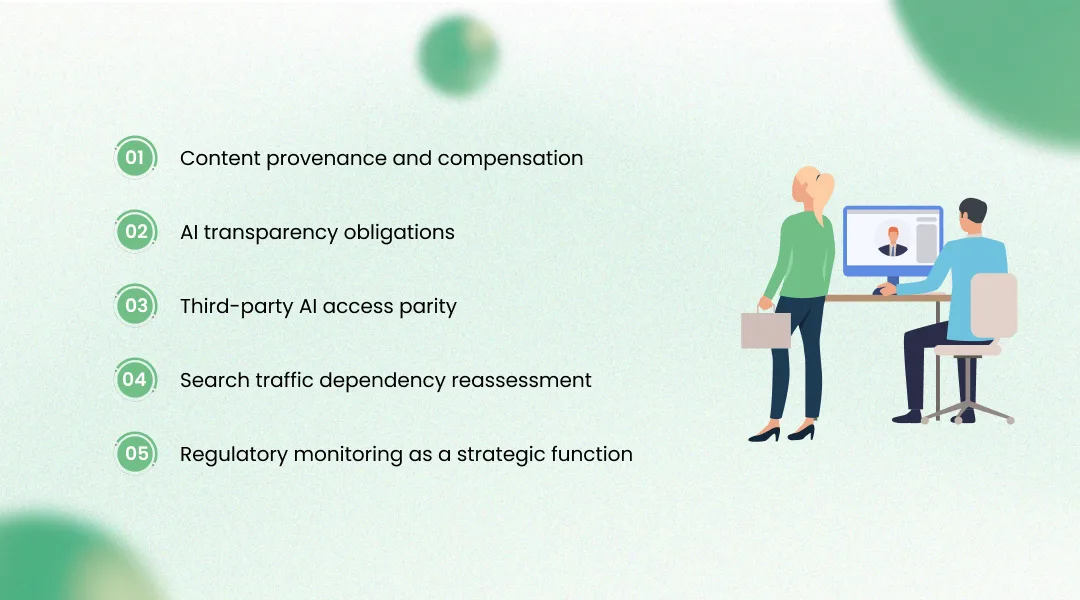
The following practical implications emerge directly from the case:
Content provenance and compensation: Any AI system that synthesizes or generates outputs based on third-party content should have a documented policy on content sourcing, compensation, and opt-out mechanisms. The EU's position in the Google case establishes that using third-party content for AI training or grounding without adequate compensation or genuine opt-out violates competition law when practiced by a dominant platform. While most organizations are not DMA gatekeepers, the principle is increasingly embedded in broader regulatory expectations and contractual standards.
AI transparency obligations: The DMA and associated regulatory frameworks are converging on a requirement that users should be able to understand when they are receiving AI-generated outputs and when those outputs may be shaped by the deploying organization's commercial interests. Building transparency into AI interfaces is not only a best practice but an emerging regulatory baseline.
Third-party AI access parity: Where organizations control distribution platforms or operating system layers through which AI services are delivered, the precedent being established by the Android AI access proceeding suggests that regulators will increasingly expect non-discriminatory access policies for competing AI services. Organizations designing platform ecosystems that include AI components should consider how access and data parity provisions can be built in from the beginning.
Search traffic dependency reassessment: For any organization whose content strategy depends substantially on organic search traffic from Google, the trajectory of AI Overviews and AI Mode represents a structural shift that should be modeled, not merely acknowledged. The 61 percent decline in click-through rates when AI Overviews appear is not a temporary anomaly. It reflects the product direction that Google announced explicitly at I/O 2026, with AI agents designed to resolve queries without returning users to the open web.
Regulatory monitoring as a strategic function: The pace of AI-related regulatory development across the EU, UK, US, and India has accelerated to the point where organizations cannot rely on periodic legal reviews to stay current. Embedding regulatory monitoring as an ongoing function within AI product teams is becoming a competitive necessity for any organization deploying AI at scale.
Three insights from this analysis stand out as genuinely important for understanding where AI regulation and AI product strategy are heading.
The first is that the integration of AI into dominant platforms creates a new category of competitive harm that existing regulatory tools were not designed to address. The EU is improvising, intelligently, by running multiple concurrent proceedings under different legal frameworks to address what is essentially a single systemic problem: the self-reinforcing flywheel that combines AI capability, data advantage, distribution dominance, and content extraction. This improvisation is likely to produce regulatory frameworks that are initially imperfect and that will be refined through enforcement experience. Organizations building AI-powered platforms should expect the rules they operate under to evolve rapidly and should design governance structures that can adapt accordingly.
The second insight is that the zero-click trajectory of AI search, documented in the data showing 93 percent zero-click rates when AI Mode is fully active, represents a structural challenge to the content ecosystem that all AI models depend on for training data. Regulators are partly motivated by this concern even when their legal arguments are framed in competition law terms. AI deployments that extract value from content ecosystems without sustaining those ecosystems are building on a degrading foundation. This is not only a regulatory risk but a strategic one.
The third insight is that geopolitics has become an operational variable in AI platform regulation. The documented delay in the Google fine due to US-EU political tensions, and the civil society pressure that overcame that delay, illustrates that AI regulation is not purely a technical or legal domain. It is embedded in a broader negotiation about the distribution of economic value and regulatory authority between the US and EU technology ecosystems. Organizations navigating this environment need both legal and geopolitical intelligence to make confident product and investment decisions.
KriraAI follows these regulatory developments not as a compliance function but as a core part of building AI systems that are designed for the real world as it actually operates. The constraints that the EU is establishing around AI-generated search content, training data sourcing, and platform distribution are not obstacles to building powerful AI. They are specifications for building AI that is durable, trustworthy, and genuinely valuable in a world where users, content creators, and regulators all have legitimate interests that AI systems must account for. Enterprises that understand this landscape, and build AI accordingly, are the ones that will find themselves ahead rather than in remediation when the regulatory frameworks mature. If your organization is building AI-powered products and wants to think through the governance, design, and strategic implications of the regulatory environment this case is accelerating, KriraAI is the partner to have that conversation with.
The European Commission's position, as reported by Handelsblatt and confirmed by Reuters in May 2026, is that Google's AI Overviews feature, which displays Gemini-generated summaries at the top of search results pages, constitutes a form of self-preferencing that violates Article 6 of the Digital Markets Act. Specifically, by using its own Gemini language model to generate these summaries, Google gives its own AI infrastructure preferential placement in search results over third-party content and rival AI services. This extends the traditional self-preferencing concern beyond ranking algorithms to AI-generated outputs themselves. The Commission has also flagged that the content used to generate these summaries is sourced from web publishers who have no meaningful ability to opt out without losing their search visibility, creating a coercive data extraction dynamic that the December 2025 investigation is examining as a separate violation of EU competition rules.
According to reporting by Germany's Handelsblatt confirmed by Reuters on May 25-26, 2026, the European Commission is finalizing a fine in the "high triple-digit million euro" range, which would make it the largest penalty ever imposed under the Digital Markets Act. The previous DMA record was a €200 million fine against Apple over App Store practices in April 2025. Google's history of EU antitrust penalties includes €2.42 billion in 2017 for Google Shopping, €4.34 billion in 2018 for Android, €1.49 billion in 2019 for advertising competition restrictions, and €2.95 billion in September 2025 for adtech self-preferencing. The maximum possible DMA penalty is 10 percent of global annual revenue, which would place Alphabet's exposure in the tens of billions of euros; the expected fine falls well below this ceiling, reflecting Google's partial compliance steps.
The regulatory principles being established in the Google DMA case apply to any organization that deploys AI in a way that combines a platform distribution advantage with AI-generated outputs. The Commission is establishing that using a dominant platform position to advantage your own AI over competitors' AI is a violation of competition law when practiced by a designated gatekeeper. While most organizations are not DMA gatekeepers, the underlying principle, that AI deployments must not exploit market dominance to extract value from content creators without fair compensation or to shut out rival AI services, is being embedded in regulatory frameworks across the EU, UK, and increasingly other jurisdictions. Enterprises building AI-powered platforms, content aggregation tools, or recommendation systems that interact with third-party data should treat the Google DMA case as a template for the regulatory risks their own deployments may face as AI regulation matures globally.
Traditional search self-preferencing involves a ranking algorithm that systematically places a platform's own results above comparable third-party results. This can in principle be remedied by equalizing ranking treatment, and compliance can be measured by comparing positions and formatting across a sample of queries. AI self-preferencing through features like Google's AI Overviews operates differently. When Gemini generates a summary that answers a user's query within the Google interface, there is no comparable third-party result to equalize against: the output is a unique synthesis, generated by Google's own model, trained on data that only Google controls, placed in a position that no rival AI service can access. The remedy cannot simply be to require equal ranking treatment because the product itself is the ranking advantage. This structural difference makes AI self-preferencing significantly harder to remedy through conventional competition enforcement tools, which is why the Commission is simultaneously pursuing multiple concurrent proceedings addressing different dimensions of the same underlying competitive harm.
If the European Commission enforces a genuine behavioral remedy rather than accepting a fine as the resolution, Google's AI search strategy in Europe could face significant operational constraints. The most consequential potential remedies include: requiring Google to provide rival AI assistants equivalent placement in search results, which would fundamentally change the user experience that Google AI Mode and AI Overviews create; requiring publishers to have a genuine opt-out mechanism from AI content usage that does not also remove them from organic search results, which would reduce the grounding data available to Gemini's search implementation; and requiring Google to share anonymized search ranking and query data with competing AI providers on fair terms, which would reduce the proprietary data advantage that differentiates Google's AI from rivals. A separate DMA proceeding expected to conclude by July 2026 may require Google to give rival AI assistants equivalent access to Android as Gemini receives, which would alter the mobile AI distribution dynamics that have made Gemini the fastest-growing AI platform by user reach in early 2026.
Ridham Chovatiya is the COO at KriraAI, driving operational excellence and scalable AI solutions. He specialises in building high-performance teams and delivering impactful, customer-centric technology strategies.