I’ve spent the last few years helping companies shift their development workflows from “manual everything” to AI-powered software development. And trust me - most founders and CTOs I meet arrive with the same expression: a mix of curiosity, fear, and the silent hope that AI will magically fix their backlog.
Here’s the thing: Generative AI can transform how software gets built. But not in the sci-fi way the internet keeps shouting about.
It’s more grounded. More practical. And far more impactful than people realize.
Before we go any further, ask yourself one honest question:
Are you trying to understand Generative AI… or trying to survive the pressure to ship faster?
Whatever your answer, you’re exactly where you need to be.
As someone who has led more than 25 AI-driven software engineering projects at KriraAI - a respected India-based AI software development company, let me show you what’s actually happening on the ground.
Here’s the simplest definition I give founders: Generative AI in software development means using large language models (LLMs), code models, and prompt-driven workflows to create, fix, analyze, or improve code automatically.
Not theoretical. Not abstract. Very literal.
Think of it as a highly trained assistant who understands programming languages, architecture patterns, documentation rules, and coding logic and responds in seconds.
Under the hood:
LLMs like GPT understand context, intent, logic patterns
Code-specific models predict code sequences
Prompt-based workflows help developers generate solutions, tests, and architecture plans
The result?
A shift from typing code line-by-line… to designing what the code should do.
Some teams are calling this the beginning of AI-driven software engineering. And honestly? They’re not wrong.
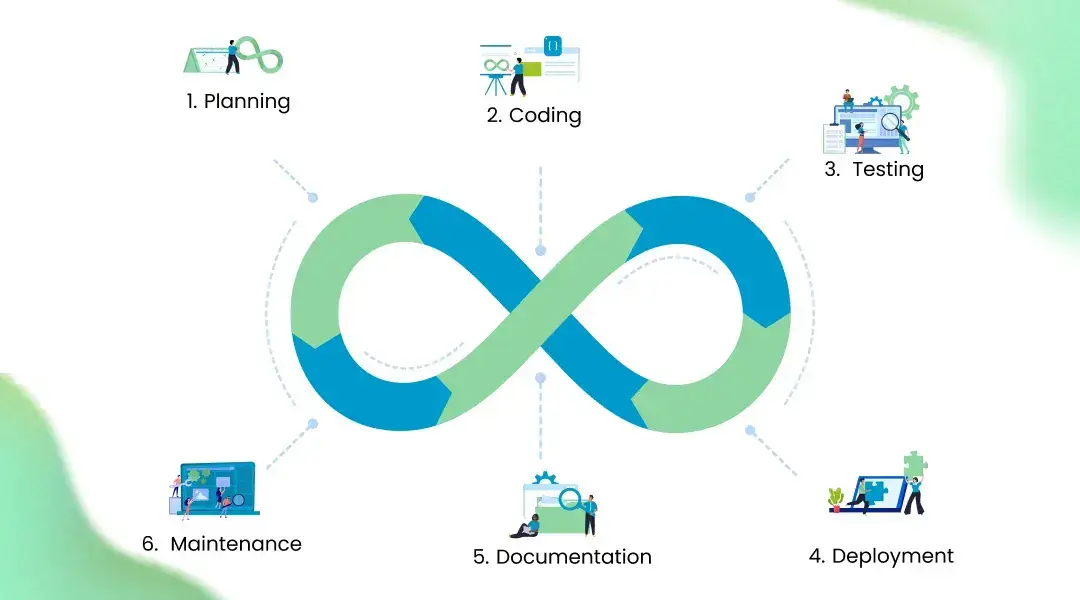
Here’s where businesses feel the real impact.
AI helps teams define requirements, generate user stories, refine acceptance criteria, and validate assumptions. (Yes, AI now writes clearer Jira tickets than many humans. Painful truth.)
This is where the magic happens. Developers use AI tools to generate functions, modules, patterns, and even full components.
Tests are produced automatically. Edge cases? AI spots them. Redundant flows? AI flags them.
AI assists with CI/CD scripts, deployment configs, environment setups, and DevOps workflows.
The part everyone avoids - AI handles it without complaining.
AI can read legacy code, explain it, and suggest improvements. That 2016 PHP mess? Suddenly less scary.
This isn’t hype. This is a workflow redesign.
After helping dozens of companies adopt Generative AI, here’s what I’ve personally seen work:
Ship MVPs in 30–50% less time. Investors love the speed. Founders finally sleep.
Use Generative AI development services to modernize legacy systems, migrate tech stacks, or accelerate digital transformation.
Improve release cycles by automating code reviews, test coverage, and feature rollouts.
Use AI to optimize infra scripts, build pipelines, detect anomalies, and stabilize deployments.
Some teams even pair this with AI Chatbots or voice interfaces for internal tools. (A few even ask about integrating with our AI Voice Agents Company solutions.)
The variety is wild and growing.
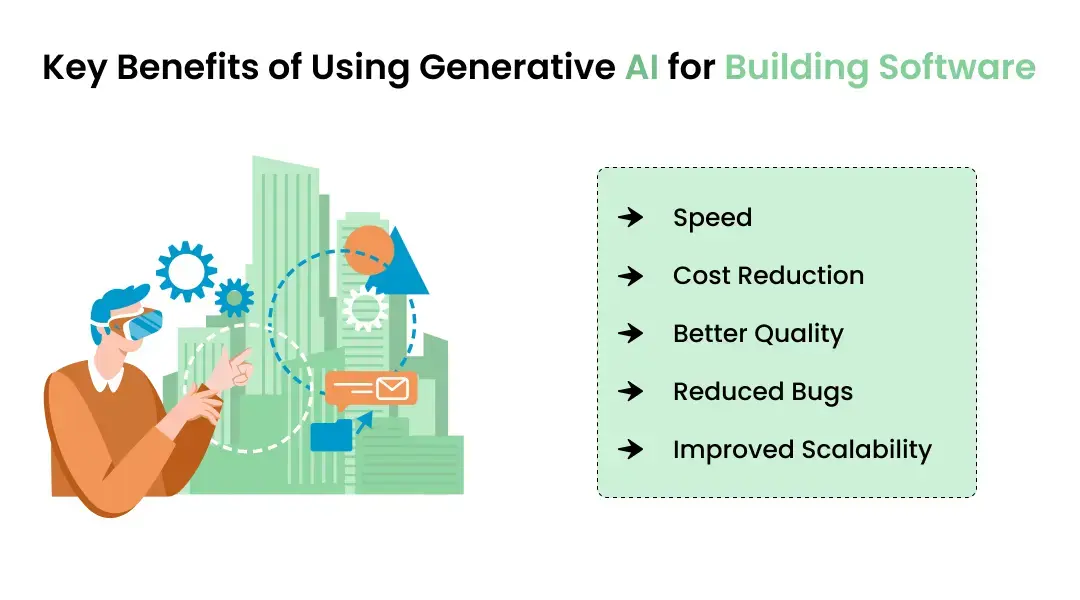
Based on real client data at KriraAI, here are the big wins:
Most engineering teams see 40–60% faster output within weeks.
Less time coding → lower development costs. Teams can reassign developers to more strategic tasks.
AI identifies vulnerabilities and improves logic consistency.
Models evaluate code patterns and highlight potential issues early.
Generative AI supports the creation of scalable AI systems that grow with your workload and architecture.
None of this requires “magic.” Just a smarter workflow.
Let’s get specific.
Write a prompt. Get working code. Refine. Ship.
AI restructures messy codebases and improves readability.
Paste your error. Get an explanation. And a fix.
Generate tests instantly—unit, integration, scenario-based.
Here’s the funny part: I once watched an engineer who hated test writing smile for the first time in months. (He now calls AI his “silent teammate.”)
These tools are reshaping how developers work day-to-day:
GitHub Copilot — autocomplete evolved into intelligence
ChatGPT — analysis, explanation, architecture ideas
AWS CodeWhisperer — great for cloud-heavy teams
Internal GenAI tools — we build these for businesses wanting custom control
When clients ask whether they should use these off-the-shelf tools or build custom AI development services, the answer is usually: Start simple. Scale intentional.
If you’re a CEO or founder, let me translate this into the metrics you actually care about:
Faster releases → better market timing
Lower development costs → improved runway
Higher innovation speed → strategic advantage
Reduced dependency on large dev teams → stability during hiring gaps
Better predictability → fewer surprises during sprints
This is why Generative AI for businesses is becoming a strategic imperative, not a luxury.
And yes, many teams even choose to Hire AI Developers specifically for integrating these workflows.
Let me be painfully honest, Generative AI adoption isn’t all sunshine.
AI-generated code is good, but not always perfect.
Sensitive data must be protected during model interactions.
Regulated industries need guardrails.
AI guesses sometimes. Those guesses can break production.
Engineers sometimes worry AI will replace them. (It won’t. It just makes them stronger.)
This is why working with a team offering Custom AI development services matters, they build safe, responsible pipelines.
Here’s my bold—but honest—take:
Software development is becoming more about designing intent than writing syntax.
Over the next 3–5 years:
Code writing will feel more like natural conversation
Testing will be 80–90% automated
Documentation will be fully AI-driven
Teams will manage AI workflows as part of standard SDLC
Companies will rely on Generative AI development services the way they rely on cloud hosting today
And developers? They won’t disappear. They’ll shift from coders → architects → orchestrators.
It’s evolution—not replacement.
I’ve guided enough companies to know this: Generative AI isn’t transforming software development someday. It’s happening now.
If you’re building a product, running engineering teams, or exploring AI-driven innovation, your next step is simple, understand how this fits your business.
And if you need help making that decision thoughtfully, KriraAI is here to be your partner. Not your vendor. Your partner.
Yes, if you want faster development, lower costs, and better productivity without sacrificing quality.
Most mid-sized projects range from moderate budgets to enterprise-level investments depending on complexity and integrations.
Absolutely. Many teams experience a 40–60% reduction within their first month.
It can be, but only with proper reviews, governance, and protected workflows.
No. AI assists developers—it doesn’t replace their judgment, creativity, or system design skills.
Founder & CEO
Divyang Mandani is the CEO of KriraAI, driving innovative AI and IT solutions with a focus on transformative technology, ethical AI, and impactful digital strategies for businesses worldwide.