Generative AI Implementation Case Study: Inference at Scale
A leading generative AI platform company was burning 2.1 million dollars every year on model inference. Each customer request hit a single frontier model, no matter how trivial. Latency at the 99th percentile had crossed 4.2 seconds. This generative AI implementation case study explains how KriraAI rebuilt that entire pipeline.
The product worked, but the unit economics were collapsing under growth. More users meant more frontier calls and a steeper cloud bill. Quality was inconsistent, and bad outputs reached production with no warning. The team had no systematic way to measure generative output quality. The platform was becoming a victim of its own success.
KriraAI engaged to fix the cost, the latency, and the quality gap together. We treated this as one engineering problem, not three separate ones. The result was a hardened LLM orchestration architecture serving real enterprise traffic. This blog walks through what we built, how we built it, and what it delivered. Every number in this story comes from the live production system.
The Problem KriraAI Was Called In To Solve
The client served generative AI features to enterprise customers through a single API. Behind that API sat one frontier model handling every request type. Summarization, classification, extraction, and chat all went to the same expensive endpoint. This worked at low volume but broke as traffic scaled.
Roughly 70 percent of incoming requests were simple and low-complexity. A small fine-tuned model could have answered them at a fraction of the cost. Instead, every one of them consumed frontier model capacity. The company paid premium token rates for work that did not need them.
The platform generated rich telemetry on every request and response. That data sat in logs that nobody queried or modelled. There was no token-level cost attribution per customer or per feature. The business could not see where the money actually went. Each ignored signal was a decision the company could have made.
Quality control was manual and covered only a tiny sample. Engineers spot-checked outputs by hand when customers complained. Around 2 percent of traffic ever received any human review. Hallucinations and format errors reached production undetected most of the time. Customers often noticed those errors before the engineering team did.
The Costs That Were Quietly Compounding
The financial damage came from three directions at once. Inference spend was rising faster than revenue per customer. High latency hurt retention on real-time features. Quality escapes drove support tickets and eroded customer trust.
Competitors were shipping faster generative features at lower price points. The client could not cut prices while inference costs kept climbing. Their roadmap was frozen because the platform could not scale economically. Generative AI cost reduction had become an existential requirement, not an optimization.
What KriraAI Built To Fix It
KriraAI built an intelligent inference orchestration layer in front of every model. It sits between the client API and all downstream model endpoints. Every request now passes through a semantic router before any model runs. That router decides the cheapest model that can answer correctly.
How A Request Flows Through The System
A request first hits the semantic router for classification and complexity scoring. The router predicts intent and difficulty from the prompt embedding. Simple requests route to a fine-tuned small language model. Hard requests route to a frontier model with retrieval grounding.
A semantic cache checks for near-duplicate requests before any model runs. Matching requests return cached responses in milliseconds at near-zero cost. For grounded tasks, a retrieval layer fetches relevant context first. The selected model then generates the response with that context attached. Repeated questions no longer cost the company anything.
Every response is scored asynchronously by an automated evaluation pipeline. An LLM-as-judge panel grades faithfulness, relevance, and format compliance. Low-scoring outputs trigger alerts and feed the retraining datasets. This closed loop runs on 100 percent of production traffic now.
What It Replaced
The system replaced a single-model architecture with a tiered model cascade. It replaced manual spot-checking with automated evaluation at full coverage. It replaced blind logging with token-level cost and quality attribution. KriraAI delivered this as a production system, not a proof of concept.
The core idea behind this LLM inference optimization is right-sizing every call. Most generative workloads do not need frontier intelligence on every request. By matching model capability to request difficulty, cost drops sharply. Quality holds because hard cases still reach the strongest models. Frontier intelligence is reserved for the requests that truly earn it.
Solution Architecture Behind This Generative AI Implementation Case Study
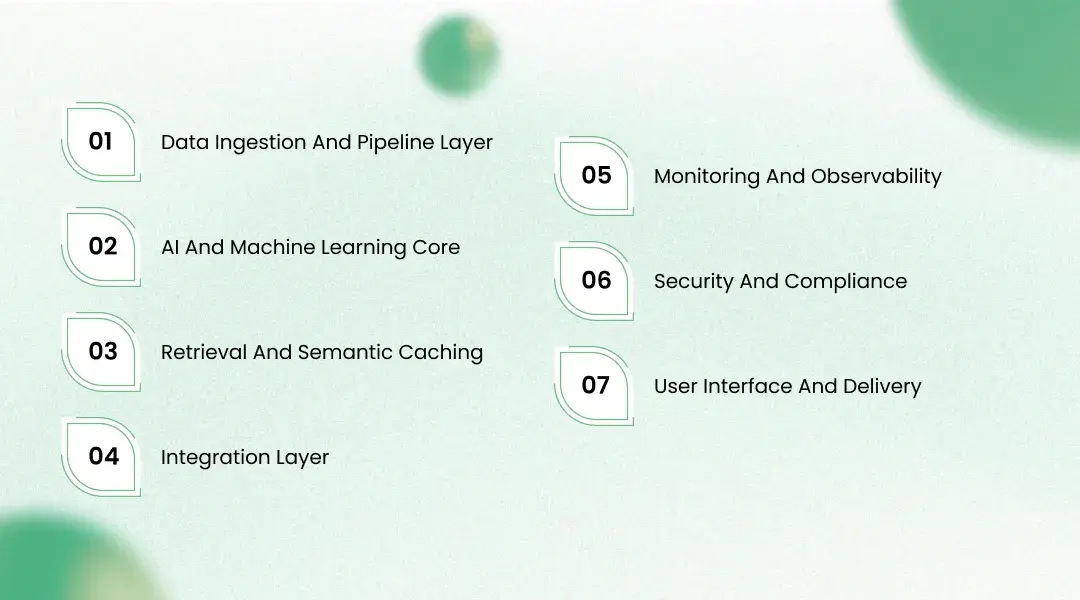
The architecture in this generative AI implementation case study spans six layers. Each layer was designed for production scale from the first day. We will walk through ingestion, the model core, integration, monitoring, security, and delivery. Every choice below had a clear engineering rationale behind it. Nothing here was bolted on after the fact.
Data Ingestion And Pipeline Layer
Request and response telemetry streams into Apache Kafka in real time. Apache Flink processes those events for token-level cost and latency attribution. Change data capture from Postgres syncs customer configuration into the platform. Batch jobs extract historical logs for evaluation and fine-tuning datasets.
Apache Airflow orchestrates the offline pipelines as versioned DAGs. Embeddings are generated at ingestion using the BGE-M3 model. A Feast feature store serves features through online and offline paths. Redis backs the online path for low-latency router lookups.
AI And Machine Learning Core
The semantic router is a fine-tuned transformer encoder based on ModernBERT. We trained it with contrastive learning to align request embeddings by difficulty. It classifies intent and predicts a complexity score per request. That score drives the routing decision across the model tiers.
The small model tier runs fine-tuned Llama 3.1 8B variants. We adapted them with LoRA on domain-specific supervised fine-tuning data. These models serve through vLLM with AWQ quantization for throughput. TensorRT-LLM handles the highest-volume routes for maximum efficiency.
The frontier tier calls hosted models for the hardest requests. Speculative decoding with a small draft model reduces frontier latency. A retrieval augmented generation pipeline grounds responses that need facts. This tiered design is the heart of our LLM orchestration architecture.
Retrieval And Semantic Caching
The retrieval layer uses Qdrant as the vector database. HNSW indexing keeps recall high while latency stays low. Hybrid search combines dense vectors with BM25 keyword matching. A cross-encoder reranker reorders the top candidates before generation.
The semantic cache stores embeddings of prior requests and responses. Incoming requests match by cosine similarity above a tuned threshold. Cache hits return instantly without invoking any model. This single layer removed a large share of redundant frontier calls.
Integration Layer
KriraAI exposed an OpenAI-compatible API so client code stayed unchanged. The client kept their existing SDK calls with zero rewrites. Internal services communicate over gRPC for low-latency routing decisions. Versioned REST and GraphQL contracts protect against breaking changes.
Evaluation results flow back through an event-driven Kafka pipeline. Webhooks push quality alerts into the client's existing incident tooling. This kept the AI layer decoupled from downstream business systems. New consumers can subscribe without touching the inference path.
Monitoring And Observability
OpenTelemetry traces every request with token-level spans end to end. Prometheus and Grafana track latency at p50, p95, and p99. Evidently monitors data drift using population stability index and KL divergence. Router accuracy is checked against a held-out golden evaluation set.
Drift on request embeddings triggers automated alerts to the on-call team. When eval scores cross a threshold, retraining jobs start automatically. Feature distribution shifts surface before they degrade routing accuracy. This observability stack keeps the system honest under changing traffic.
Security And Compliance
Model serving runs in a private VPC with no public endpoints. Role-based access control governs every API and dashboard surface. Attribute-level masking hides sensitive fields from unauthorized roles. Microsoft Presidio detects and redacts PII before any model call.
All model inputs and outputs are encrypted end to end. Audit logs write to an immutable append-only store. Prompt injection defenses screen inputs before they reach any model. The deployment meets SOC 2 and GDPR requirements for the client. Compliance was designed in, never patched on later.
User Interface And Delivery
A developer console gives the client full visibility into the platform. Real-time dashboards show cost, latency, and quality per feature. A prompt management view supports versioning and safe rollbacks. Engineers can inspect any request trace down to the token level.
The Technology Stack And Why We Chose It
Every technology in this build was chosen for a concrete reason. We matched each tool to the client's scale, constraints, and existing cloud. The platform runs on AWS using EKS for Kubernetes orchestration. KEDA autoscales GPU workloads against live queue depth. The client already trusted AWS, so we built where they lived.
Serving And Modelling Choices
We chose vLLM for serving because of its high-throughput paged attention. TensorRT-LLM was added where raw latency mattered most. Qdrant won as the vector database for its filtering and HNSW performance. We used LoRA over full fine-tuning to cut training cost and time.
Data And Operations Choices
Kafka and Flink handled streaming because the client already ran Kafka. Airflow managed orchestration since the team knew it well. Feast gave us a clean split between online and offline features. Evidently was chosen for drift detection over building it ourselves.
We avoided exotic tools that would add operational risk. Every choice favored proven systems the client could maintain after handover. This discipline is core to how KriraAI ships durable production systems. The stack is powerful, but nothing in it is fragile or obscure.
How We Delivered It: The Implementation Journey
We ran the engagement across six clearly defined phases. The whole program took 22 weeks from kickoff to full go-live. Each phase had explicit exit criteria before the next began. This structure kept a complex production LLM deployment on schedule. Discipline at each gate kept scope creep out.
Discovery and instrumentation captured real traffic patterns and cost attribution.
Architecture design defined the tiers, routing logic, and data contracts.
Development built the router, the fine-tuned models, and the evaluation pipeline.
Testing validated everything in shadow mode against live traffic.
Deployment used a canary rollout with automatic rollback guards.
Handover transferred runbooks, dashboards, and on-call procedures to the client.
The Challenges We Hit And How We Solved Them
The first challenge was messy telemetry with no token-level attribution. Logs lacked consistent schemas across older and newer services. We built a normalization layer in Flink to unify the event stream. That gave us reliable per-request cost and latency from day one.
Our first router version misclassified too many hard requests as easy. That risked quality on cases that truly needed frontier models. We retrained the router with mined hard negatives and a confidence threshold. Below that confidence, requests escalate to the frontier tier automatically.
Early retrieval relevance was weak and hurt grounded answer quality. Pure dense search missed exact-match terms the users expected. We added hybrid search and a cross-encoder reranker to fix it. Retrieval precision improved enough to ground answers reliably.
Synchronous evaluation initially added unacceptable latency to responses. We moved evaluation off the hot path into an async pipeline. Sampling and full scoring now happen after the response returns. Users get fast answers while quality monitoring still runs on everything.
[Image placeholder: request routing, escalation, and evaluation flow]
Each fix made the system more robust under real load. We validated every change in shadow mode before promoting it. By go-live, the platform was handling full production traffic confidently. KriraAI stayed engaged through stabilization, not just until launch day.
Results The Client Achieved
We measured results over the 90 days after full go-live. Every number below comes from the live production platform. The headline outcome was a 58 percent reduction in inference cost. That figure came directly from this LLM inference optimization work.
Inference cost dropped 58 percent within the first 90 days.
Latency at p99 fell from 4.2 seconds to 1.1 seconds.
The small model tier now serves 71 percent of all traffic.
Quality escapes to production dropped by 64 percent overall.
Evaluation coverage rose from 2 percent to 100 percent of requests.
Effective throughput increased by 3.4 times on the same budget.
Before the engagement, every request hit one expensive frontier model. After go-live, most requests run on cheaper fine-tuned models. Before, only 2 percent of outputs were ever reviewed. Now every single output is scored automatically.
The savings unfroze the client's product roadmap almost immediately. They reinvested the recovered budget into new generative features. This generative AI cost reduction also let them hold pricing against rivals. Faster responses improved retention on their real-time products. Confidence returned to a team that had been firefighting costs.
What This Architecture Makes Possible Next
The architecture was built to grow without rebuilding its foundation. New model tiers can slot in behind the same router. Adding a model means registering it, not re-architecting the platform. This is the advantage of a clean orchestration design.
As traffic grows, KEDA scales GPU capacity against queue depth. The semantic cache gets more effective as request volume rises. Higher volume produces richer evaluation data for continuous fine-tuning. The system improves as it runs, rather than degrading.
New use cases reuse the same routing, retrieval, and evaluation backbone. The client's two to three year roadmap builds on this foundation. They plan agentic workflows and multimodal routing on top of it. Each addition extends the platform without a costly rewrite. Reuse, not rebuild, is the design principle throughout.
Other generative AI companies can apply the same core lesson. Treat inference as a routing problem, not a single-model decision. Measure quality automatically before scaling any production LLM deployment. Build the evaluation loop early, not after the cost problem appears.
FAQs
You reduce LLM inference costs at scale by right-sizing every request. Most generative traffic is simple and does not need a frontier model. A semantic router classifies each request and sends it to the cheapest capable model. Small fine-tuned models handle the bulk of requests at a fraction of the cost. A semantic cache removes redundant calls entirely for near-duplicate requests. In this engagement, that approach cut inference spend by 58 percent in 90 days. Frontier models stay reserved for genuinely hard cases, so quality never suffers. The savings compound as request volume and cache hit rates grow over time.
Semantic model routing is the practice of choosing a model per request by meaning. A small transformer encoder reads the prompt and predicts its intent and difficulty. Based on that prediction, the router sends the request to the right model tier. Simple requests go to cheap fine-tuned models, and hard ones go to frontier models. The router in this build used a fine-tuned ModernBERT encoder trained with contrastive learning. A confidence threshold escalates uncertain cases to stronger models automatically. This keeps cost low without sacrificing quality on the requests that need real intelligence. Routing turns inference from one expensive decision into many efficient ones.
You evaluate generative AI output quality in production with an automated scoring pipeline. Every response is scored asynchronously so users never wait for evaluation. An LLM-as-judge panel grades faithfulness, relevance, and format compliance against rubrics. Reference-free metrics catch hallucinations where no ground truth exists. Scores are tracked against a held-out golden set to detect any drift. Low-scoring outputs trigger alerts and feed directly into retraining datasets. In this generative AI implementation case study, evaluation coverage rose from 2 percent to 100 percent. That full coverage cut quality escapes to production by 64 percent within 90 days.
A production LLM architecture looks like a layered system, not a single model call. It starts with a data pipeline that streams telemetry through Kafka and Flink. A semantic router and a model cascade sit at the core of the system. Retrieval and a semantic cache reduce both cost and latency on every request. An integration layer exposes a stable API while keeping internal services decoupled. Observability tracks latency percentiles, drift, and evaluation scores continuously. Security wraps everything with access control, encryption, and audit logging. This is what a hardened production LLM deployment requires beyond a basic prototype.
You prevent hallucinations in enterprise generative AI through grounding and automated evaluation together. Retrieval augmented generation attaches verified context to requests that need facts. Hybrid search and a reranker ensure the retrieved context is actually relevant. An LLM-as-judge panel then scores every response for faithfulness to that context. Outputs that fail the faithfulness check trigger alerts and review. A confidence threshold routes uncertain prompts to stronger frontier models. In this engagement, these layers together cut quality escapes by 64 percent. No single technique is enough, so KriraAI combined grounding, routing, and evaluation into one loop.
Ridham Chovatiya is the COO at KriraAI, driving operational excellence and scalable AI solutions. He specialises in building high-performance teams and delivering impactful, customer-centric technology strategies.