A recent survey of technology leaders at companies with 50 to 500 employees found that 73% consider generative AI development a strategic priority, yet only 18% have moved beyond experimentation into production deployments. That gap is not caused by a lack of ambition. It is caused by a lack of guidance written for companies that operate in the space between scrappy startups and resource-rich enterprises. Most content about generative AI development for mid-market companies either assumes you have a dedicated AI research team with a seven-figure budget or suggests you simply plug in an API key and watch the magic happen. Neither reflects reality for a company running lean engineering teams across multiple product priorities.
Mid-market companies occupy a uniquely challenging position in the generative AI landscape. They are large enough that off-the-shelf chatbot wrappers cannot address their complexity, yet small enough that building foundation models from scratch is financially absurd. They have real customers depending on reliability, compliance obligations that cannot be ignored, and engineering leaders who must justify every dollar of infrastructure spending to a board or ownership group that wants measurable returns within quarters, not years. This blog is written exclusively for that reality. It covers what generative AI applications make practical sense at this scale, what they actually cost, how to implement them without derailing your existing roadmap, and what measurable business impact you can realistically expect. If you run or lead technology at a company with 50 to 500 employees in the generative AI development space, this is the guide you have been missing.
Understanding how mid-market companies in the generative AI development space actually operate is essential before discussing adoption strategies. These are not garage startups experimenting with open-source models on personal GPUs, nor are they Google-scale research labs with unlimited compute budgets. They sit in a specific operational band that shapes every technology decision they make.
A typical mid-market generative AI company employs between 50 and 500 people, with engineering teams ranging from 15 to 120 developers. Within those teams, dedicated machine learning or AI engineers usually number between 3 and 20. The rest of the engineering organization handles product development, platform infrastructure, data engineering, and DevOps. Decision-making is faster than at a large enterprise but more layered than at a startup. A proposal to adopt a new generative AI development platform might need sign-off from a VP of Engineering, a CTO, and a finance lead, which typically takes four to eight weeks rather than a single afternoon or an 18-month procurement cycle.
Annual technology budgets at this scale typically range from $2 million to $15 million, of which AI and ML infrastructure might claim 10% to 25% depending on how central generative AI is to the company's product offering. Cloud compute costs for training and inference already consume a significant portion of that allocation. These companies usually run on AWS, Google Cloud, or Azure with moderate-to-advanced infrastructure maturity. They have CI/CD pipelines, monitoring stacks, and some form of data platform, but they rarely have dedicated MLOps teams or mature model lifecycle management systems.
The pressure on mid-market generative AI companies is distinct. They must ship production-quality AI features that compete with products from both well-funded startups burning venture capital and established enterprises with decades of data assets. They must do this while maintaining profitability or at least a credible path toward it. Every infrastructure investment is weighed against its opportunity cost. A dollar spent on a new vector database deployment is a dollar not spent on a frontend engineer who could ship the feature that closes next quarter's pipeline. This constant balancing act defines the mid-market generative AI development experience.
The conversation around adopting generative AI tools and practices is dominated by two extremes. On one end, enterprise content describes multi-year digital transformation programs with dedicated AI centers of excellence, custom model training on proprietary datasets spanning decades, and budgets measured in tens of millions. On the other end, startup content describes solo developers fine-tuning open-source models on consumer hardware and shipping MVPs in a weekend. The enterprise generative AI implementation strategy that works for a Fortune 500 company will bankrupt a mid-market team. The hacker approach that works for a five-person startup will produce systems too fragile and unscalable for a company with real customers and compliance requirements.
Mid-market companies need a fundamentally different approach to generative AI development, and that approach must account for several specific differences. Budget is the most obvious constraint, but it is not the most important one. The real differentiator is organizational complexity combined with resource limitation. A mid-market company has enough teams, products, and customers that AI adoption cannot happen in isolation. It must integrate with existing systems, respect existing data governance, and serve multiple stakeholder groups. But the company does not have enough people to staff a separate AI integration team while keeping existing product work on track.
The vendor options available at mid-market scale have expanded significantly. Companies at this size can access foundation model APIs from providers like OpenAI, Anthropic, Google, and Cohere at costs that are meaningful but manageable. They can deploy open-source models like Llama, Mistral, or Falcon on their own infrastructure with tools like vLLM or TGI. They can use orchestration frameworks such as LangChain, LlamaIndex, or Haystack without enterprise licensing fees. Partners like KriraAI specialize in helping mid-market companies navigate this landscape, building practical generative AI solutions that account for real budget and team constraints rather than selling oversized enterprise packages.
The timeline to see returns also differs sharply. Enterprise AI programs often plan for 12 to 24 months before expecting measurable ROI. Startups expect to see traction in weeks. Mid-market companies typically need to show results within one to two quarters. This means the initial use cases must be carefully selected for fast time-to-value while still demonstrating enough strategic potential to justify continued investment. Getting this selection right is arguably the single most important decision in mid-market generative AI adoption.
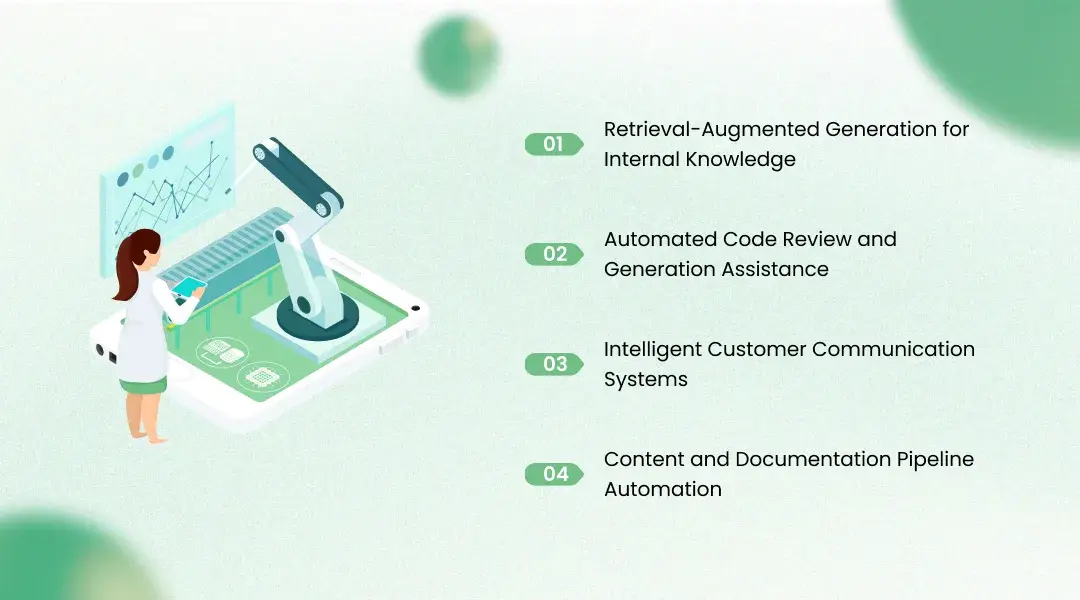
Not every generative AI application makes sense for a company with 50 to 500 employees. The right applications share three characteristics at this scale: they solve a problem that already costs the company measurable time or money, they can be implemented with existing engineering resources in under 90 days, and they do not require training custom foundation models. The following applications consistently deliver the highest return for mid-market generative AI development teams.
RAG systems that connect a large language model to a company's internal documentation, codebases, and knowledge bases are the single highest-ROI generative AI application for mid-market companies. The cost of adopting generative AI development platforms for RAG is relatively low because the core infrastructure involves a vector database, an embedding model, and API access to a foundation model. At mid-market scale, this typically runs between $2,000 and $8,000 per month in infrastructure costs.
A mid-market engineering team of 60 people that spends an average of 45 minutes per day searching for internal documentation, prior architectural decisions, or codebase context can recover approximately 225 engineering hours per week. At a blended engineering cost of $75 per hour, that represents over $67,000 in monthly productivity savings. The system can be deployed using open-source tools like LlamaIndex or Haystack with a vector store such as Pinecone, Weaviate, or Qdrant in four to six weeks with two to three engineers.
Integrating generative AI into the development workflow through code review automation, documentation generation, and test case creation yields significant returns at mid-market scale. These applications work through existing IDE integrations and CI/CD pipeline hooks, meaning they require minimal infrastructure changes. Tools in this category range from commercial options like GitHub Copilot at $19 per user per month to self-hosted solutions using open-source code models that cost $1,500 to $4,000 monthly in compute.
For mid-market companies that handle customer support, sales inquiries, or technical onboarding, generative AI-powered communication systems can reduce response times by 40% to 60% while maintaining quality. Unlike simple chatbot solutions, modern generative AI communication systems can draft nuanced technical responses, summarize customer histories, and route complex issues with contextual understanding. At mid-market volume levels of 500 to 5,000 customer interactions per month, these systems typically cost $3,000 to $10,000 monthly and can be implemented by integrating with existing CRM and helpdesk platforms.
Mid-market companies in generative AI development produce substantial technical documentation, API references, changelog entries, and marketing content. Automating portions of this pipeline with generative AI can reduce content production time by 50% to 70%. The key at this scale is not full automation but augmentation: AI generates first drafts, engineers review and refine, and the output is published through existing content management workflows. This approach costs between $500 and $3,000 per month in API usage and can be built with lightweight orchestration in two to three weeks.
The ROI of generative AI tools for growing companies must be measured against their actual operating scale, not against enterprise benchmarks that describe outcomes in millions of dollars. For a mid-market company, the meaningful metrics are time recovered per team member, cost per customer interaction reduced, deployment velocity increased, and revenue influenced through faster product iteration.
Companies with 50 to 200 employees that implement RAG-based knowledge systems report average productivity gains of 12% to 18% across engineering teams within the first quarter of deployment. For a 100-person company with 40 engineers, an 15% productivity gain is equivalent to adding six full-time engineers without the hiring cost, onboarding time, or management overhead. At an average fully-loaded engineering salary of $150,000, that represents $900,000 in annual value created from an investment of under $100,000 in infrastructure and implementation.
Customer-facing generative AI applications at mid-market scale show equally compelling returns. Companies in this size range that deploy AI-assisted customer communication report a 35% to 45% reduction in average response time and a 20% to 30% reduction in escalation rates. For a company handling 2,000 customer interactions per month with a support team of 8 to 12 people, this translates to recovering 15 to 20 hours of senior staff time per week that can be redirected to product feedback analysis and strategic customer success work.
How to build generative AI applications in a mid-size business while tracking ROI requires establishing clear baselines before deployment. Measure the current time spent on the specific task you are automating, the current error rate, and the current throughput. After deployment, track the same metrics weekly for at least 12 weeks to capture the full adoption curve. Mid-market companies that skip baseline measurement consistently underestimate their returns because they cannot quantify the improvement with precision. KriraAI works with mid-market clients to establish these measurement frameworks before implementation begins, ensuring that every generative AI investment can be tied to specific business outcomes.
The implementation path for generative AI development at mid-market scale must be compressed enough to show results within a quarter but structured enough to avoid the technical debt that comes from rushing. The following roadmap is calibrated for a company with 50 to 500 employees, a technology team of 15 to 120, and a generative AI budget of $50,000 to $250,000 for the first year.
Weeks 1 through 3: Assessment and Use Case Selection. Begin with a structured audit of your current workflows to identify the highest-impact opportunities for generative AI. Evaluate each candidate use case against three criteria: current time or cost consumed by the manual process, technical feasibility with available data and infrastructure, and organizational readiness of the team that will use the solution. Select one primary use case and one secondary use case. Do not attempt to implement more than two use cases in the first 90 days.
Weeks 4 through 6: Architecture and Vendor Selection. Design the technical architecture for your selected use cases. Decide whether to use commercial APIs, self-hosted open-source models, or a hybrid approach. Evaluate vendors against mid-market criteria specifically:
Contract flexibility with month-to-month or annual terms rather than multi-year lock-ins
Pricing transparency with clear per-token, per-seat, or per-query cost structures
Integration support for your specific tech stack and deployment model
Data handling policies that match your compliance requirements without requiring enterprise-tier contracts
Weeks 7 through 10: Build and Pilot. Implement the primary use case with a small pilot group of 5 to 15 users. Use this period to validate the technical architecture, gather user feedback, refine prompt engineering and retrieval strategies, and measure initial performance against your baselines. Allocate two to three engineers to this effort, with one serving as the technical lead who will own the system going forward.
Weeks 11 through 13: Iteration and Expansion. Based on pilot results, refine the system and expand to the full user base for the primary use case. Begin piloting the secondary use case. Establish monitoring dashboards for cost tracking, quality metrics, and usage patterns. Document architectural decisions and operational runbooks for the team that will maintain the system.
The first and most damaging mistake is attempting to fine-tune foundation models too early. Mid-market companies frequently assume that off-the-shelf models will not perform well enough for their specific domain and jump directly to fine-tuning. In practice, 80% to 90% of mid-market generative AI use cases can be solved with prompt engineering and RAG over proprietary data without any model fine-tuning. Fine-tuning should be reserved for situations where you have validated the use case with RAG, identified specific performance gaps, and accumulated enough high-quality training data to meaningfully improve the model. For most mid-market companies, this point arrives six to twelve months after initial deployment, not on day one.
The second mistake is underinvesting in evaluation infrastructure. Mid-market teams often deploy generative AI features with manual spot-checking as their only quality assurance mechanism. This works for a pilot with 10 users but fails rapidly at scale. From the first week of development, invest in automated evaluation pipelines that measure output quality, relevance, and safety on representative test sets. Open-source evaluation frameworks like RAGAS, DeepEval, or custom metric suites built with LangSmith can be implemented by a single engineer in one to two weeks.
The third mistake is treating generative AI costs as fixed rather than variable. Unlike traditional software infrastructure where costs are relatively predictable, generative AI costs scale with usage in ways that can surprise mid-market budgets. A feature that costs $500 per month during pilot can cost $15,000 per month at full adoption if token usage patterns change. Build cost monitoring and alerting from day one, set per-feature and per-user cost ceilings, and design your architecture with cost optimization as a first-class requirement. Techniques such as response caching, tiered model routing (using smaller models for simpler tasks), and prompt compression can reduce costs by 40% to 60% without meaningful quality degradation.
Mid-market companies face a category of challenges that neither startups nor enterprises encounter. The most persistent is the talent competition problem. Companies at this scale need engineers who understand both traditional software development and modern AI/ML practices. These engineers are heavily recruited by large technology companies offering compensation packages that mid-market companies cannot match. The result is that mid-market generative AI teams often operate with fewer specialized AI engineers than their ambitions require, meaning the engineers they do have must be exceptionally productive and well-supported with tooling and infrastructure.
Compliance and data governance present another mid-market-specific challenge. These companies are large enough that customers, partners, and regulators expect formal data handling policies, SOC 2 compliance, and clear documentation of how AI systems use and store data. But they are too small to have dedicated compliance teams or legal counsel specializing in AI governance. The practical solution is to adopt frameworks that embed compliance into the development process rather than treating it as a separate workstream. This includes selecting vendors with strong compliance certifications, using data processing pipelines that enforce retention and access policies automatically, and documenting AI system behavior as part of standard engineering documentation practices.
The integration complexity challenge is equally significant. A mid-market company with 50 to 500 employees typically runs 15 to 40 SaaS tools, multiple internal databases, and a mix of legacy and modern APIs. Generative AI systems that need access to this data must navigate authentication, rate limiting, schema inconsistencies, and data freshness issues across all of these sources. This integration work often consumes 40% to 60% of total implementation effort, yet it is almost never discussed in vendor marketing materials or generic adoption guides.
The mid-market generative AI development landscape in 2028 to 2030 will look dramatically different from today, and the companies that establish strong foundations now will hold structural advantages that late adopters will struggle to overcome. The advantage is not simply “having AI” versus “not having AI.” It is the compounding effect of data assets, team expertise, and process optimization that accumulates over years of operational AI usage.
Companies that deploy generative AI systems today begin building proprietary datasets from user interactions, quality feedback, and domain-specific evaluation results. Over three to five years, these datasets become a significant competitive moat. They enable fine-tuned models that outperform generic alternatives on domain-specific tasks, and they create evaluation benchmarks that drive continuous improvement. A mid-market company that waits until 2028 to begin this process will face competitors who have three years of compounding data advantage and operational AI maturity that cannot be purchased or shortcut.
The talent dimension compounds similarly. Engineering teams that work with generative AI systems for three years develop intuitions, debugging skills, and architectural patterns that are extraordinarily valuable and difficult to replicate. Mid-market companies that invest in AI capabilities now are building teams that will be highly sought-after, meaning they must also invest in retention. But companies that delay will face an even harder talent market in 2028, competing for the same AI-experienced engineers with less interesting technical challenges to offer. KriraAI advises mid-market clients to view generative AI adoption not as a technology project but as a capability-building investment whose returns compound annually.
Three insights should guide every mid-market company's approach to generative AI development. First, use case selection matters more than technology selection. The companies that succeed at this scale are not the ones using the most advanced models; they are the ones solving the most impactful problems with reliable, cost-effective implementations. Second, measurement is not optional. Establishing baselines, tracking ROI weekly, and monitoring costs per feature are the practices that separate strategic AI adoption from expensive experimentation. Third, the competitive window is open now but closing. The compounding advantages of early AI adoption in data assets, team expertise, and process optimization mean that every quarter of delay creates a gap that becomes progressively harder to close.
For mid-market companies navigating this transition, KriraAI provides the specialized expertise that bridges the gap between enterprise AI consulting and startup-oriented tooling. KriraAI builds practical, scalable generative AI solutions designed specifically for companies with 50 to 500 employees, accounting for real budget constraints, existing team capabilities, and the need to show measurable results within quarters. Whether you are evaluating your first generative AI use case or looking to scale from pilot to production, working with a partner who understands mid-market realities can compress your timeline and reduce your risk significantly. Explore how KriraAI can help your team build generative AI capabilities that deliver lasting competitive advantage at your actual scale.
A mid-market company with 50 to 500 employees should plan for an initial generative AI development budget of $75,000 to $250,000 for the first year, depending on the scope of use cases and whether the company builds primarily on commercial APIs or invests in self-hosted infrastructure. This budget should cover cloud compute costs for inference and any model hosting, API usage fees for commercial foundation models, tooling and platform subscriptions for orchestration and evaluation, and approximately 1.5 to 3 full-time-equivalent engineering effort. Companies at the lower end of the mid-market range can start meaningfully with $75,000 by focusing on a single high-impact use case using commercial APIs, while companies closer to 500 employees with more complex requirements should plan for $150,000 to $250,000 to support multiple parallel use cases and more sophisticated infrastructure.
Mid-market companies that select their initial use cases carefully and follow a structured implementation approach can expect to see measurable ROI within 8 to 14 weeks of beginning development. The key variable is use case selection: applications that automate high-frequency, time-consuming tasks with clear baselines, such as internal knowledge retrieval, documentation generation, or customer response drafting, show returns fastest because the time savings are immediately quantifiable. Applications that aim to improve decision quality or enable new capabilities take longer to demonstrate ROI because the measurement is inherently more complex. The cost of adopting generative AI development platforms at mid-market scale is low enough that even modest productivity improvements of 10% to 15% across a team of 20 to 30 people generate positive returns within the first quarter.
The optimal approach for most mid-market companies is a hybrid model where an external partner handles initial architecture design, vendor selection, and pilot implementation while internal engineers participate actively and take ownership of ongoing operations. Building entirely in-house is risky because mid-market teams rarely have deep expertise in prompt engineering, RAG architecture, model evaluation, and AI-specific DevOps simultaneously. Hiring an external partner for everything creates dependency and prevents the internal team from developing the expertise needed for long-term iteration. The hybrid approach, where a partner like KriraAI provides the specialized generative AI development expertise while your engineers learn through hands-on collaboration, builds internal capability while managing implementation risk. Plan for the external partnership to be intensive for 60 to 90 days and then transition to advisory support as your team gains confidence.
The three most significant risks for mid-market generative AI adoption are uncontrolled cost escalation, quality regression in production, and organizational resistance. Cost escalation occurs when token usage grows faster than anticipated because generative AI systems are used more broadly than planned or because prompt designs are inefficient. Quality regression happens when model providers update their foundation models and previously working prompts or retrieval strategies degrade without warning. Organizational resistance emerges when teams that were not involved in the adoption decision resist changing established workflows. Mid-market companies mitigate these risks by implementing cost monitoring with hard limits from day one, maintaining evaluation suites that run automatically against model updates, and involving end-user teams in use case selection and pilot testing from the earliest stages.
Mid-market companies can absolutely compete with and even outperform large enterprises in specific generative AI capabilities, though the strategy must be different. Large enterprises have more data, more compute budget, and more specialized talent, but they also move slower, face more internal politics, and struggle to deploy AI features to production quickly due to complex governance structures. A mid-market company with 50 to 500 employees can identify a high-value use case, build a solution, deploy it to production, gather feedback, and iterate within 90 days. The same process at a large enterprise often takes 12 to 18 months. This speed advantage means mid-market companies can compound improvements faster in focused areas, building deeply specialized AI capabilities that larger competitors cannot replicate simply by spending more money. The key is choosing the right areas to compete and executing with disciplined focus rather than trying to match enterprise breadth.
Ridham Chovatiya is the COO at KriraAI, driving operational excellence and scalable AI solutions. He specialises in building high-performance teams and delivering impactful, customer-centric technology strategies.
