I’ve walked into companies where the “knowledge management system” was a polite name for chaos.
Google Drive folders nested six levels deep. Slack threads acting as policy manuals. Employees ask the same HR question ten times a week. And leadership is wondering why productivity keeps slipping.
Let me ask you something uncomfortable:
How many hours did your team waste last week just searching for information?
That’s not a technology problem. That’s a knowledge architecture failure.
And this is where an AI internal assistant, built through purpose-driven custom AI chatbot development rather than off-the-shelf tools, shifts the conversation from storage to intelligence.
An AI internal assistant is an intelligent system trained on your company’s internal data documents, policies, emails, CRMs, and project tools that provides contextual, conversational answers to employees.
It is not a glorified search bar.
It is AI knowledge management brought to life.
At its core, an AI-powered knowledge management system combines:
Large language models
Secure data indexing
Role-based access controls
Continuous feedback learning
When an employee asks a question, the system doesn’t just keyword-match. It understands intent. It pulls context from internal documents. It generates a precise, source-backed answer.
And yes, security is baked in. We design enterprise AI assistants so HR data stays with HR, and finance data stays with finance.
Because trust is non-negotiable.
I’ll be blunt.
Most chatbots are scripted FAQ machines, though it's worth understanding how modern AI chatbots understand business context before writing off the category entirely
An enterprise AI assistant thinks in context.
Chatbots → Predefined responses. AI internal assistants → Dynamic reasoning across company knowledge.
If your “AI” can’t explain policy differences between two departments based on internal memos, it’s not AI for knowledge management. It’s automation theater.
Let’s name the real problems.
Departments hoard data unintentionally. Marketing doesn’t see sales updates. Operations doesn’t know product revisions.
Fragmentation kills speed.
You have documentation. Somewhere.
But can a new hire find the right version in under 3 minutes?
Exactly.
I’ve seen onboarding cycles stretch to 90 days simply because new employees cannot navigate internal knowledge efficiently.
That’s expensive.
“How do I apply for leave?” “Where is the updated pricing sheet?” “Who approves vendor contracts?”
Multiply that by 200 employees.
Now multiply by 12 months.
Five versions of the same SOP. Two marked “final.” One is actually current.
This is why knowledge management automation matters.
Here’s where things get interesting.
Employees ask questions as they speak.
No rigid filters. No folder digging.
An AI assistant for internal teams understands nuance.
If a sales rep asks about pricing policy, they see relevant sales documentation, not HR memos.
An AI employee assistant respects role context.
Long legal contract?
The AI generates key points instantly.
(And yes, I’ve personally watched legal teams save hours every week using this alone.)
Instead of waiting for IT tickets, employees get answers instantly. An internal AI assistant for business operations becomes a 24/7 knowledge partner.
The more it’s used, the smarter it becomes.
Not magically.
Systematically.
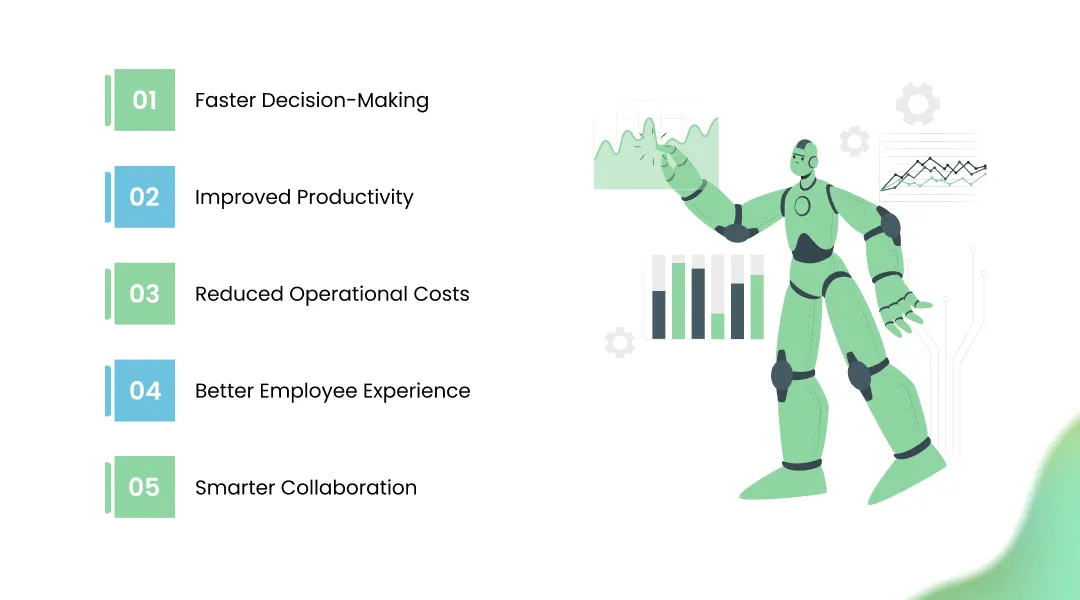
Leaders stop guessing.
Data becomes accessible.
When employees stop searching, they start executing.
Simple math.
Less repetitive HR and IT support. Faster onboarding. Lower friction.
That’s measurable ROI.
Let me shift tone for a moment.
I once worked with a mid-sized SaaS company where frustration wasn’t technical; it was emotional. Employees felt stupid asking basic questions repeatedly.
After implementing an AI knowledge management system, things changed.
People felt supported.
Small shift. Big morale boost.
Shared intelligence reduces misalignment.
An enterprise AI assistant becomes a collective brain.
This isn’t theory.
Policies, leave rules, benefits explanations. Instant answers.
Password resets. Access requests. Troubleshooting guides.
Latest pricing sheets. Case studies. Proposal templates.
Regulatory documentation. Contract clarifications.
Engineering guidelines. Release notes. API documentation.
Across industries, including IT, consulting, and e-commerce businesses adopting AI internally, the pattern repeats.
Which is why companies searching for the Best AI development Company increasingly focus on internal productivity, not just customer-facing bots.
Let’s compare.
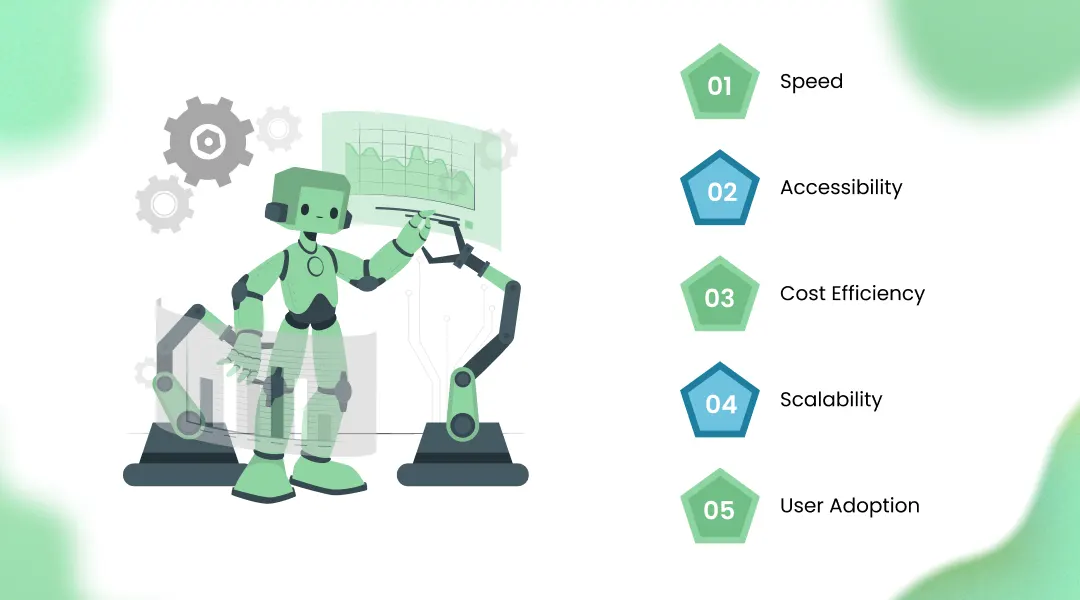
Traditional systems: Manual search. AI: Conversational answers.
Traditional: Requires training. AI: Feels intuitive.
Traditional: Hidden productivity loss. AI: Direct operational savings.
Traditional systems struggle with data growth.
AI knowledge management scales with data.
Here’s the truth.
If employees don’t use it, it fails.
AI internal assistants win because they feel human.
Generative AI changed the equation.
Large language models allow:
Intelligent summarization
Contextual reasoning
Personalized responses
Instead of static databases, you get living systems.
Future versions of AI for knowledge management will adapt to employee behavior. Predict what information is needed next.
Proactive, not reactive.
Imagine your AI assistant reminding a manager about a compliance update before audit week.
That future is nearer than most realize.
This is where strategy matters.
Map your internal knowledge sources.
Clean what’s outdated.
Garbage in, garbage out.
CRM. ERP. Document repositories. Communication tools.
Integration defines effectiveness.
Customize models to company tone, policies, and workflows, the same fine-tuning discipline behind how a corporate AI copilot supports employees day to day.
No generic deployments.
Role-based access.
Encryption.
Audit logs.
If your AI cannot meet enterprise security standards, don’t deploy it.
Monitor usage.
Collect feedback.
Refine responses.
This is where experienced partners matter. Businesses seeking the Best AI development Company should prioritize implementation depth over flashy demos.
The Future of AI in Enterprise Knowledge Management
We’re moving toward:
AI suggests information before you ask.
Flagging risks. Highlighting inconsistencies.
Hands-free access for field teams.
Specialized AI agents handle internal workflows end-to-end.
Knowledge management automation will evolve from a support function to strategic infrastructure.
And companies that adopt early? They move faster.
At KriraAI, we believe AI internal assistants are not about replacing humans.
They are about removing friction.
AI knowledge management transforms scattered information into accessible intelligence. It reduces waste. It increases clarity. It respects employee time.
And in my experience leading enterprise deployments, the companies that win are not the ones chasing hype.
They are the ones architecting internal intelligence deliberately.
The future of enterprise productivity will not be defined by who stores more data.
It will be defined by who understands it better.
An AI internal assistant is a system trained on company data that provides contextual answers to employees using natural language understanding and secure data indexing.
AI improves internal knowledge management by enabling conversational search, smart summarization, contextual access, and knowledge management automation across departments.
Chatbots rely on predefined responses. Enterprise AI assistants use large language models and internal data to generate dynamic, context-aware answers.
Start with a data audit, integrate internal systems, fine-tune the model, ensure security compliance, and continuously optimize based on usage feedback.
Yes, when built properly with role-based access control, encryption, and compliance safeguards tailored to enterprise requirements.
Founder & CEO
Divyang Mandani is the CEO of KriraAI, driving innovative AI and IT solutions with a focus on transformative technology, ethical AI, and impactful digital strategies for businesses worldwide.