I’ve been building and auditing computer vision systems long enough to recognize a familiar pattern.
The demo looks magical. The sales deck looks confident. And six months later, the system quietly gets switched off.
Not because computer vision technology doesn’t work. But because businesses were sold a fantasy instead of a future.
So let’s talk honestly - about where Computer Vision Services are actually going, what computer vision trends matter, and how businesses can prepare without burning money or trust.
Let’s strip this down to basics.
Computer Vision Services enable machines to see, interpret, and act on visual data - images, videos, camera feeds. This is not sci-fi. It’s applied mathematics, data, and engineering.
If software can read text, computer vision software services can “read” images and video. It identifies objects, tracks movement, detects defects, and flags anomalies.
That’s it. No magic.
Right now, I see computer vision in business used for:
Detecting defects on factory lines
Monitoring patient scans in hospitals
Tracking footfall and shelf activity in retail
Improving safety through AI vision systems
This is the present. The future? Much more decisive.
Here’s the uncomfortable truth.
Companies that delay computer vision adoption won’t just be slower. They’ll be structurally disadvantaged.
Vision-based automation reduces rework, waste, and human error. I’ve seen inspection costs drop by 30–40% when done right.
Unlike manual processes, computer vision automation doesn’t get tired, distracted, or inconsistent.
When your systems can see patterns humans miss, decisions become faster and smarter.
Ask yourself this (seriously): Are your competitors already testing this while you’re still “researching”?
This is where hype usually takes over. I won’t let it.
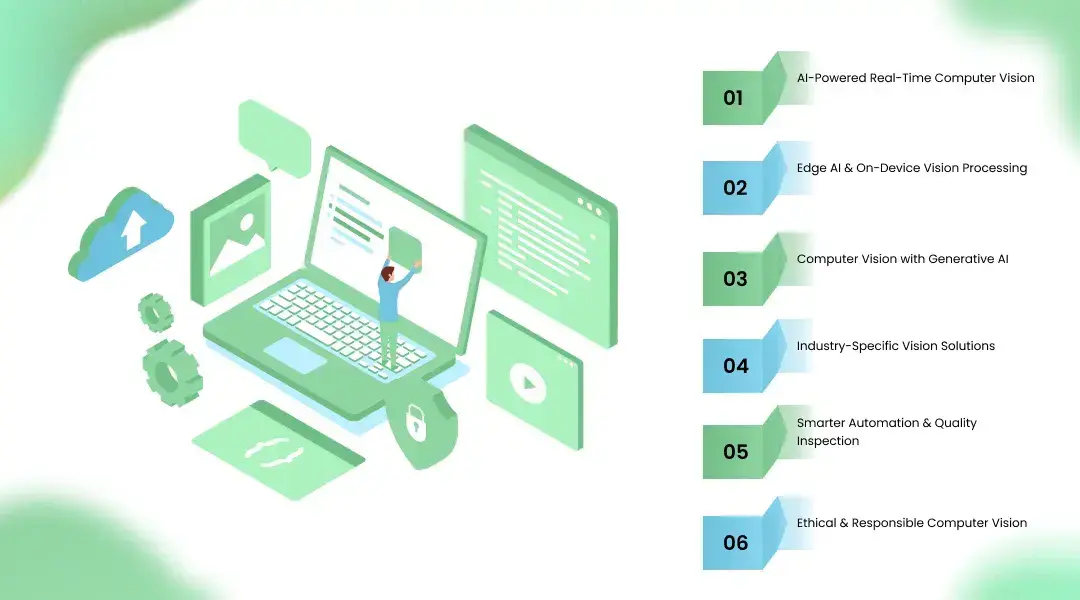
Real-time computer vision is moving from “nice demo” to operational necessity.
Factories reacting instantly to defects. Retail systems responding to live customer movement. Security platforms detect threats as they happen.
Latency is becoming unacceptable. Speed is survival.
Sending everything to the cloud is expensive and risky.
Edge-based computer vision technology processes data on devices themselves. Lower latency. Better privacy. Reduced bandwidth cost.
And yes, it actually works now.
This is subtle, but important.
Generative models are being paired with deep learning computer vision to:
Improve training with synthetic data
Handle rare edge cases
Reduce dependency on massive real-world datasets
Less data chaos. More resilience.
Generic models are failing.
The future belongs to computer vision solutions for business that understand context:
Medical-grade vision for healthcare
Industrial-grade vision for manufacturing
Retail-aware vision that understands consumer behavior
One-size-fits-all is quietly dying.
Machine learning computer vision is becoming judgment-based, not just rule-based.
Systems don’t just detect defects. They learn which defects actually matter.
That’s a big shift.
This isn’t optional anymore.
Bias, consent, and data misuse are forcing companies to rethink deployment. Regulation will follow. Quickly.
Ignoring this now is future technical debt.
Let’s ground this in reality.
Early anomaly detection in scans
Patient monitoring through non-invasive vision systems
Reduced diagnostic fatigue for doctors
Computer vision in healthcare isn’t replacing clinicians. It’s protecting them from overload.
Predictive maintenance
Zero-defect quality control
Worker safety monitoring
Computer vision in manufacturing directly impacts margins. Full stop.
Real-time shelf monitoring
Customer behavior analysis
Theft and loss prevention
Computer vision in retail turns physical stores into data-rich environments.
Behavioral anomaly detection
Automated threat alerts
Reduced human monitoring fatigue
This is where AI vision systems quietly outperform humans.
Traffic optimization
Package damage detection
Infrastructure monitoring
Cities that see better… operate better.
Here’s where most fail.
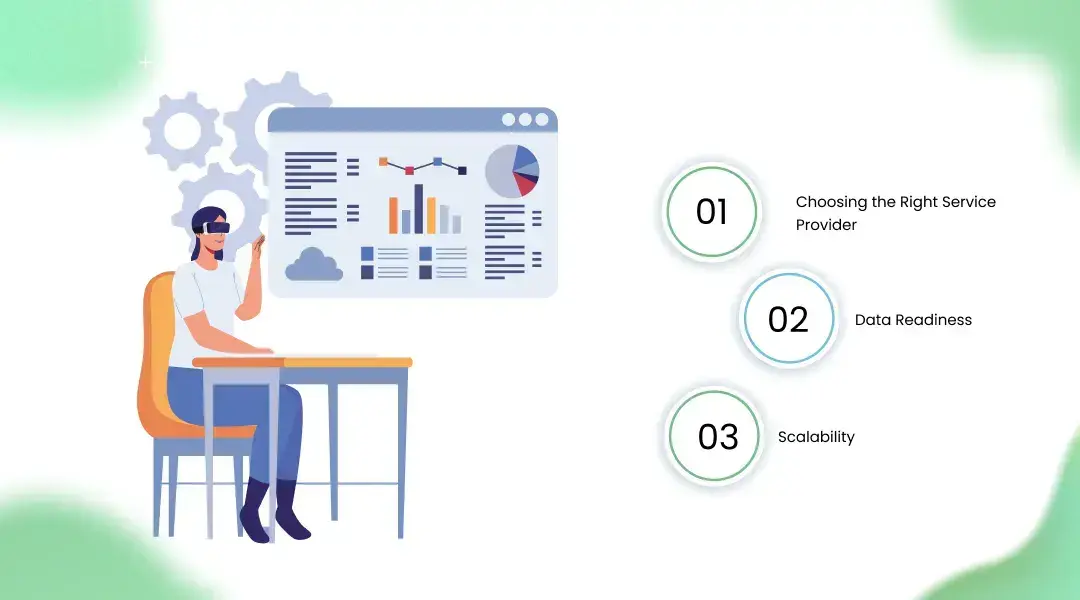
A real computer vision service provider asks uncomfortable questions about your data, goals, and constraints.
If they promise results before understanding context—walk away.
Your cameras may be fine. Your data pipelines probably aren’t.
Clean, labeled, and representative data decides success.
Pilots are easy. Scaling is hard.
Design for expansion from day one or rebuild later at triple cost.
(Yes, I’ve seen this mistake more times than I care to admit.)
Let’s not pretend this is effortless.
More cameras mean more responsibility. Mishandling visual data erodes trust fast.
Vision systems reflect the data they’re trained on. Garbage in. Bias out.
Edge devices, compute, maintenance - this requires planning, not impulse buying.
This is where KriraAI’s philosophy comes in.
We don’t sell prepackaged dreams. We design systems that fit reality.
Computer vision applications differ wildly by industry. Context beats clever code.
Vision systems evolve. Models decay. Environments change.
Long-term partnership matters more than initial pricing.
And yes, this mindset extends across what we build, from Computer Vision Services to AI Chatbots, from being an AI Voice Agents Company to delivering Best AI Voice Agent Solutions and helping clients Hire AI Developer teams that actually ship.
The future of computer vision isn’t louder demos or bigger claims.
It’s quieter. More practical. More accountable.
Businesses that treat computer vision technology as a long-term capability, not a checkbox - will win.
The rest will keep chasing demos that never make it to production.
I’ve seen both paths. Only one scale.
It’s moving toward real-time, industry-specific, and edge-based systems that deliver measurable operational impact.
Healthcare, manufacturing, retail, security, logistics, and smart infrastructure see the fastest ROI.
Costs depend on scale, data readiness, and infrastructure. Poor planning increases expense more than technology itself.
Look for domain expertise, transparency, and long-term support—not just impressive demos.
Yes, with focused use cases and scalable architecture, even small teams can deploy effectively.
Founder & CEO
Divyang Mandani is the CEO of KriraAI, driving innovative AI and IT solutions with a focus on transformative technology, ethical AI, and impactful digital strategies for businesses worldwide.