By early 2024, a leading enterprise NLP service provider was running more than fourteen hundred separately deployed text models in production. Every customer received a bespoke pipeline, and every pipeline reserved its own dedicated GPU capacity. Average cluster utilization sat at roughly eighteen percent, which meant the company paid for accelerators that idled most of the day.
This enterprise NLP solution case study documents what happened when that model sprawl became financially and operationally unsustainable. The client sold language intelligence to its own enterprise customers, yet its internal serving estate was the single largest threat to its margins. Onboarding a new tenant took four to six weeks of bespoke fine tuning and manual deployment work.
KriraAI was brought in to redesign the platform from the serving layer upward. We are an applied AI engineering firm that builds production language systems for companies whose entire revenue depends on them. This blog covers the problem we inherited, the system we built, the full architecture, the delivery journey, and the measured results the client achieved.
The client had grown by saying yes to every customer request. Each enterprise account asked for slightly different entity schemas, classification taxonomies, and tone of voice in generated summaries. The engineering team answered each request by cloning a base model, fine tuning it on tenant data, and deploying it as an isolated service.
That answer worked at fifty tenants and collapsed at a thousand. The fleet had grown to over fourteen hundred fine tuned encoder and decoder models. Most of them served a handful of requests per minute, yet each one held a GPU slice warm so latency stayed acceptable. The result was an inference bill growing faster than revenue.
The data situation was equally broken underneath the serving layer. Tenant training corpora lived in inconsistent formats across object storage, relational tables, and ad hoc exports. Annotation was almost entirely manual, and a single new tenant taxonomy could consume two analyst weeks of labeling. Valuable production signals, such as which predictions customers corrected, were logged but never fed back into training.
Human decisions were also too slow to keep up with the platform. When a model started drifting, nobody noticed until a customer complained. There was no automated drift detection, no held out evaluation cadence, and no retraining trigger. Engineers diagnosed degradation reactively, often days after accuracy had already fallen below contractual thresholds.
The costs of this inefficiency compounded in three directions at once.
Cloud accelerator spend climbed every quarter because idle GPUs scaled with tenant count rather than with actual traffic.
Customer onboarding velocity stalled, which directly capped how fast the sales team could close and activate new logos.
Engineering capacity was consumed by repetitive fine tuning and firefighting instead of building differentiated language capabilities.
Competitive pressure made the status quo impossible to defend. Newer entrants were shipping consolidated language platforms with self service onboarding measured in hours. The client risked losing renewals to vendors who could provision a custom NLP pipeline before a prospect finished their evaluation. The board had set a clear mandate to fix unit economics within two quarters.
This was the operational reality when our engagement began. The client did not need a proof of concept or another isolated model. They needed a single platform that could serve thousands of tenants from shared infrastructure without sacrificing per tenant accuracy.
KriraAI designed and delivered a unified multitenant LLM serving platform that replaced the fourteen hundred isolated models with one shared foundation. At the center of the system sits a single instruction tuned transformer backbone in the eight billion parameter class. Tenant specialization no longer happens by cloning the model; it happens through lightweight adapters loaded at request time.
The core mechanism is LoRA adapter fine tuning. Instead of training a full copy of the base model per tenant, we train a small set of low rank adapter weights that capture each customer's taxonomy, entity definitions, and stylistic preferences. These adapters are typically a few megabytes each, so thousands of them coexist cheaply. The serving runtime swaps the correct adapter onto the shared backbone for every incoming request.
The platform handles three families of language tasks through one consolidated path. Classification and extraction tasks route through the backbone with tenant adapters and structured decoding constraints. Generative tasks such as summarization and reply drafting use the same backbone with retrieval grounding. Semantic search and deduplication run on a separately trained embedding model.
For grounded generation, KriraAI built a retrieval augmented generation pipeline rather than relying on parametric memory alone. When a tenant requests a summary or an answer, the system retrieves the most relevant context from that tenant's private vector index. A cross encoder reranks the candidates, and only the top passages are injected into the prompt. This keeps generated outputs anchored to the customer's own documents and dramatically reduces fabrication.
Data flows through the system in a clear sequence from request to response.
An inbound API call arrives carrying the tenant identifier, the task type, and the input text or document reference.
A router resolves the correct LoRA adapter and, for retrieval tasks, the correct vector namespace for that tenant.
The backbone executes the task on shared GPUs using continuous batching so concurrent tenants share the same forward passes.
Structured outputs are validated against the tenant schema, then returned synchronously or pushed to downstream systems through webhooks.
The embedding model deserves its own mention because it powers search across the platform. We fine tuned it with contrastive learning so that semantically similar tenant phrases align closely in vector space. This alignment lets the retrieval layer find relevant context even when wording differs sharply from the query. The same embeddings feed deduplication and near duplicate detection for ingestion.
What this replaced is as important as what it added. The fourteen hundred standalone services were retired and their traffic migrated onto the shared backbone. The manual labeling workflow was augmented with an active learning loop that surfaces only the most informative samples for human review. KriraAI delivered this as a hardened production system carrying real enterprise traffic, not as an experiment.
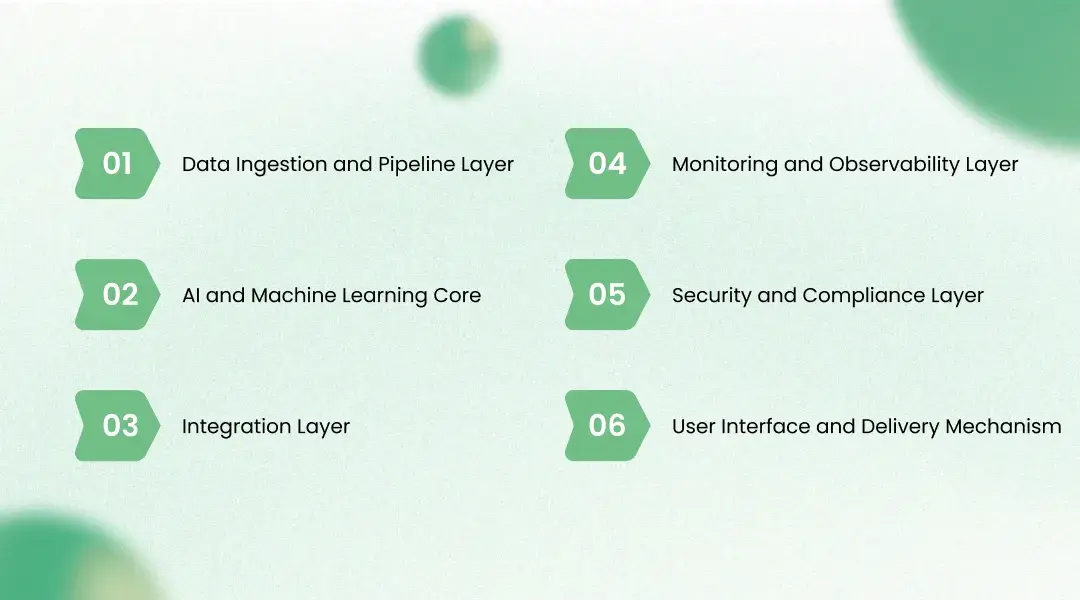
This enterprise NLP solution case study turns on the architecture, so we walk through it layer by layer. Every layer was designed for multitenancy first, because tenant isolation and shared efficiency are the two requirements that fight each other hardest in this domain. The engineering rationale behind each decision was to maximize shared infrastructure while keeping each tenant's data and behavior strictly separated.
Ingestion had to absorb messy tenant data from many sources without forcing customers to change their systems. We implemented change data capture from operational databases using Debezium, streaming row level changes into Apache Kafka topics partitioned by tenant. Batch corpora arrive from object storage through scheduled extractions, and high volume tenants stream events directly.
Transformation logic runs as stream and batch jobs that normalize every source into one canonical schema. Apache Flink handles stateful stream processing, while heavier batch transforms run on Spark. The pipeline performs schema normalization, entity resolution to collapse duplicate references, temporal feature engineering, and PII redaction before any text reaches training storage. Embeddings are generated at ingestion time so retrieval indexes stay current.
Orchestration is owned by Dagster, which manages the pipeline DAGs and enforces data quality checks between stages. We chose Dagster over plain Airflow because its asset based model maps cleanly onto per tenant datasets and makes lineage explicit. A failed quality gate halts promotion of bad data rather than silently poisoning a tenant's adapter.
The core is built on PyTorch with Hugging Face Transformers and the PEFT library for adapter management. The instruction tuned backbone was produced through supervised fine tuning on a curated cross tenant corpus, followed by a preference optimization pass that improved instruction following on extraction and summarization. Per tenant behavior is then layered on through LoRA adapter fine tuning, keeping each customer's footprint tiny.
Distributed training runs on a Ray cluster across multiple GPU nodes, with experiment tracking in Weights and Biases and model registry in MLflow. For inference, we serve the backbone with vLLM, which gives us continuous batching and paged attention so concurrent tenants share GPU memory efficiently. High throughput tenants are additionally served through TensorRT compiled engines, and weights are quantized with AWQ to fit more concurrent adapters per accelerator.
A lightweight task router sits in front of the backbone and behaves like a mixture of experts dispatcher across task families. It inspects the request, selects the adapter, applies structured decoding for classification, and enables retrieval for generative calls. The embedding model and the cross encoder reranker run as separate services so search load never competes with generation load for GPU time.
Integration was built event driven so AI outputs reach the customer's downstream systems reliably. External access is exposed through versioned REST and GraphQL APIs, with GraphQL handling the flexible field selection that NLP clients constantly ask for. Internal service to service calls use gRPC for low latency, keeping the router, backbone, embedding service, and reranker tightly coupled in performance terms.
Asynchronous and long running jobs flow through Kafka backed queues so a slow document never blocks an interactive request. When the platform produces a result, it can return it synchronously or fire a webhook into the tenant's workflow tools. API contracts are versioned explicitly so we can evolve schemas without breaking existing tenant integrations.
Observability is what finally killed silent model decay for the client. We track latency at the p50, p95, and p99 percentiles per tenant and per task type, with Prometheus scraping metrics and Grafana rendering the dashboards. Drift detection runs on Evidently, computing population stability index and KL divergence between live input distributions and training baselines.
Model quality is checked against held out evaluation sets on a fixed cadence, not only when something breaks. When drift metrics or evaluation scores cross defined thresholds, an automated retraining trigger fires through the orchestration layer for the affected tenant adapter. This closed loop means degradation is caught and corrected before it reaches a contractual breach.
Security had to satisfy enterprise buyers who entrust their text to the platform. We implemented role based access control with attribute level data masking, so analysts see only the fields their role permits. Model inputs and outputs are encrypted end to end, and the platform runs inside a private VPC with no public model endpoints exposed.
Every access and inference event is written to an immutable append only audit log, which supports forensic review and customer audits. Tenant data isolation is enforced at the storage, vector namespace, and adapter level so no tenant can influence another's behavior. The deployment was aligned to SOC 2 and GDPR obligations that govern processing of customer text at this scale.
Delivery happens through a developer console, language SDKs, and the public APIs. The console gives tenant administrators self service control over taxonomies, adapter status, and usage analytics. KriraAI built the onboarding flow so a new tenant can upload a corpus, trigger adapter training, and validate outputs without an engineer manually deploying a model.
[Diagram: end to end request path from API gateway through router, adapter selection, retrieval, backbone inference, and webhook delivery]
Every technology in the stack was chosen against the client's existing environment and scale rather than picked for novelty. The infrastructure ran on Kubernetes via managed EKS, provisioned entirely through Terraform, because the client's platform team already operated Kubernetes and needed reproducible environments across regions.
For serving, vLLM won over a naive Triton deployment because continuous batching is the single biggest lever for a multitenant LLM serving platform. Idle GPU time was the original problem, and vLLM's scheduler keeps the accelerators busy by interleaving requests from many tenants. TensorRT and AWQ quantization were added on top to raise the number of adapters resident per GPU.
The remaining choices each had a concrete rationale tied to the workload.
We selected Milvus as the vector database with HNSW indexing because per tenant namespaces and high recall at low latency were both hard requirements, and HNSW gave the best query speed at our index sizes.
We used Feast as the feature store with separate online and offline paths so training features and serving features stay consistent and never silently diverge.
We chose Dagster for orchestration because asset based DAGs model per tenant datasets and lineage far better than task only schedulers for this workload.
We standardized on Kafka and Flink for ingestion because the client already streamed events and needed exactly once stateful processing rather than fragile batch scripts.
PyTorch, Hugging Face Transformers, and PEFT formed the modeling foundation because they are the mature standard for adapter based work and gave the client a hiring pool that already knew the tools. MLflow and Weights and Biases provided the registry and experiment tracking that the team had previously lacked entirely. Redis backed the low latency caches for adapter metadata and hot retrieval results.
The full NLP platform implementation ran twenty two weeks from kickoff to general availability. KriraAI delivered it in six phases, and we share the real friction honestly because that is where the engineering judgment showed up. Each phase had an explicit exit criterion before the next one began.
Discovery and requirements ran for three weeks. We mapped the fourteen hundred existing models, profiled their real traffic, and discovered that a small fraction handled the vast majority of requests. That distribution shaped the entire consolidation plan, because it told us which adapters needed dedicated capacity and which could share aggressively.
Architecture design took four weeks and produced the layered system described above. The hardest design decision was proving that a single backbone with LoRA adapters could match the accuracy of bespoke fine tuned models. We ran a controlled bake off on ten representative tenants before committing the client to the approach.
Development spanned eight weeks across three parallel workstreams.
The serving team built the router, vLLM deployment, and adapter swapping mechanism that allowed thousands of adapters to share one backbone.
The data team rebuilt ingestion on Kafka, Flink, and Dagster, replacing brittle export scripts with monitored pipelines.
The platform team delivered the APIs, console, security controls, and the closed loop monitoring stack.
Testing and validation revealed the first serious challenge. A handful of tenants saw measurable accuracy regressions because their adapters were interfering under aggressive batching. We resolved it by isolating those high sensitivity adapters onto reserved capacity and tuning the rank of their LoRA weights upward, which recovered the lost F1 without ballooning cost.
The second challenge was data quality. Several tenant corpora contained inconsistent labels that had quietly degraded the old models too. Our entity resolution and quality gates surfaced these defects, and we ran an active learning pass that prioritized the most ambiguous samples for human relabeling. That single pass lifted baseline accuracy before the new platform even launched.
Deployment used a phased migration rather than a risky cutover. We moved tenants onto the multitenant LLM serving platform in cohorts, mirroring traffic and comparing outputs against the legacy model for each one. Handover included full runbooks, on call training, and a thirty day period where KriraAI engineers operated alongside the client's team before stepping back.
The results were measured over the first ninety days after general availability, comparing identical workloads before and after migration. The headline outcome was NLP inference cost reduction of sixty three percent, driven almost entirely by consolidating fourteen hundred models onto shared GPUs. Average accelerator utilization rose from eighteen percent to seventy four percent over the same window.
Onboarding speed changed the business, not just the infrastructure. New tenant activation fell from four to six weeks down to under seventy two hours, because adapter training and validation now run through self service rather than manual deployment. The sales team could finally activate a customer inside the evaluation window instead of after it.
Performance and quality both improved at the same time, which is rare in a consolidation.
The p95 inference latency dropped from roughly eight hundred forty milliseconds to one hundred ninety milliseconds under production load.
Average extraction and classification F1 improved by eleven points across the migrated tenant set, helped by the relabeling pass.
Manual annotation effort fell by seventy percent once the active learning loop began selecting only high value samples.
Drift related customer incidents went to near zero because automated detection and retraining now catch degradation early.
These were confirmed outcomes from a completed engagement, validated against the client's own billing and evaluation data. The NLP inference cost reduction alone covered the cost of the entire engagement well inside the first year. More importantly, unit economics inverted, so onboarding new tenants now improves margins instead of eroding them.
The platform was deliberately built so growth makes it cheaper per request, not more expensive. When data volume rises, the shared backbone absorbs it through continuous batching, and Kafka plus Flink scale ingestion horizontally without redesign. Adding GPU nodes raises capacity linearly because the serving layer was never tied to a fixed model count.
New use cases land on the existing foundation without rebuilding anything. A new task family becomes a new adapter and a routing rule, while a new tenant becomes a new vector namespace and a small adapter. This is the practical payoff of a real NLP platform implementation rather than a collection of point solutions. The marginal cost of the next tenant is now measured in megabytes.
The client's roadmap for the next two to three years builds directly on this base. The first track adds multilingual adapters using the same retrieval grounding already in place. The second track introduces tenant specific evaluation agents that score outputs continuously against business rules. The third track exposes the embedding service as its own product line for semantic search.
Other companies in the NLP service industry can apply the central lesson from this work directly. Per tenant model cloning feels flexible early and becomes a margin killer at scale, and parameter efficient adapters on a shared backbone solve it without sacrificing customization. The combination of a multitenant LLM serving platform, retrieval grounding, and closed loop monitoring is now a repeatable pattern, not a one time build.
Three insights define this engagement. The technical insight is that a shared backbone with parameter efficient adapters can match bespoke model accuracy while collapsing cost, provided serving uses continuous batching and quantization. The operational insight is that closed loop drift monitoring and automated retraining convert silent model decay into a managed, measurable process. The strategic insight is that consolidating onto a multitenant LLM serving platform turns onboarding from a margin drain into a growth lever.
KriraAI brings this same engineering rigor and delivery discipline to every client. We do not ship proofs of concept and walk away; we design hardened production systems, migrate real traffic safely, and hand over runbooks and trained on call teams. The work in this enterprise NLP solution case study reflects how we approach every engagement, from the data pipeline to the security controls to the monitoring that keeps a system honest after we leave.
If language intelligence sits at the core of your business and your serving economics or onboarding speed are holding you back, bring that challenge to KriraAI and we will architect a path through it.
The most effective way to achieve NLP inference cost reduction at scale is to stop deploying a separate model per customer and instead run one shared backbone with lightweight per tenant adapters. In this enterprise NLP solution case study, KriraAI consolidated more than fourteen hundred isolated models onto a single instruction tuned backbone using LoRA adapter fine tuning. Continuous batching through vLLM then keeps the shared GPUs busy across many tenants at once, and quantization fits more adapters per accelerator. Together these moves raised utilization from eighteen percent to seventy four percent and cut inference cost by sixty three percent.
Multitenant LLM serving is an architecture where many customers share one underlying language model rather than each receiving a dedicated copy. It works by keeping the large backbone weights shared and applying small tenant specific adapter weights at request time. A router resolves the correct adapter and, for retrieval tasks, the correct private vector namespace before inference runs. Continuous batching then interleaves requests from different tenants through the same forward passes, which is what makes the approach efficient. Strict isolation at the storage, vector, and adapter levels ensures no tenant can see or influence another tenant's data or behavior.
A full enterprise NLP platform implementation of this scope typically takes around twenty two weeks when delivered by an experienced team. KriraAI delivered this engagement across six phases covering discovery, architecture design, development, testing, phased deployment, and handover. Discovery and design consumed about seven weeks because mapping fourteen hundred existing models and proving the adapter approach was essential before any build. Development ran roughly eight weeks across parallel serving, data, and platform workstreams. Phased migration and a thirty day co operation period closed out the timeline. Onboarding new tenants afterward dropped to under seventy two hours.
NLP models are monitored for drift in production by continuously comparing live input distributions against the distributions seen during training. In this platform, KriraAI used Evidently to compute the population stability index and KL divergence per tenant and per task type. Model quality is also scored against held out evaluation sets on a fixed cadence rather than only after a complaint. When drift metrics or evaluation scores cross predefined thresholds, an automated retraining trigger fires for the affected tenant adapter through the orchestration layer. Latency is tracked at p50, p95, and p99 so performance regressions surface immediately alongside accuracy regressions.
LoRA adapter fine tuning is preferred over full fine tuning per tenant because it delivers the same customization at a tiny fraction of the storage and compute cost. A full fine tuned model copy is gigabytes in size and demands its own warm GPU capacity, which is exactly what made the client's original estate unsustainable. A LoRA adapter is usually a few megabytes, so thousands of them coexist on shared infrastructure and load onto the backbone at request time. This makes the marginal cost of a new tenant negligible. In this engagement the approach matched bespoke model accuracy while enabling the sixty three percent cost reduction.
Ridham Chovatiya is the COO at KriraAI, driving operational excellence and scalable AI solutions. He specialises in building high-performance teams and delivering impactful, customer-centric technology strategies.