Every day, 14,000 documents arrived. Contracts, compliance filings, client correspondence, regulatory updates, internal memoranda, and vendor agreements flowed into the organization from dozens of channels, each carrying information that someone needed to act on within hours. Yet the reality was that fewer than 40% of those documents received meaningful human review within the first 48 hours. The rest sat in queues, buried in shared drives, or lost in email threads, waiting for an analyst who was already drowning in yesterday's backlog. This was the operating reality for one of our enterprise clients in the professional services sector when KriraAI first engaged with their leadership team in early 2024. The client's document operations spanned six regional offices, employed over 200 analysts dedicated to document review and information extraction, and consumed roughly $6.8 million annually in direct labor costs alone. Beyond the labor expense, the downstream effects were more damaging: missed contractual deadlines generating penalty exposure, compliance reviews completed too late to influence decisions, and competitive intelligence extracted days after it could have shifted strategy. The client had attempted two prior automation initiatives, one based on optical character recognition with rigid templates and another using keyword search with Boolean logic, but neither could handle the semantic complexity, format variability, or multilingual nature of their document corpus. When they approached KriraAI, the ask was specific: build an enterprise NLP solution that could ingest, understand, classify, extract, and route document intelligence at the speed and scale their business demanded. This blog details exactly what we built, how the architecture works, what challenges we encountered during delivery, and what measurable outcomes the client achieved within nine months of going live.
The client's document processing operation had evolved organically over fifteen years, accumulating layers of manual workflows, ad hoc tools, and institutional knowledge that lived in the heads of senior analysts rather than in any system. Understanding the full scope of the dysfunction required looking at every stage of the document lifecycle, because the failures were not isolated to one step. They compounded across the entire chain.
Documents arrived through at least eleven distinct channels: email attachments, FTP uploads from partners, scanned mail processed through a legacy OCR system, downloads from regulatory portals, API feeds from two vendor platforms, and manual uploads to a SharePoint instance that had grown into an unstructured dumping ground. No single system had visibility across all channels. When an analyst needed to locate a specific contract amendment, they routinely checked four or five systems before finding it, if they found it at all. The client estimated that approximately 8% of documents were effectively lost each quarter, meaning they existed somewhere in the infrastructure but could not be located by the person who needed them within a useful timeframe. This loss rate generated an estimated $420,000 per quarter in rework, missed deadlines, and duplicate effort.
Once a document was located, it needed to be classified by type, urgency, regulatory relevance, client association, and jurisdictional applicability. Analysts performed this classification manually, relying on their individual judgment and experience. The result was predictable: inconsistent tagging, subjective urgency assessments that varied analyst to analyst, and a classification accuracy that the client's own internal audit measured at 71%. When classification was wrong, downstream routing broke. A contract renewal flagged as routine correspondence sat unreviewed until the deadline had passed. A regulatory notice tagged to the wrong jurisdiction went to the wrong compliance team. Each misclassification created a cascade of wasted effort and elevated risk.
The most labor-intensive stage was information extraction. Analysts read documents cover to cover and manually entered key data points, including party names, effective dates, financial terms, obligation clauses, regulatory references, and risk indicators, into structured fields within the client's case management system. A single complex contract could take 45 minutes to process. Regulatory filings with cross-referenced appendices took even longer. With 14,000 documents arriving daily and only 200 analysts available, the math simply did not work. The backlog grew by roughly 2,000 documents per week, and seasonal spikes during regulatory filing periods pushed that number much higher. The client had tried hiring temporary staff during peak periods, but the training ramp for new analysts was six to eight weeks, by which point the peak had often passed.
Two industry dynamics made the status quo unsustainable. First, regulatory bodies in the client's sector had begun shortening response windows for compliance submissions, with one jurisdiction reducing its review period from 30 days to 14 days. The client could not meet these compressed timelines with manual processing. Second, competitors who had invested in AI document processing automation were winning mandates by promising faster turnaround and more comprehensive coverage. The client's leadership recognized that this was no longer an efficiency optimization but a strategic necessity.
KriraAI designed and delivered an intelligent text analytics platform that replaced the client's fragmented manual pipeline with a unified, AI-driven document intelligence system. The platform handles end-to-end document processing from raw ingestion through structured output delivery, operating continuously across all eleven source channels with sub-second classification and extraction latencies for standard document types.
At its core, the platform performs five primary functions. First, it ingests documents from all source channels through a normalized pipeline that converts every input, regardless of format or origin, into a standardized representation suitable for downstream NLP processing. Second, it classifies each document along multiple taxonomic dimensions simultaneously, including document type, subject matter, urgency level, jurisdictional relevance, and client association. Third, it extracts structured information from unstructured text, pulling named entities, temporal references, financial figures, obligation clauses, regulatory citations, and risk indicators into structured schemas that map directly to the client's existing data models. Fourth, it generates concise abstractive summaries calibrated to the needs of different internal audiences, producing a two-sentence executive summary, a detailed analyst summary, and a compliance-specific summary for each document. Fifth, it routes processed documents and their extracted intelligence to the appropriate teams, systems, and workflows based on classification outputs and configurable business rules.
The NLP engine at the heart of the platform uses a multi-model architecture rather than relying on a single monolithic model. Classification is handled by a fine-tuned transformer encoder based on a domain-adapted variant of DeBERTa-v3, chosen for its superior performance on document-level classification tasks where positional encoding of long sequences matters. Named entity recognition and relation extraction use a custom sequence labeling model built on a BERT-large backbone with conditional random field output layers, trained on 28,000 manually annotated document samples from the client's own corpus. Summarization leverages a fine-tuned BART-large model with length-controlled decoding, producing summaries that consistently meet the client's readability and specificity standards. For multilingual documents, which constituted roughly 18% of the corpus spanning English, French, German, and Mandarin, the pipeline routes through language-specific model variants with a shared embedding space trained via contrastive learning to maintain semantic alignment across languages.
KriraAI built this as a production NLP architecture designed for continuous operation, not a research prototype. The system processes documents with a median end-to-end latency of 3.2 seconds per document, handles burst loads of up to 8,000 documents per hour without degradation, and maintains classification accuracy of 94.6% as measured against the client's expert-annotated validation set.
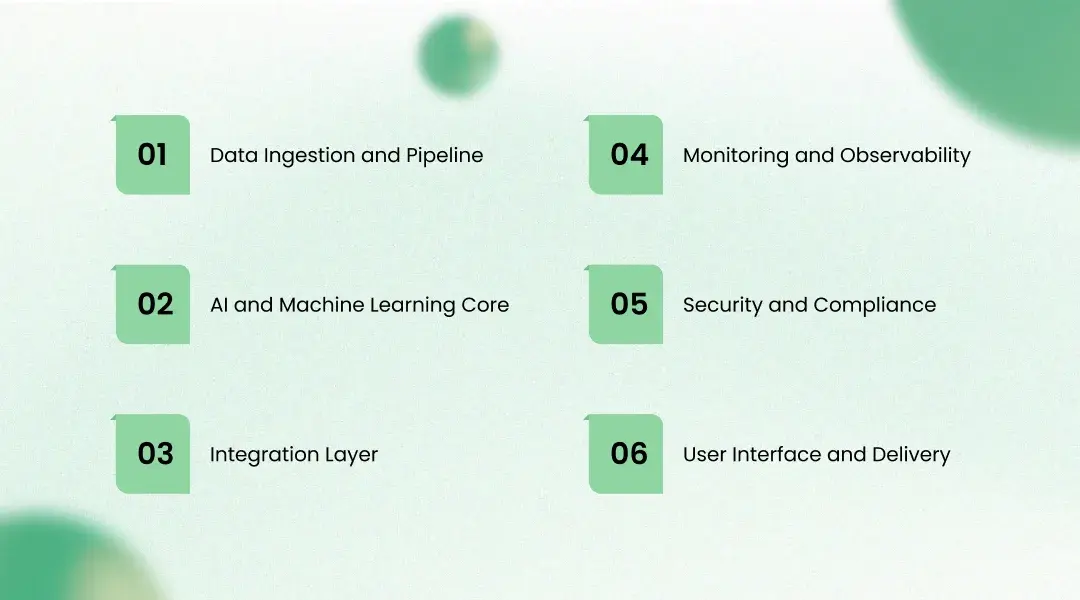
The architecture KriraAI delivered is a modular, event-driven system deployed on AWS infrastructure within the client's existing VPC. Each layer was designed for independent scalability, allowing the client to scale ingestion throughput without affecting model serving capacity and vice versa.
The ingestion layer normalizes input from all eleven source channels into a unified document representation. Email-based documents are captured via Microsoft Graph API integration with polling intervals of 30 seconds. FTP sources use a custom connector with filesystem event watching. Scanned documents pass through an enhanced OCR pipeline built on Tesseract 5 with custom post-processing models trained on the client's specific document layouts to correct common OCR errors, achieving character-level accuracy of 99.2% on clean scans and 96.8% on degraded inputs.
All ingested documents enter an Apache Kafka topic partitioned by source channel, providing durable, ordered message delivery and enabling replay for reprocessing. A stream processing layer built on Apache Flink performs initial document normalization: text extraction from PDFs using Apache Tika, encoding normalization to UTF-8, language detection using a fastText classifier, and metadata enrichment from source channel context. Processed documents are written to a document store in Amazon S3 with metadata indexed in Amazon OpenSearch for full-text and faceted search. Pipeline orchestration for batch reprocessing and retraining workflows runs on Apache Airflow with custom operators for each pipeline stage.
The ML core operates as a collection of containerized model services behind an internal API gateway. Each model, including the classifier, the NER and relation extraction model, the summarizer, and the language routing model, runs as an independent service deployed on Amazon ECS with GPU-backed instances using NVIDIA T4 accelerators. Model serving uses a custom inference server built on NVIDIA Triton Inference Server, with dynamic batching configured to optimize GPU utilization across variable document lengths.
Model artifacts are versioned in Amazon S3 with metadata tracked in MLflow. The training pipeline runs on Amazon SageMaker for compute orchestration, with training data managed in a purpose-built annotation platform that KriraAI delivered alongside the core system. This annotation platform enables the client's senior analysts to review model outputs, correct errors, and generate labeled training data that feeds directly into the retraining pipeline. Embedding generation for semantic search and similarity features uses a sentence-transformer model fine-tuned on the client's domain vocabulary. These embeddings are indexed in a Milvus vector database using HNSW indexing with 128-dimensional vectors, enabling sub-10ms nearest-neighbor retrieval across the full document corpus.
The integration layer connects the NLP platform to the client's existing systems through a combination of event-driven and request-response patterns. Processed document outputs, including classifications, extracted entities, summaries, and routing decisions, are published to a dedicated Kafka topic. The client's case management system, built on Salesforce Service Cloud, consumes these events through a custom Kafka Connect sink connector that maps extracted fields to Salesforce objects. The connector handles schema evolution gracefully, using Avro serialization with a Confluent Schema Registry to manage field additions without breaking downstream consumers.
For real-time queries, the platform exposes a GraphQL API that allows the client's internal applications to search documents, retrieve extracted entities, and request on-demand processing. API contracts are versioned and documented in an OpenAPI specification. For internal service communication between NLP model services, the platform uses gRPC with Protocol Buffers, achieving inter-service call latencies below 2ms within the cluster. A webhook subsystem notifies external systems when high-priority documents are processed, enabling the client's compliance team to receive instant alerts for regulatory filings that require immediate attention.
Production NLP systems degrade silently if monitoring is not specifically designed for ML workloads. KriraAI built a comprehensive observability stack that tracks both system health and model performance continuously. Infrastructure monitoring uses Prometheus for metrics collection and Grafana for dashboarding, tracking standard service health metrics alongside ML-specific metrics including inference latency at p50, p95, and p99 percentiles, GPU utilization and memory pressure, and batch queue depth.
Model performance monitoring operates on a separate cadence. A daily evaluation pipeline runs each model against a held-out test set of 2,000 documents, tracking accuracy, precision, recall, and F1 scores across all classification categories and entity types. Data drift detection uses population stability index calculations comparing the feature distributions of incoming documents against the training data distribution, with alerts firing when PSI exceeds 0.2 on any monitored feature. The system also tracks prediction confidence distributions, flagging shifts in the model's certainty profile that often precede measurable accuracy drops. When any monitored metric crosses a defined threshold, an automated retraining pipeline triggers, pulling the latest corrected annotations from the annotation platform and initiating a fine-tuning run with human review of the resulting model before promotion to production.
The platform operates entirely within the client's AWS VPC with no public-facing endpoints. All inter-service communication is encrypted using mutual TLS. Data at rest is encrypted using AWS KMS with customer-managed keys. Access control follows a role-based model with attribute-level data masking, ensuring that analysts in one jurisdiction cannot view documents tagged to another jurisdiction's client engagements. All model inputs and outputs are logged to an immutable, append-only audit store in Amazon S3 with object lock enabled, providing a complete chain of custody for every document processed. The platform was designed to comply with GDPR, SOC 2 Type II, and the client's industry-specific regulatory requirements for data handling and retention.
The primary user interface is a React-based document intelligence dashboard that provides analysts with a unified view of their document queue, extracted information, model confidence scores, and one-click correction capabilities. The dashboard was designed for analyst efficiency, presenting extracted entities inline with the source document text and highlighting confidence levels with visual indicators. Low-confidence extractions are surfaced for human review, creating a human-in-the-loop workflow that maintains quality while reducing total analyst effort by over 80%. Executive stakeholders access a separate analytics dashboard built on Apache Superset, providing real-time visibility into processing volumes, backlog status, extraction accuracy trends, and team productivity metrics.
Every technology in this stack was selected after evaluating alternatives against three criteria: compatibility with the client's existing AWS environment, operational maturity for production workloads, and the availability of internal expertise within KriraAI's engineering team. Below is the complete stack organized by function.
NLP Models: DeBERTa-v3 for classification (chosen over RoBERTa for its disentangled attention mechanism that performs better on long documents), BERT-large with CRF layers for NER (chosen over spaCy's transformer pipeline for its superior performance on domain-specific entity types), BART-large for summarization (chosen over Pegasus for more controllable output length), and sentence-transformers for embedding generation.
Model Serving: NVIDIA Triton Inference Server with dynamic batching (chosen over TorchServe for its superior multi-model serving and GPU scheduling capabilities).
Stream Processing: Apache Kafka for message brokering and Apache Flink for stream transformation (chosen over Kafka Streams for Flink's richer windowing and state management in complex transformation pipelines).
Pipeline Orchestration: Apache Airflow for batch workflows and retraining DAGs (chosen over Prefect because the client's DevOps team already operated Airflow for other workloads).
Vector Database: Milvus with HNSW indexing (chosen over Pinecone because the client required on-premises deployment within their VPC, and over FAISS for Milvus's superior production operational tooling).
Search and Metadata: Amazon OpenSearch for full-text document search and faceted metadata queries.
Experiment Tracking: MLflow for model versioning, experiment tracking, and artifact management.
Infrastructure: Amazon ECS on EC2 with GPU instances, Amazon S3 for object storage, AWS KMS for encryption, and Terraform for infrastructure-as-code.
Each choice reflects a deliberate engineering decision. We did not default to the most popular tool in each category. We selected the tool that fit this client's specific constraints, scale, and operational maturity.
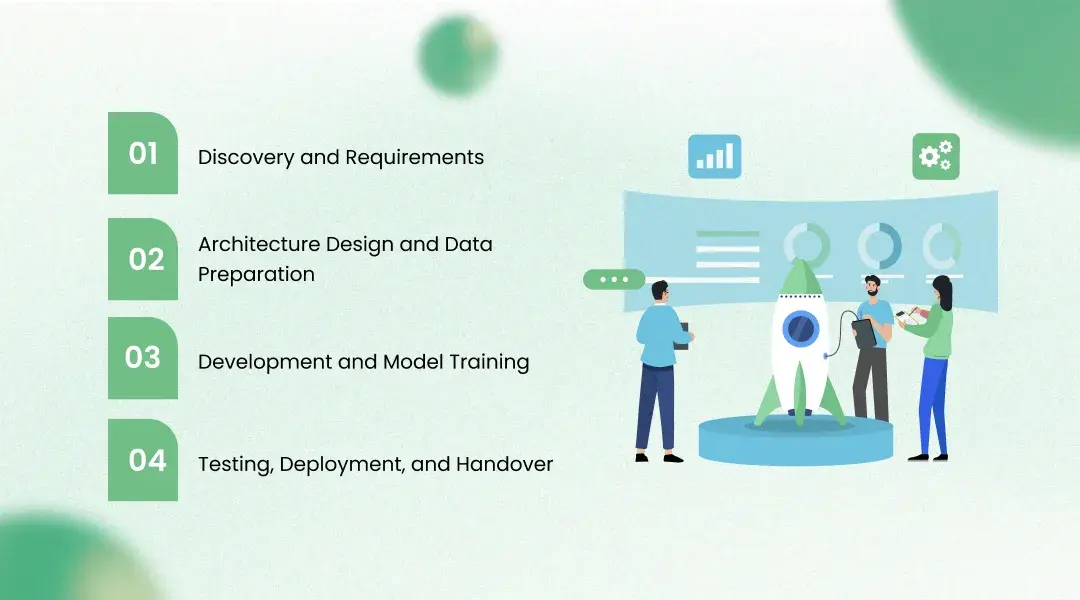
The engagement spanned 32 weeks from initial discovery through production go-live, followed by a 12-week hypercare period during which KriraAI engineers remained embedded with the client's operations team.
KriraAI's delivery team spent four weeks on-site conducting structured interviews with analysts, team leads, compliance officers, and IT operations staff. We processed a representative sample of 5,000 documents through manual analysis to understand the full taxonomy of document types, the extraction schemas required for each type, and the edge cases that would challenge any automated system. This discovery phase produced two critical artifacts: a document taxonomy of 47 distinct types organized into 8 categories, and a detailed extraction schema defining 156 distinct field types across those categories. Both artifacts became the ground truth for model training and evaluation.
Architecture design ran in parallel with data preparation. While the engineering team finalized infrastructure decisions and integration contracts, KriraAI's annotation team worked with the client's senior analysts to build the training corpus. Annotating 28,000 documents required developing a custom annotation guideline spanning 84 pages to ensure consistency across annotators. Inter-annotator agreement was measured using Cohen's kappa and iteratively improved from 0.72 to 0.91 through guideline refinement and annotator calibration sessions.
Development followed a model-first approach. Each NLP model was developed, trained, evaluated, and hardened independently before integration. The classification model reached production-quality accuracy of 94.6% after three training iterations. The NER model required more work. Initial performance on financial entity extraction was below target at 82% F1, primarily because of inconsistent formatting of monetary values and date expressions across document sources. KriraAI's ML engineers addressed this by implementing a pre-processing normalization layer that standardized numeric and temporal expressions before model inference, lifting NER F1 to 93.1%. The summarization model required the most careful calibration. Early outputs were technically accurate but failed the client's readability standards, producing summaries that were too dense for executive consumption. We resolved this through a combination of length-controlled decoding parameters and a lightweight quality classifier trained on analyst ratings of summary quality, which filtered outputs below a threshold for regeneration with adjusted parameters.
Integration testing uncovered a significant challenge with the Salesforce connector. The client's Salesforce instance had custom field validation rules that rejected certain extracted values, particularly multi-jurisdiction regulatory references that exceeded field length limits. KriraAI's integration engineers worked with the client's Salesforce administrators to redesign the field mapping, splitting long regulatory references into linked child objects. Deployment followed a phased rollout: one regional office first, then three offices simultaneously, then the remaining two. Each phase included a parallel processing period where both the manual workflow and the NLP platform operated simultaneously, allowing accuracy comparison on identical document sets. Production go-live for all six offices was completed in week 32.
The client began measuring outcomes formally at four weeks post-deployment and conducted a comprehensive assessment at nine months. The results confirmed that the intelligent text analytics platform delivered transformational impact across every metric the client tracked.
Processing Time: Median document processing time dropped from 34 minutes to 4.4 minutes, an 87% reduction. For standard document types comprising 72% of volume, processing was fully automated with no human touch required.
Classification Accuracy: Accuracy improved from the previous manual baseline of 71% to 94.6%, a 33% improvement that dramatically reduced downstream routing errors.
Annual Cost Savings: Direct labor cost savings reached $2.4 million annually. The client reallocated 74 analyst positions from manual data entry to higher-value review and advisory work.
Backlog Elimination: The persistent document backlog, which had averaged 12,000 documents at any given time, was eliminated within six weeks of full deployment and has not re-accumulated.
Compliance Deadline Adherence: On-time compliance submission rates improved from 84% to 99.2%, virtually eliminating the penalty exposure that had cost the client an estimated $380,000 in the prior fiscal year.
Extraction Accuracy: Field-level extraction accuracy across all 156 defined fields averaged 93.1%, compared to the manual baseline of 89% measured during discovery, with the NLP platform also providing consistency that manual processing could never match.
These outcomes were measured against the client's own baseline data collected during the discovery phase, ensuring that comparisons reflect genuine operational improvement rather than modeled projections.
The modular architecture KriraAI delivered was designed explicitly for extensibility. Each capability, classification, extraction, summarization, and routing, operates as an independent service that can be enhanced, replaced, or augmented without disrupting the broader platform. This design philosophy means the client's AI investment compounds over time rather than requiring periodic rebuilds.
The client's 24-month roadmap, developed collaboratively with KriraAI during the handover phase, includes three major extensions. First, adding a contract risk scoring model that consumes extracted clause data and produces a composite risk rating for each agreement, enabling proactive risk management rather than reactive review. Second, implementing a retrieval augmented generation layer that allows analysts to ask natural language questions across the entire document corpus and receive synthesized answers with source citations, transforming the platform from a processing engine into a knowledge system. Third, expanding language coverage to include Japanese and Korean as the client enters new markets, leveraging the existing multilingual embedding space and contrastive training infrastructure to accelerate new language onboarding.
For other organizations in the professional services sector evaluating AI document processing automation, this architecture demonstrates a critical principle: building NLP infrastructure as composable services rather than monolithic applications creates a foundation that adapts to evolving business requirements. The AI and ML models will improve and change over the coming years, but the data pipeline, integration contracts, monitoring infrastructure, and security architecture represent durable investments that outlast any individual model generation.
Three insights from this engagement stand out as transferable to any organization considering enterprise NLP at scale. Technically, the decision to build a multi-model architecture with independent model services rather than a single end-to-end model proved essential. Each NLP task, classification, extraction, and summarization, has different performance characteristics, retraining cadences, and failure modes. Isolating them into separate services allowed us to optimize, debug, and improve each capability independently without risking regressions elsewhere. Operationally, the most valuable investment was not the AI models themselves but the annotation infrastructure and human-in-the-loop workflows that surround them. Models degrade without continuous calibration against real-world data, and the organizations that sustain AI performance over time are those that treat annotation and feedback collection as ongoing operational functions rather than one-time project activities. Strategically, this engagement demonstrated that AI document processing automation delivers its greatest value not by eliminating human analysts but by fundamentally changing what those analysts spend their time on, shifting them from data entry to judgment, review, and advisory work that creates far more business value.
KriraAI brings this same depth of engineering rigor, architectural thinking, and delivery discipline to every client engagement. Whether the challenge involves natural language processing, computer vision, predictive analytics, or any other AI capability, our team approaches each project with the same commitment to building production systems that deliver measurable, lasting business impact. If your organization is facing a challenge where AI could transform how work gets done, we would welcome the conversation. Reach out to KriraAI and let us show you what thoughtful AI engineering can accomplish.
The timeline for implementing a production-grade enterprise NLP solution depends on three primary variables: the complexity of the document taxonomy, the availability of quality training data, and the depth of integration required with existing enterprise systems. In our experience delivering the platform described in this case study, the full implementation from discovery through production go-live required 32 weeks, with an additional 12-week hypercare period. The most time-intensive phases were data annotation and model training, which together consumed approximately 14 weeks. Organizations that have existing annotated corpora or simpler document taxonomies can expect shorter timelines, while those with highly specialized document types or complex regulatory requirements may require longer discovery and validation phases. A realistic planning range for most enterprise implementations of this nature is six to ten months.
Modern transformer-based NLP models, when properly fine-tuned on domain-specific training data, routinely achieve classification accuracy above 93% and entity extraction F1 scores above 90% on enterprise document corpora. The platform KriraAI built achieved 94.6% classification accuracy and 93.1% entity extraction F1 across 156 distinct field types. These performance levels require substantial investment in training data quality, including careful annotation guidelines, inter-annotator agreement measurement, and iterative calibration. It is important to note that accuracy varies significantly by document type and entity complexity. Simple document types like standard invoices or form letters approach 98% accuracy, while complex legal agreements with nested conditional clauses typically perform in the 88% to 92% range. Continuous monitoring and retraining are essential to maintaining these accuracy levels as document formats and vocabulary evolve over time.
Handling multilingual document corpora in production NLP systems requires more than simply swapping in a multilingual base model. The approach KriraAI implemented uses language-specific model variants that share a common embedding space trained through contrastive learning. This design ensures that semantically equivalent concepts in different languages map to nearby points in the embedding space, enabling cross-lingual search, classification consistency, and transfer learning when expanding to new languages. For the platform described here, we supported English, French, German, and Mandarin, covering approximately 18% of the document volume that arrived in non-English languages. Each language variant was fine-tuned on language-specific annotated data while maintaining alignment with the shared embedding space through contrastive loss objectives during training. This architecture significantly reduces the annotation and training cost of adding new languages compared to building entirely separate models.
Production NLP systems processing thousands of documents per hour require GPU-accelerated compute infrastructure, robust message queuing for document ingestion, and purpose-built model serving frameworks that optimize GPU utilization through dynamic batching. The architecture KriraAI delivered runs on Amazon ECS with NVIDIA T4 GPU instances, uses NVIDIA Triton Inference Server for model serving, and processes documents through an Apache Kafka and Apache Flink streaming pipeline. The total infrastructure footprint depends on throughput requirements and latency targets. For the platform described in this case study, which handles burst loads of up to 8,000 documents per hour with median end-to-end latency of 3.2 seconds, the production cluster uses six GPU instances for model inference plus standard compute instances for pipeline processing, ingestion, and API serving. Infrastructure-as-code management through Terraform ensures reproducibility and enables scaling adjustments as document volumes grow.
Model performance degradation in production NLP systems is a well-documented challenge that requires proactive monitoring and systematic retraining infrastructure. The platform KriraAI built addresses this through three mechanisms operating continuously. First, daily evaluation against a held-out test set of 2,000 documents tracks accuracy, precision, recall, and F1 across all classification and extraction categories, providing immediate visibility into performance trends. Second, data drift detection using population stability index calculations compares incoming document feature distributions against training data distributions, alerting the operations team when drift exceeds defined thresholds even before accuracy metrics show measurable decline. Third, a human-in-the-loop annotation workflow captures analyst corrections to model outputs, feeding these corrections into the training data store and triggering automated retraining pipelines when sufficient new labeled data accumulates. This closed-loop system ensures that the models continuously adapt to evolving document formats, terminology changes, and new document types without requiring manual intervention from ML engineers.
Ridham Chovatiya is the COO at KriraAI, driving operational excellence and scalable AI solutions. He specialises in building high-performance teams and delivering impactful, customer-centric technology strategies.