
Enterprise Generative AI Adoption: A Practical 2026 Guide
The generative AI industry is no longer a frontier. It is a crowded, well-funded, and increasingly competitive market. Foundation model providers, infrastructure vendors, and application startups all fight for the same enterprise budgets. The result is noise that makes clear decisions harder, not easier.
Most large enterprises now run several generative AI initiatives at once. Many of these initiatives never leave the experimentation phase. Surveys across 2025 suggested that a majority of corporate pilots stalled before production. The bottleneck was rarely the model itself.
The deeper problem is organizational and structural. Enterprise data sits in silos that models cannot easily reach. Governance teams worry about privacy, accuracy, and liability. Procurement cycles move slowly while vendor capabilities shift monthly.
Cost pressure adds another layer of tension. Inference at scale is expensive, and token costs accumulate quietly. A demo that impresses leadership can become unaffordable across thousands of daily users. Finance teams then question whether the value justifies the spend.
Competitive dynamics make standing still feel dangerous. Rivals announce AI features in earnings calls and press releases. Customers begin to expect faster service and smarter products. The pressure to act often outruns the discipline to act well.
This is the real environment for enterprise generative AI adoption today. It is not a question of whether to engage with the technology. It is a question of how to engage without wasting capital. Understanding that distinction is the first step toward a return.
Where Enterprise Generative AI Adoption Creates Value
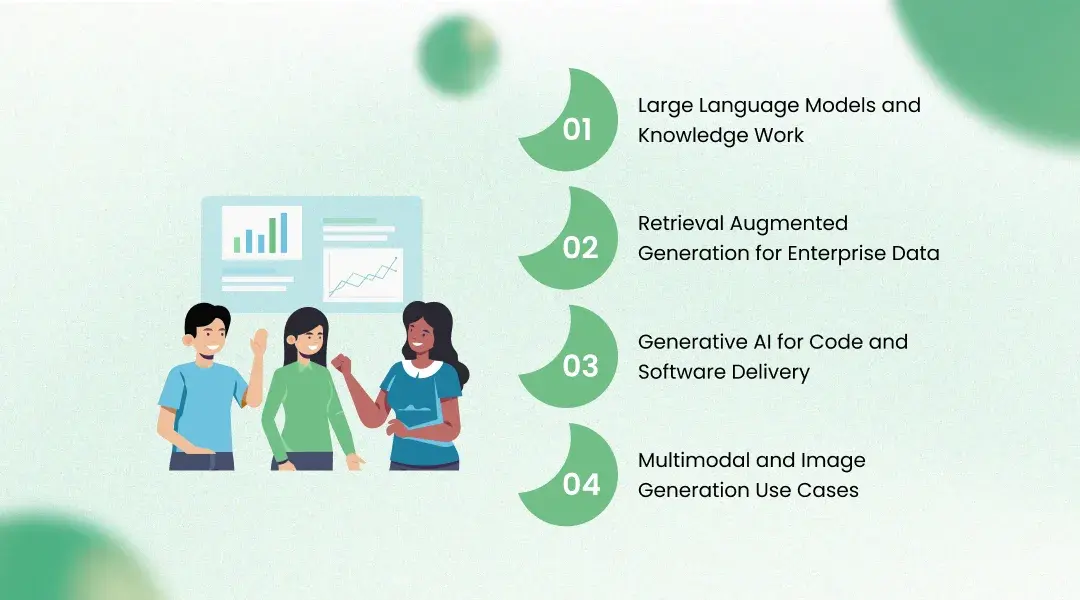
Generative AI creates the most value where language, knowledge, and unstructured content dominate the work. The strongest results come from narrow, well-scoped problems with clear success metrics. Broad ambitions tend to fail, while focused deployments tend to compound. The technologies below map directly to real enterprise problems.
Large Language Models and Knowledge Work
Large language models excel at summarizing, drafting, classifying, and answering. These are the daily tasks of knowledge workers everywhere. A support agent drafting replies can move faster with a model assist. A legal team can triage contracts before a human reviews the detail.
The honest framing matters here. Models accelerate work, but they rarely replace judgment outright. The best deployments keep a human in the loop for accountability. This is where measurable productivity gains actually appear.
KriraAI, a company that builds practical AI systems for enterprises, often starts engagements at this layer. The team identifies repetitive language tasks that drain expensive human hours. Then it wraps a model around those tasks with proper guardrails. The goal is reliable assistance, not flashy autonomy.
Retrieval Augmented Generation for Enterprise Data
Retrieval augmented generation connects a model to your private knowledge. This is the single most important pattern for enterprise generative AI adoption. Without it, models hallucinate facts and ignore your real documents. With it, answers become grounded, current, and traceable.
A RAG system indexes internal content such as policies, tickets, and manuals. The model then retrieves relevant passages before it writes any answer. This reduces fabrication and lets teams cite the source. Sales, support, and operations all benefit from this grounding.
The engineering is harder than the demos suggest. Chunking, embeddings, reranking, and evaluation all need careful tuning. Poor retrieval produces confident, wrong answers that erode trust quickly. Quality retrieval is the difference between a tool and a toy.
Generative AI for Code and Software Delivery
Generative AI has reshaped how software gets written. Code assistants now suggest functions, tests, and documentation in real time. Engineering teams report faster completion on routine programming tasks. Controlled studies have shown meaningful speed gains on scoped coding work.
The impact extends beyond raw typing speed. Models help engineers understand unfamiliar codebases more quickly. They draft tests that humans often skip under deadline pressure. They translate legacy code into modern frameworks with supervision.
These tools shine on well-defined tasks with verifiable output. They struggle with ambiguous architecture and subtle business logic. Treating them as accelerators rather than architects keeps expectations realistic. That framing protects both quality and morale.
Multimodal and Image Generation Use Cases
Generative AI now handles images, audio, and structured documents together. Marketing teams generate campaign variations in minutes rather than days. Design teams explore concepts before committing expensive production hours. Document processing pipelines extract data from invoices and forms.
These multimodal generative AI use cases unlock workflows that text alone could not. A retailer can generate product imagery at scale across catalogs. An insurer can read damage photos and pre-fill claim fields. The savings appear in cycle time and headcount efficiency.
The caution here is brand and accuracy control. Generated assets need review for tone, rights, and correctness. Unsupervised generation at scale creates reputational risk. Strong review processes turn raw capability into safe production output.
The Quantified Business Impact of Generative AI
The business case for generative AI is real, but it hides in specifics. McKinsey has estimated a striking prize for the technology. Generative AI could add 2.6 to 4.4 trillion dollars in annual value globally. That number sounds abstract until it lands inside one workflow. The discipline is translating macro potential into measured local gains.
Customer support is the clearest example of generative AI ROI. Companies deploying assisted response report handle-time reductions of 20 to 40 percent. Agents resolve tickets faster while quality holds or improves. The cost per contact drops as throughput rises across the team.
Software engineering shows similarly concrete numbers. Studies on code assistants have measured roughly 55 percent faster completion on certain tasks. Even a fraction of that gain across a large team compounds quickly. The payback period for tooling shrinks within a single quarter.
Content and marketing functions report sharp time savings too. Teams that once spent days on draft variations now spend hours. First-draft production time can fall by half or more. The human role shifts toward editing, strategy, and brand judgment.
Document-heavy operations capture savings in processing accuracy and speed. Automated extraction can cut manual review effort substantially. Error rates on structured fields often improve against tired human baselines. The combined effect is faster cycles at lower cost.
These results share one trait worth naming clearly. They come from narrow deployments with measured baselines and clear owners. Vague enterprise-wide mandates rarely produce numbers like these. Enterprise generative AI adoption pays off when it is scoped and tracked.
Strong generative AI ROI also depends on counting the full cost honestly. Inference, integration, and oversight all consume real budget over time. A gain that ignores those costs is a vanity metric. Mature teams model total cost against measured benefit before they scale.
This is exactly where many organizations lose the thread. They chase broad transformation instead of compounding small wins. KriraAI builds evaluation harnesses that tie each deployment to a baseline metric. That measurement habit is what turns a pilot into a defensible investment.
A Generative AI Implementation Roadmap
A working generative AI implementation strategy follows a predictable sequence. It begins with honesty about readiness and ends with disciplined scaling. The companies that skip steps tend to stall in pilot purgatory. The roadmap below reflects what actually works in practice.
From Readiness Assessment to Pilot
The first phase is an honest readiness and data audit. You cannot deploy reliable AI on data you cannot access. This stage maps where knowledge lives and how clean it is. It also surfaces governance, privacy, and compliance constraints early.
The sequence below outlines a grounded path from assessment to deployment. Each step builds evidence that informs the next decision. Skipping a step is where most programs quietly stall.
Audit your data sources, access patterns, and quality before any model selection begins. Most failures trace back to skipping this unglamorous first step.
Identify two or three high-value, low-risk use cases with clear baseline metrics you can measure. Narrow scope beats broad ambition every time.
Build a controlled pilot with real users, real data, and a defined success threshold. Treat it as an experiment, not a launch event.
Instrument everything so you can compare model output against the human baseline objectively. Without measurement, you cannot prove value to finance.
Decide to scale, refine, or kill the pilot based on the evidence you gathered. Killing a weak pilot is a success, not a failure.
This sequence protects budget and builds organizational trust. Each phase produces evidence that informs the next decision. Stakeholders see progress grounded in numbers rather than enthusiasm. That credibility is what unlocks the budget for full enterprise LLM deployment.
Common Mistakes and How to Avoid Them
Most enterprise generative AI adoption fails for avoidable reasons. The patterns repeat across industries and company sizes. Recognizing them early saves quarters of wasted effort. The list below captures the most damaging and most common.
Starting with the model instead of the problem leads to solutions searching for a use case. Define the business outcome first, then choose the technology.
Ignoring data quality produces confident, wrong answers that destroy user trust fast. Clean and connect your data before you scale anything.
Skipping evaluation means you cannot tell improvement from regression. Build automated tests for accuracy, safety, and tone from day one.
Treating a flashy demo as proof of production readiness sets teams up to fail. Demos hide latency, cost, and edge cases that production exposes.
Underestimating change management leaves great tools unused by skeptical employees. Adoption is a people problem as much as a technical one.
Avoiding these mistakes is mostly about discipline, not genius. KriraAI structures client deployments to confront each risk directly and early. The team pairs technical build with measurement, governance, and adoption planning. That combination is what carries projects past the pilot graveyard.
Challenges and Limitations of Generative AI Adoption
Honesty about limitations is what separates advisors from salespeople. Generative AI is powerful, but it is not magic. Several hard constraints shape every serious enterprise deployment. Ignoring them guarantees disappointment and wasted spend.
Data quality is the first and most stubborn obstacle. Models inherit the gaps and biases in your source material. Messy, siloed, or outdated data produces unreliable output. No amount of model sophistication fixes a broken data foundation.
Talent scarcity is the second constraint. Skilled machine learning and data engineers remain expensive and rare. Many enterprises lack the in-house ability to build and maintain systems. This gap pushes organizations toward partners or risky shortcuts.
Accuracy and hallucination remain genuine technical risks. Models can produce fluent statements that are simply false. In regulated fields, a confident error can carry legal consequences. Human oversight and grounding are mandatory, not optional.
Regulatory and governance pressure continues to intensify. Data protection rules constrain how content can be used and stored. Enterprises must track provenance, consent, and model behavior carefully. Compliance work is slow, but skipping it invites serious liability.
Integration complexity is the quiet project killer. Generative AI rarely works as a standalone island. It must connect to existing systems, identity, and workflows. That plumbing often costs more effort than the model itself.
Change management completes the list of real challenges. Employees fear replacement and resist unfamiliar tools. Without trust and training, even excellent systems sit idle. Technology adoption ultimately depends on people choosing to use it.
The Future of the Generative AI Industry
Project forward three to five years and the landscape shifts sharply. Generative AI will fade into the background of normal software. The novelty will disappear, and the expectation will remain. Customers will assume intelligence the way they assume connectivity today.
Agentic systems represent the next major leap. Models will move from answering questions to completing multi-step tasks. They will plan, call tools, and act within defined boundaries. This shifts the value from suggestion toward genuine workflow automation.
The competitive gap will widen between disciplined and undisciplined adopters. Companies with clean data and strong evaluation will compound their lead. Those stuck in endless pilots will fall further behind. The difference will show up in margin, speed, and customer loyalty.
Foundation models will likely commoditize at the base layer. The durable advantage will move toward data, workflow, and integration. Owning a proprietary data loop will matter more than owning a model. Smart enterprises are already building that loop now.
Cost curves will continue to fall as efficiency improves. Tasks that are uneconomic today will become trivially cheap. This will unlock use cases that current budgets cannot justify. Patience and architecture will reward those who prepared early.
The companies left behind will share a common story. They will have treated generative AI as a side project. They will have chased demos instead of building durable systems. By the time they react, the cost of catching up will be steep.
The lesson is that a generative AI implementation strategy is now a board-level concern. It shapes margin, talent, and customer experience for years ahead. Leaders who treat it as an IT footnote will regret the delay. Those who plan early will set the pace for their market.
Conclusion
Three lessons stand above the rest in this discussion. First, the gap between pilots and production is the central problem, since most initiatives never reach measurable return. Second, value concentrates in narrow, well-measured deployments rather than sweeping transformation mandates. Third, the durable advantage will come from data, workflow, and discipline rather than the model itself.
Enterprise generative AI adoption is not a question of ambition but of execution. The technology is ready, the economics are proven, and the patterns are now well understood. What separates winners from spenders is the willingness to scope tightly and measure honestly. That discipline is rare, and it is precisely where the returns hide.
This is the work that KriraAI does with enterprises every day. KriraAI builds practical AI solutions that are grounded in real data, measured against real baselines, and engineered for scale. The team pairs technical depth with governance, evaluation, and adoption planning so projects survive past the demo. The focus is always on outcomes a finance team can defend, not benchmarks that impress only engineers.
If your organization is stuck between hype and hesitation, a grounded partner changes the trajectory. You can reach out to KriraAI to explore a measured, practical approach. That approach can move your generative AI program from pilot to production. The right next step is rarely a bigger model, and almost always a clearer plan.
FAQs
Enterprise generative AI adoption is the structured process of integrating generative AI into core business operations at scale. It goes far beyond running isolated experiments or chatbots. It involves connecting models to private data, governing their behavior, and measuring their impact against real baselines. It matters because the technology now influences cost, speed, and competitiveness across industries. Companies that adopt with discipline capture productivity gains and defensible advantages. Those that adopt carelessly waste budget on tools nobody trusts or uses. The difference lies almost entirely in scope, measurement, and execution rather than raw model power.
Companies implement generative AI successfully by treating it as a sequence rather than a single launch. They begin with an honest data and readiness audit before selecting any tool. Then they choose narrow, high-value use cases with clear and measurable baselines. They build controlled pilots with real users and defined success thresholds. They instrument everything so output can be compared against human performance objectively. Finally, they scale only what proves its value and kill what does not. This disciplined sequence protects budget, builds trust, and produces the evidence that justifies wider enterprise LLM deployment over time.
The most valuable generative AI use cases cluster around language, knowledge, and unstructured content. Customer support sees major gains through assisted response and faster ticket resolution. Software engineering benefits from code generation, testing, and faster onboarding to unfamiliar systems. Marketing and content teams accelerate drafting, variation, and campaign production dramatically. Document-heavy operations automate extraction from invoices, forms, and contracts at scale. Retrieval augmented generation grounds these systems in private enterprise data for accuracy. The common thread is narrow scope, clear metrics, and human oversight. Together these turn raw capability into reliable, measurable business outcomes.
The ROI of generative AI varies widely, but disciplined deployments show concrete and repeatable numbers. Customer support teams often report handle-time reductions between 20 and 40 percent. Software engineering studies have measured task completion roughly 55 percent faster with code assistants. Content teams frequently cut first-draft production time by half or more. McKinsey has estimated generative AI could add trillions of dollars in annual economic value globally. However, these returns appear only where deployments are narrow, measured, and tied to baselines. Broad, unmeasured mandates rarely produce positive ROI and account for most documented pilot failures.
The biggest challenges in adopting generative AI are organizational and structural rather than purely technical. Poor data quality is the most stubborn obstacle, since models inherit every gap and bias. Talent scarcity makes building and maintaining systems difficult for many enterprises. Hallucination and accuracy risks demand constant human oversight, especially in regulated fields. Regulatory and governance requirements add slow but mandatory compliance work to every project. Integration complexity often costs more effort than the model itself. Change management completes the list, because unused tools deliver no value regardless of quality. Success depends on confronting all of these honestly and early.
Founder & CEO
Divyang Mandani is the CEO of KriraAI, driving innovative AI and IT solutions with a focus on transformative technology, ethical AI, and impactful digital strategies for businesses worldwide.